Matt Garrison on Winning Back-to-Back Titles with Multiple NBL Teams, NBA Opportunities and Aussie Hoops Impact Overseas
July 27, 2026



BIO: Matt Garrison was born in Alexandria, Minnesota (USA). Garrison was one of Montana’s preeminent big men in the early 1990s, winning the Gatorade Player of the Year award as a senior in 1992. As a 6-foot-8 forward out of Billings Senior, Garrison signed with Montana State.
Matt Garrison made his NBL debut with the Wollongong Hawks at 26 years of age. He scored 24 points in his first game.
After a disappointing playoff campaign where the Hawks lost four straight postseason games, Wollongong entered the 1999/00 season eager to reestablish themselves as a contender. The offseason saw several key roster changes, with the departure of promising big man David Andersen to Europe and the addition of veteran players Mike McKay (via Canberra) and Darren Perry. Perry, who had spent the past five years playing in the state league, was encouraged by coach Brendan Joyce to return to the NBL and provide leadership to the young roster.
The team also opted for a fresh import combination, deciding not to re-sign Theron Wilson (to Europe) and Clayton Ritter (to Canberra). Instead, the Hawks signed former NBA lottery pick Todd Mundt (via Newcastle) and brought back former Hawks MVP Melvin Thomas, who had spent the past four seasons with Sydney and Canberra. Another key move saw Mat Campbell (14.2 points, 3.0 rebounds, and 2.9 assists) named team captain, a position he would hold for more than a decade.
With high-scoring guard CJ Bruton (22.1 points, 3.5 rebounds, and 3.3 assists) settling into his second season with the team, the Hawks appeared to have a strong roster on paper. However, the team struggled to compete with the NBL’s top clubs, largely due to Mundt’s inability to produce at a high level. Despite showing glimpses of potential, Mundt (8.8 points and 4.9 rebounds) failed to provide the interior presence the Hawks needed. With nine games left in the season, Wollongong decided to release him and seek a mid-season replacement.
That replacement was Matt Garrison, who joined the team late in the season and immediately made an impact. Garrison provided a much-needed inside presence, averaging (17.2 points, 7.0 rebounds, and 2.4 assists) per game. His ability to score in the paint and crash the boards gave the Hawks a stronger frontcourt, but his arrival ultimately came too late to turn the season around. Despite his efforts, Wollongong limped to an eighth-place finish with an (11-17) record, failing to qualify for the playoffs.
Melvin Thomas (19.6 points, 8.6 rebounds, and 2.4 assists) and Glen Saville (14.0 points, 7.8 rebounds, and 4.0 assists) were standouts throughout the season and were voted as co-MVPs for their performances. Campbell (14.2 points, 3.0 rebounds, and 2.9 assists) was another key contributor, while veteran McKay (5.5 points and 1.9 rebounds) and Perry (1.9 points and 0.8 rebounds) provided leadership despite limited roles.
Although Wollongong’s struggles meant the season ended in disappointment, Garrison’s late-season performances were a silver lining. His versatility, work ethic, and ability to contribute on both ends of the floor led the Hawks to re-sign him for the 2000/01 season.
2000/01
After missing the playoffs the previous season, Wollongong reshaped the roster again, with CJ Bruton (to Sioux Falls), Todd Mundt, Mike McKay, Mark Dalton and Darren Perry gone from the previous season’s main group, while Eric Cooks moved into an assistant role.
Head coach Brendan Joyce retained Melvin Thomas, Matt Garrison, Mat Campbell and Glen Saville, with Campbell and Saville sharing the captaincy, while Axel Dench, Charles Thomas, Damon Lowery, Grant Kruger and Matt Shanahan were added to give the Hawks more depth and balance.
Wollongong opened the season at the WIN Entertainment Centre on October 20, where Garrison (10 points, 3 rebounds, 3 assists, and 1 steal) contributed off the bench, while Melvin Thomas (25 points and 16 rebounds) and Charles Thomas (18 points, 7 rebounds, and 5 assists) led the Hawks, but West Sydney defeated Wollongong 115-97.
Garrison (9.7 points and 4.9 rebounds) settled into a bench frontcourt role, playing both forward and centre and giving Wollongong quick scoring in short bursts. Joyce later described him as an import who accepted the difficult task of coming off the bench, bringing personality and quick points in big games.
Garrison’s best regular-season scoring game came against Adelaide on November 13, where he finished with 23 points and 7 rebounds as Wollongong handed the 36ers their first loss of the season with a 120-117 win, with Campbell (23 points) and Saville (11 points, 11 rebounds, 10 assists, and 4 steals) also delivering major performances.
On January 12 in Cairns, Garrison (16 points, 16 rebounds, and 3 steals) produced his best rebounding game of the season as Wollongong defeated the Taipans 112-109, with Melvin Thomas (26 points and 11 rebounds) and Campbell (22 points and 5 rebounds) helping the Hawks start a road double with a victory.
One week later, Garrison (22 points, 5 rebounds, and 3 assists) delivered another strong game as Wollongong smashed Melbourne 130-99 at the WIN Entertainment Centre, with Charles Thomas (30 points, 5 rebounds, and 8 assists) and Saville (23 points, 7 rebounds, 7 assists, and 4 blocks) leading one of the Hawks’ most complete wins of the season.
Melvin Thomas (18.7 points, 9.5 rebounds, and 1.3 steals), Charles Thomas (16.5 points, 4.8 rebounds, 4.1 assists, and 1.6 steals) and Saville (15.5 points, 9.7 rebounds, 4.4 assists, 2.0 steals, and 1.1 blocks) gave Wollongong three high-level all-round contributors, while Lowery (13.6 points, 3.2 assists, and 1.4 steals), Dench (13.4 points, 6.4 rebounds, and 1.1 blocks) and Campbell (12.8 points, 3.0 rebounds, and 1.1 steals) completed the main scoring group.
Saville and Melvin Thomas were named to the All-NBL Third Team, Dench won NBL Rookie of the Year and Joyce was named Coach of the Year as Wollongong finished fourth with a 21-7 record, tied with Perth but placed behind the Wildcats on the head-to-head tiebreaker.
Wollongong opened the qualifying finals at the WIN Entertainment Centre with a 97-90 overtime win over Perth, taking game one behind Melvin Thomas (22 points and 13 rebounds), Lowery (19 points, 3 rebounds, and 5 assists) and Dench (17 points and 7 rebounds), while Garrison (8 points and 2 rebounds) added scoring off the bench.
Game two moved to Perth, where Charles Thomas (25 points, 7 rebounds, and 5 assists) and Saville (23 points and 10 rebounds) led Wollongong, while Garrison (8 points, 7 rebounds, 3 assists, and 3 steals) contributed in a 106-95 loss that forced the series to a deciding game.
Game three remained in Perth, where Saville (26 points, 16 rebounds, and 4 assists), Lowery (20 points, 4 rebounds, 6 assists, and 4 steals), Dench (19 points and 5 rebounds) and Charles Thomas (16 points, 5 rebounds, and 5 assists) led Wollongong to a 98-88 upset and the first playoff series victory in club history, while Garrison was scoreless in 9:30 minutes.
The semifinals opened in Adelaide, where Wollongong edged the 36ers 84-83 behind Melvin Thomas (18 points, 13 rebounds, and 4 assists), Charles Thomas (17 points and 6 rebounds) and Saville (14 points, 18 rebounds, and 4 assists), while Garrison (6 points) played 18:01 minutes as the Hawks won in Adelaide for the first time since 1990.
Game two returned to Wollongong, where Adelaide forced a deciding game with a 111-100 win despite Dench (26 points and 9 rebounds), Melvin Thomas (22 points and 11 rebounds), Saville (17 points and 15 rebounds) and Campbell (14 points) leading the Hawks, while Garrison was scoreless in 6:33 minutes.
Game three at the WIN Entertainment Centre became one of the most controversial finishes in NBL history, with Lowery (20 points, 5 rebounds, and 3 assists) fouled on a three-point attempt in the final second and making all three free throws to win 109-108, while Melvin Thomas (28 points, 11 rebounds, 4 steals, and 2 blocks), Campbell (19 points and 4 rebounds) and Garrison (14 points, 4 rebounds, and 4 assists) helped send Wollongong to its first Grand Final series, with Kevin Brooks (26 points), Paul Maley (21 points) and Mark Nash (20 points) leading Adelaide.
The Grand Final opened at the WIN Entertainment Centre, where Wollongong defeated Townsville 104-101 behind Melvin Thomas (24 points and 14 rebounds), Campbell (19 points), Charles Thomas (17 points, 4 rebounds, and 7 assists) and Garrison (12 points, 6 rebounds, 3 assists, and 2 blocks).
Game two moved to Townsville, where the Crocodiles responded with a 114-97 win despite Lowery (25 points, 7 assists, and 3 steals), Charles Thomas (20 points and 5 assists), Melvin Thomas (16 points and 13 rebounds) and Garrison (8 points, 6 rebounds, 3 steals, and 1 block), forcing the series to a deciding game on back-to-back nights.
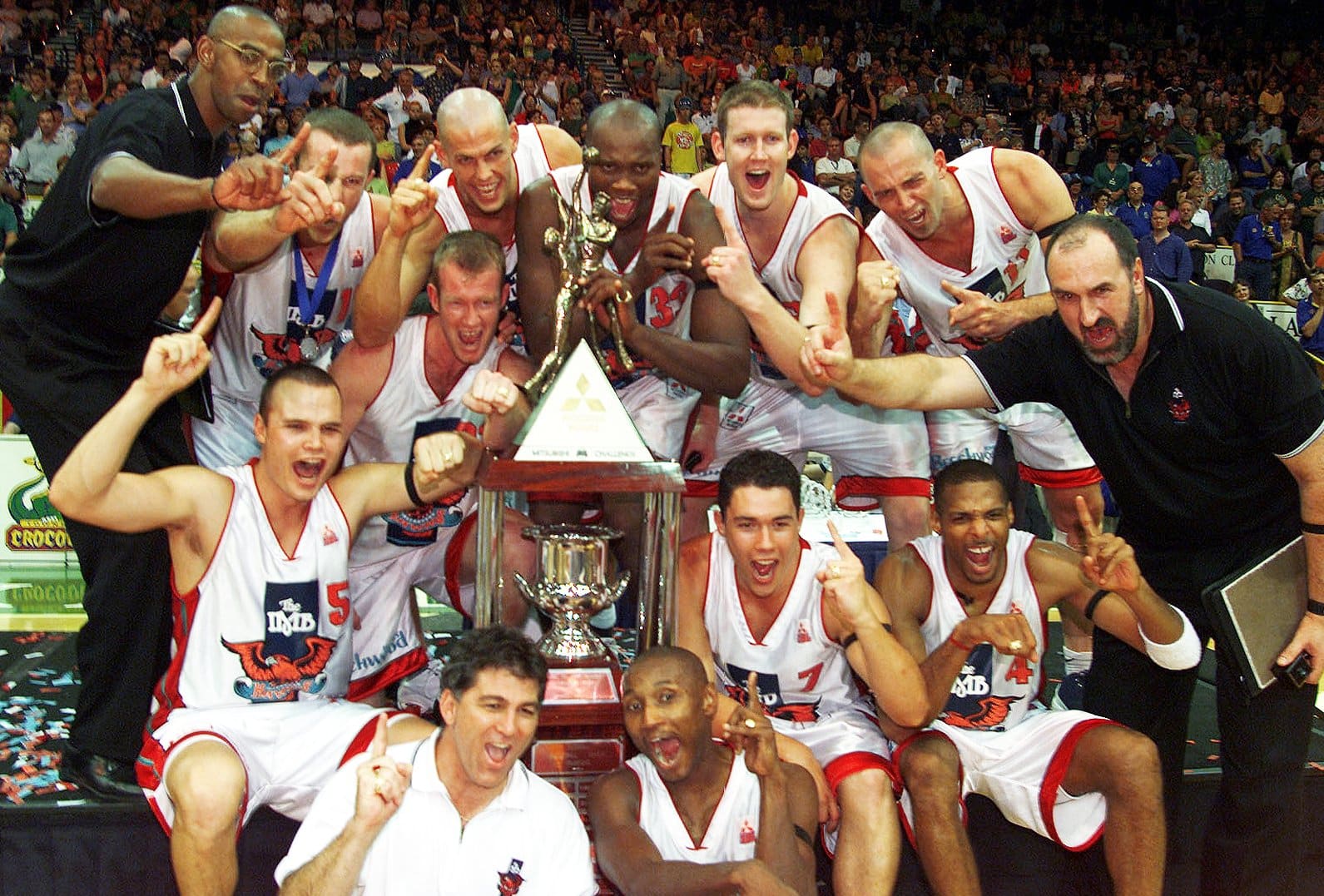
Game three saw Wollongong complete the championship run with Charles Thomas (23 points, 10 rebounds, and 5 assists), Melvin Thomas (18 points and 12 rebounds), Saville (18 points, 12 rebounds, and 5 assists), Dench (15 points and 11 rebounds) and Campbell (10 points and 3 rebounds) leading the Hawks to a 97-94 win over Townsville, while Saville was named Grand Final MVP and Garrison was scoreless in 8:44 minutes in the 97-94 championship win.
CAIRNS TAIPANS
2001/02
Rod Popp departed as head coach, while Andre Moore, Gerald Zimmerman, Kenny Payne, Matthew Alexander, Nik Mirich, Tim Duggan and Troy Boundy were not retained. Captain Anthony Stewart, Aaron Trahair, Ben Knight, Jamie Pearlman, Dewey Michaels and import Tony Rampton returned, with first-year head coach Guy Molloy adding Matt Garrison (via Wollongong), Kane Oakley and Andrew Clarke, while former player Aaron Fearne joined the coaching staff.
The Taipans opened their season in Townsville on October 13, with Garrison (3 points) making a quiet debut as Cairns suffered a 100-92 loss. Stewart (21 points, 4 rebounds, and 3 steals) and Trahair (18 points, 5 rebounds, and 7 assists) led the Taipans, while Andrew Goodwin (19 points) was among Townsville’s best.
Garrison (11.8 points and 6.5 rebounds) gave Cairns an experienced frontcourt option after helping Wollongong win the championship the previous season. He produced one of his strongest all-around performances in the Taipans’ first victory, finishing with 9 points, 11 rebounds, and 4 assists as Cairns defeated Adelaide 97-79 on October 20. Trahair (18 points, 7 rebounds, and 5 assists) and Stewart (18 points, 5 rebounds, and 4 assists) also contributed, while David Stiff (18 points and 10 rebounds) led the 36ers.
His best game came against Victoria on November 9, where Garrison (17 points, 7 rebounds, and 2 steals) helped Cairns claim a 98-91 road victory. Trahair (26 points, 9 rebounds, and 8 assists) and Stewart (18 points, 4 rebounds, and 5 assists) provided the Taipans’ other main contributions.
Garrison matched his season-high two weeks later, scoring 17 points as Cairns suffered a 100-90 home loss to West Sydney.
With Cairns sitting at 3-7, the Taipans released Garrison (to Adelaide) after only 10 games, easing the pressure created by the lucrative contract which had brought him north. Cairns replaced him with Jayson Wells (via Germany), who had finished sixth in league scoring while playing for Canberra during the 1999/00 season.
Wells (21.8 points, 8.7 rebounds, and 1.3 steals across 19 games) became Cairns’ leading scorer and won club MVP, while Knight (15.1 points and 8.2 rebounds across 30 games), Trahair (14.3 points, 4.4 rebounds, and 4 assists across 30 games) and Stewart (13.2 points across 30 games) were the other main offensive contributors.
Ron Kelley joined Cairns later in the season and averaged 12 points, 5.6 rebounds, and 1.3 blocks across 11 games. Oakley (6.5 points and 5.5 rebounds across 30 games) won the Coaches Award and finished runner-up for NBL Rookie of the Year, while Pearlman (6.7 points across 30 games) was named Best Defensive Player.
Cairns closed the season with a 96-81 loss to Adelaide on March 23, finishing at the bottom of the ladder with a 9-21 record.
ADELAIDE 36ERS
2001/02
Adelaide entered the season following its controversial 2001 semifinal elimination by eventual champion Wollongong. Kevin Brooks (to Sweden) initially agreed to return before his contract was terminated, while Darnell Mee (to Europe) departed despite previously committing to another three seasons. Paul Maley (retired) and Mark Davis (retired) also exited, leaving captain Brett Maher, David Stiff, Paul Rees, Rupert Sapwell, Mark Nash and Jason Williams as the main returning players.
Head coach Phil Smyth travelled to the Long Beach Summer League, where he recruited 26-year-old shooting guard Willie Farley as Mee’s replacement. Smyth entered the season with only one import and added local juniors Oscar Forman and Jacob Holmes to complete a younger roster.
After Adelaide opened the season 6-4, financial pressure contributed to Cairns releasing Matt Garrison (via Cairns) approximately one-third of the way through the campaign. Smyth moved quickly to sign the reigning champion, adding another experienced forward to Adelaide’s frontcourt rotation.
Garrison made his Adelaide debut at the State Sports Centre on December 22, contributing 10 points, 5 rebounds, and 1 block in a 117-85 loss to West Sydney. Farley (19 points, 4 rebounds, and 2 steals) and Rees (12 points and 5 rebounds) were the 36ers’ other main scorers.
Garrison (10.8 points and 4.2 rebounds across 26 games) appeared in every remaining game for the 36ers, providing scoring, rebounding and frontcourt depth alongside Stiff and Rees as Adelaide climbed into the top three.
He scored 15 points against Canberra on December 31, with Maher (39 points, 7 rebounds, and 5 assists) and Farley (36 points, 6 rebounds, 3 assists, and 4 steals) leading Adelaide to a 128-99 victory.
Garrison produced another strong performance in Canberra on February 2, finishing with 16 points, 3 rebounds, 2 assists, 2 steals, and 1 block as Adelaide defeated the Cannons 95-91. Farley (17 points, 5 rebounds, and 4 assists) and Maher (16 points, 9 rebounds, and 5 assists) helped the 36ers complete the road victory.
His best game came against Melbourne on March 2, where Garrison (20 points, 3 rebounds, and 2 assists) made 8-of-14 from the field and both of his three-point attempts during a 120-102 loss. Farley (25 points, 5 rebounds, and 4 assists) and Maher (20 points, 6 rebounds, and 7 assists) provided Adelaide’s other main contributions.
Adelaide closed the regular season against Garrison’s former Cairns team, with Garrison (7 points, 6 rebounds, and 5 assists) contributing across the floor in a 96-81 victory. Maher (19 points, 5 rebounds, and 11 assists) and Stiff (15 points, 9 rebounds, and 4 assists) led the 36ers, while Kelley (20 points) was Cairns’ leading scorer. Adelaide finished third with a 17-13 record after winning 11 of its 20 regular-season games following his arrival.
Farley (25.5 points, 4.5 rebounds, and 2.2 steals) finished second in the NBL for scoring and earned All-NBL Second Team honours, while Maher (21.9 points, 5.7 rebounds, 4.8 assists, and 1.4 steals) was selected to the All-NBL Third Team. Stiff (12.3 points, 8.5 rebounds, and 1.2 steals), Rees (10.2 points and 7.2 rebounds), Sapwell (8.6 points and 3.8 rebounds), Nash (7.5 points and 6.3 rebounds) and Williams (6.9 points) completed one of the league’s deepest rotations.
After sweeping Garrison’s former team Wollongong 3-0 during the regular season, Adelaide opened the Qualifying Finals at the WIN Entertainment Centre with a 107-90 victory. Farley (26 points, 5 rebounds, and 3 steals), Sapwell (19 points and 11 rebounds), Stiff (16 points, 13 rebounds, and 5 assists) and Garrison (9 points, 4 rebounds, and 1 block) led Adelaide, while Ben Pepper (22 points, 7 rebounds, and 2 blocks) and Mike Chappell (16 points and 10 rebounds) were Wollongong’s best.
Game two moved to Adelaide, where Farley (33 points, 6 rebounds, 5 assists, and 3 steals), Maher (26 points, 4 rebounds, and 5 assists) and Garrison (5 points, 2 rebounds, 2 assists, and 1 steal) completed a 2-0 sweep with a 101-95 victory, despite Melvin Thomas (25 points and 16 rebounds) and Glen Saville (19 points, 9 rebounds, and 3 assists) leading the Hawks.
Adelaide opened the semifinals in Melbourne with a 99-92 victory over Victoria, as Farley (25 points and 4 rebounds), Maher (23 points and 8 rebounds), Stiff (14 points, 9 rebounds, and 4 blocks) and Garrison (10 points, 5 rebounds, and 1 block) overcame Tony Ronaldson (27 points), Jason Smith (19 points, 8 rebounds, and 6 assists) and Chris Anstey (17 points and 8 rebounds).
The Titans responded in game two, defeating Adelaide 86-81 behind Anstey (26 points, 12 rebounds, and 2 blocks), Smith (20 points) and Darryl McDonald (13 points, 12 rebounds, and 7 assists), while Farley (24 points and 4 steals), Stiff (14 points, 11 rebounds, 5 assists, and 4 blocks) and Garrison (10 points, 7 rebounds, and 4 assists) led the 36ers.
Adelaide recovered in the deciding game behind Farley (33 points, 8 rebounds, and 6 assists), Maher (16 points, 6 rebounds, and 6 assists), Rees (16 points, 9 rebounds, and 2 blocks) and Garrison (13 points), while Ronaldson (26 points and 6 rebounds), Smith (16 points, 5 rebounds, and 5 assists) and Mark Dickel (14 points and 9 assists) led Victoria in the 36ers’ 103-92 victory.
The Grand Final series opened at Adelaide Arena, where Farley (34 points, 4 rebounds, 4 assists, and 6 steals), Maher (25 points, 8 rebounds, and 8 assists), Stiff (15 points and 13 rebounds) and Garrison (15 points and 4 rebounds) led the 36ers to a 106-97 win. Simon Dwight (28 points and 14 rebounds), John Rillie (24 points, 11 rebounds, and 8 assists) and Bruce Bolden (15 points and 9 rebounds) were best for West Sydney in its first Grand Final appearance.
Game two moved to the State Sports Centre, where Rillie (28 points and 5 assists), Dwight (20 points, 21 rebounds, and 4 blocks) and Derek Rucker (16 points, 7 rebounds, 10 assists, and 6 steals) led the Razorbacks to a 103-100 victory. Maher (25 points and 7 assists), Farley (24 points and 8 rebounds) and Garrison (15 points, 4 rebounds, 3 assists, and 2 steals) kept Adelaide close before West Sydney forced a deciding game.
The series returned to Adelaide, where the 36ers made a Grand Final-record 19-of-31 three-pointers and produced the highest score in an NBL Grand Final. Maher (30 points, 11 rebounds, and 8 assists) was named Grand Final MVP for the second time, while Farley (22 points, 5 rebounds, and 4 assists), Stiff (19 points, 13 rebounds, and 5 assists), Sapwell (19 points and 8 rebounds) and Nash (18 points, 8 rebounds, and 5 assists) overwhelmed West Sydney, despite Scott McGregor (28 points), Dwight (25 points) and Rillie (22 points) leading the Razorbacks. Adelaide secured its then league-record fourth championship, while Garrison became the first player in NBL history to win consecutive titles with different clubs. Garrison (8 points and 3 rebounds) helped Adelaide defeat West Sydney 125-107.
WOLLONGONG HAWKS
2002/03
After Adelaide ended Wollongong’s championship defence in the 2002 Quarterfinals, Charles Thomas (to Adelaide), Grant Kruger (to Townsville), Michael Chappell (to Canberra) and Josh Woods departed, while head coach Brendan Joyce retained co-captains Glen Saville and Mat Campbell alongside Melvin Thomas, Damon Lowery, Axel Dench and Ben Pepper.
Joyce replaced Thomas with import guard Cortez Groves, brought Matt Garrison (via Adelaide) back to Wollongong after he had won consecutive championships with the Hawks and 36ers, and added Geordie Cullen (via Canberra) and Tim Labka (via West Sydney).
Wollongong opened the season at the WIN Entertainment Centre on October 5, with the returning forward not playing as Groves (36 points) and Campbell (24 points, 3 rebounds, and 2 assists) led the Hawks to a 116-104 win over Townsville, while Pat Reidy (22 points) was among the Crocodiles’ best.
Garrison (11.1 points and 6.2 rebounds across 24 games) returned to an important frontcourt role, adding scoring and rebounding alongside Thomas, Dench and Pepper as Wollongong returned to the top four.
On December 15, Garrison (23 points) helped Wollongong record its third consecutive victory with a 117-91 win over Victoria at the WIN Entertainment Centre, with Saville (20 points, 11 rebounds, and 6 assists) and Campbell (19 points) providing the other main contributions.
His best game came against defending champion Adelaide on February 14, where Garrison (29 points and 10 rebounds) delivered his season-high scoring performance during a 116-100 loss. Saville (27 points, 12 rebounds, and 4 steals) and Groves (16 points and 4 steals) provided support, while Dusty Rychart (38 points, 11 rebounds, 4 steals, and 2 blocks) led the 36ers.
Wollongong entered its final regular-season game without its veteran centre, who had returned to the United States following a family tragedy. Garrison (28 points and 5 rebounds), Saville (27 points, 9 rebounds, and 5 assists) and Pepper (19 points and 5 rebounds) led the Hawks to a 124-94 win over Canberra on February 27, while Michael Hill (25 points and 6 rebounds) was best for the Cannons. The victory secured fourth place for Wollongong with an 18-12 record.
Groves (19.9 points and 1.9 steals across 34 games) led Wollongong in scoring and earned All-NBL Third Team honours, while Saville (15.9 points, 9.7 rebounds, 4 assists, and 1.6 steals across 34 games) was named Hawks MVP, won the NBL Best Defensive Player award, earned All-NBL Second Team honours and finished third in league MVP voting.
Melvin Thomas (14.5 points and 7.7 rebounds across 31 games), Campbell (11.8 points and 3.1 rebounds across 34 games) and Lowery (11.4 points, 3.4 rebounds, 4.9 assists, and 1.5 steals across 34 games) remained important members of the rotation, while Dench (8.4 points and 5.1 rebounds across 34 games) and Pepper (7.7 points, 5.6 rebounds, and 1.3 blocks across 34 games) provided additional size inside.
Wollongong opened the Qualifying Finals at the WIN Entertainment Centre with a 97-87 win over Townsville, snapping the Crocodiles’ 16-game winning streak behind Garrison (24 points, 11 rebounds, 6 assists, and 4 steals), Groves (18 points, 4 assists, and 4 steals) and Saville (13 points, 13 rebounds, and 4 assists), while Mike Kelly (20 points and 8 rebounds) and Peter Crawford (20 points) led Townsville.
Game two moved to Townsville, where Wollongong erased a 16-point deficit entering the fourth quarter to win 102-101. Groves (27 points, 5 assists, and 3 blocks), Saville (20 points, 14 rebounds, 4 assists, and 3 steals), Lowery (17 points and 5 rebounds) and Garrison (11 points) led the Hawks, while Campbell (17 points) made five three-pointers during the final term and Wayne Turner (32 points, 4 rebounds, 3 assists, and 5 steals) was best for the Crocodiles.
The semifinals opened at the WIN Entertainment Centre, where Garrison (16 points) and Lowery (14 points) led Wollongong, while Ricky Grace (24 points) and Stephen Black (23 points) carried Perth to a 121-90 win.
Game two moved to Challenge Stadium, where Saville (17 points and 6 assists), Campbell (13 points) and Garrison (12 points and 8 rebounds) led Wollongong, while Brett Wheeler (27 points and 14 rebounds) and Grace (26 points, 6 rebounds, and 6 assists) completed the sweep as Garrison played 35:47 minutes in his final NBL game, a 113-84 loss.
Matt Garrison played four seasons across three NBL teams. This included the Wollongong Hawks and the Cairns Taipans, Adelaide 36ers. He averaged 11.1 points, 5.4 rebounds, and 1.5 assists in 106 NBL games.
| SEASON | AGE | TEAM | TEAM RECORD | GP | MINS | PTS | REB | AST | OR | DR | STL | BLK | TO | PF | FGM | FGA | FG% | 3PM | 3PA | 3P% | FTM | FTA | FT% | TS% | EFG% | HS |
|---|---|---|---|---|---|---|---|---|---|---|---|---|---|---|---|---|---|---|---|---|---|---|---|---|---|---|
| 2002-03 | 29 | Wollongong | 18-12 (4) | 24 | 597 | 266 | 148 | 37 | 55 | 93 | 14 | 10 | 42 | 75 | 121 | 248 | 49% | 4 | 24 | 17% | 20 | 27 | 74% | 51% | 50% | 29 |
| 2001-02 | 28 | Adelaide | 17-13 (3) | 26 | 595 | 281 | 109 | 43 | 51 | 58 | 20 | 4 | 50 | 79 | 108 | 246 | 44% | 7 | 33 | 21% | 58 | 76 | 76% | 50% | 45% | 20 |
| 2001-02 | 28 | Cairns | 9-21 (11) | 10 | 278 | 118 | 65 | 17 | 31 | 34 | 11 | 0 | 22 | 43 | 46 | 113 | 41% | 5 | 11 | 45% | 21 | 29 | 72% | 47% | 43% | 17 |
| 2000-01 | 27 | Wollongong | 21-7 (4) | 37 | 759 | 358 | 183 | 41 | 80 | 103 | 29 | 9 | 63 | 94 | 152 | 307 | 50% | 5 | 13 | 38% | 49 | 64 | 77% | 53% | 50% | 23 |
| 1999-00 | 26 | Wollongong | 11-17 (7) | 9 | 326 | 155 | 63 | 22 | 25 | 38 | 15 | 1 | 27 | 32 | 66 | 146 | 45% | 1 | 12 | 8% | 22 | 32 | 69% | 48% | 46% | 27 | Totals | 106 | 2555 | 1178 | 568 | 160 | 242 | 326 | 89 | 24 | 204 | 323 | 493 | 1060 | 46.5% | 22 | 93 | 23.7% | 170 | 228 | 74.6% | 51% | 48% | 29 |
| SEASON | AGE | TEAM | TEAM RECORD | GP | MINS | PTS | REB | AST | OR | DR | STL | BLK | TO | PF | FGM | FGA | FG% | 3PM | 3PA | 3P% | FTM | FTA | FT% | TS% | EFG% | HS |
|---|---|---|---|---|---|---|---|---|---|---|---|---|---|---|---|---|---|---|---|---|---|---|---|---|---|---|
| 2002-03 | 29 | Wollongong | 18-12 (4) | 24 | 24.9 | 11.1 | 6.2 | 1.5 | 2.3 | 3.9 | 0.6 | 0.4 | 1.8 | 3.1 | 5.0 | 10.3 | 49% | 0.2 | 1.0 | 17% | 0.8 | 1.1 | 74% | 51% | 50% | 29 |
| 2001-02 | 28 | Adelaide | 17-13 (3) | 26 | 22.9 | 10.8 | 4.2 | 1.7 | 2.0 | 2.2 | 0.8 | 0.2 | 1.9 | 3.0 | 4.2 | 9.5 | 44% | 0.3 | 1.3 | 21% | 2.2 | 2.9 | 76% | 50% | 45% | 20 |
| 2001-02 | 28 | Cairns | 9-21 (11) | 10 | 27.8 | 11.8 | 6.5 | 1.7 | 3.1 | 3.4 | 1.1 | 0.0 | 2.2 | 4.3 | 4.6 | 11.3 | 41% | 0.5 | 1.1 | 45% | 2.1 | 2.9 | 72% | 47% | 43% | 17 |
| 2000-01 | 27 | Wollongong | 21-7 (4) | 37 | 20.5 | 9.7 | 4.9 | 1.1 | 2.2 | 2.8 | 0.8 | 0.2 | 1.7 | 2.5 | 4.1 | 8.3 | 50% | 0.1 | 0.4 | 38% | 1.3 | 1.7 | 77% | 53% | 50% | 23 |
| 1999-00 | 26 | Wollongong | 11-17 (7) | 9 | 36.2 | 17.2 | 7.0 | 2.4 | 2.8 | 4.2 | 1.7 | 0.1 | 3.0 | 3.6 | 7.3 | 16.2 | 45% | 0.1 | 1.3 | 8% | 2.4 | 3.6 | 69% | 48% | 46% | 27 | Total | 106 | 24.1 | 11.1 | 5.4 | 1.5 | 2.3 | 3.1 | 0.8 | 0.2 | 1.9 | 3.0 | 4.7 | 10.0 | 46.5% | 0.0 | 0.0 | 23.7% | 0.2 | 0.9 | 74.6% | 51% | 48% | 29 |
| POINTS | REBOUNDS | ASSISTS | STEALS | BLOCKS | TURNOVERS | TRIPLE DOUBLES | 29 | 16 | 6 | 7 | 3 | 8 | 0 |
|---|
After an impressive 2002/03 season in the NBL, Garrison earned an invitation to the Los Angeles Clippers training camp, joining a roster that included fellow free agents Jason Crowe, Josh Moore, and Desmond Penigar. At 27 years old, Garrison was the second-oldest player in camp, behind veteran Olden Polynice (39).
Despite competing for a roster spot, Garrison did not make the Clippers final team, ultimately returning to his professional career overseas.
Garrison played games in the NBA. He averaged 0 points, 0 rebounds, and 0 assists per game over his NBA career.
After completing his college education, Garrison spent the 1998/99 season playing in Austria with UB Möllersdorf After attending the Los Angeles Clippers training camp in 2003, Garrison signed to play with Al Riyadi in Lebanon for the 2003/04 season, playing for the Beirut-based club.
In 2005, he moved to Japan to join Niigata Albirex BB in the bj league’s inaugural 2005/06 season, a competition that launched with six teams. In his first Niigata season (2005/06), he played alongside Lynn Washington, who was named the league’s first MVP, and Niigata finished runners-up to champions Osaka Evessa while posting a 29–11 regular-season record.
Garrison remained with Niigata for three seasons (2005–2008), then signed with Takamatsu Five Arrows for 2008/09, when he helped spark a league-record 11-game winning streak and earned Player of the Month for February. His perimeter shooting was also recognised at the league’s showcase events, winning the bj league three-point contest in 2007 and again in 2008 before his two-year reign ended at the 2009 contest.
Matt Garrison was one of Montana’s top basketball prospects in the early 1990s, winning the Gatorade Player of the Year award as a senior at Billings Senior High in 1992. The 6-foot-8 forward then signed with Montana State, where he played two seasons before an injury derailed his college career with the Bobcats. Seeking a fresh start, he transferred to Biola University in California, where he flourished.
At Biola, Garrison developed into a versatile offensive threat, earning Golden State Athletic Conference Player of the Year honors for the 1996-97 season after averaging (15.3 points and 6.9 rebounds) per game. His standout performances also earned him NAIA All-America First Team recognition. Over two seasons, he scored exactly (1,000 points) for the Eagles, cementing his place in program history.
Garrison's improved perimeter game helped him extend his career beyond college, leading to professional stints in the U.S. and overseas. He was even invited to an NBA training camp with the Los Angeles Clippers in 2003 before eventually transitioning into coaching. His impact on the game was recognized when he was named one of Montana's top 50 basketball players of all time.
Garrison began coaching while still playing professionally in Japan, working as a coach at the Kobe Bryant Academy from 2007 to 2009 and also gaining experience through basketball camps and talent evaluation in the United States.
After retiring from professional basketball in 2009, Garrison returned to California and served as an assistant coach at JSerra Catholic High School in San Juan Capistrano from 2009 to 2011.
On 27 June 2011, Garrison returned to Japan after agreeing to become head coach of his former club, Niigata Albirex BB, for the 2011/12 bj-league season, replacing long-time coach Masaya Hirose.
In his first season as a professional head coach, Garrison led Niigata to a 28–24 regular-season record and fourth place in the Eastern Conference. The Albirex reached the postseason and went 3–2 in the playoffs before being eliminated in the second round.
Niigata re-signed Garrison for the 2012/13 season, his second year as head coach.
Garrison led Niigata to a 36–16 regular-season record in 2012/13, finishing first in the Eastern Conference and claiming the Eastern Conference regular-season title. The Albirex advanced to the Final Four at Ariake Colosseum and finished fourth overall.
His work during the 2012/13 season earned him the bj-league Best Coach of the Year award.
Despite the conference title, Final Four appearance and Coach of the Year honour, Niigata did not offer Garrison a new contract after the season, ending his tenure on 27 May 2013.
Across his two seasons as Niigata head coach, Garrison compiled a 64–40 regular-season record and guided the club to the playoffs in both seasons.
Whilst we try to source as much information as we can for every player who has ever played in the NBL some information on a player profile may be missing. If you have additional information on a player you'd like us to add to a profile, please send it to us using the enquiry form below.
Submissions are then sent to info@aussiehoopla.com