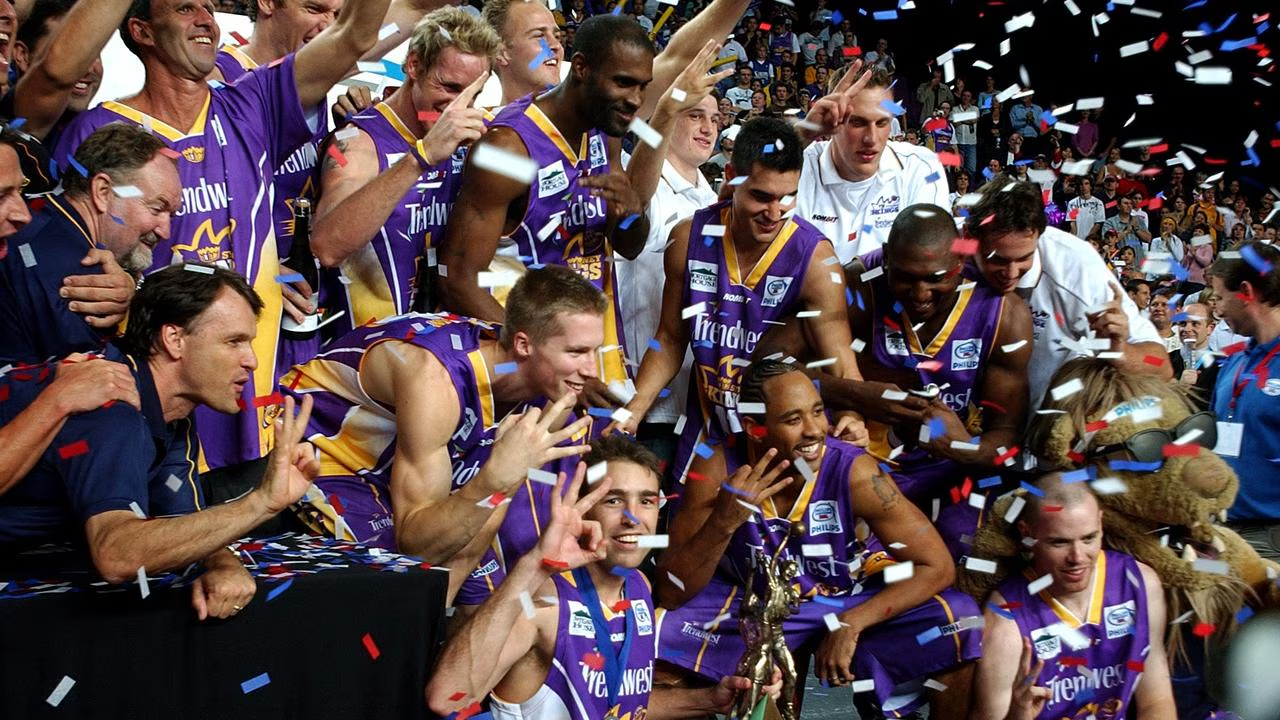
Kings vs Hawks: Ep. 4 — Sydney’s Three-Peat Response To Wollongong’s 2001 Title
December 8, 2025


NICKNAME/S: Twin Air
BIO: Jason Smith was born in Box Hill (VIC) and began playing basketball as a junior with the Vermont basketball program.
FAMILY: Jason’s brother, Darren Smith also played 201 games in the NBL.
Jason Smith made his NBL debut with the South East Melbourne Magic at 20 years of age. He scored two points in his first game.
Brian Goorjian’s youth movement continued in 1995. After moving on from star import Robert Rose the season prior, veteran big man Bruce Bolden would not be offered a chance to return (he would move on to sign with the Sydney Kings), with his replacement coming in the form of young 7-footer Chris Anstey from the Melbourne Tigers.
Anstey’s move to the Magic was one of huge controversy when Melbourne coach Lindsey Gaze appealed the signing via the NBL tribunal. The NBL decided that Anstey could not leave the Tigers and would have to play for Melbourne as long as the Tigers could match the contract, which they did.
After some extremely creative salary tweaking where Magic CEO Graham McNaney and Goorjian convinced all of the Magic players to sign for less so they could offer Anstey a larger contract (which also fit within the NBL salary cap) that the Tigers couldn’t match. Once Anstey had signed with the Magic, all of the team’s players were reinstated to their previous contracts.
After the Anstey deal was done, the Magic rounded out the roster by adding Nunawading junior Jason Smith, re-signing import Adonis Jordan and pairing him with Richard ‘Scooter’ Barry, son of NBA Hall of Famer Rick Barry. Unfortunately, Barry (14.3 points, 2.8 rebounds, 5.3 assists, and 2.3 steals) didn’t quite make the impact in the NBL that his father had in the NBA and was shown the door after four games. Goorjian chose to elevate 23-year-old development player Shane Bright (0.3 points, 0.4 rebounds, and 0.6 assists) for the remaining games instead of bringing in another import, aiming to give his young local core of MacKinnon, Anstey and Smith as much playing time as possible.
The Magic went on to finish second on the ladder (18-8), with Tony Ronaldson (21.5 points, 6.7 rebounds, 3.9 assists, and 1.0 steals) leading the team in scoring and Jordan (20.0 points, 2.9 rebounds, 5.9 assists, and 1.8 steals) leading the Magic in assists.
Additionally, 33-year-old big man John Dorge (16.1 points, 12.3 rebounds, 1.1 steals, and 3.0 blocks) turned the clock back and delivered a breakout season, leading the league in blocked shots. Dorge’s improved play saw him selected to the All-NBL first team at the end of the season while backup guard Darren Lucas (9.4 points, 4.6 rebounds, 3.7 assists, and 1.8 steals) took home the league’s Best Defensive Player award.
In the postseason, the Magic lost game one of their quarterfinal matchup with the Illawarra (108-113), then returned to Melbourne to win both games two (92-89) and three (93-75). Moving onto the semi-finals, South East Melbourne would face North Melbourne and saw their season end early thanks to losses in both games one (77-98) and game three (92-107).
1996
By 1996, Magic coach Brian Goorjian had succeeded in rebuilding his roster with young Aussie talent like Sam MacKinnon, Chris Anstey and Jason Smith, all under 21 years of age, key contributors on the team. In a move to create more opportunities for his young team, he replaced high-scoring import Adonis Jordan with pass-first point guard Billy McCaffrey (via Vanderbilt) and signed tenacious defender Mike Kelly who was one of the premier players in the state league competition and had a brief cameo with the Magic 1994. Rupert Sapwell was replaced by 18-year-old Frank Drmic, and Goorjian’s veteran core of Tony Ronaldson, John Dorge, Andrew Parkinson, and Darren Lucas returned, believing this was their year to go all the way.
South East Melbourne would deliver a balanced attack with six players averaging double figures in scoring for the season. Tony Ronaldson (18.6 points, 5.2 rebounds and 4.7 assists) and new import Billy McCaffrey (17.6 points, 2.8 rebounds 4.7 assists) led the team in scoring, and assists while Anstey (11.8 points, 7.8 rebounds, and 1.5 blocks per game) delivered a breakout season, doubling his playing time (from 9.6 minutes to 21.3 minutes) and sharing the centre position with Dorge (12.4 points. 8.8 rebounds and 1.2 blocks in 27.1 minutes). Anstey’s play earning him the Most Improved Player award at season’s end.
This season, the Magic were unstoppable at home, winning 11 from 13 games. The team’s weaknesses, however, seemed to come from its youthful inexperience and learning to win on the road. Case in point, the Magic managed only two away wins during the regular season against playoff team’s.
Smith averaged 3.5 points, 1.5 rebounds, and 0.9 assists over the course of the season and helped guide the Magic (19-7) to a second-place finish on the ladder.
Once into the Playoffs, the Magic were able to get revenge on the North Melbourne Giants, who had ended their season in 1995. South East Melbourne defeated North Melbourne in game one (96-82), after shutting down Giants star point guard Darryl McDonald (11 points, 6 rebounds, 5 assists, and 6 turnovers). Veteran Andrew Parkinson (19 points) came off the bench to lead the Magic in scoring, and import duo Billy McCaffrey (18 points, 6 rebounds and 5 assists) and Mike Kelly (15 points, 8 rebounds, and 2 steals) delivered all-round efforts and a dominant Chris Anstey (12 points and 7 rebounds) created havoc inside.
In Game two, the Magic shut down Giant’s big man Paul Rees, who had 28 points in game one and only 10 points in game two. After not playing in Game one Smith played five minutes in Game two but failed to score. Tony Ronaldson led the way in scoring, both inside and out, finishing with 25 points, 4 rebounds, 5 assists, 2 steals and 2 blocks. Mike Kelly was able to both limit the impact of McDonald defensively and finish with 17 points, 8 rebounds and 5 assists and Sam MacKinnon was unstoppable at both ends, finishing with 14 points and 14 rebounds to claim a 87-77 victory in Game 2.
South East Melbourne would face Adelaide in their semi-final matchup, Ronaldson (20 points, 5 rebounds, 7 assists) continued to carry the scoring load in game one, but thanks to 36ers athletic forward Leon Trimmingham (23 points and 9 rebounds), the Magic were unable to get it done in the game’s closing moments (86-87). In game two, Ronaldson produced a all-around effort of 11 points, 8 rebounds, and 8 assists and the Magic’s young stars played a key role in the 112-81 win. MacKinnon notched up 20 points, 5 rebounds, and 7 assists alongside Anstey, who added 14 points and 6 rebounds, but most importantly, the two were able to limit Trimmingham’s impact to only 10 points (3 from 12 shooting). Smith saw minimal court time during the series, scoring a total of 3 points in 7 minutes across both games as the win saw the Magic set-up a Grand Final series with crosstown rival the Melbourne Tigers.
Melbourne was too good in game one (100-89), with Gaze (35 points, 8 rebounds, and 7 assists) delivering his best game of the series in front of a packed Melbourne crowd. Mark Bradtke (24 points and 15 rebounds) and Lanard Copeland (23 points, 4 rebounds and 3 assists) were also brilliant, scoring whenever Gaze didn’t, and the Tigers ‘Big Three’ combining for 82 points.
The Magic would then bounce back and win game two (88-84) in front of a Grand Final record crowd of 15,064 at the National Tennis Centre at Flinders Park, which still stands as Melbourne’s highest-attended NBL game ever. Gaze (21 points, 5 rebounds, and 9 assists) led the Tigers in scoring in the loss, while the Magic were led by Tony Ronaldson (28 points) and Mike Kelly (19 points, 9 rebounds, 4 assists and 2 steals).
The third and deciding game would be held less than 48 hours later, a scenario that benefitted the younger legs of the Magic. Smith would contribute four points as the Magic delivered the final blow, a 30-point blowout, led by Billy McCaffrey (24 points and 5 assists) and the incredibly efficient performances from Sam MacKinnon (18 points on 9 from 10 shooting and 9 rebounds) and John Dorge (16 points on 8 from 11 shooting and 8 rebounds). The field goal percentage at the end of the game the telling factor, the 107-70 South East Melbourne victory, a result of the Magic shooting 46/85 (54%( from the field compared to the Tigers 23/60 (38%).
The 1996 NBL Grand Final series drew a aggregate attendance record of 43,605 (average 14,535), the largest crowd ever for a three-game NBL series. Magic guard Mike Kelly was awarded the Finals MVP award after averaging 16 points, 6 rebounds, 4 assists and 2.3 steals across the three-game series.
1997
After finishing second with a 19-7 record before defeating the Melbourne Tigers in three games to win the 1996 championship, South East Melbourne retained the majority of Brian Goorjian’s title-winning roster. Billy McCaffrey (to Philadelphia Power) was not retained and replaced by import Brian Tolbert (via Eastern Michigan), while Darren Lucas (retired) departed and Matthew Moore (via Newcastle) was added. Tony Ronaldson, Sam MacKinnon, Chris Anstey, Mike Kelly, John Dorge, Andrew Parkinson, Frank Drmic and Jason Smith returned, with Drmic moving into a larger role after appearing in 22 games the previous season.
South East Melbourne opened its title defence at the Perth Entertainment Centre on April 11, where Smith (8 points, 1 rebound, and 1 assist) made three of four shots in seven minutes as the Magic defeated Perth 104-84. Tolbert (22 points, 6 assists, and 3 steals) and Ronaldson (19 points and 6 rebounds) led South East Melbourne, while Anthony Stewart (17 points) was Perth’s leading scorer.
Smith (5.6 points across 34 games) moved into a larger role during his third NBL season, increasing his playing time from 9.0 minutes per game the previous year to 15.4 minutes. He appeared in 29 of South East Melbourne’s 30 regular-season games and all five postseason games, with his only absence coming against North Melbourne on May 10. No injury was reported for the missed game.
Smith’s best scoring game came against Melbourne at Melbourne Park on July 12, where he made seven of eight shots, including all three three-point attempts, and finished with 17 points, 2 assists, and 2 steals in 25 minutes. Kelly (18 points, 5 rebounds, 3 assists, and 2 steals) and Anstey (14 points, 11 rebounds, 4 steals, and 4 blocks) provided support, while Andrew Gaze (35 points, 10 rebounds, and 7 assists) led the Tigers to a 96-89 victory.
During the season, Smith was also part of the Magic group that shared the court with Shaquille O’Neal when the NBA superstar trained with the reigning NBL champions during his 1997 Australian tour.
South East Melbourne again relied on one of the league’s deepest rotations. Ronaldson (16 points, 4.9 rebounds, and 3.2 assists) led the team in scoring, while MacKinnon (15.2 points, 6.3 rebounds, 3.3 assists, and 1.5 steals), Anstey (13.8 points, 9.8 rebounds, 1.6 steals, and 1.8 blocks), Kelly (12.6 points, 4.8 rebounds, 3.1 assists, and 1.5 steals) and Tolbert (12.2 points, 3.6 rebounds, and 3.7 assists) gave the Magic five players averaging double figures. Drmic (8.7 points and 4.5 rebounds), Dorge (7 points and 6 rebounds) and Parkinson (5.7 points) provided further depth. Kelly was named the NBL’s Best Defensive Player for the first time, while Goorjian shared Coach of the Year honours with Melbourne’s Lindsay Gaze.
South East Melbourne closed the regular season against Newcastle at Dandenong Basketball Stadium on September 28, where Smith (12 points, 3 rebounds, and 1 assist) made five of nine shots as the Magic defeated the Falcons 108-99. MacKinnon (25 points, 5 rebounds, 6 assists, and 2 steals) and Ronaldson (18 points, 3 rebounds, 5 assists, and 2 blocks) led South East Melbourne, while Tonny Jensen (16 points, 5 rebounds, and 5 assists) was Newcastle’s best. The victory completed a 22-8 regular season, giving the Magic a franchise-record 22 wins, first place and a first-round playoff bye.
South East Melbourne opened the semifinals in Perth on October 13, where Smith (7 points, 1 rebound, 2 assists, and 2 steals) made all three field-goal attempts as the Magic defeated the Wildcats 92-82. Anstey (19 points, 16 rebounds, and 5 steals) and Ronaldson (18 points) led South East Melbourne, while Todd Lichti (20 points) and Ricky Grace (19 points and 6 assists) led Perth.
Game two moved to Melbourne Park, where Smith (4 points, 3 rebounds, 3 assists, and 3 blocks) played 19 minutes as MacKinnon (21 points, 7 rebounds, and 4 assists) and Tolbert (19 points and 4 rebounds) led South East Melbourne to a 96-69 victory. Grace (16 points) and David Van Dyke (13 points, 11 rebounds, and 3 blocks) were Perth’s best as the Magic completed the semifinal sweep.
The Grand Final brought a rematch with Melbourne. The Tigers had struggled early before Jarvis Lang (19.1 points and 9.1 rebounds across 8 games) was released after knee problems continued to limit him, with Marcus Timmons (16.8 points, 9.3 rebounds, 3.7 assists, 1.7 steals, and 1.5 blocks across 17 games) joining as his replacement. Melbourne then won its final 13 regular-season games and entered the Grand Final on a 15-game winning streak.
A great Australian sporting rivalry!! pic.twitter.com/qVrlKwROkN
— RANDOM HOOPS (@HoopsRandom) March 21, 2023
Melbourne dominated game one 111-74 at Melbourne Park, with Smith (4 points, 5 rebounds, and 1 assist) playing almost 25 minutes. Drmic (12 points and 11 rebounds) and MacKinnon (11 points, 4 rebounds, and 4 assists) led South East Melbourne, while Lanard Copeland (29 points and 6 rebounds), Timmons (24 points and 9 rebounds) and Gaze (23 points and 9 assists) led the Tigers.
Game two remained at Melbourne Park, where Smith (2 rebounds) was scoreless in seven minutes as Goorjian changed the frontcourt by starting Dorge in place of Anstey. Anstey (21 points, 8 rebounds, and 3 blocks) responded from the bench, while Drmic (16 points and 5 rebounds) and MacKinnon (15 points, 4 rebounds, and 6 assists) helped South East Melbourne win 84-78. Copeland (28 points) and Gaze (18 points, 5 rebounds, and 5 assists) led Melbourne as the Magic ended the Tigers’ 17-game winning streak and forced a deciding game.
Game three remained at Melbourne Park, where Smith (6 points, 2 rebounds, 1 assist, 1 steal, and 1 block) played 18 minutes as Ronaldson (26 points and 8 rebounds) and Kelly (11 points and 6 rebounds) led South East Melbourne. Copeland (26 points and 6 rebounds), Gaze (22 points, 5 rebounds, and 9 assists) and Mark Bradtke (21 points and 11 rebounds) led Melbourne to a 93-83 victory and the championship. MacKinnon suffered a broken nose after a hard foul from Warrick Giddey (4 rebounds, 3 assists, and 1 block), who also blocked Drmic late and delivered a mid-court screen on Kelly during the closing stages. Copeland was named Grand Final MVP after averaging 27.6 points and 3.3 rebounds while shooting 56 percent across the series.
1998
After finishing first with a 22-8 record before losing the 1997 Grand Final to Melbourne, South East Melbourne returned under Brian Goorjian looking to go one step further. Chris Anstey (to Dallas), Brian Tolbert and Matthew Moore departed, while Tony Ronaldson, Sam Mackinnon, Mike Kelly, Frank Drmic, John Dorge, Andrew Parkinson and Jason Smith returned. Goorjian added former NBA guard Clinton McDaniel, Brett Wheeler (via Adelaide) and Ben Knight (via Sydney), with Wheeler helping replace the frontcourt size lost when Anstey left for the NBA.
South East Melbourne opened the season against Newcastle at the Newcastle Entertainment Centre on January 30, where Smith (7 points, 2 rebounds, 3 assists, 1 steal, and 1 block) contributed from the bench as the Magic defeated the Falcons 93-73. McDaniel (19 points, 1 rebound, 4 assists, and 5 steals) and Drmic (18 points, 5 rebounds, 2 assists, and 1 steal) led South East Melbourne, while Isaac Burton (21 points, 5 rebounds, 2 assists, and 1 block) was Newcastle’s best.
Smith (9.2 points and 4.1 rebounds across 33 games) produced a breakout season after averaging 5.6 points and 2.2 rebounds the previous year, becoming a regular part of Goorjian’s rotation off the bench. He appeared in 29 of South East Melbourne’s 30 regular-season games and all four postseason games, with his only regular-season non-appearance coming against Adelaide on May 13. His increased role was rewarded when he was named the NBL Best Sixth Man.
Smith’s best game came against Townsville at Melbourne Park on April 5, where he made 8-of-11 field goals and all three of his three-point attempts to finish with a season-high 22 points, 6 rebounds, 3 assists, and 2 steals as the Magic defeated the Crocodiles 96-92. Ronaldson (21 points, 9 rebounds, and 4 assists) and Kelly (14 points, 4 rebounds, 5 assists, and 1 block) provided support.
McDaniel (17.4 points, 3.3 rebounds, 4.3 assists, and 2.7 steals across 24 games) was sidelined after South East Melbourne’s April 24 meeting with Newcastle and missed the next 10 regular-season games. Former 1996 championship guard Billy McCaffrey (10.3 points across 7 games) returned as McDaniel’s injury replacement on May 6 and played seven games through May 27 before McDaniel returned on June 3. McDaniel’s 2.7 steals per game ultimately led the NBL.
Ronaldson (18.1 points, 5.2 rebounds, and 3.1 assists across 34 games) again led South East Melbourne in scoring, while Drmic (14.4 points, 6.6 rebounds, and 3 assists across 34 games) produced a breakout season that drew interest from NBA teams. Mackinnon (13.2 points, 7.8 rebounds, 5.2 assists, and 1.6 steals across 33 games), Kelly (13 points, 4.2 rebounds, 3.3 assists, and 1.3 steals across 34 games) and Wheeler (12.6 points and 7.1 rebounds across 34 games) gave Goorjian a deep rotation. South East Melbourne won its first six games, Kelly was named NBL Best Defensive Player for the second consecutive season and Goorjian won his third NBL Coach of the Year award.
South East Melbourne completed the regular season against defending champion Melbourne at Melbourne Park on June 6, where Smith (11 points, 5 rebounds, 4 assists, and 2 steals) produced another all-round performance, but the Tigers won 110-106. McDaniel (24 points, 4 rebounds, 6 assists, 1 steal, and 2 blocks) and Kelly (17 points, 6 rebounds, 6 assists, and 2 steals) led the Magic, while Andrew Gaze (33 points) was Melbourne’s leading scorer. Despite the loss, South East Melbourne finished first with a 26-4 record, which at the time was the third-best regular-season winning percentage in NBL history behind Adelaide’s 24-2 season in 1986 and Geelong’s 21-2 record in 1984.
Finishing first gave South East Melbourne a first-round bye before the Magic opened their semifinal series against Brisbane at the Brisbane Convention Centre on June 19. Smith (3 points and 2 assists) contributed 16 minutes from the bench as South East Melbourne defeated Brisbane 106-98, with Ronaldson (26 points, 4 rebounds, and 4 assists) and Kelly (25 points, 4 rebounds, 3 assists, 1 steal, and 2 blocks) leading the Magic, while Steve Woodberry (46 points, 12 rebounds, and 1 assist) produced a huge game for the Bullets.
Game two moved to Melbourne Park, where Smith (2 points, 2 rebounds, and 1 assist) again came from the bench as the Magic won 90-84 and completed the sweep. Mackinnon (30 points, 10 rebounds, 1 assist, 3 steals, and 1 block) and Ronaldson (19 points, 5 rebounds, and 5 assists) led South East Melbourne, while Woodberry (28 points, 8 rebounds, 4 assists, and 2 steals) was Brisbane’s best. The victory sent the Magic into the Grand Final for the third consecutive season.
The Grand Final opened at Adelaide Arena on June 28, where Smith (5 points, 6 rebounds, 3 assists, and 1 steal) played 22 minutes from the bench, but Adelaide defeated South East Melbourne 100-93. Wheeler (29 points, 9 rebounds, 3 assists, and 1 block) and McDaniel (20 points, 3 rebounds, 4 assists, and 2 steals) led the Magic, while Kevin Brooks (24 points, 8 rebounds, 3 assists, and 1 block) was Adelaide’s best. The result was only the second time the 36ers had defeated South East Melbourne since the Magic was formed in 1992.
Game two moved to Melbourne Park, where Smith (4 points, 8 rebounds, and 3 assists) provided 23 minutes from the bench, but Adelaide overwhelmed South East Melbourne 90-62. Wheeler (12 points, 5 rebounds, 4 assists, and 1 block) and Ronaldson (11 points, 6 rebounds, 1 assist, and 1 steal) were the Magic’s leading scorers, while Brooks (21 points, 6 rebounds, 1 assist, 1 steal, and 2 blocks) and Martin Cattalini (20 points, 6 rebounds, and 1 assist) led the 36ers. South East Melbourne committed 26 turnovers and made only 6-of-8 free throws compared with Adelaide’s 14 turnovers and 25-of-33 from the line, with the 36ers holding the Magic below 15 points in three quarters. Adelaide completed the sweep, captured its first NBL championship since 1986 and Brooks was named Grand Final MVP. The 1998 season was also the NBL’s final winter campaign and the last season of the South East Melbourne Magic, which merged with the North Melbourne Giants to form the Victoria Titans for 1998/99. Goorjian remained head coach and Smith was one of five Magic players retained by the new club alongside Drmic, Wheeler, Kelly and Ronaldson.
VICTORIA TITANS
1998/99
After the NBL’s move to summer, interest in the league had declined, and financially, it had become difficult for Melbourne to sustain three separate clubs. In an effort to boost sponsorship and membership numbers, the South East Melbourne Magic merged with the North Melbourne Giants, who had struggled financially for a number of years.
The team was re-branded to the Victoria Titans and, with the majority of the front office being former Magic owners, a decision was made to retain Brian Goorjian as head coach, leaving Giants coach Brett Brown without a job. Selecting a team generated criticism as Goorjian’s appointment coincided with the decision not to offer Pat Reidy (to Newcastle), then a member of the Australian national team, a spot on the roster.
The Titans completed their roster by signing four players from the Giants roster, Darryl McDonald, Ben Pepper, David Smith, and Paul Maley, and five players from the Magic roster, Jason Smith, Frank Drmic, Brett Wheeler, Mike Kelly and Tony Ronaldson, while Brad Sheridan (via AIS) also joined the new club.
Victoria opened its inaugural season against Melbourne at Melbourne Park on October 10, where Smith (6 points) played 24:42 minutes, but the Tigers defeated the Titans 99-80. McDonald (16 points, 4 rebounds, 2 assists, and 2 steals) and Pepper (15 points and 10 rebounds) were Victoria’s best as the new roster struggled for cohesion in its first game together.
Smith (11.2 points and 4.1 rebounds) became part of Victoria’s balanced wing rotation and delivered one of his first major games against West Sydney on November 20, finishing with 21 points and 7 rebounds as the Titans won 92-81. Ronaldson (22 points) and Drmic (16 points and 7 rebounds) provided the support as Victoria won despite McDonald playing only 4:42 minutes.
Smith’s best scoring game came against Perth on November 28, where he made four three-pointers and finished with 30 points, 4 steals, and 1 block as Victoria defeated the Wildcats 86-83. Ronaldson (14 points and 4 rebounds) and Kelly (14 points and 7 rebounds) were the other main contributors as the Titans collected their fourth win in five games.
Smith produced one of his strongest all-round games against Adelaide on December 26, finishing with 25 points, 6 rebounds, 4 assists, 3 steals, and 1 block, but the 36ers held on for a 93-91 win at Melbourne Park. Drmic (17 points) and Kelly (16 points, 7 rebounds, and 5 assists) helped keep Victoria close in the two-point loss.
Smith (22 points and 7 rebounds) delivered another 20-point game against Wollongong on February 19, but the Hawks edged Victoria 86-85 at the WIN Entertainment Centre. Ronaldson (18 points and 6 rebounds) and Pepper (14 points and 7 rebounds) were the other main contributors in the one-point loss.
Ronaldson (16.9 points, 5.2 rebounds, and 3.2 assists), who was named team captain of the new franchise, responded by leading Victoria in scoring and earning club MVP honours. Pepper (12.5 points, 7.2 rebounds, and 1.2 blocks) finished second in scoring and led the team in rebounds and blocks, while McDonald (11.1 points, 5 rebounds, 8.2 assists, and 2.4 steals) led both the Titans and the NBL in assists and steals. Wheeler (11 points and 5.9 rebounds), Drmic (10.8 points and 5.2 rebounds), Kelly (10.2 points, 3.9 rebounds, 3.3 assists, and 1.2 steals) and Maley (7.2 points) gave Goorjian seven double-figure scorers as Victoria finished fourth with a 16-10 record, lost only three games at home and entered the playoffs on a four-game winning streak.
Victoria opened the Qualifying Finals at Melbourne Park by defeating Wollongong 96-65 behind Ronaldson (20 points and 4 rebounds), Smith (18 points, 3 rebounds, 2 steals, and 2 blocks), Wheeler (15 points and 6 rebounds), Pepper (12 points and 16 rebounds) and Maley (12 points and 5 rebounds).
Game two moved to the WIN Entertainment Centre, where Victoria defeated Wollongong 91-82 and completed the sweep behind Ronaldson (20 points and 4 rebounds), Smith (19 points and 5 rebounds), Wheeler (14 points and 8 rebounds) and McDonald (7 points, 5 rebounds, 14 assists, and 5 steals), sending the Titans into a semifinal series against Melbourne.
The semifinals opened at Melbourne Park, where Victoria ground out an 80-77 win over Melbourne behind Ronaldson (17 points, 6 rebounds, and 5 assists), Maley (16 points) and McDonald (11 points, 3 rebounds, and 9 assists), while Marcus Timmons (31 points and 9 rebounds) led the Tigers. Smith (3 points and 3 rebounds) played 18:47 minutes in the win.
Game two stayed at Melbourne Park, where Kelly (19 points and 7 rebounds), Pepper (15 points, 13 rebounds, 2 steals, and 2 blocks) and McDonald (13 points, 11 rebounds, 6 assists, and 5 steals) led Victoria to a 94-87 win over Melbourne, completing the sweep and sending the Titans into a Grand Final series against Adelaide. Smith (9 points and 2 blocks) played 15:02 minutes in the win.
The Grand Final series opened in Melbourne, where Adelaide made 16 three-pointers and defeated Victoria 104-94 behind Brett Maher (31 points) and Darnell Mee (25 points, 6 rebounds, and 6 assists). McDonald (23 points, 6 rebounds, 9 assists, and 2 steals), Ronaldson (19 points and 4 rebounds) and Pepper (18 points) led Victoria, while Smith (6 points and 3 rebounds) played 24:52 minutes.
Game two moved to Adelaide, where Maher (25 points) came out firing for the 36ers, but Victoria slowed the game down and levelled the series with an 88-82 win. Ronaldson (22 points), Wheeler (18 points and 9 rebounds), Smith (15 points, 6 rebounds, and 3 assists) and McDonald (12 points, 6 rebounds, and 7 assists) led the Titans and forced a deciding game.
Game three remained in Adelaide, where more than 7,000 36ers fans saw Martin Cattalini (19 points and 9 rebounds) lead Adelaide and Maher (15 points and 7 rebounds) named Grand Final MVP as the 36ers completed back-to-back championships. Pepper (15 points) and Ronaldson (15 points and 6 rebounds) led Victoria, who shot 26-of-78 from the field, while Smith (7 points, 3 rebounds, and 2 blocks) played 19:56 minutes in the 80-69 loss.
1999/00
After Victoria’s Grand Final loss to Adelaide, Brian Goorjian kept most of the group together but looked to make the roster younger after twice falling short of a championship, first with South East Melbourne in 1998 and then with the Titans in 1999. Paul Maley (to Adelaide) and Mike Kelly (to Townsville) exited, while Nathan Taylor returned to the roster and development player Glen Siegle was elevated into the full squad.
Tony Ronaldson, Darryl McDonald, Jason Smith, Frank Drmic, Brett Wheeler, Ben Pepper, David Smith and Brad Sheridan all returned as Victoria entered its second season looking to finish the job after back-to-back Grand Final defeats.
Victoria opened the season at Melbourne Park on October 2, where Smith (29 points and 7 rebounds) delivered one of his best scoring games as the Titans defeated Townsville 106-95. McDonald (19 points, 6 assists, and 4 steals) and Drmic (17 points) provided the support as Victoria started its season with a home win.
Smith (17.9 points, 5.1 rebounds, and 1.3 steals) enjoyed a breakout season, jumping from a supporting role into Victoria’s leading scorer and later earning club MVP honours. His strong start continued against Canberra on October 15, where he finished with 26 points, 6 rebounds, 2 steals, and 3 blocks as the Titans defeated the Cannons 97-82, with Pepper (17 points, 8 rebounds, and 4 blocks) and McDonald (15 points, 4 rebounds, 11 assists, and 3 steals) helping Victoria improve to 3-1.
Smith matched his season high the next night against Melbourne, making six three-pointers and finishing with 29 points and 4 rebounds as Victoria defeated the Tigers 112-77. Drmic (22 points and 5 rebounds) and Ronaldson (17 points and 5 rebounds) helped the Titans dominate their local rival and complete the back-to-back.
Smith produced another major game in Brisbane on December 4, finishing with 27 points and 8 rebounds as Victoria defeated the Bullets 86-75. McDonald (16 points and 6 assists) and Drmic (12 points and 8 rebounds) helped the Titans win on the road and remain near the top of the standings.
Smith (27 points and 6 rebounds) added another key performance against Cairns on January 29 as Victoria defeated the Taipans 84-57 at the Cairns Convention Centre, with Ronaldson (23 points and 5 rebounds) and McDonald (2 points, 6 rebounds, and 9 assists) helping the Titans complete the road win.
Ronaldson (16 points and 5.4 rebounds) remained captain and one of Victoria’s most reliable scorers, while McDonald (13.8 points, 4 rebounds, 7.8 assists, and 2.5 steals) again led both Victoria and the NBL in assists and steals. Drmic (13.3 points and 5.6 rebounds), Wheeler (11.9 points and 7.7 rebounds), Pepper (10.4 points and 6 rebounds) and David Smith (5 points and 3 rebounds) helped Victoria deliver a balanced attack with six players scoring in double figures. The Titans finished fourth with a 20-8 record, built their season around a 11-3 home record and entered the playoffs against Melbourne.
Victoria opened the elimination finals at Melbourne Park, where Melbourne took game one 101-94 despite Smith (22 points and 5 rebounds), McDonald (17 points, 4 rebounds, and 5 assists) and Drmic (16 points, 4 rebounds, and 5 assists) leading the Titans.
Game two stayed at Melbourne Park, where Victoria answered with a 78-70 win behind Ronaldson (18 points and 5 rebounds), McDonald (15 points, 5 rebounds, 6 assists, and 3 steals), Smith (13 points and 4 rebounds) and Drmic (12 points and 11 rebounds), forcing a deciding game.
Game three remained in Melbourne, where Victoria overcame Andrew Gaze (30 points, 4 rebounds, and 7 assists) and eliminated the Tigers with a 105-96 win. McDonald (29 points, 4 rebounds, 9 assists, and 4 steals) led the Titans, while Ronaldson (19 points and 7 rebounds), Smith (14 points) and Drmic (14 points and 8 rebounds) helped Victoria move into a semifinal series against Adelaide, who had picked up the discarded Titan Paul Maley (12.3 points and 6.1 rebounds) midseason.
Adelaide, who had finished the season in first place (and had the wood of the Titan’s it was believed) and entered the in the semifinals as favourites. Ronaldson (26 points and 5 rebounds) and MacDonald (24 points, 6 rebounds, 8 assists, 2 steals and 3 blocks) would lead the Titans to a game one win in Melbourne (101-86), before the series moved to Adelaide for games two and three.
Game two saw Martin Cattalini (24 points and 7 rebounds) and Darnell Mee (22 points, 7 rebounds, 6 assists, and 4 steals) led the 36ers back into the series with a 95-72 win. Ronaldson (17 points and 5 rebounds), Drmic (14 points) and Smith (13 points) were Victoria’s main contributors as Adelaide forced another deciding game.
Game three remained at Adelaide Arena, where Victoria finally overcame the 36ers with a 93-89 win behind McDonald (24 points, 7 rebounds, 6 assists, and 3 steals), Pepper (21 points and 7 rebounds) and Drmic (19 points and 4 rebounds), while Mee (22 points, 6 rebounds, 5 assists, and 2 steals) again filled the stat sheet for Adelaide. Smith (11 points, 6 rebounds, 4 assists, and 3 steals) played 40:57 minutes as the win sent Victoria into its second straight Grand Final series and sparked a Titans celebration on court before the series with Perth had begun.
The Grand Final series opened at Melbourne Park, where Perth defeated Victoria 84-78 behind league MVP Paul Rogers (24 points and 20 rebounds), who connected on 10 of 16 shots. Ronaldson (25 points) led the Titans, while Drmic (13 points and 4 rebounds) and Smith (11 points) supported Victoria in the loss.
Game two moved to Perth, where Marcus Timmons (27 points, 6 rebounds, and 5 steals), who couldn’t miss going 9/15 from the field, led the Wildcats to a 83-76 win and was named Finals MVP as Perth completed the sweep. McDonald (25 points, 5 rebounds, 6 assists, and 4 steals) led Victoria, while Smith (11 points, 4 rebounds, 3 assists, 2 steals, and 2 blocks) played 39:25 minutes in the 83-76 loss.
2000/01
Victoria’s 2000/01 season began with Brian Goorjian reshaping a roster that had again fallen short in the Grand Final. Frank Drmic (to Sydney), Nathan Taylor (to Melbourne) and David Smith exited, while Jason Smith, Tony Ronaldson, Darryl McDonald, Brett Wheeler, Ben Pepper, Brad Sheridan and Glen Siegle returned from the previous season’s group.
Goorjian brought Chris Anstey (via Chicago) back to Australia after three seasons in the NBA, replaced David Smith with Jason Smith’s older brother Darren Smith and signed Mark Dickel (via UNLV). Dickel occupied an import spot because New Zealand players were not considered local players in the NBL until 2003.
Victoria opened the season with a 95-80 road win over Brisbane, where Smith (15 points, 4 rebounds, and 4 steals) helped the Titans start with a victory. Ronaldson (17 points and 7 rebounds), McDonald (16 points, 9 rebounds, 6 assists, 2 steals, and 2 blocks), Dickel (12 points and 7 assists) and Wheeler (7 points and 11 rebounds) gave Victoria a balanced opening night.
Smith (20.5 points and 5.4 rebounds) produced the highest-scoring season of his career, became Victoria’s leading scorer and was selected to the All-NBL First Team. He also finished as the NBL’s leading three-point shooter, giving Goorjian the elite perimeter scorer the Titans needed after Drmic’s exit.
Smith’s best game came against Melbourne on February 3, where he finished with 31 points and 9 rebounds as Victoria edged the Tigers 86-84. McDonald (13 points, 4 rebounds, 12 assists, and 5 steals) controlled the game, while Sheridan (16 points and 9 rebounds) and Ronaldson (15 points and 6 rebounds) helped the Titans win another tight game against their cross-town rival.
Smith also delivered one of his most efficient shooting games against Perth on January 20, finishing with 27 points and 7 rebounds while making all six of his three-point attempts. McDonald (18 points and 9 assists) and Ronaldson (16 points and 5 rebounds) supported him as Smith continued his career-best scoring run.
On March 10, Smith (28 points) made seven three-pointers as Victoria defeated Melbourne 133-124. Ronaldson (31 points and 5 rebounds), McDonald (23 points and 14 assists) and Sheridan (10 points, 7 rebounds, and 3 assists) helped the Titans produce one of their biggest offensive games of the season.
Victoria closed the regular season with a 113-98 home win over Adelaide, where Smith (26 points, 7 rebounds, and 3 assists) helped the Titans finish first with a franchise-best 22-6 record. Ronaldson (23 points and 5 rebounds), McDonald (15 points, 4 rebounds, 10 assists, and 3 steals) and Dickel (13 points and 14 assists) were also key in the win.
Anstey (16.4 points, 9.4 rebounds, and 2 blocks) returned a vastly improved player and was named Titans MVP and NBL Sixth Man of the Year, despite coming off the bench behind Wheeler (13 points and 8 rebounds). Ronaldson (16.3 points and 5.7 rebounds), McDonald (15.4 points, 5 rebounds, 7.9 assists, and 2.7 steals) and Dickel (13.2 points, 3 rebounds, and 5.1 assists) gave Victoria six players averaging at least 13 points, while Darren Smith (6.6 points and 3.7 rebounds), Sheridan (6 points) and Pepper (4.1 points and 3.8 rebounds) added depth.
Injuries to Pepper, Anstey and Darren Smith led to development players Marcus Wright and Pero Vasiljevic being elevated to the full roster during the season, but Victoria still entered the playoffs on top of the ladder.
Victoria opened the qualifying finals against Adelaide with a 101-96 win that saw Smith (2 points and 2 rebounds) play only 13:18 minutes before sufffering a severe knee injury that ended his season, with the loss of Victoria’s leading scorer and best perimeter shooter becoming a major factor in the Titans losing momentum from that point. Anstey (27 points and 16 rebounds), Wheeler (18 points, 7 rebounds, and 3 blocks), McDonald (13 points, 6 rebounds, 9 assists, and 1 block) and Ronaldson (11 points and 2 rebounds) carried Victoria to the win.
Game two moved to Melbourne, where Brooks (34 points and 9 rebounds), Maher (24 points and 5 assists) and Mee (12 points, 6 rebounds, 5 assists, and 3 steals) led the 36ers to a 96-83 win. Wheeler (12 points and 11 rebounds), Ronaldson (11 points), Dickel (12 points and 7 assists) and Darren Smith (8 points and 4 rebounds) were Victoria’s main contributors as the Titans played without Smith and Adelaide forced a deciding game.
Game three remained in Melbourne, where Adelaide won 115-103 to take the series 2-1, with Brooks (25 points and 7 rebounds per game) and Mee (22 points, 7 rebounds, and 5 assists per game) having driven the 36ers across the three games. Darren Smith (21 points and 8 rebounds), Ronaldson (22 points and 7 rebounds), Dickel (17 points, 5 rebounds, and 6 assists), McDonald (12 points, 6 rebounds, 5 assists, and 1 block) and Wheeler (11 points and 5 rebounds) led Victoria who still advanced due to being the highest-placed losing team from the qualifying finals.
The semifinal series opened in Melbourne, where Ronaldson (22 points, 5 rebounds, and 4 assists), McDonald (20 points, 6 rebounds, and 5 assists), Wheeler (17 points, 13 rebounds, and 2 blocks) and Dickel (16 points and 6 assists) led Victoria to a 106-97 win over Townsville..
Game two moved to Townsville, where Goodwin (19 points and 11 rebounds), Reidy (19 points and 4 assists) and Robert Rose (19 points, 11 rebounds, and 8 assists) led the Crocodiles to a 98-82 win. Sheridan (17 points, 3 rebounds, and 2 assists) and Ronaldson (17 points and 8 rebounds) top-scored for Victoria, while Anstey (2 points, 3 rebounds, 2 steals, and 1 block) suffered an injury early in the game and missed the remainder of the series, leaving the Titans without both Anstey and Smith for the deciding game.
Game three remained in Townsville, where Dickel (33 points and 4 assists), McDonald (19 points, 5 rebounds, 5 assists, and 3 steals), Darren Smith (15 points, 6 rebounds, 4 assists, and 4 steals) and Sheridan (8 points, 4 rebounds, and 1 steal) led Victoria, while Goodwin (23 points), Rose (20 points, 6 rebounds, 8 assists, and 2 steals) and Mike Kelly (17 points, 10 rebounds, 6 assists, and 2 steals) carried Townsville to a 101-97 win.
2001/02
Victoria entered the 2001/02 season looking to recover from its semifinal defeat to Townsville, which had ended Brian Goorjian’s run of seven consecutive Grand Final appearances. The Titans abandoned their three-centre rotation by allowing Ben Pepper (to Wollongong) to leave, while Glen Siegle (to Brisbane) also exited. Darryl McDonald’s naturalisation allowed Goorjian to sign Jamahl Mosley (via Salamanca) as a second import, with Nathan Crosswell (via Melbourne’s state league squad) added to the backcourt and Mark Dickel retained as an import because New Zealand players were not considered locals until 2003.
Jason Smith remained sidelined by the severe knee injury he had suffered during the previous postseason and did not play when Victoria opened against Melbourne at Hisense Arena on October 13. Dickel (21 points, 3 rebounds, and 3 assists) and McDonald (19 points, 4 rebounds, 7 assists, and 3 steals) led the Titans, but the Tigers won 109-103.
Smith (18.8 points and 5.4 rebounds across 21 games) missed the opening 14 games before returning against Perth on December 22, immediately restoring one of Victoria’s most dangerous perimeter scorers to the rotation. He made three three-pointers and finished with 11 points in 14:16 minutes as the Titans defeated the Wildcats 118-93, with Ronaldson (30 points) and Anstey (20 points, 14 rebounds, and 3 steals) leading the win.
Smith reached his season-high against Sydney on January 12, making 10 of 15 shots and five three-pointers to finish with 27 points, 5 rebounds, 1 assist, 1 steal, and 2 blocks as Victoria defeated the Kings 101-80 at the Sydney Superdome. McDonald (9 points, 12 rebounds, 7 assists, and 2 blocks) and Anstey (9 points, 9 rebounds, 3 assists, 2 steals, and 4 blocks) helped the Titans complete the 21-point road win.
He matched that scoring total against Melbourne on February 8, making six three-pointers and finishing with 27 points, 6 rebounds, 1 assist, and 1 block as Victoria defeated the Tigers 123-98. Mosley (18 points and 5 rebounds) and Ronaldson (17 points and 8 rebounds) supported Smith as the Titans recorded their largest win over their cross-town rival during the regular season.
Smith again scored 27 points against Canberra on March 1, making seven of 12 three-point attempts while adding 5 rebounds, 1 assist, and 1 steal as Victoria defeated the Cannons 126-108. Sheridan (31 points, 4 assists, and 2 steals) made eight three-pointers and Anstey (14 points, 10 rebounds, 3 steals, and 2 blocks) controlled the interior as the Titans continued their push for first place.
His final regular-season appearance came against Wollongong on March 22, where Smith (24 points and 6 rebounds) made eight of 13 shots and four three-pointers as Victoria defeated the Hawks 103-95. Anstey (16 points, 11 rebounds, 5 assists, 4 steals, and 3 blocks) and Dickel (13 points and 4 assists) helped the Titans secure the win before Victoria completed the regular season in first place with a 21-9 record, collecting its second consecutive minor premiership.
Captain Ronaldson (19.5 points and 4.5 rebounds) led Victoria in scoring, while Anstey (16.8 points, 10.5 rebounds, 1.4 steals, and 1.3 blocks) was named Titans MVP and selected to the All-NBL First Team. McDonald (12 points, 5.1 rebounds, 7.3 assists, and 2.3 steals) led the league in steals and joined Ronaldson on the All-NBL Third Team, with Dickel (11.6 points, 4.4 rebounds, and 6.1 assists) giving the Titans another playmaker. Mosley (11.5 points and 6.7 rebounds) became the first import to win the NBL Best Sixth Man award, while Darren Smith (8.8 points and 3.8 rebounds), Sheridan (8.1 points), Brett Wheeler (7.3 points and 6.2 rebounds) and Crosswell (5.3 points) completed the main rotation as Goorjian was named NBL Coach of the Year.
Victoria opened the qualifying finals against sixth-placed Melbourne with a 113-107 win, led by Smith (27 points, 7 rebounds, 3 assists, and 2 steals), Anstey (19 points, 9 rebounds, and 2 blocks) and Sheridan (15 points, 5 rebounds, 2 assists, 2 steals, and 1 block), while Hoare (20 points and 13 rebounds) was Melbourne’s best.
Game two remained at Hisense Arena, where Smith (22 points, 5 rebounds, 2 assists, and 2 steals), McDonald (11 points, 6 rebounds, 7 assists, 4 steals, and 1 block) and Ronaldson (13 points and 3 rebounds) led Victoria, but Copeland (41 points, 5 assists, and 2 steals) and Timmons (19 points, 6 rebounds, and 3 assists) carried Melbourne to a 107-105 win.
The deciding game saw Copeland (37 points, 6 rebounds, and 6 assists) and Timmons (21 points, 9 rebounds, and 4 blocks) lead Melbourne to a 103-97 victory. Anstey (32 points, 20 rebounds, 3 assists, 2 steals, and 2 blocks), Ronaldson (24 points, 6 rebounds, and 1 block) and Smith (11 points, 9 rebounds, 3 assists, and 1 block) led the Titans, who still progressed as the highest-ranked losing team from the qualifying finals.
The semifinals opened in Melbourne, where Smith (19 points, 8 rebounds, and 6 assists), Ronaldson (27 points and 5 rebounds) and Anstey (17 points, 8 rebounds, and 2 steals) led Victoria, but Farley (25 points and 4 rebounds) and Maher (23 points and 8 rebounds) carried Adelaide to a 99-92 win.
Game two moved to Adelaide, where Smith (20 points, 3 rebounds, and 4 assists), Anstey (26 points, 12 rebounds, 1 assist, 1 steal, and 2 blocks) and McDonald (13 points, 12 rebounds, and 7 assists) led Victoria to an 86-81 win. Farley (24 points) and Maher (15 points) were Adelaide’s leading scorers as the Titans levelled the series.
Game three remained in Adelaide, where Farley (33 points, 8 rebounds, and 6 assists), Maher (16 points, 6 rebounds, and 6 assists) and Rees (16 points and 9 rebounds) led the 36ers, while Ronaldson (26 points and 6 rebounds) and Dickel (14 points, 3 rebounds, and 9 assists) supported Smith (16 points, 5 rebounds, and 5 assists), who played 44:31 minutes in the 103-92 loss.
The loss became the final game played by the Victoria Titans, with financial difficulties leading the club to sell its licence to a group headed by Peter Fiddes and rebrand as the Victoria Giants while Smith headed overseas, before rejoining coach Brian Goorjian in Sydney the following season.
SYDNEY KINGS
2003/04
After winning the 2003 NBL championship, team captain Shane Heal chose to retire from basketball. Strangely enough, while retired Heal was offered a contract to play with the NBA’s San Antonio Spurs, which he accepted. CJ Bruton was signed as Heal’s replacement for Kings as the looked to rebuild the roster for a chance at back to back titles. With the Kings losing both imports Chris Williams and Kavossy Franklin to bigger deals overseas, import Ebe Ere was signed, and instead of finding a second import, coach Brian Goorjian added Jason Smith, who had just returned from Europe, and Brett Wheeler, who had both played for Goorjian whilst with the Victoria Titans.
With only one import, this allowed up-and-coming talent, Matthew Neilsen (22.2 points, 10.6 rebounds, 3.5 assists, 1.0 steal, and 2.5 blocks), to deliver a breakout season and alongside Bruton (16.7 points, 3.6 rebounds, and 3.8 assists) and Ere (19.6 points, 5.7 rebounds, and 1.2 steals) that propelled the Kings’ to back-to-back championships.
The team began the season scorching hot, winning ten straight games before losing Smith (11.5 points, 4.7 rebounds, 1.7 assists, and 1.1 steals) when he suffered a season-ending injury. Unable to return, Goorjian would replace him with import Chris Carrawell (13.2 points, 7.2 rebounds, 2.8 assists, and 1.3 steals), who played out the team’s last 11 regular season games.
Sydney would finish first place finish in the regular season with a 26-7 record and go on to win their second championship after their best-of-five grand final series with crosstown rivals West Sydney Razorbacks went down to the deciding fifth game. Nielsen would win the regular season and finals MVP in 2003/04 before leaving to play overseas.
Smith would play in 13 games, averaging 11.5 points, 4.7 rebounds, and 1.7 assists.
2004/05
The 2004/05 season was a defining one for Jason Smith, as he led the Sydney Kings to their historic third consecutive NBL Championship.
As team captain, Smith was the heart and soul of the Kings, setting the tone with his leadership, defensive intensity, and ability to deliver in clutch moments.
Under head coach Brian Goorjian, Sydney once again established itself as the league’s dominant force, finishing first in the regular season with a 21-11 record.
Smith had one of the best seasons of his career, averaging 19.2 points, 6.9 rebounds, and 3.6 assists, while also contributing 1.8 steals per game.
His ability to impact both ends of the floor made him invaluable to the Kings’ success.
He was supported by a strong core, including Mark Sanford (16.7 points, 7.4 rebounds), Rolan Roberts (16.4 points, 9.1 rebounds), and C.J. Bruton (16.3 points, 3.9 rebounds, 5.7 assists), but it was Smith’s leadership that kept the Kings focused as they chased history.
Throughout the season, Smith delivered numerous standout performances, proving why he was one of the league’s most complete players.
One of his best games came on January 28 against Perth, where he scored 26 points, 5 rebounds, and 3 assists, hitting 5 three-pointers.
He followed that up with another strong showing on February 11 against Hunter, dropping 28 points, 7 rebounds, and 4 assists, showcasing his ability to take over games.
In the playoffs, Smith continued to shine, stepping up when the team needed him most.
Sydney swept Brisbane 2-0 in the semifinals before facing the Illawarra Hawks in the Grand Final series.
The Kings were simply unstoppable in the 2005 NBL Grand Final series, sweeping the Illawarra Hawks in three straight games with dominant performances.
In Game 1, Sydney took control early and never looked back, securing a 96-73 victory.
Jason Smith (21 points, 3 rebounds, and 7 assists) set the tone for the Kings with his leadership and all-around play, helping his team establish a commanding presence in the series.
Game 2 saw the Kings continue their dominance, cruising to a 105-80 win.
Smith remained a steady force, contributing 12 points and 7 rebounds, ensuring Sydney maintained full control heading into the decisive third game.
In Game 3, Smith delivered one of the greatest performances of his career, putting on a Finals masterpiece to lead the Kings to a 112-85 victory and their historic third consecutive NBL Championship.
He erupted for 38 points, 12 rebounds, and 1 assist, cementing his legacy with an unforgettable display that earned him Grand Final MVP honors.
Smith capped off an incredible season in which he averaged 19.2 points, 6.9 rebounds, and 3.6 assists, while also contributing 1.8 steals per game.
His ability to dominate on both ends of the floor and deliver in clutch moments played a crucial role in securing Sydney’s place in NBL history as the first team to ever win three consecutive championships.
2005/06
The 2005/06 season saw Smith average 16.9 points, 5.5 rebounds, and 2.8 assists and play a key role in helping the Kings to a first place finish in the regular season with a 26-6 record.
2006/07
During the 2006/07 season Smith averaged 12.5 points, 4 rebounds, and 1.7 assists and helped the Kings finish with a record of 20-13 and end the regular season in fourth place.
2007/08
The Kings had been drifting further and further away from the championship since completing a three-peat in 2005. A grand final loss in 2006, a semi-final exit in 2005 and losing veteran Brad Sheridan to retirement and their second-leading scorer David Barlow prompted Sydney to re-tool their roster. The Kings would start by making a huge offer to Illawarra Hawks star Glen Saville, one which he couldn’t refuse. Imports Jerome Beasley and Ed Scott were replaced with Dontaye Draper and Isiah Victor and the Kings started the season off on fire.
Sydney won their first five games until they suffered a upset loss to rival club West Sydney, but backed this up by winning the next seven games in a row.
Smith averaged 12.9 points, 4.1 rebounds, and 1.7 assists alongside Mark Worthington (17.4 points, 6.4 rebounds, 2.9 assists and 1.4 steals) who delivered his best season to date, leading the Kings in both scoring and rebounds. Draper (13.6 points, 3.2 rebounds, 4.4 assists and 1.8 steals), who led the team in assists and steals, provided the leadership needed at the point as the Kings delivered a balanced attack with six players averaging double figures, including Jason Smith (12.9 ppg), Luke Kendall (11.3 ppg), Victor (10.8 ppg) and Saville (10.6 ppg).
The Kings would finish the regular season with a 27-3 record, losing only one home game all season and ending the season on a eight game winning streak. Sydney clinched top spot on the ladder (five games ahead of Melbourne) after winning their last eight games of the season. With the league’s top eight team’s advancing to the playoffs, Sydney and Melbourne (22-8), would automatically advance to the semi finals. There they would face Perth and Brisbane respectively. Sydney would defeat Perth in three games, while Melbourne eliminated Brisbane to face each other in the best-of-five Grand Final series.
Worthington would erupt for 35 points, 7 rebounds and 3 assists in game one in front of the home crowd, with the Kings convincingly winning Game one, 95-74. The key to the victory being the defensive efforts from Ian Crosswhite (11 points, 9 rebounds), Russell Hinder (4 points, 3 rebounds and Worthington, who held NBL MVP Chris Anstey to a mere 12 points
game two shifted to Melbourne and behind former King David Barlow (24 points), Sean Lampley (21 points) and a resurgent Anstey (21 points and 9 rebounds) the Tigers defeated Sydney 104-93.
game three saw Melbourne survive a fierce final quarter comeback behind a 89-87 victory, witnessed by 6,009 Kings fans at the Sydney Entertainment Centre. Melbourne had allowed a 78-66 three-quarter-time lead to disappear by the fourth quarter, where they trailed by four points with just under four minutes to play. However, they outscored Sydney 7-1 in the game’s remaining moments, which saw import forward Sean Lampley clinching the game with a three-pointer to make it 89-87 victory with just 12 seconds remaining. With Sydney unable to respond, Anstey finished with 27 points and 15 rebounds for the Tigers, while Kings star Mark Worthington top-scored again for Sydney with 22 points.
The Kings made sure the same result wouldn’t happen in game four, thanks to inspired performances by injured guard Dontaye Draper (8 points, 4 assists and 2 steals) and forward Isiah Victor (23 points, 9 rebounds), the Sydney Kings came back from the dead to extend the series to a fifth game. To win, the Kings staged the biggest last-quarter comeback ever in a NBL Grand Final, trailing by as much as 18 points (72-54) late in the third quarter. Draper, who was not expected to play because of a hamstring injury, sat on the bench for almost all of the first three quarters. But, after coming on late in the third term, he scored eight points in the final quarter, including two crucial three-pointers, to help lift his side to a 90-87 victory, culminating with Kings coach Brian Goorjian running laps around our court with a clenched fist. Isiah Victor led the Kings with 23 points and 9 rebounds, while Chris Anstey led the Tigers, recording his second-highest score of the season, adding 33 points and eight rebounds in the losing effort.
Many expected the Tigers to roll over after the emotional game four loss, especially with game five being played a mere 48 hours later. The game was played in front of a sellout crowd of 10,244 (the King’s first sellout since 2003), and although Sydney finished the first quarter in front, the Tigers outscored them (28-19) in the second and at the end of the third, the Tigers held a 61-63 lead. In the series thus far, Sydney had outscored Melbourne 97-59 in the four previous fourth quarters, but with Tigers duo Chris Anstey and Dave Thomas both delivering 21 point games, Melbourne rebounded to defeat Sydney 85-73. Anstey, who had averaged 22.8 points and 10.4 rebounds over the five games, was fittingly named Finals MVP and in doing so, became only the second player ever (Sam MacKinnon had achieved the feat in 2007) to win a NBL championship, the season MVP, Grand Final MVP and Best Defensive Player all in the same season.
Mark Worthington led the Kings with 17 points while Jason Smith and Luke Kendall both finished with 7 points each, unable to get the types of shots they generally made.
On 24 March 2008, coach Brian Goorjian quit the club after a mutual agreement, and on 12 June 2008, the NBL terminated the Sydney team’s licence as Firepower collapsed and the Kings were unable to pay player salaries.
SYDNEY SPIRIT
2008/09
After struggling through the 2007/08 as the Razorbacks, West Sydney changed their name to the Sydney Spirit for the 2008/09 NBL season. The change was influenced by the Sydney Kings folding in 2008 and the Razorbacks ownership hoping to rebrand to Sydney in a effort to capitalise on the Sydney market.
The Spirit struggled to be competitive during the first half of the season, partly due to Damian Martin (5.0 points, 5.4 rebounds, 3.1 assists, and 1.9 steals) playing through a broken wrist suffered during the pre-season. To make things even worse, it became clear the club was in dire financial straits with attendances at the State Sports Centre rarely selling more than 2,000 tickets. A game against the Cairns Taipans in Round 21 made history when only a paltry 920 fans showed up, the lowest NBL attendance since the early 1980’s.
As a solution to keeping the team afloat and the NBL season alive, the Spirit’s ten contracted players and three coaches, including head coach Rob Beveridge, all agreed to live off just $150,000 between them to keep the franchise going—roughly $700 per week for Smith. Shortly after team captain Liam Rush (who left for Sweden), big man Julian Khazzouh (Holland) and import Derrick Low would all leave the team for better deals overseas.
Despite the setbacks Smith would average 14.2 points, 4.9 rebounds, and 2.7 assists as whilst the Spirit finished in eighth place on the ladder (11–19), missing the playoffs before exiting and leaving Sydney without a NBL team.
Jason Smith played fourteen seasons across four NBL teams. This included the South East Melbourne Magic, Victoria Titans, Sydney Kings and Sydney Spirit. He averaged 12.9 points, 4.3 rebounds, and 1.8 assists in 408 NBL games.
– 43rd in total points
HIGHLIGHTS:
| SEASON | AGE | TEAM | TEAM RECORD | GP | MINS | PTS | REB | AST | OR | DR | STL | BLK | TO | PF | FGM | FGA | FG% | 3PM | 3PA | 3P% | FTM | FTA | FT% | TS% | EFG% | HS |
|---|---|---|---|---|---|---|---|---|---|---|---|---|---|---|---|---|---|---|---|---|---|---|---|---|---|---|
| 2008-09 | 34 | Sydney | 11-19 (8) | 19 | 733 | 270 | 94 | 51 | 20 | 74 | 12 | 10 | 56 | 57 | 83 | 229 | 36% | 43 | 112 | 38% | 61 | 83 | 73% | 50% | 46% | 20 |
| 2007-08 | 33 | Sydney | 27-3 (1) | 37 | 1,179 | 478 | 152 | 63 | 37 | 115 | 33 | 15 | 69 | 99 | 155 | 350 | 44% | 95 | 224 | 42% | 73 | 95 | 77% | 60% | 58% | 25 |
| 2006-07 | 32 | Sydney | 20-13 (4) | 33 | 1,097 | 411 | 133 | 55 | 26 | 107 | 38 | 19 | 35 | 83 | 143 | 306 | 47% | 71 | 184 | 39% | 54 | 68 | 79% | 61% | 58% | 25 |
| 2005-06 | 31 | Sydney | 26-6 (1) | 36 | 1,224 | 607 | 199 | 100 | 51 | 148 | 47 | 30 | 70 | 116 | 213 | 483 | 44% | 115 | 290 | 40% | 66 | 92 | 72% | 58% | 56% | 29 |
| 2004-05 | 30 | Sydney | 21-11 (1) | 37 | 1,435 | 712 | 256 | 132 | 60 | 196 | 67 | 18 | 88 | 120 | 249 | 535 | 47% | 117 | 303 | 39% | 97 | 142 | 68% | 59% | 57% | 38 |
| 2003-04 | 29 | Sydney | 26-7 (1) | 13 | 430 | 149 | 61 | 22 | 13 | 48 | 14 | 9 | 32 | 22 | 55 | 143 | 38% | 25 | 83 | 30% | 14 | 18 | 78% | 49% | 47% | 22 |
| 2001-02 | 27 | Victoria | 21-9 (1) | 21 | 783 | 394 | 113 | 54 | 37 | 76 | 13 | 8 | 45 | 71 | 138 | 319 | 43% | 75 | 197 | 38% | 43 | 51 | 84% | 57% | 55% | 27 |
| 2000-01 | 26 | Victoria | 22-6 (1) | 29 | 1,094 | 594 | 157 | 51 | 42 | 115 | 27 | 12 | 65 | 85 | 213 | 428 | 50% | 110 | 232 | 47% | 58 | 80 | 73% | 64% | 63% | 31 |
| 1999-00 | 25 | Victoria | 20-8 (4) | 36 | 1,447 | 645 | 185 | 63 | 66 | 119 | 46 | 14 | 74 | 116 | 231 | 493 | 47% | 97 | 240 | 40% | 86 | 115 | 75% | 59% | 57% | 29 |
| 1998-99 | 24 | Victoria | 16-10 (4) | 33 | 951 | 370 | 135 | 42 | 45 | 90 | 23 | 19 | 50 | 75 | 133 | 264 | 50% | 48 | 121 | 40% | 56 | 73 | 77% | 62% | 59% | 30 |
| 1998 | 23 | South East Melbourne | 26-4 (1) | 33 | 738 | 305 | 134 | 47 | 60 | 74 | 23 | 10 | 49 | 77 | 104 | 203 | 51% | 41 | 83 | 49% | 56 | 73 | 77% | 64% | 61% | 22 |
| 1997 | 22 | South East Melbourne | 22-8 (1) | 34 | 522 | 190 | 76 | 33 | 36 | 40 | 18 | 9 | 36 | 66 | 71 | 142 | 50% | 20 | 53 | 38% | 28 | 37 | 76% | 60% | 57% | 17 |
| 1996 | 21 | South East Melbourne | 19-7 (2) | 26 | 234 | 90 | 40 | 23 | 15 | 25 | 9 | 6 | 22 | 25 | 30 | 62 | 48% | 9 | 21 | 43% | 21 | 28 | 75% | 60% | 56% | 13 |
| 1995 | 21 | South East Melbourne | 18-8 (2) | 21 | 99 | 55 | 15 | 10 | 5 | 10 | 9 | 1 | 14 | 17 | 21 | 37 | 57% | 3 | 8 | 38% | 10 | 12 | 83% | 64% | 61% | 7 | Totals | 408 | 11966 | 5270 | 1750 | 746 | 513 | 1237 | 379 | 180 | 705 | 1029 | 1839 | 3994 | 46.0% | 869 | 2151 | 40.4% | 723 | 967 | 74.8% | 60% | 57% | 38 |
| SEASON | AGE | TEAM | TEAM RECORD | GP | MINS | PTS | REB | AST | OR | DR | STL | BLK | TO | PF | FGM | FGA | FG% | 3PM | 3PA | 3P% | FTM | FTA | FT% | TS% | EFG% | HS |
|---|---|---|---|---|---|---|---|---|---|---|---|---|---|---|---|---|---|---|---|---|---|---|---|---|---|---|
| 2008-09 | 34 | Sydney | 11-19 (8) | 19 | 38.6 | 14.2 | 4.9 | 2.7 | 1.1 | 3.9 | 0.6 | 0.5 | 2.9 | 3.0 | 4.4 | 12.1 | 36% | 2.3 | 5.9 | 38% | 3.2 | 4.4 | 73% | 50% | 46% | 20 |
| 2007-08 | 33 | Sydney | 27-3 (1) | 37 | 31.9 | 12.9 | 4.1 | 1.7 | 1.0 | 3.1 | 0.9 | 0.4 | 1.9 | 2.7 | 4.2 | 9.5 | 44% | 2.6 | 6.1 | 42% | 2.0 | 2.6 | 77% | 60% | 58% | 25 |
| 2006-07 | 32 | Sydney | 20-13 (4) | 33 | 33.2 | 12.5 | 4.0 | 1.7 | 0.8 | 3.2 | 1.2 | 0.6 | 1.1 | 2.5 | 4.3 | 9.3 | 47% | 2.2 | 5.6 | 39% | 1.6 | 2.1 | 79% | 61% | 58% | 25 |
| 2005-06 | 31 | Sydney | 26-6 (1) | 36 | 34.0 | 16.9 | 5.5 | 2.8 | 1.4 | 4.1 | 1.3 | 0.8 | 1.9 | 3.2 | 5.9 | 13.4 | 44% | 3.2 | 8.1 | 40% | 1.8 | 2.6 | 72% | 58% | 56% | 29 |
| 2004-05 | 30 | Sydney | 21-11 (1) | 37 | 38.8 | 19.2 | 6.9 | 3.6 | 1.6 | 5.3 | 1.8 | 0.5 | 2.4 | 3.2 | 6.7 | 14.5 | 47% | 3.2 | 8.2 | 39% | 2.6 | 3.8 | 68% | 59% | 57% | 38 |
| 2003-04 | 29 | Sydney | 26-7 (1) | 13 | 33.1 | 11.5 | 4.7 | 1.7 | 1.0 | 3.7 | 1.1 | 0.7 | 2.5 | 1.7 | 4.2 | 11.0 | 38% | 1.9 | 6.4 | 30% | 1.1 | 1.4 | 78% | 49% | 47% | 22 |
| 2001-02 | 27 | Victoria | 21-9 (1) | 21 | 37.3 | 18.8 | 5.4 | 2.6 | 1.8 | 3.6 | 0.6 | 0.4 | 2.1 | 3.4 | 6.6 | 15.2 | 43% | 3.6 | 9.4 | 38% | 2.0 | 2.4 | 84% | 57% | 55% | 27 |
| 2000-01 | 26 | Victoria | 22-6 (1) | 29 | 37.7 | 20.5 | 5.4 | 1.8 | 1.4 | 4.0 | 0.9 | 0.4 | 2.2 | 2.9 | 7.3 | 14.8 | 50% | 3.8 | 8.0 | 47% | 2.0 | 2.8 | 73% | 64% | 63% | 31 |
| 1999-00 | 25 | Victoria | 20-8 (4) | 36 | 40.2 | 17.9 | 5.1 | 1.8 | 1.8 | 3.3 | 1.3 | 0.4 | 2.1 | 3.2 | 6.4 | 13.7 | 47% | 2.7 | 6.7 | 40% | 2.4 | 3.2 | 75% | 59% | 57% | 29 |
| 1998-99 | 24 | Victoria | 16-10 (4) | 33 | 28.8 | 11.2 | 4.1 | 1.3 | 1.4 | 2.7 | 0.7 | 0.6 | 1.5 | 2.3 | 4.0 | 8.0 | 50% | 1.5 | 3.7 | 40% | 1.7 | 2.2 | 77% | 62% | 59% | 30 |
| 1998 | 23 | South East Melbourne | 26-4 (1) | 33 | 22.4 | 9.2 | 4.1 | 1.4 | 1.8 | 2.2 | 0.7 | 0.3 | 1.5 | 2.3 | 3.2 | 6.2 | 51% | 1.2 | 2.5 | 49% | 1.7 | 2.2 | 77% | 64% | 61% | 22 |
| 1997 | 22 | South East Melbourne | 22-8 (1) | 34 | 15.4 | 5.6 | 2.2 | 1.0 | 1.1 | 1.2 | 0.5 | 0.3 | 1.1 | 1.9 | 2.1 | 4.2 | 50% | 0.6 | 1.6 | 38% | 0.8 | 1.1 | 76% | 60% | 57% | 17 |
| 1996 | 21 | South East Melbourne | 19-7 (2) | 26 | 9.0 | 3.5 | 1.5 | 0.9 | 0.6 | 1.0 | 0.3 | 0.2 | 0.8 | 1.0 | 1.2 | 2.4 | 48% | 0.3 | 0.8 | 43% | 0.8 | 1.1 | 75% | 60% | 56% | 13 |
| 1995 | 21 | South East Melbourne | 18-8 (2) | 21 | 4.7 | 2.6 | 0.7 | 0.5 | 0.2 | 0.5 | 0.4 | 0.0 | 0.7 | 0.8 | 1.0 | 1.8 | 57% | 0.1 | 0.4 | 38% | 0.5 | 0.6 | 83% | 64% | 61% | 7 | Total | 408 | 29.3 | 12.9 | 4.3 | 1.8 | 1.3 | 3.0 | 0.9 | 0.4 | 1.7 | 2.5 | 4.5 | 9.8 | 46.0% | 0.0 | 0.0 | 40.4% | 2.1 | 5.3 | 74.8% | 60% | 57% | 38 |
| POINTS | REBOUNDS | ASSISTS | STEALS | BLOCKS | TURNOVERS | TRIPLE DOUBLES | 38 | 13 | 7 | 5 | 4 | 7 | 0 |
|---|
Smith joined Nunawading for the 1991 state league season, entering the senior pathway after coming through the Vermont and Nunawading junior systems. The Box Hill-born guard-forward had been born on 20 October 1974 and moved into Nunawading’s senior environment during the period when the Spectres’ men’s team had re-emerged in the South East Australian Basketball League system.
Smith continued with Nunawading for the 1992 and 1993 state league seasons, keeping him with the Spectres through the CBA-era seasons before his college move. His early Nunawading years followed a junior rise in which he did not make a Nunawading first team until under-20 level, then moved into senior basketball with the club before his later professional career.
Smith joined Sandringham for the 1996 ABA South/East season, returning to Victorian state league basketball during the same period in which the South and East conferences operated under the Australian Basketball Association structure. Sandringham became his state league club for three straight seasons from 1996 to 1998.
Smith remained with Sandringham for the 1997 ABA South/East season, continuing as a senior wing option in the Sabres’ state league group. The stint kept him active in Victorian state league basketball while he was also building his wider professional profile.
Smith completed his Sandringham stint in the 1998 ABA South/East season, closing a three-year run with the Sabres before returning to Nunawading the following year.
Smith rejoined Nunawading for the 1999 SEABL season, returning to the Spectres after his Sandringham run. Nunawading’s men reached the SEABL conference runner-up stage that season, giving Smith’s second stint with the club a finals-linked year in the state league competition.
Smith returned to Nunawading again for the 2003 SEABL season, adding another one-year Spectres stint after his earlier runs in 1991–1993 and 1999. The 2003 season kept his state league timeline tied to the club where he had first moved through the senior pathway.
Smith joined Sutherland for the 2004 Waratah League season, moving into the New South Wales state league system for a one-year stint with the Sharks. That season followed his Victorian state league runs with Nunawading and Sandringham and completed the known state league stops in his playing career.
Smith remained a part of the national team as Australia looked to rebound from losing to New Zealand and missing out on the 2002 World Championships. The loss saw Phil Smyth replaced as head coach by Brian Goorjian, who immediately convinced Shane Heal to return to the national program (he had retired after the 2000 Olympics), and build the team around teenage big man Andrew Bogut. In his first Olympics Bogut (13.7 points, 9 rebounds, and 1.2 blocks) was the teams starting centre and leading rebounder while Heal (16.7 points and 3.5 assists) would lead the team in scoring and assists. selected a part of the national program as the team. Due to the teams inexperience, the Boomers (1-5) lost to every team in their pool bar Angola, missing the quarterfinals. Australia would then defeat New Zealand, 98-80, to determine who finished the tournament in ninth place.
In 2006, Smith again suited up for Australia at the 2006 FIBA World Championship in Japan. The Boomers started the tournament with a opening victory over Brazil (83-79) but then lost their next three games in a row. Bogut (12.8 points and 6.2 rebounds) led the team in points and rebounds and helped the team deliver a convincing win over Qatar (93–46) which qualified the team for the second round. Their poor record (2-3) saw them draw USA who soundly defeated Australia (113-73) and ended their campaign tied for ninth place.
| YEAR | AGE | GP | MINS | PTS | REB | AST | OR | DR | STL | BLK | TO | PF | FGM | FGA | FG% | 3PM | 3PA | 3P% | FTM | FTA | FT% |
|---|---|---|---|---|---|---|---|---|---|---|---|---|---|---|---|---|---|---|---|---|---|
| 2006 | 32 | 6 | 133 | 55 | 17 | 2 | 1 | 16 | 0 | 0 | 12 | 17 | 20 | 39 | 51.3% | 12 | 29 | 41.4% | 3 | 6 | 50.0% |
| 2004 | 30 | 6 | 157 | 41 | 19 | 9 | 6 | 13 | 3 | 0 | 5 | 11 | 14 | 31 | 45.2% | 13 | 27 | 48.1% | 0 | 0 | 0.0% |
| 2000 | 26 | 7 | 72 | 15 | 5 | 2 | 1 | 4 | 2 | 0 | 3 | 6 | 5 | 14 | 35.7% | 1 | 10 | 10.0% | 4 | 6 | 66.7% | Total | 19 | 362 | 111 | 41 | 13 | 8 | 33 | 5 | 0 | 20 | 34 | 39 | 84 | 46% | 26 | 66 | 39% | 7 | 12 | 58% |
| YEAR | AGE | GP | MINS | PTS | REB | AST | OR | DR | STL | BLK | TO | PF | FGM | FGA | FG% | 3PM | 3PA | 3P% | FTM | FTA | FT% |
|---|---|---|---|---|---|---|---|---|---|---|---|---|---|---|---|---|---|---|---|---|---|
| 2006 | 32 | 6 | 22.2 | 9.2 | 2.8 | 0.3 | 0.2 | 2.7 | 0.0 | 0.0 | 2.0 | 2.8 | 3.3 | 6.5 | 51.3% | 2.0 | 4.8 | 41.4% | 0.5 | 1.0 | 50.0% |
| 2004 | 30 | 6 | 26.2 | 6.8 | 3.2 | 1.5 | 1.0 | 2.2 | 0.5 | 0.0 | 0.8 | 1.8 | 2.3 | 5.2 | 45.2% | 2.2 | 4.5 | 48.1% | 0.0 | 0.0 | 0.0% |
| 2000 | 26 | 7 | 10.3 | 2.1 | 0.7 | 0.3 | 0.1 | 0.6 | 0.3 | 0.0 | 0.4 | 0.9 | 0.7 | 2.0 | 35.7% | 0.1 | 1.4 | 10.0% | 0.6 | 0.9 | 66.7% | Total | 19 | 19.1 | 5.8 | 2.2 | 0.7 | 0.4 | 1.7 | 0.3 | 0.0 | 1.1 | 1.8 | 2.1 | 4.4 | 46% | 1.4 | 3.5 | 39% | 0.4 | 0.6 | 58% |
Jason Smith joined Rida Scafati for the 2002–03 Legadue season, playing his first season in Italy, and he spent the 2002/03 campaign with Scafati in the Italian second division.
During Scafati’s 2002–03 Legadue season, the club finished second in the regular season (20–12) before being eliminated in the quarterfinals by Castel Maggiore (2–3), with Smith part of a roster that included Lamont Barnes, Valerio Amoroso, and Nicola Bonsignori under head coach Francesco Vitucci.
Smith moved to Scavolini Pesaro in February 2003 and finished the 2002–03 Lega Basket Serie A season with Pesaro, appearing in 13 games and averaging 4.7 points, 1.8 rebounds, 0.4 assists, 1.0 steals, and 0.2 blocks in 14.0 minutes per game while shooting 53.5% from the field and 53.6% from three-point range, alongside teammates Ken Lacey, Miroslav Beric, Corey Albano, and Andrea Pecile.
In 2005, Smith joined KK Cibona Zagreb in Croatia, and on 11 May 2005 he led Cibona in scoring with 21 points in a domestic league win over Dubrovnik when the club suited up only seven available players.
Smith played college basketball at Cal Lutheran, As a freshman he joined the Kingsmen for the 1993-94 season under head coach Mike Dunlap and helped the program finish 25-3 overall while sharing the Southern California Intercollegiate Athletic Conference title and reaching the NCAA Division III tournament round of 16.
He was part of a Cal Lutheran team that opened 9-0, setting a school record for consecutive wins to start a season and surpassing the program’s previous best opening of 8-0 from 1983-84.
Smith broke into the rotation immediately as a freshman wing and delivered one of his early notable performances with 10 points off the bench in a November 1993 win over Concordia.
He followed that with a double-double on December 29, 1993 against Gustavus Adolphus, finishing with 13 points, 12 rebounds, 4 assists, 4 turnovers, 2 blocks, and 4 steals in 34 minutes as Cal Lutheran won 91-78 to improve to 8-0.
In the next game of that holiday event he scored 15 points in the championship victory that pushed the Kingsmen to 9-0, and he earned all-tournament honours as Cal Lutheran established the best start in program history.
Before his midseason injury interruption, Smith was averaging 11.1 points and 5.4 rebounds per game for the Kingsmen.
A bone chip in his knee then sidelined him for seven games, all during SCIAC play, which interrupted his first college season and forced him out of the lineup through a substantial portion of conference action.
He returned late in the regular season and made an immediate impact against Pomona-Pitzer on February 26, 1994 with 12 points, 4 rebounds, 1 assist, and 1 steal in 25 minutes, including two three-pointers during a second-half run that helped Cal Lutheran pull away for an 83-62 win.
In another late-season conference game against Redlands he had 9 first-half points as the Kingsmen built momentum in a stretch run that kept them in the SCIAC title race.
Smith also contributed in the NCAA Division III tournament, tipping in a missed shot during the second half of Cal Lutheran’s 95-81 win over UC San Diego as the Kingsmen advanced to the national round of 16 for the second time in three years.
The 1993-94 Cal Lutheran roster around him featured Derrick Clark, Damon Ridley, Dave Ulloa, Rupert Sapwell, Paul Tapp, Paul LaMott, and Kenny Caesar, with Clark and Sapwell both earning All-SCIAC First Team recognition on a team that won a share of its third straight conference championship.
No complete season-by-season statistical table with Smith’s final full 1993-94 totals, shooting percentages, minutes average, or career totals was located in the available college statistical archives, but his freshman season is clearly tied to a 25-3 team, a shared SCIAC title, an NCAA Division III tournament run to the round of 16, a pre-injury scoring average of 11.1 points per game, a pre-injury rebounding average of 5.4 per game, a 13-point and 12-rebound double-double against Gustavus Adolphus, and a 15-point performance in the win that lifted Cal Lutheran to its record 9-0 start.
- 1x time NBL Finals MVP (2005)
- 1x time NBL 6th Man (1998)
- 2x All-NBL First Team
- 2x All-NBL Second Team
Jason Smith moved into basketball coaching and player development following his playing career.
In 2020, Smith joined the Hawthorn Magic junior program as a Specialist Skills Coach, working on court with players and coaches.
In 2021, Smith was appointed a Junior Raiders Boys Coordinator with Knox Basketball.
Whilst we try to source as much information as we can for every player who has ever played in the NBL some information on a player profile may be missing. If you have additional information on a player you'd like us to add to a profile, please send it to us using the enquiry form below.
Submissions are then sent to info@aussiehoopla.com

