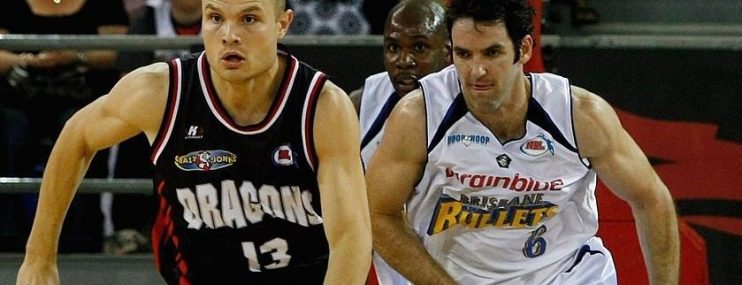
Dejan Vasiljevic
February 8, 2021


 Perth Wildcats—
 Sydney Kings4 seasons
 Cairns Taipans2 seasons
 West Sydney Razorbacks3 seasons
 Hunter Pirates1 season
 Wollongong Hawks1 season
NICKNAME/S: Yeah Yeah Trahair
BIO: Aaron Trahair was born in Bendigo (VIC) and began playing basketball as a junior with the Bendigo basketball program. Trahair received a scholarship to attend the Australian Institute of Sport (Canberra) in 1992. He spent two years there and played for the program’s state league team (1992, 1993).
Aaron Trahair made his NBL debut with the Perth Wildcats at 18 years of age. He scored two points in his first game.
Aaron Trahair began his NBL career with the Perth Wildcats in 1994, joining a team that had retained almost its entire roster from the previous season, with the only departure being the retiring Steve Davis. Looking to build for the future, the Wildcats added two promising rookies—AIS graduate Aaron Trahair and CJ Bruton, son of club legend Cal Bruton.
Under head coach Adrian Hurley and team captain Andrew Vlahov, Perth started the season strong, winning its first three games. After five rounds, the Wildcats sat atop the NBL ladder with a 7–2 record. However, inconsistency plagued the team throughout the middle of the season, as losses to Brisbane (127–126), Hobart (93–92), and South East Melbourne (112–94) saw them drop to a 10–5 record. While many expected the Wildcats to bounce back from their Grand Final loss the previous season and contend for a championship, they struggled to find the same level of dominance. The team showed flashes of brilliance, including a dominant 131–108 win over Melbourne in Round 18, but followed it up with a surprising home loss to Newcastle (83–92).
Scott Fisher (20.5 points, 9.5 rebounds, and 3.2 assists) led the team in scoring for the second consecutive year, while Ricky Grace (18.7 points, 3.9 rebounds, and 6.2 assists), James Crawford (18.1 points, 8.7 rebounds, and 1.6 assists), and Andrew Vlahov (17.5 points, 9.8 rebounds, and 4.7 assists) all had strong seasons. Fisher delivered several standout performances, including a 31-point, 14-rebound, and 6-assist effort in a last-second loss to Brisbane and a 36-point, 16-rebound game against Geelong. Grace also had an incredible stretch in August, posting 40 points, 6 rebounds, and 7 assists in a win over Brisbane before following it up with 24 points and a season-high 15 assists against Melbourne.
While the veterans carried the bulk of the workload, rookies Trahair (5.4 points, 3.4 rebounds, and 2.0 assists) and Bruton (4.9 points, 1.5 rebounds, and 1.5 assists) showed promising signs. Bruton made a spectacular entrance into the league, nailing a half-court buzzer-beater on his first shot in the NBL, but ultimately decided to pursue college basketball in the United States after the season, citing limited playing opportunities behind Grace.
Perth finished the regular season with a 16–10 record, securing the sixth seed in the playoffs based on a 2–0 head-to-head advantage over Sydney. In the quarterfinals, they faced South East Melbourne, who outclassed them in Game 1, winning 113–82. With the series shifting to Melbourne, the Magic sealed the series with a 100–86 victory, eliminating the Wildcats in the first round.
The following year, Trahair was a member of the Australian under 19’s team that won silver at the Junior World Championships, and won his only NBL championship with the Wildcats. In doing so, he was a member of the Wildcat’s squad that travelled to the McDonald’s Championship in London that competed against the NBA’s Houston Rockets and Spain’s Real Madrid.
When the Sydney Kings lost guard Shane Heal to the Minnesota Timberwolves In 1997, the signed Trahair as a replacement. The Kings had high hopes when they signed Aaron Trahair at the beginning of the season, with Trahair was expected to step up and take the reigns of the Kings. Trahair faced a certain degree of difficulty in doing this, up until that time his NBL career had consisted of playing most of his time at shooting guard alongside Ricky Grace at Perth. Stepping into a role as the starting point guard included its challenges and Trahair saw his production decline from 13.4 points (41% from the field) and 3.8 assists with the Wildcats to 11.4 points (36% from the field) and 3.2 assists at the Kings.
Mid-season Trahair was moved to the off-guard role and the Kings allowed Isaac Burton to play point-guard. In his first outing in his new position, Trahair played a nice all around game, scoring 11 points and also contributing 6 assists, 4 rebounds, and 3 steals. He scored in double figures in his next seven outings, and actually improved his assists average even though he wasn’t running the point. Aaron played his best game of the season in a 88-89 loss to the South East Melbourne on 21st June, scoring a team-high 19 points on 7-11 shooting to go along with 7 rebounds, and 4 assists. Trahair suffered a season ending foot injury after the All-Star break, missing the final 6 games of the season.
Prior to the commencement of the 2007/08 season, the unsigned Trahair trained and appeared in several pre-season matches with the Wildcats while in Perth visiting family. Despite early reports that the Wildcats would not sign Trahair (as they held out for the possibility that American forward Shawn Redhage would become a Australian citizen), the guard was officially signed up shortly before the first match of the season against his previous club, the Singapore Slingers. However, after appearing in just eight games with limited minutes for the Wildcats, Trahair was released by the club in December 2007 to allow him to sign with the Wollongong Hawks for the remainder of the season.
SYDNEY KINGS
1997
After finishing fifth with a 16-10 record before being eliminated by Canberra in the 1996 quarterfinals, Sydney entered Alan Black’s second season needing to replace captain Shane Heal (to Minnesota), while Neil Turner also departed and Dean Uthoff retired. Isaac Burton, Melvin Thomas, Bruce Bolden, Stephen Whitehead, Justin Withers, Brad Williams, Brad Rosen and Danny Williams returned from the previous season’s group, while Black signed Aaron Trahair (via Perth) as Heal’s replacement and added Cameron Dickinson (via Townsville) and rookie Ben Knight, with Matthew Nielsen (via AIS) returning to the club after spending 1996 in Canberra. Bolden was named captain in Heal’s absence. With Hobart, Geelong and Gold Coast exiting the NBL following 1996 and their talent redistributed across the remaining clubs, Sydney entered a reduced 11-team competition without the scoring and playmaking Heal had provided.
Sydney opened the season against North Melbourne at the Melbourne Sports & Entertainment Centre on April 11, where Trahair (9 points, 3 rebounds, and 6 assists) made three three-pointers, but the Giants defeated the Kings 85-81. Burton (19 points, 6 rebounds, 3 assists, 3 steals, and 1 block) and Thomas (11 points, 18 rebounds, 2 assists, and 4 steals) provided support, while Pat Reidy (24 points) led North Melbourne. The loss began a difficult opening stretch in which Sydney dropped three of its first four games.
Trahair (11.4 points, 3.7 rebounds, 3.2 assists, and 1.5 steals across 22 games) was initially asked to become Sydney’s starting point guard after spending most of his Perth career playing off the ball alongside Ricky Grace. The transition proved difficult and his field-goal percentage fell from 41 percent with Perth the previous season to 36 percent with Sydney. Black eventually shifted Trahair back to the off-guard role and gave Burton greater responsibility running the offence, with the move sparking a stretch of eight consecutive double-figure scoring appearances for Trahair while his playmaking remained productive.
Trahair’s highest-scoring game came against eventual champion Melbourne at Melbourne Park on June 13, where Trahair (21 points, 7 rebounds, 2 assists, and 1 steal) made three three-pointers and all four of his free throws as Sydney defeated the Tigers 106-96. Thomas (22 points, 13 rebounds, 3 assists, and 1 steal) and Burton (17 points, 7 rebounds, 8 assists, 3 steals, and 1 block) also produced major games, overcoming Andrew Gaze (35 points, 4 rebounds, 7 assists, and 1 steal) to give the Kings an important win.
Trahair’s best game came against South East Melbourne at the Sydney Entertainment Centre on June 21, where Trahair (19 points, 7 rebounds, 4 assists, and 3 steals) made 7-of-11 shots, including three of five three-pointers. Dickinson (16 points, 2 rebounds, and 1 steal) and Burton (15 points, 3 rebounds, 6 assists, and 3 steals) provided support, but Chris Anstey (24 points, 14 rebounds, 1 steal, and 1 block) led the Magic to an 89-88 victory.
During the mid-season break, Trahair represented Australia at the 1997 FIBA Under-22 World Championship, averaging 12.9 points and 3.8 assists as Australia won the gold medal. He scored 18 points in the final against Puerto Rico before returning to the Kings, but a foot injury subsequently ended his NBL season and ruled him out of Sydney’s final eight games.
Burton (20.8 points, 5.7 rebounds, 5.1 assists, and 3 steals across 30 games) led Sydney in scoring and steals while taking on greater responsibility as the primary playmaker, while Thomas (18.9 points, 10.7 rebounds, and 1.6 steals across 30 games) led the Kings in rebounding. Whitehead (12.5 points and 4.8 rebounds across 30 games) developed into Sydney’s third-leading scorer, captain Bolden (11.6 points and 7.2 rebounds across 25 games) remained an experienced frontcourt presence and Dickinson (10.8 points across 30 games) supplied additional perimeter scoring. Nielsen (9.9 points and 4.9 rebounds across 29 games) established himself in the rotation and was named NBL Rookie of the Year, while Rosen (5.1 points across 26 games) was moved into the starting lineup during August after Trahair’s injury increased his role in the backcourt.
Trahair remained sidelined with the foot injury as Sydney closed the season against Canberra at the AIS Arena on September 27, where Burton (31 points, 4 rebounds, 4 assists, and 4 steals) and Thomas (25 points, 10 rebounds, 2 assists, and 2 blocks) led the Kings, but Robert Rose (37 points, 12 rebounds, and 2 assists) carried the Cannons to a 98-95 victory. The loss completed a three-game losing streak and left Sydney tenth with a 12-18 record, outside the playoffs.
1998
After finishing tenth with a 12-18 record in 1997, Sydney entered 1998 with Aaron Trahair no longer required to carry the same point-guard responsibility he had during his first season with the Kings. Trahair had been signed as Shane Heal’s replacement after Heal joined Minnesota and spent much of 1997 adjusting from the shooting-guard role he had played alongside Ricky Grace in Perth to running Sydney’s offence. A foot injury ended his first Kings season early, before Heal returned from the NBA for 1998 and gave Sydney greater flexibility with Trahair across both guard positions.
Bill Tomlinson replaced Alan Black as head coach, while Isaac Burton (to Newcastle), Melvin Thomas (to Canberra), Cameron Dickinson (to Wollongong) and Ben Knight (to South East Melbourne) departed. Captain Bruce Bolden, Matthew Nielsen, Stephen Whitehead, Brad Rosen and Brad Williams returned alongside Trahair, with Heal (via Minnesota), Scott McGregor (via Newcastle), Matt Nover and 19-year-old Stephen Jackson among the major additions. Jackson had been selected by Phoenix in the second round of the 1997 NBA Draft and became the youngest import signing in NBL history when he began his professional career with Sydney.
The Kings opened at the AIS Arena on February 1, where Trahair (35 points, 4 rebounds, 3 assists, and 1 steal) made 13-of-15 field goals and 8-of-10 three-pointers as Sydney defeated Canberra 123-96. McGregor (24 points) and Heal (22 points, 7 rebounds, and 16 assists) provided the other major contributions, while Mike McKay (25 points) led the Cannons. Jackson went scoreless in his NBL debut, becoming the first import in league history to fail to score in his first game.
Trahair (13.1 points, 3.5 rebounds, and 3 assists across 27 games) settled back into a more natural combination-guard role and improved his efficiency from his first season in Sydney, lifting his field-goal percentage from 36 to 42 percent and his three-point shooting from 32 to 37 percent. The Kings won their opening three games against Canberra, Newcastle and Melbourne, but were unable to turn the early momentum into a sustained run.
Four games into his NBL career, Jackson suffered a broken foot while attempting to block Kevin Brooks and was ruled out for the remainder of the season. Nover also struggled to establish himself, leaving Sydney searching for combinations around its Australian core as the promising start quickly unravelled.
Trahair delivered his best and highest-scoring performance of the season against Wollongong at the Sydney Entertainment Centre on March 7. Trahair (40 points) made 13-of-16 shots in a spectacular individual performance, but the Hawks defeated Sydney 108-99.
Nover was released soon afterwards, with former King Dave Simmons and former Sacramento forward Evers Burns brought in to strengthen the frontcourt. Simmons (6.5 points and 6.3 rebounds across 6 games) lasted six appearances before Sydney released him and signed former North Carolina State guard Kelsey Weems. The addition of another ball-handler gave Tomlinson greater freedom to use Heal and Trahair for extended stretches at shooting guard. Sydney’s import turnover eventually included Kenny Payne, who never appeared in a game, Bryan Caver (2 games), Jackson (4 games), Nover (7 games), Simmons (6 games), Burns (22 games) and Weems (12 games).
Heal (20.9 points, 3.7 rebounds, and 6.7 assists across 29 games) led Sydney in scoring, while Nielsen (16.4 points, 8.3 rebounds, and 1.3 steals across 28 games) continued his rapid development after averaging 9.9 points and 4.9 rebounds the previous season. Weems (20 points, 4.9 rebounds, 5.1 assists, and 1.5 steals across 12 games) supplied significant production after arriving, while Burns (16.5 points and 9.4 rebounds across 22 games), Bolden (10.6 points and 5.3 rebounds across 30 games) and McGregor (9.4 points and 5.3 rebounds across 30 games) provided further support. The continual roster changes contributed to Sydney losing 10 of 12 games after its 3-0 opening, while difficulties containing opposition guards remained a problem during the second half of the season.
Sydney completed its season in Townsville on June 9, where Trahair (5 points, 3 rebounds, 2 assists, and 1 steal) helped the Kings produce their highest score of the year. Nielsen (38 points, 15 rebounds, and 5 assists) and Bolden (29 points and 8 rebounds) led Sydney, while Simon Kerle (29 points) was Townsville’s leading scorer. The Kings won 140-131 for their second consecutive victory, finishing eighth with a 13-17 record and missing the playoffs.
1998/99
After finishing eighth with a 13-17 record and missing the playoffs in 1998, Sydney entered the 1998/99 season facing another major roster overhaul as the NBL shifted from a winter to a summer competition. Shane Heal departed to play for Near East in Greece, longtime captain Bruce Bolden joined the expansion West Sydney Razorbacks, and Brad Williams and Stephen Whitehead were not re-signed. Head coach Bill Tomlinson chose to rebuild around young Australian talent, particularly Aaron Trahair and Matthew Nielsen, who returned alongside Scott McGregor and Kelsey Weems.
The Kings added Ben Castle (via Brisbane) and Darren Smith (via state league), while Weems, who had joined Sydney for the final 12 games of the previous season, was re-signed and paired with incoming import Alonzo Goldston. With Bolden gone, veteran guard Brad Rosen was named captain, leaving Trahair with greater responsibility in a backcourt that no longer had Heal’s scoring and playmaking.
Sydney opened the season against West Sydney at the Sydney Entertainment Centre on October 10, with the Razorbacks playing their first NBL game. Trahair (18 points, 5 rebounds, 2 assists, and 1 block) made four three-pointers, while Nielsen (23 points, 7 rebounds, 2 assists, and 3 blocks) led the Kings in scoring and Goldston (16 points and 11 rebounds) added a double-double. However, John Rillie (23 points) led the Razorbacks to a 103-97 victory, beginning a difficult opening stretch for Sydney.
Trahair (15.7 points, 5.9 rebounds, and 1.3 steals across 26 games) became one of Sydney’s most dependable players, appearing in every regular-season game while providing scoring, rebounding and playmaking across both guard positions. After averaging 13.1 points and 3.5 rebounds the previous season, he increased his production despite the Kings struggling to establish a consistent backcourt combination. Nielsen (20.4 points, 9.2 rebounds, and 1.3 blocks across 19 games) also took another significant step forward, lifting his scoring average from 16.4 points in 1998 and establishing himself as one of the team’s primary offensive options.
Trahair delivered one of Sydney’s strongest early performances against his former club Perth at the Perth Entertainment Centre on October 16, finishing with 21 points, 6 rebounds, 3 assists, 1 steal, and 1 block. Goldston (18 points, 14 rebounds, 3 assists, and 2 steals) controlled the boards, while Nielsen (12 points, 12 rebounds, and 3 blocks) added another double-double. Despite Paul Rogers (23 points) leading the Wildcats, Sydney secured a 75-70 victory for its first win of the season. The result proved to be a rare bright spot as the Kings lost seven of their opening eight games.
Goldston (14.2 points, 10.2 rebounds, 1.8 steals, and 1.5 blocks across 6 games) provided strong individual production but faced criticism over his off-court focus, including his interest in Sydney’s nightlife. His final appearance came against Melbourne at the Sydney Entertainment Centre on November 14, where Trahair (25 points, 6 rebounds, 4 assists, and 4 steals) made five three-pointers and Nielsen (25 points, 5 rebounds, 4 assists, 3 steals, and 2 blocks) matched him as Sydney’s leading scorer. Goldston (19 points and 13 rebounds) added another double-double, but Andrew Gaze (41 points) led the Tigers to a 107-102 victory.
Following Goldston’s release, Sydney signed former NBA centre Acie Earl (21.6 points, 12.5 rebounds, 1.4 steals, and 2.9 blocks across 20 games) to strengthen its frontcourt. Earl had previously played for Boston, Toronto and Milwaukee, and had scored a career-high 40 points against his former Celtics teammates while playing for the Raptors in April 1996. Although questions about his work ethic followed him to Sydney, his arrival gave the Kings a much stronger presence around the basket and another proven scoring option alongside Trahair and Nielsen.
Earl made his Kings debut against Melbourne at Melbourne Park on November 27, producing 25 points, 11 rebounds, and 2 steals. Trahair (24 points, 7 rebounds, and 7 assists) played a major role in Sydney’s offence, while Nielsen (16 points, 9 rebounds, and 6 assists) provided further support. However, Gaze (40 points) again proved too difficult to contain as Melbourne defeated Sydney 102-97. The loss highlighted the Kings’ continuing defensive problems despite the increased offensive production following Earl’s arrival.
Sydney began finding some consistency in December, including a 93-72 victory over Wollongong at the Sydney Entertainment Centre on December 5. Trahair (9 points, 17 rebounds, 5 assists, and 1 steal) produced his best rebounding game of the season, helping the Kings dominate the boards despite struggling with his shooting. Nielsen (29 points and 13 rebounds) led Sydney in scoring, while Earl (13 points, 11 rebounds, and 4 blocks) provided another strong defensive presence inside.
Trahair followed with 26 points, 6 rebounds, 4 assists, and 2 steals against Wollongong at the WIN Entertainment Centre on December 11, making six three-pointers as Sydney defeated the Hawks 108-97. Earl (27 points, 15 rebounds, and 5 blocks) controlled the interior, while Nielsen (21 points and 9 rebounds) provided another major contribution. The win gave Sydney consecutive victories for the first time that season.
The following evening, Sydney travelled to Brisbane and produced one of its most impressive results, defeating the Bullets 103-95 after overtime. Trahair (21 points, 6 rebounds, 1 assist, and 3 steals) played all 53 minutes, while Earl (33 points, 12 rebounds, 2 assists, and 1 block) made 12-of-19 field goals in just his fifth game with the Kings. Weems (22 points, 9 rebounds, and 5 assists) added valuable support, and Earl helped hold Brisbane big man Thaddeus Delaney to 4-of-14 shooting. Despite Steve Woodberry (38 points, 10 rebounds, 5 assists, and 3 steals) producing a dominant performance for the Bullets, Sydney secured its third consecutive win.
Trahair’s highest-scoring performance came against Canberra at the AIS Arena on January 2, where he finished with 30 points, 6 rebounds, 1 assist, and 3 steals. He connected on five three-pointers and made all five of his free throws, while Earl (25 points, 13 rebounds, and 3 blocks) and Nielsen (15 points and 7 rebounds) provided support. However, former Kings import Melvin Thomas (28 points, 18 rebounds, 4 assists, and 3 steals) dominated for Canberra as the Cannons defeated Sydney 113-90.
Nielsen delivered his highest-scoring performance of the season against Brisbane at the Sydney Entertainment Centre on January 23, finishing with 35 points, 10 rebounds, and 1 block. Earl (26 points, 10 rebounds, 4 assists, and 4 blocks) also produced a major game inside, but Trahair (8 points, 6 rebounds, and 3 assists) struggled offensively as Brisbane defeated Sydney 109-98. The result was another setback for a Kings team that continued to produce strong individual performances without being able to turn them into consistent victories.
One of Sydney’s best offensive performances came against Newcastle at the Newcastle Entertainment Centre on February 12, where Trahair (28 points and 4 rebounds) made three three-pointers and scored efficiently on 10-of-19 shooting. Weems (32 points, 3 rebounds, 5 assists, and 5 steals) delivered his finest performance of the season, while Earl (20 points, 13 rebounds, and 2 blocks) added another double-double. Pat Reidy (21 points) led the Falcons, but Sydney came away with a 109-100 victory.
Trahair produced his strongest overall statistical performance of the season against Townsville at the Sydney Entertainment Centre on March 6, recording 27 points, 8 rebounds, 4 assists, and 1 block. He made six of his nine three-point attempts, while Weems (30 points, 3 rebounds, 5 assists, and 2 steals) added another outstanding scoring performance and McGregor (19 points, 5 rebounds, and 5 assists) provided support. Sydney defeated the Crocodiles 119-101, with Trahair’s combination of scoring efficiency, rebounding and playmaking helping the Kings secure one of their most convincing victories of the season.
Despite their struggles, Sydney received strong contributions from several members of its roster. Weems (15.2 points, 3.7 rebounds, and 3.8 assists across 26 games) remained one of the team’s leading perimeter scorers, although his overall impact was less consistent than during his late-season run the previous year. McGregor (12.7 points and 6.4 rebounds across 26 games) provided reliable frontcourt support, while Smith (6.1 points and 3 rebounds across 25 games), Castle (4.6 points across 16 games), and captain Rosen (3.6 points across 25 games) helped fill out the rotation. Earl’s dominance at both ends earned him All-NBL Third Team honours, but the Kings were unable to overcome their poor start, finishing with a 5-8 home record and a 4-9 road record. Sydney ended the regular season ninth with a 9-17 record, missing the playoffs for the third consecutive season.
Sydney closed its season against West Sydney at the Sydney Entertainment Centre on March 12, where Trahair (19 points, 3 rebounds, and 2 assists) helped the Kings secure a 98-91 victory over their cross-town rivals. Earl (26 points, 12 rebounds, 5 assists, and 3 blocks) led the Kings, while Rosen (16 points, 3 rebounds, 3 assists, and 2 steals) produced his highest-scoring game of the season. Derek Rucker (29 points and 9 assists) led the Razorbacks, but Sydney finished its campaign with consecutive victories, completing a disappointing 9-17 season outside the playoffs.
1999/00
After finishing ninth with a 9-17 record in 1998/99, Sydney entered the 1999/00 season looking to end a three-year playoff drought. The Kings replaced Bill Tomlinson with Brett Brown, their fourth head coach in six seasons, and continued rebuilding around their promising Australian core. Kelsey Weems, Alonzo Goldston, Brad Rosen and Craig McAndrew departed, while Aaron Trahair, Matthew Nielsen, Scott McGregor, Darren Smith, Ben Castle and Acie Earl returned. Brown added Ben Melmeth (via Newcastle), Derek Moore (via South Carolina Aiken) and reigning NBL Most Valuable Player Steve Woodberry (via Brisbane), creating an impressive roster on paper. With the team moving into the Sydney SuperDome ahead of the 2000 Olympic Games, expectations were high that the Kings could finally return to the playoffs.
Sydney opened the season against Canberra at the Sydney SuperDome on October 2, where Trahair (19 points, 2 rebounds, 5 assists, 1 steal, and 2 blocks) helped the Kings secure a convincing 98-76 victory. Melmeth (22 points, 15 rebounds, and 2 blocks) dominated the interior, while McGregor (14 points and 6 rebounds) provided support. Randy Rutherford (28 points, 6 rebounds, 6 assists, and 2 steals) led Canberra, but Sydney controlled the contest to begin Brown’s coaching tenure with a win.
Trahair (15.2 points, 4.6 rebounds, and 4.4 assists across 28 games) remained one of Sydney’s most dependable players, appearing in every regular-season game and averaging 40.8 minutes per contest. After operating primarily as a secondary scorer the previous season, his responsibilities shifted towards organising the offence, increasing his assists average from 2.9 to 4.4 per game while continuing to provide perimeter scoring and versatility across both guard positions.
Despite the promising start, Sydney’s roster began changing almost immediately. Earl (8 points, 6 rebounds, 3 assists, and 5 blocks across 1 game) had dominated the previous season but returned short of the conditioning and form expected of him. He was released after the opener, with Sydney moving quickly to sign Kevin Brooks (16.8 points and 6.2 rebounds across 27 games), who had helped Adelaide win consecutive NBL championships. Brooks’s arrival came under unusual circumstances after the 36ers attempted to retain him, only for the league to refuse to approve his proposed contract due to salary-cap concerns following Adelaide’s signing of Paul Maley. With Brooks suddenly without a team, Sydney secured the experienced forward to strengthen its frontcourt.
Brooks made his Kings debut against expansion club Cairns at the Cairns Convention Centre on October 12, finishing with 16 points and 7 rebounds as Sydney defeated the Taipans 104-78. Trahair (15 points, 3 rebounds, 5 assists, and 1 block) controlled the backcourt alongside Nielsen (21 points, 5 rebounds, and 2 assists), while Ricky Robinson (25 points, 7 rebounds, and 3 assists) led Cairns. The victory gave Sydney a 2-0 start, but the Kings then lost their next three games as the difficulties surrounding their newly assembled roster became apparent.
Woodberry (7.8 points, 3.8 rebounds, 3.8 assists, and 1.5 steals across 4 games) was another high-profile addition who failed to establish himself in Sydney. The reigning MVP suffered a leg injury and was unable to reproduce the form that had made him one of the league’s premier guards with Brisbane. His final appearance came against Wollongong at the WIN Entertainment Centre on October 17, where Trahair (17 points, 3 rebounds, and 4 assists) and Nielsen (20 points, 3 rebounds, 3 steals, and 2 blocks) led Sydney, while Woodberry (4 points, 6 rebounds, and 5 assists) struggled offensively. CJ Bruton (26 points, 4 rebounds, 4 assists, and 3 steals) led Wollongong to a convincing 99-77 victory. Woodberry was subsequently released after just four appearances, leaving Brown searching for another import guard.
One of Trahair’s strongest all-around performances came against Melbourne at Melbourne Park on October 29, where he finished with 22 points, 4 rebounds, 13 assists, and 6 steals as Sydney defeated the Tigers 103-91. Trahair made four three-pointers and controlled the game from the backcourt, while Brooks (22 points and 3 rebounds) and McGregor (22 points and 6 rebounds) provided the scoring support. The victory ended Sydney’s three-game losing streak, with Trahair receiving the maximum three votes in the game’s MVP voting, reflecting his influence at both ends of the floor.
Sydney replaced Woodberry with Drew Barry (7.6 points, 4 rebounds, and 6.3 assists across 8 games), the son of NBA legend Rick Barry, who arrived with previous NBA experience. Barry provided additional passing and ball-handling, allowing Trahair to spend more time operating away from the ball, but struggled to deliver the offensive production expected from an import guard. The Kings continued searching for the right backcourt combination despite having several talented young Australians established in the rotation.
Trahair delivered one of the finest performances of his career against Townsville at the Townsville Entertainment Centre on November 12, recording 21 points, 11 rebounds, 10 assists, and 1 steal as Sydney defeated the Crocodiles 115-101. Nielsen (26 points, 8 rebounds, and 4 assists) led the Kings in scoring, while Brooks (16 points and 5 rebounds) provided additional support. Sam MacKinnon (28 points, 7 rebounds, and 2 steals) led Townsville, but Trahair’s ability to control the game through his scoring, rebounding and passing proved decisive. The performance was the third triple-double in Sydney Kings history, following two recorded by Dwayne McClain during the 1993 season, and marked Trahair’s only NBL triple-double.
Sydney continued to struggle with consistency despite its improving offensive production. One of the team’s strongest results came against Wollongong on December 17, where Trahair (15 points, 4 rebounds, and 5 assists) helped the Kings defeat the Hawks 120-97 at the WIN Entertainment Centre. Nielsen (33 points, 3 rebounds, and 2 blocks) produced his highest-scoring game of the season, while Brooks (32 points, 5 rebounds, and 2 assists) delivered another outstanding shooting performance. Bruton (31 points, 3 rebounds, and 5 assists) and Melvin Thomas (24 points, 8 rebounds, 5 assists, and 3 steals) led Wollongong, but Sydney’s balanced offence proved too strong.
The following evening Sydney suffered a major setback against Perth at the Sydney SuperDome, with Trahair (9 points, 5 rebounds, 9 assists, and 1 steal) struggling to find his shooting touch as the Wildcats delivered a 115-84 defeat. Moore (18 points, 9 rebounds, and 1 block) and Smith (17 points) were Sydney’s leading scorers, while Paul Rogers (23 points, 12 rebounds, and 1 block) and Andrew Vlahov (19 points, 9 rebounds, and 4 assists) controlled the interior for Perth. The 31-point defeat highlighted the Kings’ defensive problems and inability to consistently compete with the league’s leading teams.
Barry was also released during December after failing to meet expectations, with Sydney turning to Kendrick Johnson (21.6 points, 5.2 rebounds, and 4.5 assists across 12 games) as its third import guard of the season. The American immediately provided the aggressive scoring option Brown had been seeking, giving the Kings another perimeter threat alongside Trahair. By this point Sydney had already been forced to overhaul much of the import combination it had assembled during the offseason, with the repeated changes making it difficult to establish continuity.
Johnson made an immediate impact in his Sydney debut against cross-town rivals West Sydney at the Whitlam Centre on December 30, exploding for 31 points, 7 rebounds, and 9 assists as the Kings recorded a dominant 123-87 victory. Trahair (18 points, 3 rebounds, 1 assist, and 1 steal) added four three-pointers, while Brooks (26 points and 9 rebounds) delivered another strong performance. Cheikh Ya Ya Dia (25 points, 17 rebounds, and 4 blocks) led the Razorbacks, but Sydney’s new-look backcourt overwhelmed its local rivals and produced the club’s largest winning margin of the season.
Trahair’s highest-scoring performance came against Canberra at the AIS Arena on January 8, where he made 11-of-14 field goals, including four three-pointers, and all six free throws to finish with 32 points, 7 rebounds, 4 assists, and 2 steals. Johnson (19 points, 3 rebounds, and 6 assists) and Nielsen (18 points, 4 rebounds, 4 assists, and 2 blocks) provided support, while Troy Pilon (18 points, 7 assists, and 3 steals) and Clayton Ritter (18 points and 8 rebounds) were Canberra’s leading performers. Despite Trahair’s outstanding shooting performance, the Cannons held on for a 108-105 victory, denying Sydney an important road win.
The Kings’ defensive problems remained evident against Victoria at the Sydney SuperDome on January 22, where Trahair (11 points, 4 rebounds, and 3 assists) was unable to prevent a heavy 106-75 defeat. Brooks (20 points and 3 rebounds) and Nielsen (14 points and 10 rebounds) led Sydney, while Brett Wheeler (20 points and 8 rebounds) and Jason Smith (19 points and 7 rebounds) were Victoria’s leading performers. The result matched Sydney’s 31-point loss to Perth as its heaviest defeat of the season and further damaged the Kings’ hopes of reaching the playoffs.
Nielsen (16.7 points and 6.7 rebounds across 28 games) continued developing into one of the league’s most promising young forwards, taking on the captaincy and becoming Sydney’s main frontcourt scoring option alongside Brooks. His improvement was recognised with the Kings’ team MVP award at season’s end, despite the team’s disappointing results. McGregor (10.3 points and 5 rebounds across 27 games) provided scoring and rebounding at both forward positions, while Melmeth (11.5 points and 8.7 rebounds across 13 games) had delivered strong interior production during the opening months before his appearances became limited. Moore (9.2 points, 5.1 rebounds, and 1.6 blocks across 28 games) emerged as one of Sydney’s most consistent defensive contributors and was named NBL Rookie of the Year. Smith (5.8 points across 26 games) and Castle (2.9 points across 24 games) provided further Australian depth, but the repeated roster changes prevented the talented group from establishing the consistency needed to challenge the league’s leading teams.
Despite improving its win total from the previous season, Sydney struggled through the final weeks, losing consecutive games to Melbourne, Canberra and Wollongong before its last regular-season appearance. The Kings had shown flashes of their potential through Trahair’s triple-double, Nielsen’s continued development and the scoring provided by Brooks and Johnson, but defensive inconsistency and repeated import changes prevented the team from building sustained momentum.
Sydney completed the season against Victoria at the Sydney SuperDome on March 11, where Trahair (12 points, 4 rebounds, 6 assists, and 2 steals) continued to organise the offence despite another difficult shooting performance. Moore (20 points, 13 rebounds, 2 assists, 4 steals, and 2 blocks) delivered one of his strongest games of the season, while Johnson (19 points, 5 rebounds, and 4 assists) provided additional scoring. Frank Drmic (18 points, 7 rebounds, and 2 assists) led Victoria, which defeated Sydney 87-80 and handed the Kings their fourth consecutive loss. The defeat completed an 11-17 regular season, leaving Sydney ninth and outside the playoffs for a fourth consecutive year.
2003/04
The West Sydney Razorbacks entered the 2003/04 season with a bold new approach, opting not to re-sign import Willie Farley and veteran foundation duo Derek Rucker and Bruce Bolden. In doing so, they made history by becoming the first team in the modern NBL era to field an all-Australian roster. With John Rillie returning after spending half of the previous season in Greece and Sam MacKinnon back from injury, the Razorbacks finally had stability and a clear opportunity to build chemistry and push for a championship.
West Sydney opened the season in dominant fashion, securing a 119-103 victory over Hunter, with Simon Dwight (26 points, 9 rebounds, and 7 assists) and Sam MacKinnon (24 points, 9 rebounds, and 8 assists) both flirting with triple-doubles. Aaron Trahair made an early impact as well, showcasing his ability to contribute as a scorer and playmaker in the backcourt.
The Razorbacks started 3-1 before running into a tough three-game losing streak, including a loss to Sydney (83-97), where Kings star Matt Nielsen dominated with 29 points and 8 rebounds. They also fell to Wollongong (81-90) and Victoria (101-106), dropping to 3-4 and needing to turn things around quickly.
With their season at a crossroads, West Sydney responded with a dominant 10-game winning streak. This stretch included statement victories over Sydney (97-87), Wollongong (109-105), and Victoria (107-95), propelling them back into the upper tier of the standings. During this run, Trahair proved to be an invaluable member of the starting lineup, consistently providing secondary scoring and distributing the ball effectively alongside Rillie. He averaged 13.6 points, 3.8 rebounds, and 2.6 assists over the course of the season, providing a steady presence in the backcourt.
John Rillie (20.0 points, 7.5 rebounds, and 5.1 assists) led the team in scoring, while MacKinnon (17.3 points, 9.5 rebounds, 5.2 assists, 1.6 steals, and 1.4 blocks) and Dwight (15.0 points, 9.1 rebounds, 4.0 assists, and 3.7 blocks) continued to anchor both ends of the floor. Trahair and Scott McGregor (13.0 points, 6.3 rebounds, and 3.1 assists) rounded out the starting five, with Russell Hinder (9.7 points, 5.9 rebounds, and 1.4 assists) and rookie Steven Markovic (8.8 points, 2.2 rebounds, and 2.3 assists) playing key roles off the bench.
A setback came in February when McGregor sustained a season-ending injury in a 110-99 loss to Wollongong. Hinder moved into the starting lineup, while Markovic saw increased minutes. Despite this adversity, the Razorbacks finished the regular season strong, closing with a 22-11 record, securing third place and setting club records for most wins in a season, most home wins, and most road victories.
West Sydney carried this momentum into the playoffs, overpowering Cairns 110-88 in the elimination final. Trahair was instrumental, leading the team with 31 points and 4 assists, while MacKinnon (28 points, 4 rebounds, 5 assists, 3 steals, and 2 blocks) and Dwight (11 points, 12 rebounds, 9 assists, and 6 blocks) controlled the interior.
The Razorbacks then swept Wollongong in the semifinals, winning Game 1 by 16 points (107-91), with Rillie (25 points, 8 rebounds, and 6 assists) leading the way, supported by Dwight (22 points, 10 rebounds, 2 steals, and 2 blocks) and MacKinnon (12 points, 14 rebounds, and 6 assists). In Game 2, Rillie delivered a spectacular performance, exploding for 45 points, 9 rebounds, and 4 steals while shooting 17-of-26 from the field, sealing a 110-95 victory and a trip to the NBL Grand Final.
For the first time in league history, the Grand Final was a best-of-five series, with West Sydney facing minor premiers Sydney (26-7), led by league MVP Matt Nielsen.
Game 1 saw the Kings take control with a 96-76 victory behind CJ Bruton’s sharpshooting (35 points, 5 rebounds, and 6 assists on 9-of-16 shooting). Dwight (23 points, 12 rebounds, 6 assists, and 2 blocks) led the Razorbacks in scoring.
West Sydney responded in Game 2 with a dominant 87-72 victory, leveling the series. Trahair played a key role, scoring 17 points and helping facilitate the offense, while Rillie (18 points) also made key contributions.
Game 3 was an overtime thriller, with the Razorbacks edging out an 82-80 win to take a 2-1 series lead. Dwight (17 points, 6 rebounds, 4 assists, and 3 blocks) continued to make his presence felt inside, while Trahair’s composure and timely scoring helped West Sydney stay ahead in the extra period.
With a chance to close out the series in Game 4, Rillie erupted for 31 points, but the Kings secured an 82-77 victory, setting up the first-ever Game 5 in NBL Grand Final history.
Before a packed crowd of 9,609 at the Sydney Entertainment Centre, the Razorbacks fought valiantly but ultimately fell short, losing 90-79. Sydney’s defense tightened up on Rillie, holding him to 12 points and 10 rebounds, while Trahair (20 points) and Dwight (18 points, 12 rebounds, and 5 assists) put in strong performances. However, an explosive fourth-quarter effort from Ebi Ere (25 points) proved to be the difference, while Brett Wheeler (18 points, 11 rebounds) and Matt Nielsen (14 points, 12 rebounds) dominated the interior. Nielsen was named Grand Final MVP, capping off his stellar season.
Despite falling just short of the championship, the 2003/04 season was one of the Razorbacks’ finest. John Rillie and Sam MacKinnon were named to the All-NBL First Team, while Steven Markovic earned NBL Rookie of the Year honours. Trahair’s strong postseason performances further cemented his importance to the team, as he proved to be a reliable offensive weapon throughout the playoffs. Although West Sydney fell just shy of the ultimate prize, their all-Australian roster had firmly established itself as one of the premier teams in the league.
2004/05
After making a run to the 2004 NBL Grand Final, the West Sydney Razorbacks underwent a significant transformation in the offseason. Longtime head coach Gordie McLeod was let go after six seasons, with assistant Mark Watkins stepping into the head coaching role, backed by player endorsement. At the same time, financial instability plagued the club’s ownership group, the Canterbury-Bankstown Bulldogs, who were fined $500,000 and stripped of all 37 NRL premiership points due to serious breaches of the NRL salary cap. This financial strain heavily influenced the Razorbacks’ ability to retain talent.
The team saw the departure of several key players, most notably John Rillie (to Townsville), while key role players Russell Hinder (to Hunter) and David Pennisi (to Europe) also left, and Brad Williams retired. These exits left significant gaps in the rotation, requiring West Sydney to rebuild heading into the new season.
Among those returning was Scott McGregor, who had missed the previous season due to a season-ending injury. Reigning NBL Rookie of the Year Steven Markovic took on an expanded role, stepping up in the backcourt to help fill the void left by Rillie. Additionally, Aaron Trahair continued to provide stability at the guard position, bringing experience and playmaking to a team in transition. The Razorbacks also added Nick Horvath (via Duke University), who became the team’s primary scoring option, averaging 20.4 points, 11.1 rebounds, and 1.3 blocks per game.
Simon Dwight (15.9 points, 10.6 rebounds, 2.9 assists, and 3.2 blocks) continued to be a dominant defensive force, leading the league in shot-blocking. Team captain Sam MacKinnon (14.5 points, 8.2 rebounds, 5.9 assists, 1.7 steals, and 1.2 blocks) remained the team’s most versatile player, contributing across multiple statistical categories. Meanwhile, Scott McGregor (12.6 points, 6.3 rebounds, and 3.6 assists) resumed his role as a key frontcourt contributor, while Trahair (12.1 points, 4.7 rebounds, and 3.8 assists) added valuable depth in the backcourt.
West Sydney’s season opener was a 97–120 loss to Perth on October 2, 2004, rather than a victory over Adelaide. Their first win came in Round 2, a 106–75 home win over Brisbane on October 10, followed by a 113–111 road win against Brisbane, where Horvath (23 points, 17 rebounds) and McGregor (26 points) led the way.
However, early momentum was short-lived, as the team suffered a four-game losing streak between late October and early November. The skid included a 97–105 home loss to Melbourne, followed by back-to-back defeats against Adelaide (85–102) and Perth (90–101). The team struggled to replace Rillie’s perimeter scoring, with Trahair and Markovic taking on increased playmaking responsibilities in the backcourt.
The Razorbacks bounced back in Round 8, securing a 96–82 victory over Wollongong, led by Horvath (29 points, 14 rebounds) and MacKinnon (22 points, 9 rebounds, and 5 assists). In the following game, they defeated Cairns 87–84, with Markovic (18 points, 6 assists) stepping up as an offensive spark. Despite these flashes of strong play, inconsistency continued to plague the team, preventing them from gaining sustained momentum.
A seven-game losing streak from January 2 to January 29, 2005, effectively ended the Razorbacks’ playoff aspirations. The skid included a 123–89 loss to Sydney and a 112–85 loss to Sydney on February 19, highlighting defensive issues and a lack of consistent scoring options outside of Horvath. During this period, Trahair’s veteran presence became crucial, as he helped stabilize the team despite its struggles, averaging 12.1 points, 4.7 rebounds, and 3.8 assists on the season.
The Razorbacks managed to register some late-season highlights, including a 103–76 home win over Hunter on February 2, where McGregor (21 points, 7 rebounds) stepped up. Another key victory came on February 11, when they defeated Wollongong 117–95, showcasing one of their best offensive performances of the season. Trahair played a key role in orchestrating the offense, contributing both as a playmaker and perimeter shooter.
Despite these positive moments, West Sydney finished the season in ninth place with an 11–21 record, missing the playoffs just one year after making the Grand Final. While Horvath, MacKinnon, and Dwight posted strong individual seasons, the Razorbacks struggled with cohesion and lacked a secondary scoring option to support Horvath. Trahair remained a steady presence in the backcourt, providing leadership and efficiency, but it wasn’t enough to overcome the team’s overall lack of depth and firepower.
Aaron Trahair played fifteen seasons across seven NBL teams. This included the Perth Wildcats and the Hunter Pirates, Singapore Slingers, West Sydney Razorbacks, Wollongong Hawks, Sydney Kings, Cairns Taipans. He averaged 12.4 points, 3.9 rebounds, and 3.3 assists in 422 NBL games.
– 42nd in total games played.
– 45th in total points
– 22nd in total assists
– 40th in total steals
| SEASON | AGE | TEAM | TEAM RECORD | GP | MINS | PTS | REB | AST | OR | DR | STL | BLK | TO | PF | FGM | FGA | FG% | 3PM | 3PA | 3P% | FTM | FTA | FT% | TS% | EFG% | HS |
|---|---|---|---|---|---|---|---|---|---|---|---|---|---|---|---|---|---|---|---|---|---|---|---|---|---|---|
| 2007-08 | 32 | Perth | 18-12 (4) | 8 | 102 | 12 | 9 | 5 | 2 | 7 | 4 | 2 | 3 | 7 | 4 | 18 | 22% | 4 | 15 | 27% | 0 | 0 | 0% | 33% | 33% | 9 |
| 2007-08 | 32 | Wollongong | 9-21 (11) | 12 | 238 | 87 | 26 | 27 | 4 | 22 | 7 | 3 | 12 | 14 | 29 | 75 | 39% | 19 | 50 | 38% | 10 | 15 | 67% | 53% | 51% | 18 |
| 2006-07 | 31 | Singapore | 13-20 (8) | 32 | 929 | 321 | 94 | 88 | 23 | 71 | 17 | 3 | 59 | 60 | 109 | 268 | 41% | 69 | 173 | 40% | 34 | 44 | 77% | 56% | 54% | 28 |
| 2005-06 | 30 | Hunter | 13-19 (8) | 31 | 1,118 | 419 | 123 | 109 | 19 | 104 | 27 | 1 | 67 | 58 | 126 | 326 | 39% | 88 | 214 | 41% | 79 | 96 | 82% | 57% | 52% | 35 |
| 2004-05 | 29 | West Sydney | 11-21 (9) | 32 | 1,184 | 387 | 149 | 121 | 35 | 114 | 41 | 10 | 88 | 103 | 133 | 384 | 35% | 62 | 220 | 28% | 59 | 82 | 72% | 46% | 43% | 27 |
| 2003-04 | 28 | West Sydney | 22-11 (3) | 38 | 1,259 | 516 | 144 | 100 | 40 | 104 | 31 | 15 | 83 | 81 | 173 | 455 | 38% | 78 | 230 | 34% | 92 | 127 | 72% | 51% | 47% | 31 |
| 2002-03 | 27 | West Sydney | 14-16 (7) | 26 | 763 | 251 | 99 | 66 | 28 | 71 | 20 | 8 | 42 | 62 | 81 | 228 | 36% | 40 | 125 | 32% | 49 | 63 | 78% | 49% | 44% | 23 |
| 2001-02 | 26 | Cairns | 9-21 (11) | 30 | 1,070 | 429 | 131 | 120 | 22 | 109 | 31 | 2 | 118 | 68 | 141 | 375 | 38% | 60 | 184 | 33% | 87 | 105 | 83% | 51% | 46% | 32 |
| 2000-01 | 25 | Cairns | 6-22 (9) | 28 | 1,176 | 558 | 108 | 152 | 23 | 85 | 18 | 6 | 118 | 67 | 168 | 471 | 36% | 70 | 216 | 32% | 152 | 183 | 83% | 51% | 43% | 43 |
| 1999-00 | 24 | Sydney | 11-17 (9) | 28 | 1,143 | 425 | 128 | 124 | 38 | 90 | 32 | 5 | 73 | 82 | 139 | 382 | 36% | 71 | 209 | 34% | 76 | 89 | 85% | 50% | 46% | 32 |
| 1998-99 | 23 | Sydney | 9-17 (9) | 26 | 1,126 | 408 | 154 | 76 | 39 | 115 | 33 | 5 | 71 | 59 | 139 | 418 | 33% | 66 | 208 | 32% | 64 | 94 | 68% | 44% | 41% | 30 |
| 1998 | 22 | Sydney | 13-17 (8) | 27 | 886 | 353 | 95 | 80 | 28 | 67 | 25 | 5 | 43 | 40 | 124 | 297 | 42% | 63 | 171 | 37% | 42 | 54 | 78% | 55% | 52% | 40 |
| 1997 | 21 | Sydney | 12-18 (10) | 22 | 841 | 251 | 82 | 70 | 19 | 63 | 32 | 2 | 40 | 35 | 83 | 231 | 36% | 44 | 137 | 32% | 41 | 47 | 87% | 50% | 45% | 21 |
| 1996 | 20 | Perth | 16-10 (3) | 28 | 1,085 | 375 | 119 | 105 | 22 | 97 | 43 | 2 | 69 | 43 | 130 | 318 | 41% | 67 | 179 | 37% | 48 | 63 | 76% | 54% | 51% | 29 |
| 1995 | 19 | Perth | 19-7 (1) | 32 | 1,000 | 310 | 111 | 100 | 24 | 87 | 40 | 3 | 53 | 45 | 113 | 267 | 42% | 61 | 146 | 42% | 23 | 28 | 82% | 55% | 54% | 25 |
| 1994 | 18 | Perth | 16-10 (6) | 22 | 493 | 118 | 74 | 43 | 18 | 56 | 16 | 2 | 38 | 27 | 41 | 118 | 35% | 16 | 52 | 31% | 20 | 31 | 65% | 45% | 42% | 19 | Totals | 422 | 14413 | 5220 | 1646 | 1386 | 384 | 1262 | 417 | 74 | 977 | 851 | 1733 | 4631 | 37.4% | 878 | 2529 | 34.7% | 876 | 1121 | 78.1% | 51% | 47% | 43 |
| SEASON | AGE | TEAM | TEAM RECORD | GP | MINS | PTS | REB | AST | OR | DR | STL | BLK | TO | PF | FGM | FGA | FG% | 3PM | 3PA | 3P% | FTM | FTA | FT% | TS% | EFG% | HS |
|---|---|---|---|---|---|---|---|---|---|---|---|---|---|---|---|---|---|---|---|---|---|---|---|---|---|---|
| 2007-08 | 32 | Perth | 18-12 (4) | 8 | 12.8 | 1.5 | 1.1 | 0.6 | 0.3 | 0.9 | 0.5 | 0.3 | 0.4 | 0.9 | 0.5 | 2.3 | 22% | 0.5 | 1.9 | 27% | 0.0 | 0.0 | 0% | 33% | 33% | 9 |
| 2007-08 | 32 | Wollongong | 9-21 (11) | 12 | 19.8 | 7.3 | 2.2 | 2.3 | 0.3 | 1.8 | 0.6 | 0.3 | 1.0 | 1.2 | 2.4 | 6.3 | 39% | 1.6 | 4.2 | 38% | 0.8 | 1.3 | 67% | 53% | 51% | 18 |
| 2006-07 | 31 | Singapore | 13-20 (8) | 32 | 29.0 | 10.0 | 2.9 | 2.8 | 0.7 | 2.2 | 0.5 | 0.1 | 1.8 | 1.9 | 3.4 | 8.4 | 41% | 2.2 | 5.4 | 40% | 1.1 | 1.4 | 77% | 56% | 54% | 28 |
| 2005-06 | 30 | Hunter | 13-19 (8) | 31 | 36.1 | 13.5 | 4.0 | 3.5 | 0.6 | 3.4 | 0.9 | 0.0 | 2.2 | 1.9 | 4.1 | 10.5 | 39% | 2.8 | 6.9 | 41% | 2.5 | 3.1 | 82% | 57% | 52% | 35 |
| 2004-05 | 29 | West Sydney | 11-21 (9) | 32 | 37.0 | 12.1 | 4.7 | 3.8 | 1.1 | 3.6 | 1.3 | 0.3 | 2.8 | 3.2 | 4.2 | 12.0 | 35% | 1.9 | 6.9 | 28% | 1.8 | 2.6 | 72% | 46% | 43% | 27 |
| 2003-04 | 28 | West Sydney | 22-11 (3) | 38 | 33.1 | 13.6 | 3.8 | 2.6 | 1.1 | 2.7 | 0.8 | 0.4 | 2.2 | 2.1 | 4.6 | 12.0 | 38% | 2.1 | 6.1 | 34% | 2.4 | 3.3 | 72% | 51% | 47% | 31 |
| 2002-03 | 27 | West Sydney | 14-16 (7) | 26 | 29.3 | 9.7 | 3.8 | 2.5 | 1.1 | 2.7 | 0.8 | 0.3 | 1.6 | 2.4 | 3.1 | 8.8 | 36% | 1.5 | 4.8 | 32% | 1.9 | 2.4 | 78% | 49% | 44% | 23 |
| 2001-02 | 26 | Cairns | 9-21 (11) | 30 | 35.7 | 14.3 | 4.4 | 4.0 | 0.7 | 3.6 | 1.0 | 0.1 | 3.9 | 2.3 | 4.7 | 12.5 | 38% | 2.0 | 6.1 | 33% | 2.9 | 3.5 | 83% | 51% | 46% | 32 |
| 2000-01 | 25 | Cairns | 6-22 (9) | 28 | 42.0 | 19.9 | 3.9 | 5.4 | 0.8 | 3.0 | 0.6 | 0.2 | 4.2 | 2.4 | 6.0 | 16.8 | 36% | 2.5 | 7.7 | 32% | 5.4 | 6.5 | 83% | 51% | 43% | 43 |
| 1999-00 | 24 | Sydney | 11-17 (9) | 28 | 40.8 | 15.2 | 4.6 | 4.4 | 1.4 | 3.2 | 1.1 | 0.2 | 2.6 | 2.9 | 5.0 | 13.6 | 36% | 2.5 | 7.5 | 34% | 2.7 | 3.2 | 85% | 50% | 46% | 32 |
| 1998-99 | 23 | Sydney | 9-17 (9) | 26 | 43.3 | 15.7 | 5.9 | 2.9 | 1.5 | 4.4 | 1.3 | 0.2 | 2.7 | 2.3 | 5.3 | 16.1 | 33% | 2.5 | 8.0 | 32% | 2.5 | 3.6 | 68% | 44% | 41% | 30 |
| 1998 | 22 | Sydney | 13-17 (8) | 27 | 32.8 | 13.1 | 3.5 | 3.0 | 1.0 | 2.5 | 0.9 | 0.2 | 1.6 | 1.5 | 4.6 | 11.0 | 42% | 2.3 | 6.3 | 37% | 1.6 | 2.0 | 78% | 55% | 52% | 40 |
| 1997 | 21 | Sydney | 12-18 (10) | 22 | 38.2 | 11.4 | 3.7 | 3.2 | 0.9 | 2.9 | 1.5 | 0.1 | 1.8 | 1.6 | 3.8 | 10.5 | 36% | 2.0 | 6.2 | 32% | 1.9 | 2.1 | 87% | 50% | 45% | 21 |
| 1996 | 20 | Perth | 16-10 (3) | 28 | 38.8 | 13.4 | 4.3 | 3.8 | 0.8 | 3.5 | 1.5 | 0.1 | 2.5 | 1.5 | 4.6 | 11.4 | 41% | 2.4 | 6.4 | 37% | 1.7 | 2.3 | 76% | 54% | 51% | 29 |
| 1995 | 19 | Perth | 19-7 (1) | 32 | 31.3 | 9.7 | 3.5 | 3.1 | 0.8 | 2.7 | 1.3 | 0.1 | 1.7 | 1.4 | 3.5 | 8.3 | 42% | 1.9 | 4.6 | 42% | 0.7 | 0.9 | 82% | 55% | 54% | 25 |
| 1994 | 18 | Perth | 16-10 (6) | 22 | 22.4 | 5.4 | 3.4 | 2.0 | 0.8 | 2.5 | 0.7 | 0.1 | 1.7 | 1.2 | 1.9 | 5.4 | 35% | 0.7 | 2.4 | 31% | 0.9 | 1.4 | 65% | 45% | 42% | 19 | Total | 422 | 34.2 | 12.4 | 3.9 | 3.3 | 0.9 | 3.0 | 1.0 | 0.2 | 2.3 | 2.0 | 4.1 | 11.0 | 37.4% | 2.1 | 6.0 | 34.7% | 2.1 | 2.7 | 78.1% | 51% | 47% | 43 |
| POINTS | REBOUNDS | ASSISTS | STEALS | BLOCKS | TURNOVERS | TRIPLE DOUBLES | 43 | 17 | 16 | 6 | 3 | 8 | 1 |
|---|
Trahair joined AIS for the 1992 state league season, beginning a two-year stint with the institute’s state league team across 1992 and 1993.
Trahair continued with AIS in 1993, when the men’s group included David Bowden, Timothy Brenton, Simon Dwight, Cameron Jackson, Craig McAndrew, Nikola Mirich, Zoran Pejcinovic, Glen Saville, Mathew Scalzi, Mathew Shanahan and Bradley Williams.
Trahair joined Rockingham for the 2007 State Basketball League season, playing 19 games and finishing with 320 points, 130 rebounds and 97 assists while averaging 16.8 points per game and making 68 three-pointers.
In the 2007 SBL quarter-finals, Trahair played all 48 minutes for Rockingham in a 91–86 win over Goldfields and scored 30 points, including five made three-pointers and a perfect 7-of-7 at the free throw line.
Trahair remained with Rockingham for the 2008 SBL season, playing 13 games and averaging 15.0 points in 35 minutes per game while shooting 52-of-122 from three-point range and 24-of-30 from the free throw line.
Trahair joined Mandurah for the 2009 SBL season, beginning the Magic stint that formed the next part of his state league career before a return to Rockingham in 2010.
Trahair returned to Rockingham for the 2010 SBL season, preserving the Rockingham 2010 stop between his 2009 Mandurah season and his later Mandurah run from 2011 to 2013.
Trahair rejoined Mandurah for the 2011 SBL season, with the Magic roster also including Taylor Mullenax, Thomas Remmerswaal, Andrew Bowman and Casey Crevelone.
Trahair continued with Mandurah in the 2012 SBL season and led all scorers with 25 points, including seven three-pointers, in a Magic double-header win.
Trahair stayed with Mandurah in 2013, and in June he added 17 points on 4-of-5 three-point shooting as the Magic beat Goldfields 113–92 at Mandurah Aquatic and Recreation Centre.
In Round 17 of the 2013 SBL season, Trahair scored 28 points for Mandurah in the Magic’s game against Wanneroo, with Rhett Della Maddalena adding 29 points and Taylor Mullenax recording 22 points and 10 rebounds.
Trahair joined Mackay for the 2017 QBL season and remained with Mackay in 2018, before retiring from the state league.
Trahair won a gold medal for Australia at the FIBA Under 23 World Championships in 1997.
In 2015, Trahair began his coaching career as an assistant coach for the Rockingham Flames in Western Australia's State Basketball League (SBL). Later that year, he was appointed head coach of the Geraldton Buccaneers for the 2016 season. However, in October 2016, he parted ways with the Buccaneers and returned to the Mandurah Magic, where he took over as head coach of the men's team for the 2017 season.
Trahair remained with the Magic through 2022 before being appointed head coach of the Kalamunda Eastern Suns for the 2023 NBL1 West season.
Ahead of the 2025 NBL1 West season, Trahair recruited former Perth Wildcats import and NBL Grand Final MVP Terrico White, alongside returning guard Marshall Nelson and new additions Travis Fee, Joel Vaiangina and Denzel Jackson. The Eastern Suns opened the season with an 81–61 win over the South West Slammers on April 5, before narrowly missing the finals.
On October 17, 2025, the Eastern Suns confirmed Trahair would return as head coach of their NBL1 West men's team for the 2026 season. In May 2026, NBL1 reported that Trahair had entrusted 17-year-old Marley Sam with the team's point guard role as the Suns made their best ever start to an SBL/NBL1 season.
Whilst we try to source as much information as we can for every player who has ever played in the NBL some information on a player profile may be missing. If you have additional information on a player you'd like us to add to a profile, please send it to us using the enquiry form below.
Submissions are then sent to info@aussiehoopla.com
HAVE A TAKE ON THE GAME?
Love Australian basketball? Have a story to tell or an opinion worth sharing? We're keen to hear from passionate basketball fans, writers and aspiring journalists. Pitch your idea and be part of the Aussie Hoopla writing team.