

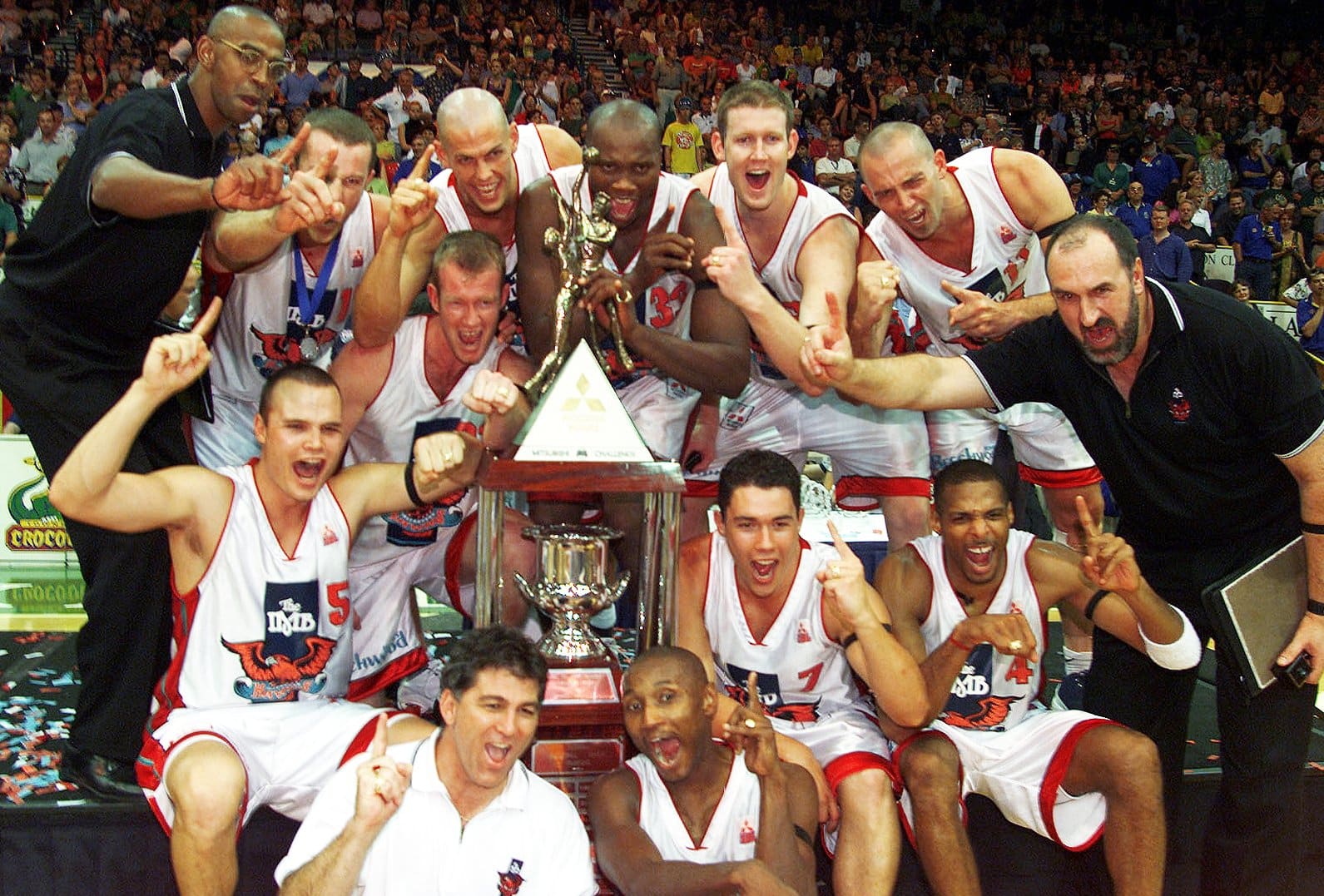
There have been championship runs in the NBL defined by dominance and the sheer weight of talent that could overwhelm opponents before the ball was tipped.
The dynasties of Perth, the star-studded reign of Melbourne, and the rise of Sydney’s financial muscle all tell tales of powerhouses that knew how to stay at the top. But there has only ever been one championship like Wollongong’s in 2001—a title won through sheer resilience, a team that had no business being there until they forced their way in.
For two decades, the Wollongong Hawks had been the league’s scrappers. They were a club that knew hardship, operating in a regional market with none of the financial backing of their big-city rivals. They had history, but not of success—no banners, no championships, just an identity built around hard work and defiance.
Then came the 2000-01 season. A year where they turned defiance into belief with a team built on chemistry, selflessness, and a stubborn refusal to lose.
Brendan Joyce wasn’t interested in a rebuild—he was building a contender, even if nobody saw it at the time.
He made sweeping roster changes, bringing in players who weren’t stars but who fit the vision.
Charles Thomas, a veteran point guard with the poise to guide a team through the trenches. Damon Lowery, a journeyman guard who played like every game might be his last, unknowingly destined to become part of NBL history. Axel Dench, a rookie big man stretching the floor and giving the Hawks a new dimension.
Matt Garrison, an American forward who could energise a game with his relentless effort. Grant Kruger, an enforcer who provided an intimidating presence inside, and Matt Shanahan, a veteran shooter who added depth to the backcourt.
They weren’t a superteam, but they had the makings of something special.
By the time the regular season ended, Wollongong had done more than just compete—it had stormed into the upper echelon.
They went 21-7, tying for third in the league. They won an astonishing 12 road games, proving their ability to win in the toughest environments. And, most tellingly, they went 12-0 in games decided by three points or fewer—a testament to their ability to handle pressure like no other team in the league.
Yet, when it came time for league awards, not a single Wollongong player was named to the All-NBL First or Second Team. That, more than anything, summed up the Hawks. No stars. No egos. Just a group of men who refused to let each other down.
Their roster was built to complement each other. Melvin Thomas was the leader in the paint, averaging 18.7 points and 9.5 rebounds. Charles Thomas controlled the tempo, putting up 16.5 points and 4.1 assists per game.
Glen Saville was the two-way dynamo, contributing 15.5 points, 9.7 rebounds, and 4.4 assists while being the team’s best defender. Damon Lowery provided energy and clutch play off the bench, and Axel Dench stretched defence with his ability to hit from deep.
The Playoff Gauntlet: Slaying the Giants
Wollongong entered the playoffs knowing it had never won a postseason series. Every round featured an opponent that had haunted them in previous years.
Quarter-Finals: Redemption Against Perth
The Perth Wildcats had eliminated the Hawks in 1998, reinforcing their reputation as a finals failure.
But this was a different Wollongong team, and they proved it with a 97-90 win in Game 1, led by Melvin Thomas’ 22 points and 13 rebounds, and Lowery’s 19 points off the bench.
The Wildcats responded in Game 2 with a dominant 106-95 victory, setting up a do-or-die Game 3 in Perth—a place the Hawks had never won in the playoffs.
It didn’t matter. Saville had one of the best games of his career, posting 26 points and 16 rebounds, leading Wollongong to a historic 98-88 win.
The Hawks had exorcised their demons, winning their first-ever playoff series.
Semi-Finals: The Most Controversial Finish in NBL History
If Perth had been Wollongong’s playoff tormentor in the past, Adelaide was its ultimate roadblock. The 36ers had ended the Hawks’ seasons in 1998 and 1999.
Wollongong hadn’t won in Adelaide since 1990.
Game 1 was a slugfest, but Wollongong held on for an 84-83 win. It had finally broken the Adelaide curse.
The 36ers stormed back in Game 2, handing the Hawks a humbling 111-100 defeat. That set up a winner-take-all Game 3 in Wollongong.
What happened next would become NBL legend.
With Adelaide leading 108-106 in the dying seconds, Lowery launched a desperate three-pointer. Darnell Mee, one of the league’s best defenders, blocked it cleanly—but the whistle blew.
Foul.
Adelaide was outraged. Wollongong was stunned.
Lowery, never the flashiest player, now had the weight of a season on his shoulders. He needed to make all three free throws to win.
The first shot bounced on the rim, rolled around, and dropped in.
The second did the same.
The third hit the rim—once, twice, three times—before falling in.
Wollongong 109, Adelaide 108.
The crowd erupted. Adelaide was left in shock.
“I shouldn’t have put us in that situation,” Mee admitted years later.
“Whenever I think about playing in Australia, that’s the first thing I think about.”
Wollongong was through to its first NBL Grand Final appearance.
Grand Final: The Underdog vs The Underdog
Their opponent was another unlikely finalist—the Townsville Crocodiles, also seeking their first championship.
Game 1 was a thriller, with Wollongong holding on for a 104-101 victory thanks to Melvin Thomas’ 24 points and 14 rebounds.
Game 2 was a disaster. The Crocs blew them off the court, winning 114-97.
The championship would be decided in Game 3—less than 24 hours later.
It was pure survival.
Charles Thomas played like a man possessed, putting up 23 points, 10 rebounds, and 5 assists. Melvin Thomas and Glen Saville delivered double-doubles.
Every shot was contested. Every loose ball was fought for like it was the last play of their lives.
And when the final buzzer sounded, it was Wollongong standing at the top, holding on for a heart-stopping 97-94 win, becoming the first team from New South Wales to win an NBL title.
A Championship That Defined a City
They didn’t just win a championship – they created history.
Glen Saville, the heart and soul of the Hawks, was named Finals MVP.
For a club that had never been taken seriously, it was the ultimate validation.
Brendan Joyce, named Coach of the Year, had built something special.
Damon Lowery had become a cult hero, his free throws forever etched into NBL history.
Even today, their banner hangs in the rafters at the WIN Entertainment Centre, a reminder of the team that wasn’t supposed to win—but did.