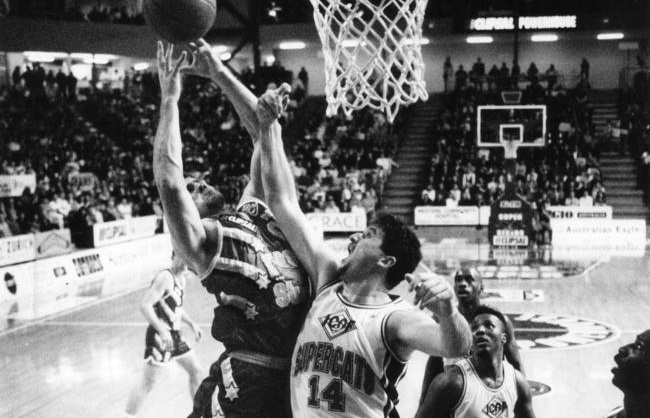
Chris Blakemore (1993 Rookie Of The Year) on the Adelaide 36ers ‘Mike Dunlap era’
April 11, 2022


NICKNAME/S: Wheels
BIO: Brett Wheeler was born in Adelaide (SA) and began playing basketball as a junior with the Noarlunga Tigers in Southern Adelaide.
Brett Wheeler made his NBL debut with the Adelaide 36ers at 19 years of age. He scored one point in his first NBL game.
Despite Adelaide having their worst season ever in 1990, head coach Don Shipway was able to avoid being fired and looked to rebuild around the squad’s young talent. He began with replacing 37-year-old club legend Al Green with 29 year old, former NBA player Butch Hays as the teams import point guard, signing him to a two year deal. The 36ers also added 19-year-old Adelaide product Brett Wheeler, who at 208 cm provided the extra size the team needed to support Bradtke.
Wheeler made his NBL debut for Adelaide, playing 7:46 minutes and scoring 1 point in a 93–90 loss to the Perth Wildcats at the Perth Entertainment Centre (29 June 91).
Butch Hays (24.6 points, 4.5 rebounds, and 9.0 assists) and Mark Davis (23.0 points and 14.7 rebounds) would lead the team as Wheeler averaged 2.2 points, 1.5 rebounds, and 0.3 assists alongside the all-star pair, helping the 36ers return to the playoffs. Finishing in fourth place (16-10), Adelaide would face Melbourne in the elimination finals. The 36ers defeated the Tigers in two straight games and move on to the semifinals. There they were eliminated by defending and eventual champions Perth (0-2).
1991 was also the last season the 36ers would play out of the 3,000 seat Apollo Stadium before moving into the 8,000 seat Clipsal Powerhouse.
1992
Adelaide had played at the Apollo Stadium since the team’s inception in 1982, but by the early 1990s, ticket demand was far too great to remain there, and the team moved into the 8,000 seat Clipsal Powerhouse prior to the 1992 season. During the off-season, the team was able to retain import point guard Butch Hays and captain Mark Davis but saw local favourite and former captain Darryl Pearce sign with the North Melbourne Giants.
The venue quickly became a fortress for the 36ers, with every game played in front of a sell-out crowd. The increased fan support saw Adelaide open the year with a 106-84 victory over the North Melbourne Giants. After this initial success, however, the team failed to win again across their next seven games, including losses to perennial easy beats like Hobart and Newcastle.
The 36ers would then face a major hurdle after the league’s mid-season break to accommodate the Barcelona Olympics. After the Boomers finished the tournament in fourth place, Bradtke returned with the announcement that he had accepted a lucrative deal (reportedly worth $200,000) to finish the season playing for Spanish team Juver Murcia. In his 17 games prior to the break, Bradtke had clearly become the best local big man in the competition. In his last game wearing a 36ers jersey, he scored acareer-high 43 points, grabbed 25 boards against Geelong at home and averaged 20.1 points, 14.8 rebounds, and 1.9 assists for the season.
The 36ers, although never looking like a playoff team, were never able to fill the gap left by Bradtke and limped home to an 11-13 record, finishing in the ninth spot.
Davis (23.5 points, 14.2 rebounds, 2.3 assists, 1.2 steals and 1.1 blocks) again led the team with his spectacular all-around game, with Wheeler also contributing 2.5 points, 1.6 rebounds, and 0.3 assists per game.
Despite the disappointing season, two positives came from this season. The first was the rookie debuts of local teenagers Brett Maher (2.2 points in 8 minutes per game), who went on to play a record 525 games for the 36ers, and 18-year-old Paul Rogers, who appeared in five games but later became a big part of the 36ers and the Australian national team. Mark Davis also played his last season as an import, obtaining his Australian citizenship this year and qualifying as a local player until his retirement.
Bradtke, who had signed with the Spanish club for only one season, had an agreement to play with Adelaide if he returned in 1993. Upon his return to Australia, Bradtke made it known he did not want to play the final year of his contract in Adelaide, amongst rumours the Melbourne Tigers were actively recruiting him. After negotiations between the two parties broke down, the 36ers gave permission for Bradtke to leave if a team would buy out his remaining contract. However, the NBL stepped in and vetoed the buyout, effectively letting Bradtke leave for Melbourne without the 36ers receiving any compensation. After the fact it became clear Bradtke had decided to move to Melbourne to be closer to then girlfriend (and future wife), pro-tennis player Nicole Provis.
1993
After two losing seasons under coach Don Shipway, Adelaide hired American coach Don Monson to replace him and steer the team back to its winning ways. With the 36ers still regrouping from the loss of Australian Boomers big man Mark Bradtke (to Melbourne), they built up the team’s frontcourt by adding Chris Blakemore, a talented young big man from the Australian Institute of Sport, import Paris McCurdy and welcomed back former 36er Willie Simmons (via Canberra). Key additions to the back court included Australian Boomers guard Phil Smyth (via Canberra) and the return of local prodigy Scott Ninnis (via South East Melbourne) who had spent two seasons playing under Brian Goorjian in Melbourne.
After nine games it was clear McCurdy (12.7 points, 7.7 rebounds, and 2.0 steals) wasn’t what the team needed and he was replaced by import David Robinson (18.3 points, 8.9 rebounds, and 2.4 assists) a serviceable import for sure, but not quite the same player as his NBA namesake.
While Wheeler averaged 0.9 points, 0.9 rebounds, and 0.2 assists, Adelaide improved on last season under Monson, finishing in seventh place (14-12) and returning to the playoffs.
Mark Davis (22.8 points, 12.9 rebounds, 2.2 assists, and 1.0 blocks) led the team in scoring and rebounding, Ninnis (19.4 points, 3.1 rebounds, 4.7 assists, and 1.3 steals) delivered the best season of his career and was selected as the league’s Most Improved Player and Blakemore (5.7 points and 4.9 rebounds) went on to claim Rookie of the Year honours.
Once into the playoffs, Adelaide were eliminated in the Quarterfinals by defending champions South East Melbourne.
1994
During the 1994 season Wheeler averaged 3.4 points, 3.2 rebounds, and 0.6 assists and helped the 36ers finish the regular season in second place (18-8 ).
1995
Under coach Mike Dunlap, Adelaide’s good form continued into 1995 after deciding no to re-sign veteran Phil Smyth (to Sydney) and instead focus on the young core of Brett Maher, Chris Blakemore and Brett Wheeler. Imports Robert Rose and Mark Davis would lead the team in scoring and rebounding while Jo Jo English, previously a member of the Chicago Bulls, would join the team mid-season after Mark Davis became a naturalised Australian.
Adelaide finished in sixth place (17-9) and then eliminated Newcastle in the Quarterfinals. A semifinal matchup against Perth saw national media headlines when Blakemore elbowed Perth forward Martin Cattalini in game one, delivering a cut to his mouth that required 15 stitches. The incident almost led to a brawl and saw Blakemore suspended for game two. Perth went on to win the second game (85-76) and Adelaide’s playoff run was ended by the Wildcats for the fourth time in eight years (1987, 1989, 1991 and 1995).
At the end of the season, Robert Rose request for a raise was denied and led to his exit from the club. It was believed the 36ers felt that Rose (31 years old) had already played his best basketball and wasn’t worth the money. With coach Dunlap focused on building a younger roster, the departures of Mike McKay (to Brisbane), Phil Smyth (to Sydney) were next to go. Finally, due to an end of season altercation with Dunlap due to the aforementioned Cattalini incident, he chose to follow Rose and signed a deal to play in Canberra as well.
1996
After losing to Perth in the semifinals in 1995, a series which included a vicious elbow from Chris Blakemore to the head of Wildcats forward Martin Cattalini, head coach Mike Dunlap had lost favour with Blakemore and 36ers MVP Robert Rose, who both left the team and signed with the Canberra Cannons. Long range specialist Mike McKay also found Dunlap hard to play for, and he left to play with the Brisbane Bullets.
Despite this, the 36ers recruited well going into the 1996 NBL season, signing slam-dunking forward Leon Trimmingham from the Sydney Kings and, funnily enough, Martin Cattalini from the championship winning Perth Wildcats. John Rillie, who was coming off a Rookie of the Year winning season with Brisbane, was added as a backup guard to Brett Maher, and new import Rick Brunson, who had just narrowly missed out on being drafted to the NBA. This was also the season Davis was replaced as captain of the 36ers by Brett Maher, who at mid-season would be selected to play for Australia at the 1996 Olympic Games.
The 36ers got great production from starters Brunson (21.6 points, 4.1 rebounds, 6.5 assists, and 2.5 steals), Trimmingham (19 points, 8.9 rebounds, and 1.5 steals), Maher (15.5 points, 4.1 rebounds, 3 assists, and 1.9 steals), Rillie (13.7 points, 3.5 rebounds, 3 assists, and 1.2 steals) and Mark Davis (12.7 points, 8.2 rebounds, and 2 assists) but continued to struggle against the league’s top teams.
This season Wheeler would develop into a solid backup centre, appearing in 28 games, and average 9.0 points, 6.6 rebounds, and 0.6 assists.
Following the sudden death of his father after the 1996 season, coach Dunlap returned home to the United States and decided to stay there to be closer to his family. The team finished in sixth place with a record of 16-10. The 36ers defeated arch-rivals Perth Wildcats in the quarterfinals before being eliminated in the semifinals by eventual champs the South East Melbourne Magic in two straight games.
This season would also be Dunlap’s last with the team after he requested the team release 36ers legend Mark Davis and focus on the team’s younger players. Since joining the 36ers, Dunlap had been systematically removing the older players from the squad, but the club board instead retained Davis (who went on to play another four seasons) and agreed that Dunlap would not return as coach.
1997
After finishing sixth with a 16-10 record in 1996, defeating Perth in the quarterfinals before being swept by eventual champion South East Melbourne in the semifinals, Adelaide entered 1997 without club MVP Rick Brunson (to United States), while Simon O’Donnell also did not return. Following the sudden death of his father, Mike Dunlap returned to the United States and did not continue as coach, with the club board also choosing to retain Mark Davis after Dunlap had wanted him released. Dunlap’s assistant and former Gold Coast Rollers coach Dave Claxton was promoted, retaining Brett Maher, Leon Trimmingham, John Rillie, Davis, Martin Cattalini, Brad McKinnon and Nathan Hawkes, while Scott Ninnis (via Newcastle) returned one year after Dunlap had cut him and Rupert Sapwell (via Geelong) and import big man Jeff Brown were added. Maher replaced Davis as captain, beginning a role he would hold until his retirement in 2009.
Adelaide opened the season at the Clipsal Powerhouse on April 13, where Brett Wheeler (1 point, 1 rebound, and 1 steal) played 6:36 off the bench as defending champion South East Melbourne defeated the 36ers 85-83. Brown (22 points, 6 rebounds, 2 assists, and 2 steals) and Rillie (18 points, 7 rebounds, 4 assists, 1 steal, and 1 block) led Adelaide, while Sam Mackinnon (19 points, 13 rebounds, 3 assists, and 2 steals) was the Magic’s best.
Wheeler (12.6 points and 6.9 rebounds across 30 games) appeared in every game and produced the best scoring season of his career to that point, while shooting 55 percent from the field and remaining one of Adelaide’s main frontcourt players.
Brown (7.7 points and 3.8 rebounds across 6 games) had been signed to play alongside Trimmingham and Davis and give Adelaide the type of dominant frontcourt that had delivered recent championships for Perth. With the 36ers sitting at 2-4 after six games, it was clear Brown wasn’t the player Adelaide needed and he was released. Hoping to find a quick replacement, Adelaide brought back former big man Willie Simmons (5.6 points and 4 rebounds across 23 games) (via state leagues), who had not appeared in the NBL since 1994 after spending the previous two seasons playing in the state leagues.
Wheeler’s best game came against Newcastle at the Clipsal Powerhouse on June 22, where Wheeler (30 points, 8 rebounds, and 1 steal) shot 11-of-20 from the field and scored a career-high 30 points as Adelaide produced its highest score of the season in a 141-99 victory. Maher (19 points, 4 rebounds, and 8 assists) and Cattalini (17 points, 6 rebounds, and 3 steals) provided support, while Scott McGregor (20 points and 5 assists) led Newcastle.
One of his strongest all-around games came against Perth on July 11, where Wheeler (14 points, 12 rebounds, 2 assists, 2 steals, and 4 blocks) controlled the paint, while Maher (30 points, 5 rebounds, and 4 assists) and Rillie (17 points and 6 assists) led the scoring. Adelaide held an eight-point lead entering the fourth quarter, but Ricky Grace (25 points) helped Perth outscore the 36ers 36-23 in the final period and escape with a 112-107 victory. At that point of the season, Wheeler was shooting 60 percent from the field through 18 games, sixth-best in the NBL.
Trimmingham (19.4 points, 8.3 rebounds, and 1.2 steals across 29 games) led Adelaide in scoring and rebounding despite spending much of the season as the sixth man and was voted into the NBL All-Star Game by the fans. Maher (18.8 points, 4.2 rebounds, 5 assists, and 1.9 steals across 30 games) won Adelaide’s club MVP award, earned All-NBL Second Team honours and was also selected to the All-Star Game during his first season as captain. Rillie (13.4 points, 4.6 rebounds, 4.7 assists, and 1.2 steals across 30 games), Davis (9.4 points and 6 rebounds across 30 games), Cattalini (8.5 points and 3.6 rebounds across 30 games) and McKinnon (5.8 points across 26 games) provided the remaining scoring.
Adelaide entered its final game on a three-game losing streak and returned to the Clipsal Powerhouse on September 27, where Wheeler (19 points, 15 rebounds, and 1 assist) produced one of his strongest games of the season, with Cattalini (33 points, 8 rebounds, 4 assists, and 2 steals) and Maher (16 points, 6 rebounds, 5 assists, and 1 steal) also contributing, but Andrew Gaze (36 points, 5 rebounds, and 3 assists) led Melbourne to a 110-104 victory. The fourth consecutive loss left Adelaide seventh with a 14-16 record, 7-8 at home and 7-8 on the road and outside the playoffs for the first time since 1992.
SOUTH EAST MELBOURNE MAGIC
1998
After finishing first with a 22-8 record before losing the 1997 Grand Final series to Melbourne, South East Melbourne returned under Brian Goorjian looking to go one step further. Chris Anstey (to Dallas) departed for the NBA and import Brian Tolbert was not retained, with Goorjian adding former NBA guard Clinton McDaniel, Ben Knight (via Sydney) and Wheeler (via Adelaide), who joined the Magic after seven seasons with the 36ers and was brought in to replace Anstey in the frontcourt. Tony Ronaldson, Sam Mackinnon, Mike Kelly, Frank Drmic, Jason Smith, John Dorge and Andrew Parkinson returned from the previous season.
South East Melbourne opened the season at the Newcastle Entertainment Centre on January 30, where Wheeler (17 points and 6 rebounds) made seven of nine shots as the Magic defeated Newcastle 93-73. McDaniel (19 points and 5 steals) and Drmic (18 points and 5 rebounds) provided support, while Isaac Burton (21 points and 5 rebounds) was Newcastle’s leading scorer.
Wheeler (12.6 points and 7.1 rebounds across 34 games) appeared in every game, finished second on the team in rebounding behind Mackinnon and shot 61 percent from the field as he filled the frontcourt role vacated by Anstey.
Wheeler produced one of his strongest early-season games against North Melbourne on February 21, finishing with 20 points, 12 rebounds, 2 steals, and 1 block as South East Melbourne defeated the Giants 93-81. McDaniel (23 points, 5 rebounds, 8 assists, and 5 steals) led the Magic in scoring, while Ronaldson (15 points, 5 rebounds, and 6 assists) also contributed.
Six days later in Townsville, Wheeler (9 points and 5 rebounds) missed his only field-goal attempt but made nine of ten free throws as South East Melbourne defeated the Suns 108-103, scoring all nine of his points without making a field goal.
Wheeler delivered another major performance against Sydney at Melbourne Park on May 2, making nine of 12 shots and finishing with 21 points and 13 rebounds as South East Melbourne defeated the Kings 126-108. Ronaldson (32 points, 2 rebounds, 3 assists, and 2 blocks) and Mackinnon (20 points and 11 rebounds) provided support, while Kelsey Weems (27 points) was Sydney’s leading scorer.
McDaniel (17.4 points, 3.3 rebounds, 4.3 assists, and 2.7 steals across 24 games) dropped out of the lineup after April 24 and missed the next ten games, with 1996 championship guard Billy McCaffrey (10.3 points across 7 games) (via Germany) returning to the Magic and appearing in seven games from May 6 through May 27 before McDaniel returned on June 3.
Wheeler’s best regular-season scoring game came against his former team Adelaide at Melbourne Park on May 13, where Wheeler (22 points, 5 rebounds, 1 assist, 1 steal, and 1 block) made 11 of 17 shots as South East Melbourne defeated the 36ers 77-74. Mackinnon (18 points and 14 rebounds) and Ronaldson (14 points and 4 assists) provided support, while Kevin Brooks (20 points, 6 rebounds, and 2 steals) led Adelaide.
Wheeler produced another double-double when Adelaide returned to Melbourne on June 3, finishing with 18 points, 13 rebounds, and 2 steals as the Magic defeated the 36ers 99-98. Ronaldson (29 points and 6 rebounds) and Kelly (17 points, 4 assists, and 2 blocks) provided support, while Martin Cattalini (24 points and 9 rebounds) led Adelaide. The victory completed South East Melbourne’s three-game regular-season sweep of the team they would later meet in the Grand Final, with the three games decided by a combined six points.
Ronaldson (18.1 points, 5.2 rebounds, and 3.1 assists across 34 games) led South East Melbourne in scoring for the fourth consecutive season, while Drmic (14.4 points, 6.6 rebounds, and 3 assists across 34 games) enjoyed a breakout season which gained the attention of NBA scouts. Mackinnon (13.2 points, 7.8 rebounds, 5.2 assists, and 1.6 steals across 33 games), Kelly (13 points, 4.2 rebounds, 3.3 assists, and 1.3 steals across 34 games) and Smith (9.2 points and 4.1 rebounds across 33 games) gave the Magic one of the deepest rotations in the league. McDaniel led the NBL in steals, Mackinnon was selected to the All-NBL Second Team and Ronaldson, Drmic and McDaniel were selected to the All-NBL Third Team. Smith was named the NBL’s Best Sixth Man, Kelly won the Best Defensive Player award for the second consecutive season and Goorjian received his third Coach of the Year award.
South East Melbourne closed the regular season against Melbourne at Melbourne Park on June 6, where Wheeler (11 points and 5 rebounds), McDaniel (24 points, 4 rebounds, and 2 blocks) and Kelly (17 points, 6 rebounds, 4 assists, and 2 steals) led the Magic, but Andrew Gaze (33 points) helped the Tigers win 110-106. The loss left South East Melbourne first with a 26-4 record, at the time the third-best regular-season winning percentage in NBL history.
South East Melbourne received a first-round bye before opening the semifinals in Brisbane, where Wheeler (7 points and 1 rebound), Ronaldson (26 points and 4 rebounds) and Kelly (25 points) helped the Magic defeat the Bullets 106-98, while Steve Woodberry (46 points and 12 rebounds) produced a huge performance for Brisbane.
Game two moved to Melbourne Park, where Wheeler (4 points and 5 rebounds), Mackinnon (30 points, 10 rebounds, and 3 steals) and Ronaldson (19 points, 5 rebounds, and 6 assists) helped South East Melbourne defeat Brisbane 90-84. Woodberry (28 points and 8 rebounds) again led the Bullets as the Magic completed the sweep and reached the Grand Final for the third consecutive season.
Wheeler’s highest-scoring game of the season came in the opening game of the Grand Final at the Clipsal Powerhouse, where Wheeler (29 points and 9 rebounds) made 12 of 15 shots to lead South East Melbourne. McDaniel (20 points, 4 assists, and 2 steals) and Ronaldson (18 points and 8 rebounds) provided support, but Brooks (24 points and 8 rebounds) helped Adelaide win 100-93. The Magic had defeated the 36ers in all three regular-season meetings, but Adelaide’s victory was only its second against South East Melbourne since the Magic was formed in 1992.
Game two moved to Melbourne Park, where Wheeler (12 points and 5 rebounds) and Ronaldson (11 points and 6 rebounds) were South East Melbourne’s only double-figure scorers as Adelaide held the Magic to 30 percent shooting and forced 26 turnovers. Brooks (21 points, 6 rebounds, 2 assists, and 2 blocks) and Martin Cattalini (20 points and 6 rebounds) led the 36ers to a 90-62 victory and the championship, with Brooks named Grand Final MVP. The championship completed the NBL’s final season played during the winter months and was also the final game in South East Melbourne Magic history, with the club merging with the North Melbourne Giants during the off-season to form the Victoria Titans, where Wheeler remained under Goorjian.
VICTORIA TITANS
1998/99
After the NBL’s move to summer, interest in the league had declined, and financially, it had become difficult for Melbourne to sustain three separate clubs. In an effort to boost sponsorship and membership numbers, the South East Melbourne Magic merged with the North Melbourne Giants, who had struggled financially for a number of years.
The team was re-branded to the Victoria Titans and, with the majority of the front office being former Magic owners, a decision was made to retain Brian Goorjian as head coach, leaving Giants coach Brett Brown without a role. Selecting a team generated criticism as Goorjian’s appointment coincided with the decision not to offer Pat Reidy (to Newcastle), then a member of the Australian national team, a spot on the roster.
The Titans completed their roster by signing four players from the Giants, Darryl McDonald, Ben Pepper, David Smith, and Paul Maley, and five players from the Magic, Tony Ronaldson, Jason Smith, Frank Drmic, Brett Wheeler and Mike Kelly, while rookie Brad Sheridan (via AIS) also joined the new club.
Victoria opened its first season against Melbourne at Melbourne Park on October 10, where Wheeler (7 points and 4 rebounds) played 19:23 minutes, but the Tigers defeated the Titans 99-80. McDonald (16 points, 4 rebounds, 2 assists, and 2 steals) and Pepper (15 points and 10 rebounds) were Victoria’s best as the new roster struggled for cohesion in its first game together.
Wheeler (11 points and 5.9 rebounds) became part of Goorjian’s big frontcourt rotation and helped Victoria bounce back in game two, finishing with 20 points and 6 rebounds as the Titans defeated Canberra 110-94. Ronaldson (28 points, 8 rebounds, and 8 assists) and McDonald (21 points, 6 rebounds, 10 assists, and 2 steals) led the first win in club history.
Wheeler’s best all-round regular-season game came in Adelaide on February 13, where he matched his season high with 20 points and added 10 rebounds, but the 36ers defeated Victoria 89-70. Jason Smith (14 points) was the only other Titan to score in double figures as Wheeler carried much of the frontcourt offence in the loss.
Wheeler (18 points and 6 rebounds) closed the regular season strongly against Melbourne on March 13, helping Victoria defeat the Tigers 97-89 at Melbourne Park. Kelly (16 points, 4 rebounds, and 6 assists) and Pepper (14 points and 12 rebounds) gave the Titans support as Victoria finished the regular season on a four-game winning streak.
Ronaldson (16.9 points, 5.2 rebounds, and 3.2 assists) was named captain and led Victoria in scoring, later earning club MVP honours. Pepper (12.5 points, 7.2 rebounds, and 1.2 blocks) led the team in rebounding and blocks, while McDonald (11.1 points, 5 rebounds, 8.2 assists, and 2.4 steals) led both the Titans and the NBL in assists and steals. Smith (11.2 points and 4.1 rebounds), Drmic (10.8 points and 5.2 rebounds), Kelly (10.2 points, 3.9 rebounds, 3.3 assists, and 1.2 steals) and Maley (7.2 points) gave Victoria seven double-figure scorers as the Titans finished fourth with a 16-10 record and lost only three games at home.
Victoria opened the Qualifying Finals at Melbourne Park with a 96-65 win over Wollongong, taking control of the series behind Ronaldson (20 points and 4 rebounds), Smith (18 points), Wheeler (15 points and 6 rebounds), Pepper (12 points and 16 rebounds) and Maley (12 points and 5 rebounds).
Game two moved to the WIN Entertainment Centre, where Victoria completed the sweep with a 91-82 win behind Ronaldson (20 points and 4 rebounds), Smith (19 points and 5 rebounds), Wheeler (14 points and 8 rebounds), Pepper (11 points and 6 rebounds) and McDonald (7 points, 5 rebounds, 14 assists, and 5 steals).
The semifinals opened at Melbourne Park, where Victoria ground out an 80-77 win over Melbourne behind Ronaldson (17 points, 6 rebounds, and 5 assists), Maley (16 points), Wheeler (12 points and 7 rebounds) and McDonald (11 points, 3 rebounds, and 9 assists), while Marcus Timmons (31 points and 9 rebounds) led the Tigers.
Game two stayed at Melbourne Park, where Kelly (19 points and 7 rebounds), Pepper (15 points, 13 rebounds, 2 steals, and 2 blocks) and McDonald (13 points, 11 rebounds, 6 assists, and 5 steals) led Victoria to a 94-87 win over Melbourne, completing the sweep and sending the Titans into the Grand Final. Wheeler (11 points) played 15:45 minutes in the win.
The Grand Final series opened in Melbourne, where Adelaide made 16 three-pointers and defeated Victoria 104-94 behind Brett Maher (31 points) and Darnell Mee (25 points, 6 rebounds, and 6 assists). McDonald (23 points, 6 rebounds, 9 assists, and 2 steals), Ronaldson (19 points and 4 rebounds) and Pepper (18 points) led Victoria, while Wheeler (6 points and 5 rebounds) played 29:27 minutes.
Game two moved to Adelaide, where Maher (25 points) came out firing for the 36ers, but Victoria slowed the game down and levelled the series with an 88-82 win. Ronaldson (22 points), Wheeler (18 points and 9 rebounds), Smith (15 points, 6 rebounds, and 3 assists) and McDonald (12 points, 6 rebounds, and 7 assists) led the Titans and forced a deciding game.
Game three remained in Adelaide, where more than 7,000 36ers fans saw Martin Cattalini (19 points and 9 rebounds) lead Adelaide and Maher (15 points and 7 rebounds) named Grand Final MVP as the 36ers completed back-to-back championships. Pepper (15 points) and Ronaldson (15 points and 6 rebounds) led Victoria, while the Titans shot 26-of-78 from the field. Wheeler (8 points and 7 rebounds) played 27:41 minutes in the 80-69 loss.
1999/00
After losing back-to-back Grand Final series across the South East Melbourne and Victoria transition, Brian Goorjian kept most of the roster together but looked to make the group younger. Paul Maley (to Adelaide) and Mike Kelly (to Townsville) exited, while Nathan Taylor returned to the roster and development player Glen Siegle was elevated into the full squad.
The rest of the Titans’ Grand Final core returned as Victoria entered its second season still trying to turn consecutive runner-up finishes into a championship.
Victoria opened the season at Melbourne Park on October 2, where Wheeler (9 points, 3 rebounds, and 1 block) played 23:20 minutes as the Titans defeated Townsville 106-95. Jason Smith (29 points and 7 rebounds), McDonald (19 points, 6 assists, and 4 steals) and Drmic (17 points) led the scoring as Victoria started the season with a home win.
Wheeler (11.9 points and 7.7 rebounds) remained a key part of Victoria’s frontcourt and improved his work on the glass, giving Goorjian a physical interior option alongside Ronaldson and Pepper.
Wheeler’s best scoring game came against Sydney on January 22, where he finished with 20 points and 8 rebounds as Victoria defeated the Kings 106-75 at the Sydney Superdome. Smith (19 points and 7 rebounds), Drmic (17 points and 5 rebounds) and McDonald (6 points, 3 rebounds, 12 assists, and 5 steals) helped the Titans control the road win.
Wheeler produced his best rebounding game against Adelaide on December 26, finishing with 16 points and 13 rebounds, but the 36ers defeated Victoria 103-77 at Melbourne Park. Smith (15 points and 7 rebounds), McDonald (15 points) and Drmic (10 points and 7 rebounds) were Victoria’s other main contributors in the loss.
Wheeler added another double-double against Adelaide on February 5, finishing with 10 points and 12 rebounds as Victoria defeated the 36ers 83-75 at Melbourne Park. Smith (24 points and 7 rebounds), Ronaldson (17 points and 7 rebounds) and McDonald (10 points, 7 assists, and 5 steals) helped the Titans defeat the league leaders and stay in touch with the top four.
Smith (17.9 points, 5.1 rebounds, and 1.3 steals) enjoyed a breakout season, leading Victoria in scoring and earning club MVP honours. Ronaldson (16 points and 5.4 rebounds) remained captain and one of the Titans’ most reliable scorers, while McDonald (13.8 points, 4 rebounds, 7.8 assists, and 2.5 steals) led both Victoria and the NBL in assists and steals. Drmic (13.3 points and 5.6 rebounds), Pepper (10.4 points and 6 rebounds) and David Smith (5 points and 3 rebounds) helped Victoria deliver a balanced attack with six players scoring in double figures. The Titans finished fourth with a 20-8 record, built their season around a 11-3 home record and entered the playoffs against Melbourne.
Victoria opened the elimination finals at Melbourne Park, where Melbourne took game one 101-94 despite Smith (22 points and 5 rebounds), McDonald (17 points, 4 rebounds, and 5 assists) and Drmic (16 points, 4 rebounds, and 5 assists) leading the Titans. Wheeler (16 points and 9 rebounds) played 28:55 minutes in the loss.
Game two stayed at Melbourne Park, where Victoria answered with a 78-70 win behind Ronaldson (18 points and 5 rebounds), McDonald (15 points, 5 rebounds, 6 assists, and 3 steals), Smith (13 points and 4 rebounds) and Drmic (12 points and 11 rebounds). Wheeler (10 points, 6 rebounds, and 1 block) played 35:56 minutes as the Titans forced a deciding game.
Game three remained in Melbourne, where Victoria overcame Andrew Gaze (30 points, 4 rebounds, and 7 assists) and eliminated the Tigers with a 105-96 win. McDonald (29 points, 4 rebounds, 9 assists, and 4 steals) led the Titans, while Ronaldson (19 points and 7 rebounds), Wheeler (15 points and 14 rebounds), Smith (14 points) and Drmic (14 points and 8 rebounds) helped Victoria move into a semifinal series against Adelaide.
The semifinals opened in Melbourne, where Victoria defeated Adelaide 101-86 behind Ronaldson (26 points and 5 rebounds), McDonald (24 points, 6 rebounds, 8 assists, 2 steals, and 3 blocks), Smith (18 points and 6 rebounds) and Wheeler (15 points, 6 rebounds, and 1 block), taking game one against the team that had ended the Titans’ previous two seasons.
Game two moved to Adelaide, where Martin Cattalini (24 points and 7 rebounds) and Darnell Mee (22 points, 7 rebounds, 6 assists, and 4 steals) led the 36ers back into the series with a 95-72 win. Ronaldson (17 points and 5 rebounds), Drmic (14 points) and Smith (13 points) were Victoria’s main contributors, while Wheeler (7 points, 8 rebounds, and 1 steal) played 32:19 minutes as Adelaide forced another deciding game.
Game three remained at Adelaide Arena, where Victoria finally overcame the 36ers with a 93-89 win behind McDonald (24 points, 7 rebounds, 6 assists, and 3 steals), Pepper (21 points and 7 rebounds) and Drmic (19 points and 4 rebounds), while Mee (22 points, 6 rebounds, 5 assists, and 2 steals) again filled the stat sheet for Adelaide. Wheeler (9 points, 5 rebounds, 2 steals, and 2 blocks) played 31:58 minutes as the win sent Victoria into its second straight Grand Final series.
The Grand Final series opened at Melbourne Park, where Perth defeated Victoria 84-78 behind league MVP Paul Rogers (24 points and 20 rebounds). Ronaldson (25 points) led the Titans, while Drmic (13 points and 4 rebounds), Smith (11 points) and McDonald (8 points, 5 rebounds, 6 assists, and 2 steals) kept Victoria within reach. Wheeler (11 points, 12 rebounds, 1 steal, and 1 block) played 34:10 minutes in the loss.
Game two moved to Perth, where Marcus Timmons (27 points, 6 rebounds, and 5 steals) led the Wildcats to a 83-76 win and was named Finals MVP as Perth completed the sweep. McDonald (25 points, 5 rebounds, 6 assists, and 4 steals) led Victoria, while Wheeler (14 points, 4 rebounds, and 2 blocks) played 31:38 minutes in the 83-76 loss.
2000/01
After being swept by Perth in the previous season’s Grand Final, Victoria lost Frank Drmic (to Sydney), Nathan Taylor (to Melbourne) and David Smith, while Jason Smith, Tony Ronaldson, Darryl McDonald, Brett Wheeler, Ben Pepper, Brad Sheridan and Glen Siegle returned from the previous season’s group.
Head coach Brian Goorjian brought Chris Anstey (via Chicago) back to Australia following three seasons in the NBA, replaced David Smith with his older brother Darren Smith and signed Mark Dickel (via UNLV). Dickel occupied an import position because New Zealand players were not considered local players in the NBL until 2003.
Victoria opened the season in Brisbane on October 20, where Wheeler (7 points, 11 rebounds, 1 assist, and 1 block) started at centre as the Titans defeated the Bullets 95-80. Ronaldson (17 points, 7 rebounds, 3 assists, and 1 block) and McDonald (16 points, 9 rebounds, 6 assists, 2 steals, and 2 blocks) led Victoria to the road win.
Wheeler (13 points and 8 rebounds) retained the starting centre position despite Anstey (16.4 points, 9.4 rebounds, and 2 blocks) returning from the NBA, allowing Goorjian to use Anstey from the bench and recreate the double-headed centre combination he had employed with Anstey and John Dorge during South East Melbourne’s 1996 championship season.
Wheeler’s best regular-season game came against Brisbane on November 11, where he finished with 24 points, 17 rebounds, 1 assist, 1 steal, and 1 block as Victoria defeated the Bullets 112-92 at Vodafone Arena. Ronaldson (22 points, 6 rebounds, and 5 assists) and Jason Smith (21 points, 6 rebounds, 2 assists, 1 steal, and 1 block) helped the Titans collect the comfortable home win.
Wheeler matched his season-high scoring total against Perth on February 16, making 10 of 13 field-goal attempts and finishing with 24 points, 7 rebounds, 1 steal, and 3 blocks as Victoria defeated the Wildcats 100-87. Anstey (18 points, 11 rebounds, 1 steal, and 2 blocks) and Jason Smith (14 points, 6 rebounds, 3 assists, 1 steal, and 2 blocks) helped the Titans control the frontcourt battle.
Wheeler also delivered 7 points, 16 rebounds, and 4 steals against Canberra on January 26 as Victoria defeated the Cannons 116-85 at the AIS Arena. Jason Smith (28 points and 9 rebounds) and McDonald (12 points, 7 assists, 3 steals, and 1 block) led the scoring and playmaking as Wheeler dominated the boards during the road win.
Victoria closed the regular season against Adelaide on March 31, where Wheeler (14 points, 9 rebounds, 1 steal, and 2 blocks) helped the Titans defeat the 36ers 113-98. Jason Smith (26 points, 7 rebounds, 3 assists, 2 steals, and 1 block) and Ronaldson (23 points, 5 rebounds, and 1 block) led Victoria as the club secured first place with a 22-6 record.
Jason Smith (20.5 points and 5.4 rebounds) produced the highest-scoring season of his career, while Ronaldson (16.3 points and 5.7 rebounds), McDonald (15.4 points, 5 rebounds, 7.9 assists, and 2.7 steals) and Dickel (13.2 points, 3 rebounds, and 5.1 assists) joined Wheeler and Anstey in giving Victoria six players who averaged at least 13 points. Darren Smith (6.6 points and 3.7 rebounds) and Sheridan (6 points) provided further depth, while Anstey was named Titans MVP and NBL Best Sixth Man and Jason Smith earned All-NBL First Team honours.
Mid-season injuries to Pepper (4.1 points and 3.8 rebounds), Anstey and Darren Smith led to development players Marcus Wright and Pero Vasiljevic being elevated to the full roster as Victoria maintained its position at the top of the ladder.
Victoria opened the qualifying finals at Adelaide Arena, where Wheeler (18 points, 7 rebounds, and 3 blocks), Anstey (27 points, 16 rebounds, and 1 block) and McDonald (13 points, 6 rebounds, and 9 assists) led the Titans to a 101-96 win. Kevin Brooks (24 points, 8 rebounds, and 6 assists), Brett Maher (19 points, 4 rebounds, 6 assists, and 2 steals) and Darnell Mee (18 points, 9 rebounds, 4 assists, 2 steals, and 3 blocks) led Adelaide.
Game two moved to Melbourne, where Brooks (34 points and 9 rebounds), Maher (24 points, 4 rebounds, and 5 assists) and Mee (12 points, 6 rebounds, 5 assists, and 3 steals) led Adelaide to a 96-83 win. Ronaldson (22 points, 7 rebounds, 2 assists, and 1 block) top-scored for Victoria, while Wheeler (12 points, 11 rebounds, 2 assists, and 1 block) and Dickel (12 points, 3 rebounds, 7 assists, and 1 steal) provided support as the 36ers forced a deciding game. By game two, Jason Smith was sidelined by a knee injury and would miss the remainder of the postseason.
Game three remained in Melbourne, where Adelaide won 115-103 to take the series 2-1. Anstey (21 points, 15 rebounds, and 2 steals), Darren Smith (21 points, 8 rebounds, and 2 steals), Dickel (17 points, 5 rebounds, 6 assists, and 1 block) and Wheeler (11 points and 5 rebounds) led Victoria, which still advanced as the highest-placed losing team from the qualifying finals.
The semifinal series opened at Vodafone Arena, where Wheeler (17 points, 13 rebounds, and 2 blocks), Ronaldson (22 points, 5 rebounds, and 4 assists) and McDonald (20 points, 6 rebounds, and 5 assists) led Victoria to a 106-97 win over Townsville. Robert Rose (26 points) and Mike Kelly (17 points and 9 rebounds) led the Crocodiles as the Titans took game one.
Game two moved to Townsville, where Andrew Goodwin (19 points and 11 rebounds), Pat Reidy (19 points and 4 assists) and Rose (19 points, 11 rebounds, and 8 assists) led the Crocodiles to a 98-82 win. Sheridan (17 points, 3 rebounds, and 2 assists) and Ronaldson (17 points and 8 rebounds) top-scored for Victoria, while Wheeler (9 points, 5 rebounds, 1 assist, and 1 steal) played 30:55 minutes. Anstey (2 points, 3 rebounds, 2 steals, and 1 block) suffered an injury during his 7:31 minutes and missed the deciding game.
Game three remained in Townsville, where Dickel (33 points and 4 assists), McDonald (19 points, 5 rebounds, 5 assists, 3 steals, and 1 block) and Darren Smith (15 points, 6 rebounds, 4 assists, and 4 steals) led Victoria, while Goodwin (23 points), Rose (20 points, 6 rebounds, 8 assists, and 2 steals) and Kelly (17 points, 10 rebounds, 6 assists, and 2 steals) carried Townsville to a 101-97 win that ended the Titans’ season. Wheeler struggled in the deciding game, scoring only 5 points after making 2 of 5 field goals and 1 of 5 free throws, while adding 6 rebounds, 1 steal, and 2 blocks in 40:59 minutes in the 101-97 loss.
2001/02
Townsville’s semifinal victory brought Victoria’s previous campaign to an end and left Brian Goorjian outside the Grand Final for the first time in seven years. The Titans responded by dismantling their three-centre rotation, with Ben Pepper (to Wollongong) and Glen Siegle (to Brisbane) leaving the roster. Darryl McDonald’s naturalisation allowed Goorjian to recruit Jamahl Mosley (via Salamanca) as a second import, while Nathan Crosswell (via Melbourne’s state league squad) joined the backcourt and Mark Dickel remained an import because New Zealand players were not considered locals until 2003. Chris Anstey moved into the starting lineup, leaving Brett Wheeler to provide experienced frontcourt depth from the bench.
Victoria opened the season against Melbourne at Hisense Arena on October 13, where Wheeler (0 points) did not score as Dickel (21 points, 3 rebounds, and 3 assists) and McDonald (19 points, 4 rebounds, 7 assists, and 3 steals) led the Titans before the Tigers won 109-103.
Wheeler (7.3 points and 6.2 rebounds across 26 games) saw his role decrease after averaging 13 points and 8 rebounds as a starter the previous season, but remained a valuable interior option behind Anstey and gave the Titans rebounding, size and experience throughout the year.
Wheeler produced one of his strongest performances in Perth on November 28, finishing with 18 points and 13 rebounds as Victoria fell to the Wildcats 88-83. Darren Smith (12 points and 7 rebounds) and McDonald (10 points, 5 assists, and 4 steals) provided support, while Grace (20 points and 4 rebounds) was Perth’s leading scorer.
Against Townsville on March 15, Wheeler (15 points, 10 rebounds, and 2 blocks) gave Victoria another double-double as the Titans defeated the Crocodiles 125-120. Anstey (26 points, 15 rebounds, and 3 assists) and McDonald (23 points, 8 assists, and 3 steals) helped Victoria hold off Townsville in the five-point win.
Wheeler’s best scoring game came against Wollongong on March 22, where he made eight of 10 shots and finished with 20 points, 5 rebounds, and 2 steals as Victoria defeated the Hawks 103-95. Jason Smith (24 points and 6 rebounds) and Anstey (16 points, 11 rebounds, 5 assists, 4 steals, and 3 blocks) led the support as the Titans secured their second consecutive minor premiership and finished first with a 21-9 record.
Captain Ronaldson (19.5 points and 4.5 rebounds) led Victoria in scoring and earned All-NBL Third Team selection, while Jason Smith (18.8 points and 5.4 rebounds) returned from a serious knee injury to strengthen the perimeter rotation. Anstey (16.8 points, 10.5 rebounds, 1.4 steals, and 1.3 blocks) was named Titans MVP and selected to the All-NBL First Team.
McDonald (12 points, 5.1 rebounds, 7.3 assists, and 2.3 steals) led the NBL in steals and joined Ronaldson on the All-NBL Third Team, while Dickel (11.6 points, 4.4 rebounds, and 6.1 assists) provided another playmaker. Mosley (11.5 points and 6.7 rebounds) became the first import to win the NBL Best Sixth Man award, with Darren Smith (8.8 points and 3.8 rebounds), Brad Sheridan (8.1 points) and Crosswell (5.3 points) completing the main rotation as Goorjian was named NBL Coach of the Year.
Victoria opened the qualifying finals against sixth-placed Melbourne with a 113-107 win, with Wheeler (8 points, 12 rebounds, and 1 block) controlling the glass alongside Jason Smith (27 points, 7 rebounds, 3 assists, and 2 steals) and Anstey (19 points, 9 rebounds, and 2 blocks), while Hoare (20 points and 13 rebounds) was Melbourne’s best.
Game two remained at Hisense Arena, where Wheeler (6 points and 9 rebounds), Jason Smith (22 points, 5 rebounds, and 2 steals) and McDonald (11 points, 6 rebounds, 7 assists, 4 steals, and 1 block) led Victoria. Copeland (41 points, 5 assists, and 2 steals) and Timmons (19 points, 6 rebounds, and 3 assists) carried Melbourne to a 107-105 win and forced a deciding game.
Game three saw Wheeler (2 points, 3 rebounds, and 1 steal) support Anstey (32 points, 20 rebounds, 3 assists, 2 steals, and 2 blocks) and Ronaldson (24 points, 6 rebounds, and 1 block), while Copeland (37 points, 6 rebounds, and 6 assists) and Timmons (21 points, 9 rebounds, and 4 blocks) led Melbourne to a 103-97 win. Victoria still progressed as the highest-ranked losing team from the qualifying finals.
The semifinals opened against Adelaide in Melbourne, where Wheeler (14 points and 7 rebounds), Ronaldson (27 points and 5 rebounds) and Jason Smith (19 points, 8 rebounds, and 6 assists) led Victoria. Farley (25 points and 4 rebounds) and Maher (23 points and 8 rebounds) carried the 36ers to a 99-92 win.
Game two moved to Adelaide, where Wheeler (9 points and 4 rebounds) provided support behind Anstey (26 points, 12 rebounds, 1 steal, and 2 blocks), Jason Smith (20 points, 3 rebounds, and 4 assists) and McDonald (13 points, 12 rebounds, and 7 assists). Farley (24 points) and Maher (15 points) led Adelaide, but Victoria won 86-81 and forced a deciding game.
Game three remained in Adelaide, where Farley (33 points, 8 rebounds, and 6 assists), Maher (16 points, 6 rebounds, and 6 assists) and Rees (16 points and 9 rebounds) led the 36ers, while Ronaldson (26 points and 6 rebounds), Jason Smith (16 points, 5 rebounds, and 5 assists) and Dickel (14 points, 3 rebounds, and 9 assists) carried Victoria. Wheeler (2 points) played in the 103-92 loss.
PERTH WILDCATS
2002/03
In 2002, club legend and captain Andrew Vlahov retired after 12 seasons, leaving Ricky Grace as the only remaining Wildcat from the team’s early championships in the 1990s. Following Vlahov’s retirement, Grace became captain of the Wildcats’ (a role he continued until his retirement) before the closure of the Perth Entertainment Centre saw the Wildcats return to their old home, the Superdrome (now HBF Stadium), for the 2002/03 season.
Vlahov’s retirement created an enormous gap in both leadership and frontcourt that seemed impossible to fill. However, as a result of the unexpected demise of the Victoria Titans, Vlahov’s fellow Australian Boomers teammate Tony Ronaldson would join the team and capably fill his role. Big man Brett Wheeler would also move across from Victoria to Perth and fill the shoes of the recently departed Paul Rogers, who had decided to return to his hometown 36ers.
The team hardly missing a step despite losing Vlahov and Rogers, starting the season 5-1. The new-look squad delivered a balanced offensive attack with seven players, all scoring in double figures. Import Rob Feaster (19.2 points, 7.6 rebounds and 3.3 assists) would lead the team in scoring, the recently acquired Wheeler (12.1 points and 8.6 rebounds) led the team in rebounds and Grace (18.9 points, 4.6 rebounds and 8.0 assists) led both the team and league in assists. Key rotation players James Harvey (14 ppg), Stephen Black (12.6 ppg), Tony Ronaldson (12 ppg) and Matthew Burston (11.6 ppg) all scoring in double figures.
As a result, the Wildcats were unbeatable at home, finishing with a 14-1 home record and ending the regular season on a four-game winning streak. Perth and Sydney ended the season with equal records (22-8) but due to the Kings having the head-to-head advantage (2-1), the Wildcats finished in second place, with the Kings claiming top spot.
The Wildcats balanced roster saw a number of players recognised at the 2003 NBL awards night. Stephen Black earned the Sixth Man of the Year award, and Matthew Burston won the league’s Most Improved Player award, having leapt from 2.3 ppg in 6 minutes of game time to 11.6 ppg and 6.8 rpg and averaging 21 minutes per game. Grace’s continued form saw him named to the All-NBL First team for the fourth time.
The Qualifying Finals saw Perth match up against their former teammate Rogers and the Adelaide 36ers. Perth would win games one and three behind big games from Grace, who came up big in Perth’s wins in game one (29 points, 7 rebounds and 7 assists) and game three (32 points, 7 rebounds and 4 assists).
The Wildcats’ semi-final match-up would be against the fourth-placed Hawks, who they swiftly eliminated in two straight games with the one-two punch of Grace and Wheeler really hitting its stride. Game one saw Grace (24 points, 6 rebounds and 7 assists) and Wheeler (21 points and 7 rebounds) destroy the Hawks 121-90 at home before a similar result saw Grace (26 points, 6 rebounds and 6 assists) and Wheeler (27 points and 14 rebounds) eliminate the Hawks in Perth for game two (113–84). The win saw Perth reach their seventh Grand Final in 17 years.
The Sydney Kings had followed a similar path to the Wildcats, defeating the Melbourne Tigers (2-1) in the Qualifying Finals before convincing wins over the Townsville Crocodiles (2-1) saw the two teams who had led the competition all season face off in Grand Final series.
The Kings lineup, which featured league MVP Chris Williams, Shane Heal and Matt Nielsen, guided Sydney to a narrow victory at home for the opening game, overcoming the phenomenal play of Grace (15 points, 10 rebounds, and 10 assists), who recorded the second triple double ever in a grand final series. With Williams (26 points, 15 rebounds, 3 assists and 4 steals) shooting 12/23 from the field, the Kings claimed the opening game (98-94).
Even with game two being held in Perth and Feaster (40 points, 15 rebounds, 2 assists, 2 blocks, and 1 steal) doing everything he could, including scoring 30 points in 4th quarter, the same result followed. Behind a near triple double from Shane Heal (23 points, 9 rebounds, and 12 assists), a big defensive effort from Nielsen (21 points, 6 rebounds, and 2 blocks), and another stellar performance from Williams (24 points, 6 rebounds and 6 assists), this time shooting an even higher percentage (10/17 shooting), Sydney won their first NBL championship (117-101). Williams would be a unanimous choice for named Finals MVP.
SYDNEY KINGS
2003/04
After winning the 2003 NBL championship, team captain Shane Heal chose to retire from basketball. Strangely enough, while retired Heal was offered a contract to play with the NBA’s San Antonio Spurs, which he accepted. CJ Bruton was signed as Heal’s replacement for Kings as the looked to rebuild the roster for a chance at back to back titles. With the Kings losing both imports Chris Williams and Kavossy Franklin to bigger deals overseas, import Ebe Ere was signed, and instead of finding a second import, coach Brian Goorjian added Jason Smith, who had just returned from Europe, and Brett Wheeler, who had both played for Goorjian whilst with the Victoria Titans.
With only one import, this allowed up-and-coming talent, Matthew Neilsen (22.2 points, 10.6 rebounds, 3.5 assists, 1.0 steal, and 2.5 blocks), to deliver a breakout season and alongside Bruton (16.7 points, 3.6 rebounds, and 3.8 assists) and Ere (19.6 points, 5.7 rebounds, and 1.2 steals) that propelled the Kings’ to back-to-back championships.
The team began the season scorching hot, winning ten straight games before losing Smith (11.5 points, 4.7 rebounds, 1.7 assists, and 1.1 steals) when he suffered a season-ending injury. Unable to return, Goorjian would replace him with import Chris Carrawell (13.2 points, 7.2 rebounds, 2.8 assists, and 1.3 steals), who played out the team’s last 11 regular season games.
Sydney would finish first place finish in the regular season with a 26-7 record and go on to win their second championship after their best-of-five grand final series with crosstown rivals West Sydney Razorbacks went down to the deciding fifth game. Nielsen would win the regular season and finals MVP in 2003/04 before leaving to play overseas.
Wheeler would play in 37 games, averaging 8.3 points, 7.9 rebounds, and 0.8 assists.
2004/05
The 2004/05 season was a historic one for the Sydney Kings, as they became the first team in NBL history to win three consecutive championships.
Brett Wheeler played an important depth role in the Kings’ frontcourt, providing valuable minutes as a veteran big man off the bench. Across 30 appearances, Wheeler averaged 3.5 points, 4.3 rebounds, and 0.7 assists per game, offering rebounding and interior defense when called upon.
Throughout the season, Wheeler had several strong performances. In the opening game of the season on October 10 against the New Zealand Breakers, he scored 10 points on 3-of-5 shooting and went a perfect 4-of-4 from the free-throw line. A week later on October 16 against Melbourne, he again reached double figures with 10 points while making eight free throws. Another notable outing came on November 6 against the New Zealand Breakers, where he contributed 7 points and 7 rebounds in a solid two-way effort.
Eight games into the season, Sydney made a significant roster change, releasing Thalo Green (5.3 points, 1.9 rebounds, and 1.5 assists) due to a lingering virus that limited his performance. In his place, the Kings signed Rolan Roberts, a powerful forward who immediately strengthened the team’s interior presence and played a crucial role in their championship run.
Twelve games into the season, rookie Luke Kendall (12.3 points, 4.6 rebounds, and 5.3 assists) suffered an ACL injury, causing him to miss the remainder of the season.
Under head coach Brian Goorjian, the Kings continued their dominance, finishing atop the regular season standings with a 21-11 record.
Sydney opened their playoff campaign in dominant fashion, defeating the Brisbane Bullets 113-79 in Game 1 of the semifinals. Wheeler played limited minutes but contributed 4 points and 4 rebounds in the victory. The Kings then closed out the series in Game 2 (111-105), with Jason Smith (24 points, 7 rebounds, and 3 assists) and Ben Knight (22 points, 14 rebounds, and 4 assists) leading the way.
The Grand Final series saw Sydney dominate the Illawarra Hawks in three straight games, completing one of the most commanding championship runs in NBL history.
In Game 1, the Kings secured a 96-73 victory, with Wheeler playing 20 minutes and contributing 4 points and 4 rebounds while providing solid defense inside.
Sydney extended their dominance in Game 2 with a 105-80 win on the road. While C.J. Bruton led the scoring with 26 points, Wheeler provided defensive presence and rebounding in limited minutes.
Game 3 saw the Kings clinch the title with a commanding 112-85 victory, with Jason Smith delivering a Grand Final MVP performance (38 points, 12 rebounds, and 1 assist). Wheeler chipped in with 4 points, 5 rebounds, and 1 block, helping Sydney secure the historic three-peat.
With their 3-0 Grand Final series win, the Kings cemented themselves as one of the greatest teams in NBL history, becoming the first team ever to complete a three-peat.
During his 17 year career, Wheeler appeared in a record eight NBL Grand Finals (at least once with every team he played with), winning the championship in 2004 and 2005 with the Kings.
Brett Wheeler played sixteen seasons across five NBL teams. This included the Adelaide 36ers and the South East Melbourne Magic, Victoria Titans, Sydney Kings, Perth Wildcats. He averaged 8.5 points, 6 rebounds, and 0.6 assists in 448 NBL games.
– 34th in total games played.
– 31st in total rebounds
– 27th in total blocks
| SEASON | AGE | TEAM | TEAM RECORD | GP | MINS | PTS | REB | AST | OR | DR | STL | BLK | TO | PF | FGM | FGA | FG% | 3PM | 3PA | 3P% | FTM | FTA | FT% | TS% | EFG% | HS |
|---|---|---|---|---|---|---|---|---|---|---|---|---|---|---|---|---|---|---|---|---|---|---|---|---|---|---|
| 2006-07 | 35 | Adelaide | 11-22 (11) | 17 | 366 | 97 | 102 | 7 | 40 | 62 | 3 | 12 | 22 | 56 | 36 | 67 | 54% | 0 | 0 | 0% | 25 | 42 | 60% | 56% | 54% | 12 |
| 2004-05 | 33 | Sydney | 21-11 (1) | 30 | 510 | 106 | 128 | 20 | 44 | 84 | 13 | 23 | 26 | 68 | 32 | 84 | 38% | 0 | 0 | 0% | 42 | 63 | 67% | 47% | 38% | 10 |
| 2003-04 | 32 | Sydney | 26-7 (1) | 37 | 977 | 307 | 294 | 30 | 129 | 165 | 15 | 34 | 55 | 102 | 103 | 192 | 54% | 1 | 1 | 100% | 100 | 153 | 65% | 58% | 54% | 19 |
| 2002-03 | 31 | Perth | 22-8 (2) | 34 | 910 | 412 | 294 | 21 | 118 | 176 | 22 | 21 | 48 | 104 | 148 | 252 | 59% | 0 | 0 | 0% | 116 | 176 | 66% | 61% | 59% | 27 |
| 2001-02 | 30 | Victoria | 21-9 (1) | 26 | 498 | 191 | 160 | 11 | 80 | 80 | 11 | 14 | 31 | 77 | 68 | 118 | 58% | 0 | 0 | 0% | 55 | 90 | 61% | 59% | 58% | 20 |
| 2000-01 | 29 | Victoria | 22-6 (1) | 34 | 1,054 | 442 | 273 | 21 | 104 | 169 | 22 | 36 | 51 | 136 | 158 | 282 | 56% | 0 | 0 | 0% | 126 | 171 | 74% | 61% | 56% | 24 |
| 1999-00 | 28 | Victoria | 20-8 (4) | 34 | 1,086 | 403 | 262 | 20 | 118 | 144 | 22 | 25 | 65 | 109 | 152 | 296 | 51% | 0 | 1 | 0% | 99 | 160 | 62% | 54% | 51% | 20 |
| 1998-99 | 27 | Victoria | 16-10 (4) | 32 | 774 | 353 | 189 | 14 | 81 | 108 | 16 | 19 | 37 | 93 | 135 | 210 | 64% | 0 | 1 | 0% | 83 | 123 | 67% | 66% | 64% | 20 |
| 1998 | 26 | South East Melbourne | 26-4 (1) | 34 | 1,004 | 428 | 242 | 26 | 92 | 150 | 23 | 22 | 70 | 119 | 161 | 264 | 61% | 0 | 0 | 0% | 106 | 158 | 67% | 63% | 61% | 29 |
| 1997 | 25 | Adelaide | 14-16 (7) | 30 | 894 | 377 | 206 | 26 | 101 | 105 | 22 | 16 | 50 | 92 | 133 | 240 | 55% | 0 | 0 | 0% | 111 | 165 | 67% | 59% | 55% | 30 |
| 1996 | 24 | Adelaide | 16-10 (6) | 28 | 739 | 251 | 184 | 17 | 87 | 97 | 21 | 14 | 40 | 97 | 99 | 205 | 48% | 0 | 2 | 0% | 53 | 79 | 67% | 52% | 48% | 20 |
| 1995 | 23 | Adelaide | 17-9 (4) | 31 | 719 | 247 | 193 | 24 | 114 | 79 | 26 | 17 | 42 | 111 | 100 | 207 | 48% | 0 | 0 | 0% | 47 | 77 | 61% | 51% | 48% | 29 |
| 1994 | 22 | Adelaide | 18-8 (4) | 27 | 348 | 93 | 86 | 16 | 45 | 41 | 6 | 13 | 19 | 56 | 38 | 81 | 47% | 0 | 0 | 0% | 17 | 42 | 40% | 46% | 47% | 12 |
| 1993 | 21 | Adelaide | 14-12 (7) | 19 | 85 | 17 | 17 | 4 | 5 | 12 | 2 | 4 | 5 | 17 | 6 | 20 | 30% | 0 | 0 | 0% | 5 | 10 | 50% | 34% | 30% | 5 |
| 1992 | 20 | Adelaide | 11-13 (9) | 20 | 198 | 50 | 32 | 5 | 14 | 18 | 1 | 14 | 11 | 26 | 22 | 53 | 42% | 0 | 0 | 0% | 6 | 11 | 55% | 43% | 42% | 13 |
| 1991 | 19 | Adelaide | 16-10 (4) | 15 | 119 | 33 | 23 | 4 | 10 | 13 | 2 | 7 | 2 | 18 | 13 | 20 | 65% | 0 | 0 | 0% | 7 | 16 | 44% | 60% | 65% | 6 | Totals | 448 | 10281 | 3807 | 2685 | 266 | 1182 | 1503 | 227 | 291 | 574 | 1281 | 1404 | 2591 | 54.2% | 1 | 5 | 20.0% | 998 | 1536 | 65.0% | 58% | 54% | 30 |
| SEASON | AGE | TEAM | TEAM RECORD | GP | MINS | PTS | REB | AST | OR | DR | STL | BLK | TO | PF | FGM | FGA | FG% | 3PM | 3PA | 3P% | FTM | FTA | FT% | TS% | EFG% | HS |
|---|---|---|---|---|---|---|---|---|---|---|---|---|---|---|---|---|---|---|---|---|---|---|---|---|---|---|
| 2006-07 | 35 | Adelaide | 11-22 (11) | 17 | 21.5 | 5.7 | 6.0 | 0.4 | 2.4 | 3.6 | 0.2 | 0.7 | 1.3 | 3.3 | 2.1 | 3.9 | 54% | 0.0 | 0.0 | 0% | 1.5 | 2.5 | 60% | 56% | 54% | 12 |
| 2004-05 | 33 | Sydney | 21-11 (1) | 30 | 17.0 | 3.5 | 4.3 | 0.7 | 1.5 | 2.8 | 0.4 | 0.8 | 0.9 | 2.3 | 1.1 | 2.8 | 38% | 0.0 | 0.0 | 0% | 1.4 | 2.1 | 67% | 47% | 38% | 10 |
| 2003-04 | 32 | Sydney | 26-7 (1) | 37 | 26.4 | 8.3 | 7.9 | 0.8 | 3.5 | 4.5 | 0.4 | 0.9 | 1.5 | 2.8 | 2.8 | 5.2 | 54% | 0.0 | 0.0 | 100% | 2.7 | 4.1 | 65% | 58% | 54% | 19 |
| 2002-03 | 31 | Perth | 22-8 (2) | 34 | 26.8 | 12.1 | 8.6 | 0.6 | 3.5 | 5.2 | 0.6 | 0.6 | 1.4 | 3.1 | 4.4 | 7.4 | 59% | 0.0 | 0.0 | 0% | 3.4 | 5.2 | 66% | 61% | 59% | 27 |
| 2001-02 | 30 | Victoria | 21-9 (1) | 26 | 19.2 | 7.3 | 6.2 | 0.4 | 3.1 | 3.1 | 0.4 | 0.5 | 1.2 | 3.0 | 2.6 | 4.5 | 58% | 0.0 | 0.0 | 0% | 2.1 | 3.5 | 61% | 59% | 58% | 20 |
| 2000-01 | 29 | Victoria | 22-6 (1) | 34 | 31.0 | 13.0 | 8.0 | 0.6 | 3.1 | 5.0 | 0.6 | 1.1 | 1.5 | 4.0 | 4.6 | 8.3 | 56% | 0.0 | 0.0 | 0% | 3.7 | 5.0 | 74% | 61% | 56% | 24 |
| 1999-00 | 28 | Victoria | 20-8 (4) | 34 | 31.9 | 11.9 | 7.7 | 0.6 | 3.5 | 4.2 | 0.6 | 0.7 | 1.9 | 3.2 | 4.5 | 8.7 | 51% | 0.0 | 0.0 | 0% | 2.9 | 4.7 | 62% | 54% | 51% | 20 |
| 1998-99 | 27 | Victoria | 16-10 (4) | 32 | 24.2 | 11.0 | 5.9 | 0.4 | 2.5 | 3.4 | 0.5 | 0.6 | 1.2 | 2.9 | 4.2 | 6.6 | 64% | 0.0 | 0.0 | 0% | 2.6 | 3.8 | 67% | 66% | 64% | 20 |
| 1998 | 26 | South East Melbourne | 26-4 (1) | 34 | 29.5 | 12.6 | 7.1 | 0.8 | 2.7 | 4.4 | 0.7 | 0.6 | 2.1 | 3.5 | 4.7 | 7.8 | 61% | 0.0 | 0.0 | 0% | 3.1 | 4.6 | 67% | 63% | 61% | 29 |
| 1997 | 25 | Adelaide | 14-16 (7) | 30 | 29.8 | 12.6 | 6.9 | 0.9 | 3.4 | 3.5 | 0.7 | 0.5 | 1.7 | 3.1 | 4.4 | 8.0 | 55% | 0.0 | 0.0 | 0% | 3.7 | 5.5 | 67% | 59% | 55% | 30 |
| 1996 | 24 | Adelaide | 16-10 (6) | 28 | 26.4 | 9.0 | 6.6 | 0.6 | 3.1 | 3.5 | 0.8 | 0.5 | 1.4 | 3.5 | 3.5 | 7.3 | 48% | 0.0 | 0.1 | 0% | 1.9 | 2.8 | 67% | 52% | 48% | 20 |
| 1995 | 23 | Adelaide | 17-9 (4) | 31 | 23.2 | 8.0 | 6.2 | 0.8 | 3.7 | 2.5 | 0.8 | 0.5 | 1.4 | 3.6 | 3.2 | 6.7 | 48% | 0.0 | 0.0 | 0% | 1.5 | 2.5 | 61% | 51% | 48% | 29 |
| 1994 | 22 | Adelaide | 18-8 (4) | 27 | 12.9 | 3.4 | 3.2 | 0.6 | 1.7 | 1.5 | 0.2 | 0.5 | 0.7 | 2.1 | 1.4 | 3.0 | 47% | 0.0 | 0.0 | 0% | 0.6 | 1.6 | 40% | 46% | 47% | 12 |
| 1993 | 21 | Adelaide | 14-12 (7) | 19 | 4.5 | 0.9 | 0.9 | 0.2 | 0.3 | 0.6 | 0.1 | 0.2 | 0.3 | 0.9 | 0.3 | 1.1 | 30% | 0.0 | 0.0 | 0% | 0.3 | 0.5 | 50% | 34% | 30% | 5 |
| 1992 | 20 | Adelaide | 11-13 (9) | 20 | 9.9 | 2.5 | 1.6 | 0.3 | 0.7 | 0.9 | 0.1 | 0.7 | 0.6 | 1.3 | 1.1 | 2.7 | 42% | 0.0 | 0.0 | 0% | 0.3 | 0.6 | 55% | 43% | 42% | 13 |
| 1991 | 19 | Adelaide | 16-10 (4) | 15 | 7.9 | 2.2 | 1.5 | 0.3 | 0.7 | 0.9 | 0.1 | 0.5 | 0.1 | 1.2 | 0.9 | 1.3 | 65% | 0.0 | 0.0 | 0% | 0.5 | 1.1 | 44% | 60% | 65% | 6 | Total | 448 | 22.9 | 8.5 | 6.0 | 0.6 | 2.6 | 3.4 | 0.5 | 0.6 | 1.3 | 2.9 | 3.1 | 5.8 | 54.2% | 0.0 | 0.0 | 20.0% | 0.0 | 0.0 | 65.0% | 58% | 54% | 30 |
| POINTS | REBOUNDS | ASSISTS | STEALS | BLOCKS | TURNOVERS | TRIPLE DOUBLES | 30 | 17 | 5 | 5 | 5 | 8 | 0 |
|---|
Wheeler joined Noarlunga City for the 1992 season and was part of the Tigers championship team alongside Ricky Simpson, Rick Hodges, Ben Osborne and Willie Jennette. Noarlunga defeated Sturt 87–79 in the grand final, securing the clubs first mens championship since 1977 and its third mens title overall.
Wheeler moved from Noarlunga to South Adelaide for the 1993 season. His departure came after Noarlungas 1992 championship, with Wheeler spending the following season with the Panthers while the Tigers went on to defend their title.
Wheeler’s basketball coaching work has primarily been in clinics and community development rather than as a head or assistant coach of a senior club team. He became involved with Red Dust during the early years of his NBL career after John Van Groningen introduced him to the organisation. Wheeler became a regular on trips to remote communities where groups of basketball players conducted Outback basketball clinics, including repeated visits to communities across the Western Desert.
His long involvement with Red Dust continued after his professional playing career, combining basketball instruction with mentoring and youth development. The organisation later described Wheeler as a long-time Red Dust role model, with his work extending beyond on-court instruction to discussions with young people about school, life and community programs.
In 2016, Wheeler was one of the coaches involved in a Macquarie Sports visit to Tiwi College on Melville Island. The program included basketball alongside cricket, Australian rules football, touch football and soccer, with students rotating through coaching sessions before taking part in a round-robin basketball competition. Wheeler was specifically included among the coaches alongside Matthew Hayden, Damien Fitzpatrick and Servet Uzunlar.
Wheeler continued working with Red Dust as its programs expanded beyond their original sports-clinic model into broader youth, health, cultural and creative programs. His long-term work with the organisation eventually developed into a staff position, and he is currently its Storytelling Program Manager.
No senior club, NBL, state-league, representative or school-team head-coaching appointment for Wheeler could be established from the available material. His identifiable basketball coaching record is centred on clinics, mentoring and player development through Red Dust and programs such as the Tiwi College initiative rather than conventional team coaching.
Whilst we try to source as much information as we can for every player who has ever played in the NBL some information on a player profile may be missing. If you have additional information on a player you'd like us to add to a profile, please send it to us using the enquiry form below.
Submissions are then sent to info@aussiehoopla.com

