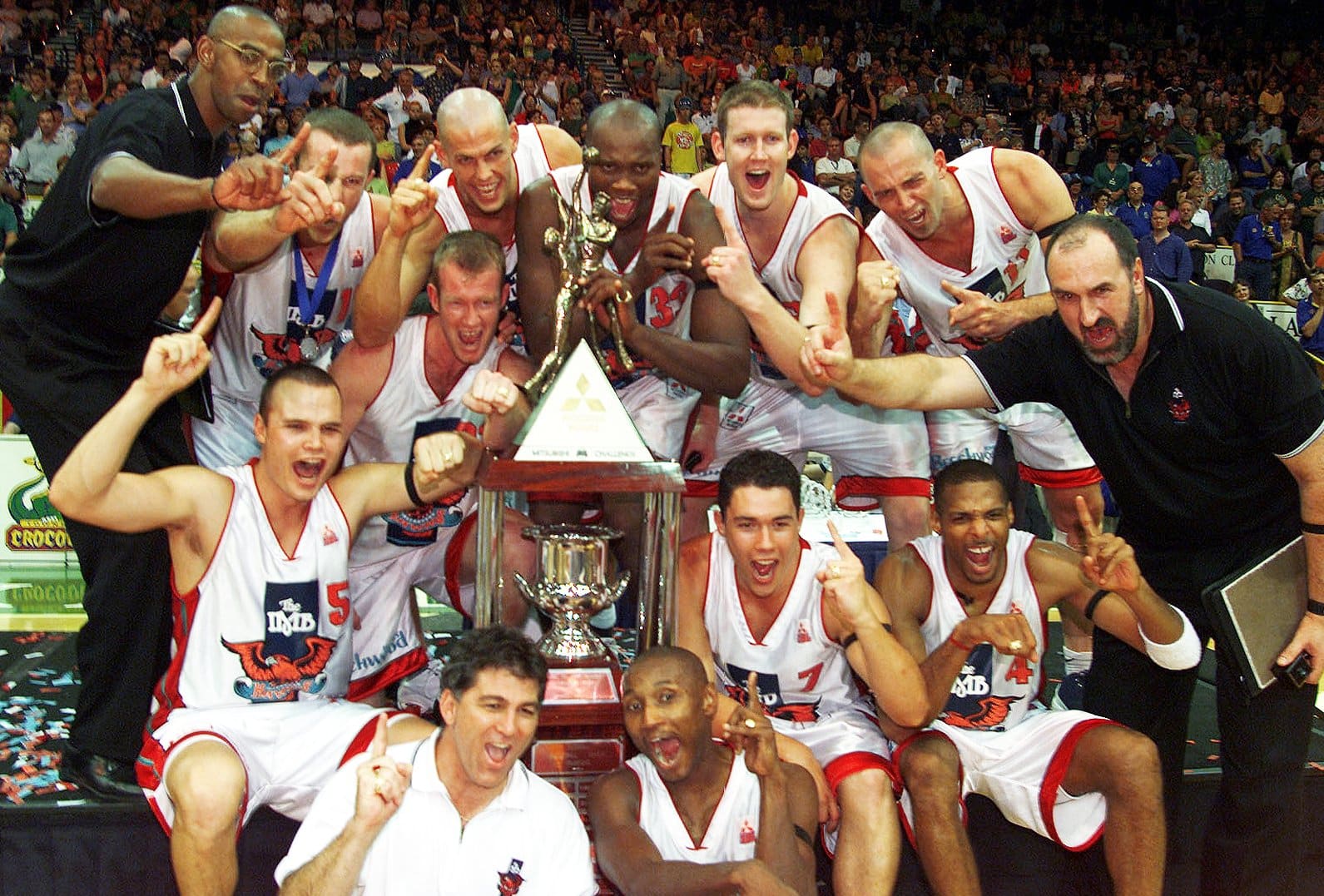
The Wollongong Hawks’ 2001 NBL Championship: The defining moment of an underdog’s rise
March 15, 2025


BIO: Axel Dench was born in Melbourne (VIC) and began playing basketball as a junior with the Nunawading basketball program.
Axel Dench made his NBL debut with the Wollongong Hawks at 24 years of age. He scored 12 points in his first game.
Prior to the start of the 2000/01 season, coach Brendan Joyce revamped nearly half the Wollongong Hawks’ roster after CJ Bruton (to Sioux Falls), Todd Mundt, Mike McKay, Mark Dalton and Darren Perry exited the team, bringing in Axel Dench (via Gonzaga), Charles Thomas, Damon Lowery, Grant Kruger, Matt Shanahan and veteran Ray Borner. The changes paid immediate dividends as the Hawks enjoyed their most successful regular season in franchise history.
Joyce retained co-captains Mat Campbell and Glen Saville together with Melvin Thomas and Matt Garrison, giving Wollongong a deeper roster built around chemistry, role players and balance rather than individual stars, while Dench arrived after starting 32 of 33 games during his senior year at Gonzaga and giving the Hawks another frontcourt player who could stretch the floor.
Wollongong opened the season at the WIN Entertainment Centre with a 115-97 loss to West Sydney, where Dench (12 points, 9 rebounds, and 4 blocks) made an immediate impact in his NBL debut, while Melvin Thomas (25 points and 16 rebounds) and Charles Thomas (18 points, 7 rebounds, and 5 assists) led Wollongong.
Dench (13.4 points, 6.4 rebounds, and 1.1 blocks) quickly became one of the league’s best rookies, giving the Hawks size, shooting and rim protection as part of a frontcourt rotation that could play through Thomas, Saville, Garrison or Dench depending on the matchup.
His best regular-season scoring game came in Melbourne on October 27, where Dench (25 points, 6 rebounds, and 1 block) helped Wollongong defeat the Victoria Giants 88-81, with Melvin Thomas (31 points, 13 rebounds, 5 assists, and 3 steals) and Saville (10 points, 8 rebounds, 5 assists, and 3 steals) helping the Hawks collect their first win of the season.
On December 1 at Shoalhaven Basketball Stadium, Dench (24 points, 10 rebounds, and 3 blocks) delivered one of his best all-round games as Wollongong defeated Brisbane 111-98, with Saville (24 points, 11 rebounds, 4 steals, and 2 blocks) and Lowery (19 points and 6 assists) helping the Hawks win their first game in Nowra.
With six players averaging double figures, Wollongong became one of the league’s most balanced offensive teams. Melvin Thomas (18.7 points, 9.5 rebounds, and 1.3 steals) and Charles Thomas (16.5 points, 4.8 rebounds, 4.1 assists, and 1.6 steals) became the team’s two leading scorers, while Saville (15.5 points, 9.7 rebounds, 4.4 assists, 2.0 steals, and 1.1 blocks), Lowery (13.6 points, 3.2 assists, and 1.4 steals), Campbell (12.8 points, 3.0 rebounds, and 1.1 steals) and Garrison (9.7 points and 4.9 rebounds) completed the main rotation.
Wollongong finished tied with Perth at 21-7 but placed fourth after losing the head-to-head tiebreaker. The Hawks went 12-0 in games decided by three points or fewer, finished with a league-best 12-2 road record and had no player selected to the All-NBL First or Second Team, highlighting how much of their success was built around depth and collective play.
Saville and Melvin Thomas were named to the All-NBL Third Team, while Dench was named NBL Rookie of the Year after polling 71 of a possible 90 votes to finish ahead of teammate Lowery, who finished second in the voting. Joyce was also named Coach of the Year as Wollongong entered the playoffs chasing the first postseason series win in club history.
Wollongong opened the qualifying finals at the WIN Entertainment Centre with a 97-90 overtime win over Perth, with Melvin Thomas (22 points and 13 rebounds), Lowery (19 points, 3 rebounds, and 5 assists), Dench (17 points and 7 rebounds) and Campbell (10 points and 5 rebounds) helping the Hawks take game one.
Game two moved to Perth, where Charles Thomas (25 points, 7 rebounds, and 5 assists) and Saville (23 points, 10 rebounds, and 4 assists) led Wollongong, while Dench (8 points, 6 rebounds, and 2 blocks) was held down as the Wildcats responded with a 106-95 win.
Game three remained in Perth, where Saville (26 points, 16 rebounds, and 4 assists), Lowery (20 points, 4 rebounds, 6 assists, and 4 steals), Dench (19 points, 5 rebounds, 3 assists, and 2 blocks) and Charles Thomas (16 points, 5 rebounds, and 5 assists) led Wollongong to a 98-88 upset and the first playoff series victory in club history.
The semifinals opened in Adelaide, where Dench (5 points and 4 rebounds) had a quieter game as Wollongong edged the 36ers 84-83 behind Melvin Thomas (18 points, 13 rebounds, and 4 assists), Charles Thomas (17 points and 6 rebounds) and Saville (14 points, 18 rebounds, and 4 assists), giving the Hawks their first win in Adelaide since 1990.
Game two returned to Wollongong, where Dench (26 points and 9 rebounds) produced his best game of the postseason and scored 17 first-half points, but Adelaide forced a deciding game with a 111-100 win despite Melvin Thomas (22 points and 11 rebounds), Saville (17 points and 15 rebounds) and Campbell (14 points) also leading the Hawks, with the 36ers breaking the game open by making seven consecutive three-pointers during their fourth-quarter comeback.
Game three at the WIN Entertainment Centre became one of the most dramatic finishes in NBL history, with Dench (10 points, 2 rebounds, 3 assists, and 2 blocks) helping Wollongong stay close before Lowery (20 points, 5 rebounds, and 3 assists) was fouled on a final-second three-point attempt and made all three free throws to win 109-108. Melvin Thomas (28 points, 11 rebounds, 4 steals, and 2 blocks) shot 13-of-18, while Campbell (19 points and 4 rebounds) made 5-of-6 three-pointers and Garrison (14 points, 4 rebounds, and 4 assists) also contributed as Wollongong reached its first Grand Final series, with Kevin Brooks (26 points), Paul Maley (21 points) and Mark Nash (20 points) leading Adelaide.
The Grand Final opened at the WIN Entertainment Centre against Townsville, where Wollongong won 104-101 behind Melvin Thomas (24 points and 14 rebounds), Campbell (19 points, 3 assists, and 2 blocks), Charles Thomas (17 points, 4 rebounds, and 7 assists), Saville (14 points and 10 rebounds) and Dench (13 points).
Game two moved to Townsville, where the Crocodiles responded with a 114-97 win despite Lowery (25 points, 7 assists, and 3 steals), Charles Thomas (20 points and 5 assists) and Melvin Thomas (16 points, 13 rebounds, and 3 blocks), while Dench (5 points, 5 rebounds, and 2 blocks) was held down as the series was forced to a deciding game on back-to-back nights.
Game three saw Wollongong become the first New South Wales club to win an NBL championship, with Charles Thomas (23 points, 10 rebounds, and 5 assists), Melvin Thomas (18 points and 12 rebounds), Saville (18 points, 12 rebounds, and 5 assists) and Campbell (10 points and 3 rebounds) leading the Hawks to a 97-94 win, with Saville named Grand Final MVP as Dench (15 points, 11 rebounds, 2 assists, and 3 steals) played 40:29 minutes in the championship win.
2001/02
Wollongong entered the 2001/02 NBL season as the defending champions, looking to build on their historic title win. Coached by Brendan Joyce and led by co-captains Mat Campbell and Glen Saville, the Hawks made key roster changes, with Matt Garrison departing for Cairns and Ben Pepper (12.3 points, 7.2 rebounds, and 0.7 blocks) joining the team to bolster the frontcourt.
Axel Dench (9.5 points, 4.5 rebounds, and 1.5 assists per game) remained a key part of Wollongong’s frontcourt rotation in his second NBL season. However, injuries took a toll, limiting him to just 17 games and forcing him to miss almost half the season.
The Hawks finished the regular season in fourth place with a 16-14 record, securing a playoff berth. The team was led by Glen Saville (15.3 points, 9.6 rebounds, and 3.8 assists), Charles Thomas (14.9 points, 4.1 rebounds, and 4.5 assists), Melvin Thomas (14.7 points, 9.7 rebounds, and 2.3 assists), and Mat Campbell (12.7 points, 2.6 rebounds, and 1.8 assists), with Dench playing a key supporting role in their frontcourt rotation.
Wollongong’s postseason campaign was short-lived, as they were eliminated in the qualifying finals by the Adelaide 36ers in two straight games. In Game 1 at WIN Entertainment Centre, the Hawks struggled to contain Adelaide’s offense, suffering a 107-90 loss. Three days later, they faced the 36ers again at Adelaide Arena but fell short in a 101-95 defeat, bringing their title defense to an early end.
MELBOURNE TIGERS
2006/07
Melbourne entered the 2006/07 season as defending champions, with their core group largely intact. The only roster changes saw Nathan Crosswell, Axel Dench, and Liam Norton join the squad, replacing Neil Mottram, Braith Cox, and Gerard Leonard. Dench, returning to Australia after playing overseas in Portugal, was signed as a replacement for Mottram, who had taken up an opportunity to play in Italy.
The Tigers got off to a strong start (5-1) and looked primed for another championship run. Led by reigning MVP Chris Anstey (19.4 points, 9.3 rebounds, 2.8 assists, 1.4 steals, and 1.8 blocks), Melbourne had one of the deepest rosters in the league. Key contributors included Dave Thomas (16.7 points and 6.7 rebounds), Rashad Tucker (14.2 points and 8.0 rebounds), Stephen Hoare (12.5 points and 6.7 rebounds), Darryl McDonald (10.6 points and 5.2 assists), and Darryl Corletto (10.4 points). With six players capable of leading the team in scoring on any given night, Melbourne posed a constant offensive threat to opposing teams.
Dench (7.6 points, 3.7 rebounds, and 1.4 assists) would play in all 38 games for Melbourne, playing as a back up to Anstey.
Despite their dominance, the Tigers were rivaled all season by the Brisbane Bullets, who underwent a massive off-season recruitment drive. Brisbane, which had finished sixth the previous season (17-15), added CJ Bruton, Ebi Ere, Dusty Rychart, and Dillon Boucher to a roster that already featured Anstey’s former teammates Sam MacKinnon and Mark Bradtke. The additions helped Brisbane put together one of the greatest teams in NBL history.
Brisbane finished the regular season in first place (28-5), while Melbourne finished second (25-8). Both teams lived up to their status as championship favorites, with Brisbane eliminating the Sydney Kings (2-0) and Melbourne defeating the Cairns Taipans (2-0) to set up a highly anticipated Grand Final series.
Melbourne’s semifinal sweep of Cairns came with a surprising standout performance in Game 1, where Axel Dench (18 points) led the Tigers in scoring as Anstey (5 points) struggled with foul trouble. Melbourne took the win (100-87) behind Dench’s unexpected offensive spark. In Game 2 (95-87), the Tigers overcame a huge performance from Taipans import Darnell Mee (23 points, 5 rebounds, 7 assists, and 2 blocks), securing victory with a balanced attack. Six Melbourne players finished in double figures, including Anstey (16 points and 9 rebounds), Hoare (15 points, 8 rebounds, and 6 assists), Tucker (15 points and 12 rebounds), Corletto (15 points), McDonald (10 points), and Crosswell (10 points).
The Grand Final series opened with a thriller in Melbourne, where Chris Anstey (21 points and 9 rebounds) and Dave Thomas (19 points) delivered strong performances. However, Brisbane edged out a 98-95 win, led by Stephen Black (24 points, 5 rebounds, and 5 assists) and Sam MacKinnon (18 points, 12 rebounds, and 8 assists).
In Game 2, Anstey bounced back in dominant fashion, scoring 31 points and grabbing 8 rebounds to lead the Tigers to victory, evening the series before it shifted back to Brisbane.
Game 3 saw the Bullets take control, delivering a commanding 113-93 win in front of 7,539 home fans. Melbourne struggled to contain Brisbane’s depth, with Stephen Black (22 points), MacKinnon (19 points, 7 rebounds, 9 assists, and 3 steals), and the Bullets’ frontcourt holding Anstey to just 9 points.
Facing elimination, Melbourne entered Game 4 determined to force a decider. The Tigers held a narrow 52-51 lead at halftime, but Brisbane took control in the third quarter with a 27-15 run. The Bullets closed out the series with a 103-94 victory, securing the 2007 NBL championship.
Darryl McDonald (17 points and 4 assists) and Rashad Tucker (17 points and 12 rebounds) led Melbourne’s efforts in the final game, but it wasn’t enough to stop Brisbane’s well-rounded attack. CJ Bruton (22 points and 7 assists) and Dusty Rychart (21 points) sealed the win for the Bullets, while Sam MacKinnon was named Grand Final MVP, becoming the first player in NBL history to win a championship, season MVP, Grand Final MVP, and Best Defensive Player in the same season.
Axel Dench played six seasons across three NBL teams. This included the Wollongong Hawks, Melbourne Tigers and Adelaide 36ers. He averaged 9.3 points, 4.9 rebounds, and 1.5 assists in 187 NBL games.
| SEASON | AGE | TEAM | TEAM RECORD | GP | MINS | PTS | REB | AST | OR | DR | STL | BLK | TO | PF | FGM | FGA | FG% | 3PM | 3PA | 3P% | FTM | FTA | FT% | TS% | EFG% | HS |
|---|---|---|---|---|---|---|---|---|---|---|---|---|---|---|---|---|---|---|---|---|---|---|---|---|---|---|
| 2007-08 | 32 | Adelaide | 14-16 (9) | 29 | 458 | 191 | 113 | 43 | 34 | 79 | 6 | 10 | 50 | 54 | 76 | 189 | 40% | 22 | 65 | 34% | 17 | 29 | 59% | 47% | 46% | 25 |
| 2006-07 | 31 | Melbourne | 25-8 (2) | 38 | 793 | 288 | 141 | 54 | 50 | 91 | 10 | 25 | 49 | 98 | 108 | 232 | 47% | 31 | 84 | 37% | 41 | 52 | 79% | 56% | 53% | 21 |
| 2003-04 | 28 | Wollongong | 25-8 (2) | 35 | 797 | 373 | 195 | 58 | 74 | 121 | 12 | 25 | 45 | 78 | 144 | 330 | 44% | 52 | 133 | 39% | 33 | 47 | 70% | 53% | 52% | 29 |
| 2002-03 | 27 | Wollongong | 18-12 (4) | 34 | 841 | 285 | 173 | 56 | 57 | 116 | 16 | 26 | 51 | 95 | 110 | 241 | 46% | 38 | 88 | 43% | 27 | 38 | 71% | 55% | 54% | 19 |
| 2001-02 | 26 | Wollongong | 16-14 (4) | 17 | 409 | 161 | 77 | 26 | 29 | 48 | 9 | 13 | 32 | 56 | 62 | 137 | 45% | 18 | 36 | 50% | 19 | 27 | 70% | 54% | 52% | 17 |
| 2000-01 | 25 | Wollongong | 21-7 (4) | 34 | 1,070 | 455 | 218 | 61 | 86 | 132 | 12 | 37 | 90 | 124 | 171 | 366 | 47% | 39 | 85 | 46% | 74 | 102 | 73% | 55% | 52% | 26 | Totals | 187 | 4368 | 1753 | 917 | 298 | 330 | 587 | 65 | 136 | 317 | 505 | 671 | 1495 | 44.9% | 200 | 491 | 40.7% | 211 | 295 | 71.5% | 54% | 52% | 29 |
| SEASON | AGE | TEAM | TEAM RECORD | GP | MINS | PTS | REB | AST | OR | DR | STL | BLK | TO | PF | FGM | FGA | FG% | 3PM | 3PA | 3P% | FTM | FTA | FT% | TS% | EFG% | HS |
|---|---|---|---|---|---|---|---|---|---|---|---|---|---|---|---|---|---|---|---|---|---|---|---|---|---|---|
| 2007-08 | 32 | Adelaide | 14-16 (9) | 29 | 15.8 | 6.6 | 3.9 | 1.5 | 1.2 | 2.7 | 0.2 | 0.3 | 1.7 | 1.9 | 2.6 | 6.5 | 40% | 0.8 | 2.2 | 34% | 0.6 | 1.0 | 59% | 47% | 46% | 25 |
| 2006-07 | 31 | Melbourne | 25-8 (2) | 38 | 20.9 | 7.6 | 3.7 | 1.4 | 1.3 | 2.4 | 0.3 | 0.7 | 1.3 | 2.6 | 2.8 | 6.1 | 47% | 0.8 | 2.2 | 37% | 1.1 | 1.4 | 79% | 56% | 53% | 21 |
| 2003-04 | 28 | Wollongong | 25-8 (2) | 35 | 22.8 | 10.7 | 5.6 | 1.7 | 2.1 | 3.5 | 0.3 | 0.7 | 1.3 | 2.2 | 4.1 | 9.4 | 44% | 1.5 | 3.8 | 39% | 0.9 | 1.3 | 70% | 53% | 52% | 29 |
| 2002-03 | 27 | Wollongong | 18-12 (4) | 34 | 24.7 | 8.4 | 5.1 | 1.6 | 1.7 | 3.4 | 0.5 | 0.8 | 1.5 | 2.8 | 3.2 | 7.1 | 46% | 1.1 | 2.6 | 43% | 0.8 | 1.1 | 71% | 55% | 54% | 19 |
| 2001-02 | 26 | Wollongong | 16-14 (4) | 17 | 24.1 | 9.5 | 4.5 | 1.5 | 1.7 | 2.8 | 0.5 | 0.8 | 1.9 | 3.3 | 3.6 | 8.1 | 45% | 1.1 | 2.1 | 50% | 1.1 | 1.6 | 70% | 54% | 52% | 17 |
| 2000-01 | 25 | Wollongong | 21-7 (4) | 34 | 31.5 | 13.4 | 6.4 | 1.8 | 2.5 | 3.9 | 0.4 | 1.1 | 2.6 | 3.6 | 5.0 | 10.8 | 47% | 1.1 | 2.5 | 46% | 2.2 | 3.0 | 73% | 55% | 52% | 26 | Total | 187 | 23.4 | 9.4 | 4.9 | 1.6 | 1.8 | 3.1 | 0.3 | 0.7 | 1.7 | 2.7 | 3.6 | 8.0 | 44.9% | 0.0 | 0.0 | 40.7% | 1.1 | 2.6 | 71.5% | 54% | 52% | 29 |
| POINTS | REBOUNDS | ASSISTS | STEALS | BLOCKS | TURNOVERS | TRIPLE DOUBLES | 29 | 17 | 6 | 3 | 4 | 7 | 0 |
|---|
Dench joined McKinnon for the 2012 Big V season, with the Cougars reaching the Division Two Men elimination final against Warrandyte after Dench averaged 12.3 points and 10.0 rebounds per game.
Dench remained with McKinnon through the club’s move into higher Big V competition, and by 2015 the Cougars were in the State Championship Men finals after a regular season that included a nine-game winning streak before an elimination final matchup with Hume City.
In 2016, Dench was part of McKinnon’s Big V State Championship Men group and produced back-to-back triple-doubles late in the season, with one of those games including 10 points, 18 rebounds and 11 assists.
Dench played 23 games for McKinnon in the 2017 Big V season and averaged 5.8 points, 4.5 rebounds and 3.2 assists in 17.3 minutes per game, shooting 42.6 percent on two-point attempts, 38.6 percent from three-point range and 75.0 percent at the free-throw line.
Member of 2002 Boomers Squad which failed to qualify for World Championships
Axel Dench played two seasons in Portugal from 2004 to 2006, beginning with FC Barreirense in 2004–05 where he recorded a career-high 30 points in a professional game along with 14 rebounds and seven assists, and finished the season averaging 14.7 points, 9.3 rebounds and 3.4 assists per game while playing at 119kg to provide a more commanding inside presence. He suited up alongside teammates including Steffon Bradford and Betinho Gomes, and on April 29, 2005 he played in a 1/4 Final loss to Ovarense Aerosoles (97–69), logging 38:00 with nine points and seven rebounds.
In 2005–06, Dench moved to FC Porto (Porto Ferpinta) and averaged nine points per game and 4.5 rebounds, with one report noting his Porto season at nine points per game with 47% three-point shooting and five rebounds per game. He was part of FC Porto’s Taça de Portugal-winning squad under coach Luís Magalhães alongside players such as Lorenzo Orr, Dustin Hellenga, Rodrigo Mascarenhas, Emiliano Morales, João Rocha and Paulo Cunha, with Porto defeating SL Benfica 95–84 in the final on April 2, 2006, and Dench contributing in the run including a 30 March 2006 quarter-final win over CAB Madeira (71–67) where he played 24:51 with two points, seven rebounds and three assists.
Dench played four NCAA Division I seasons at Gonzaga from 1996-97 through 1999-00, finishing his college career with 129 appearances and averages of 7.3 points, 4.3 rebounds and 1.2 assists per game while shooting 50.9% from the field, 40.5% from three-point range (49-of-121), and 69.4% at the free throw line (170-of-245).
As a freshman in 1996-97, Dench was a late recruit who still played all 27 games and made 20 starts, averaging 7.7 points in 22.1 minutes per game while ranking among the WCC leaders in efficiency with a 50.3% field goal mark and 78.4% at the line, and Gonzaga finished that season 15-12 overall (8-6 in WCC play) under head coach Dan Fitzgerald.
In 1997-98, Dench started 31 games as a sophomore as Gonzaga went 24-10 overall (10-4 in the WCC) under head coach Dan Monson, with the Bulldogs winning the WCC regular season and then reaching the NIT second round, while Dench posted 5.3 points per game, hit 11-of-30 from three (36.7%), and recorded his lone double-double of the season with 13 points and 10 rebounds against Mississippi State at the Top of the World Classic.
During his junior year in 1998-99, Dench was used primarily off the bench and averaged 6.8 points per game while shooting 48.9% from the field, scoring a season-high 22 points at TCU on 10-of-16 shooting and reaching double figures nine times, as Gonzaga finished 28-7 overall (12-2 WCC), won both the WCC regular season and WCC tournament, and made a West Region run to the NCAA Tournament regional final after beating Minnesota, Stanford and Florida before falling to Connecticut.
In his senior season in 1999-00, Dench started in 32 of 33 games in his senior year with Gonzaga.
That 1999-00 season saw Gonzaga finish 26-9 overall (11-3 WCC) and win the WCC tournament to reach the NCAA Tournament, where the Bulldogs beat Louisville in the first round and St. John’s in the second round before losing to Purdue in the West Regional semifinal, with Dench producing 9.6 points, 5.0 rebounds and 1.5 assists per game in 22.2 minutes per night while shooting 54.1% from the field and 46.4% from three (26-of-56).
Dench’s senior-year notes included missing two games at the start of WCC play due to soft tissue damage in his right calf, ranking second on the team in rebounding at 5.0 per game, and finishing fifth in the WCC in field-goal percentage at 54.1%, while also setting several single-game marks such as a career-high 28 points against Portland and a season-high nine rebounds against Oregon at the Rainbow Classic, then adding 14 points in the NCAA Tournament first round and 17 points against St. John’s in the second round.
Across Dench’s full Gonzaga career, his year-by-year scoring moved from 208 points as a freshman to 180 as a sophomore, 238 as a junior, and 317 as a senior, and his career totals included 943 points, 549 rebounds, 159 assists, 58 steals and 67 blocks alongside 2,513 minutes played, with his best perimeter season coming as a senior when he combined increased volume with efficiency by making 26 threes at 46.4% after shooting 36.7% as a sophomore and 35.3% as a junior.
- NBL Rookie Of The Year (2001)
Whilst we try to source as much information as we can for every player who has ever played in the NBL some information on a player profile may be missing. If you have additional information on a player you'd like us to add to a profile, please send it to us using the enquiry form below.
Submissions are then sent to info@aussiehoopla.com

