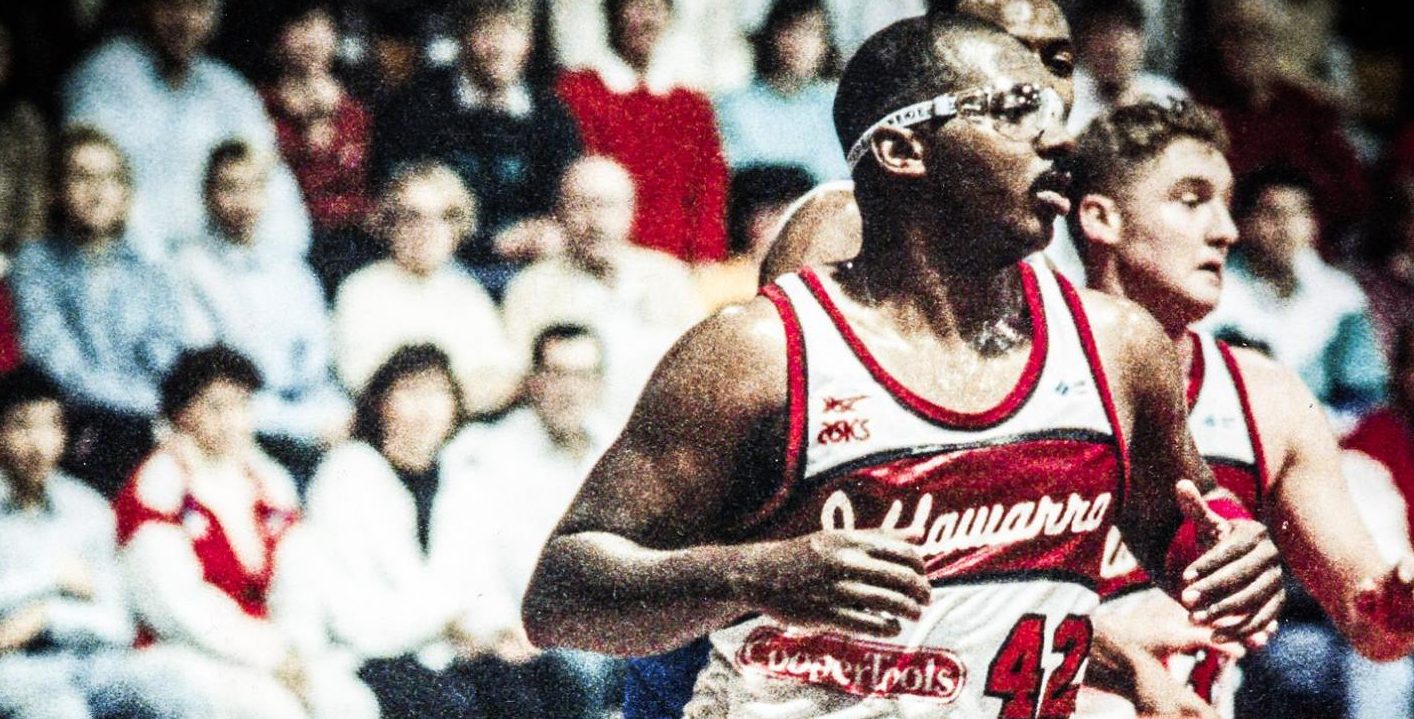
The Greatest NBL Players at Every Age
April 11, 2021


NICKNAME/S: The Man Mountain
FAMILY: His third cousin Jarrod Uthoff also played basketball at Iowa State before playing in the NBA.
Dean’s brother, Ed, also distinguished himself in college ball and was team captain at San Jose State.
Dean Uthoff made his NBL debut with the Nunawading Spectres at 24 years of age. He scored 20 points in his first game.
In 1983, Uthoff averaged 16.2 points, 14.6 rebounds, and 3.4 assists as the Spectres finished with a record of 15-7 and in fifth place during the regular season.
1984
Coach Barry Barnes led the Spectres to a record of 14 wins, 9 losses in 1984 which saw them finish in fourth place in the NBL’s Western Division. Due to the size of the league (the NBL featured 17 team’s at this time), the NBL finals series in 1984 consisted of the elimination-style divisional finals, two semi-final games, and one championship-deciding grand final.
Nunawading would defeat Adelaide, 108–101 in their Elimination Final before losing to Geelong in the Qualifying Finals, 91–115, in the next game.
Uthoff would lead the league in rebounding this season and average 20.1 points, 18.5 rebounds, and 4.9 assists per game. His 18.5 rebounds per game remains the highest single season rebound total of all-time.
1985
In 1985 Uthoff faced a number of injuries that saw him play in only two games before sitting out the rest of the season.
He would spend the 1986 and 1987 seasons playing in the state leagues as he rehabilitated the injury before returning to the Spectres (who had since been re-named to the Eastside Melbourne Spectres in 1988). During his time away from the NBL Uthoff had become a naturalised Australian and played as a local player from 1988 onwards.
EASTSIDE MELBOURNE SPECTRES
1988
After the Spectres chose not to re-sign Barry Barnes (who had been the Spectres head coach since they entered the NBL), former Melbourne Tigers player, Brian Goorjian, who had been coaching Ballarat in the Victorian State League was named as his successor. Goorjian’s arrival wasn’t exactly a warm one. With some team members feeling that Barnes’ assistant coach Colin Cadee should have been given the job, a number of players signed a petition to prevent Goorjian from getting the role.
Once appointed as head coach Goorjian, import Bruce Bolden and Brendan Joyce left for rival club Westside Melbourne and Peter Blight headed to Hobart. Goorjian retained the younger players on the roster, Ron Lemons, Warren Pink, Steve Lunardon, Shane Froling and Darren Lucas and but decided not to re-sign the team’s leading scorer from last season, Vince Hinchen. Instead, he would look to find a import better suited to the new look roster.
Goorjian struggled to find the right US talent to balance out the team. His first import, Kevin Ross (14.0 points, 3.5 rebounds), lasted only two games before being sent back to the US, and his replacement Quentin Anderson (12.0 points, 9.5 rebounds), wasn’t much better and was also given the axe after two games. Goorjian had also signed Harvard University’s leading scorer Arne Duncan to pair with the aforementioned Ross and Anderson. Duncan (24.1 points, 4.7 rebounds and 5.4 assists) was a totally different story. A blue-chip athlete who went on the lead the team in scoring and in fact, packed a suitcase and flew to Australia with just a week’s notice after narrowly missing out on a contract with the Boston Celtics.
Mid-season Goorjian then signed Rick Sharpe (19.6 points, 5.3 rebounds and 3.2 assists), who had played for his father Ed Goorjian at the University of Loyola.
By the time Eastside had got its import situation sorted they were already 0-6 which included losses to both Hobart and Sydney, both among the league’s weakest team’s that season.
Uthoff lead the league in rebounding and average 18.3 points, 17.2 rebounds, and 4.3 assists. Eastside finished the season with 11 wins, 13 losses, and in the eleventh spot, leading Goorjian to describe the season as a ‘disaster’. Lucas would go on to be named the league’s Most Improved Player that year in one of the few positives of the Spectres season.
1989
After a import merry-go-round and lacklustre season in coach Brian Goorjian’s first year, he looked to create some stability within the franchise. He re-signed import Arne Duncan, last year’s leading scorer and paired him with import Ben Tower, a Michigan native who had been drafted by the Detroit Pistons five years earlier.
The Spectres retained the core group of last season’s roster, team captain Warren Pink, Dean Uthoff, the league’s leading rebounder and the league’s most improved player Darren Lucas. The rest of the roster was built around a bunch of young talent, with Shane Froling, Paul Hotchin and Steve Lunardon all returning with one more season of experienced, 17-year-old Spectres junior player Rupert Sapwell and 24-year-old Wayne Larkins from Westside Melbourne.
During the pre-season, Duncan suffered a injury that saw him miss the first half of the regular season.
The Spectres then signed Kent Lockhart, who had been playing in the state league for Sandringham, as an injury replacement for Duncan. Goorjian, who had been playing pickup basketball games against state league players during the offseason, was impressed by his ability to play both sides of the ball.
Lockhart (28.8 points, 6.6 rebounds, and 2.4 assists) led the team in scoring, and made such a impact on the team that when Duncan returned from injury, the team released Ben Tower and signed Lockhart to the full-time roster. With Duncan putting up big numbers again (28.6 points, 6.2 rebounds, and 5.6 assists) and Dean Uthoff (18.6 points, 17.0 rebounds, and 4.0 assists) leading the league in rebounding for a second consecutive year, the Spectres finished the year on a four-game winning streak. Lockhart, who posted an incredible 47 points against the Newcastle Falcons in Round 18, was named to the All-NBL First Team, and with Eastside Melbourne improved from an 11–13 record to a 14–12 record, leaving Spectres’ fans very optimistic for next season.
1990
Eastside had been slowly improving each season since Brian Goorjian was appointed head coach in 1988, and by 1990 many of the core group that had been a part of the roster when Goorjian took over had developed from junior talent to highly productive NBL players.
The only changes to the local roster were the exits of veterans Paul Hotchins and Warren Pink, who were then replaced with Darren Perry (Brisbane) and Nunawading junior Tony Ronaldson, who had just completed a year at the Australian Institute of Sport. The departure of import Arne Duncan then made room for the return of former Spectre Bruce Bolden.
To kick off the season, Eastside was tipped to be the big improvers of 1990 after finishing ‘best of the rest’ the year prior. The team started off by winning its first three games on the schedule, but over the course of the season, the team never seemed to be able to beat the league’s best. While they knocked off the majority of the league, losses they couldn’t see to deliver wins against elite team’s like Perth, Brisbane and North Melbourne. In Round 21, Eastside turned things around with a win over crosstown rivals North Melbourne (118-111), but then followed that up with a 3-2 run home.
Despite this, Eastside still managed to finish second on the ladder thanks to a impressive 10-3 home record. Lockhart (27.0 points, 7.6 rebounds, 4.5 assists, and 1.3 steals) returned a better player in his second year in the league, leading the team in scoring and being selected to the All-NBL Second Team. Bolden (26.4 points, 11.5 rebounds, 4.5 assists, 2.0 steals and 1.2 blocks) filled the stat sheet most games and Uthoff (17.9 points and 13.6 rebounds) led the team in rebounding once again. Perry (10.7 points, 2.4 rebounds and 5.6 assists) running the point guard spot was a big part of the Spectres improvement from 14-10 last season, to 16-8 in 1990.
Due to finishing in second place, Eastside received a first-round bye then met Brisbane, who eliminated Sydney in the elimination finals, in the semi final. This was the first time a Goorjian coached team had reached the semi finals but they were eliminated by the Bullets amidst little fanfare in two straight games.
1991
After making the playoffs for the first time in three years, coach Brian Goorjian was able to bring back almost the entire squad for another shot at the championship, the team’s only key loss being bruising forward Shane Froling, who was replaced with Scott Ninnis.
Behind Eastside’s formidable frontcourt, led by Bruce Bolden (27.2 ppg and 10.4 rpg) and Kent Lockhart (18.6 ppg and 5.7 rpg) the Spectres finished the season with a 17-9 record. Uthoff also contributed 16.8 points, 13.6 rebounds, and 3.8 assists as Eastside finished in second place, earning them a first-round bye in the playoffs. Eastside would then eliminate North Melbourne, 2–0 in the semifinals before facing off against the Perth Wildcats, who had finished the season in first place (22-4) and eliminated the Adelaide 36ers in their semi-final matchup. The Grand Final series would see Perth come away victorious with a 109-83 win in game one before the Spectres evened things up with a 86-81 win in game two. Behind the stellar play from Perth imports Ricky Grace and Pete Hanson, who would be awarded the Grand Final MVP, Perth defeated Eastside in the deciding game, 90-80.
SYDNEY KINGS
1992
In 1992, Uthoff averaged 16.9 points, 12.2 rebounds, and 2.2 assists as the Kings finished with a record of 17-7 and in second place during the regular season.
1993
In 1993, Uthoff averaged 9.6 points, 12 rebounds, and 2.2 assists, playing a key role in the King’s rotation, helping the team finish 11th in the regular season with an 11–15 record.
1994
After finishing 11th with an 11-15 record and missing the playoffs in 1993, Sydney reshaped its roster while retaining Damian Keogh, Greg Hubbard, Dean Uthoff, Mark Dalton, Tim Morrissey and Jody Austin. After three seasons together, coach Bob Turner chose not to re-sign import duo Dwayne McClain and Ken McClary amid rumours that McClain’s rise in popularity had led to difficulties coaching the star, while Tony De Ambrosis (to Gold Coast), Wayne Womack, James Carr, John Blake and Mike Kenny also did not return.
Turner signed Mario Donaldson (via Omaha) after spotting him during Omaha’s 1993 CBA championship season and paired him with Leon Trimmingham (via Briar Cliff), a relatively unknown forward who had been recommended by former Hobart coach Dr David Atkins. Neil Turner (via Hobart) and Brad Williams were also added to the roster.
Sydney opened the season at the Sydney Entertainment Centre on April 9, where Uthoff (7 points, 8 rebounds, 1 assist, and 1 steal) contributed as Trimmingham (32 points, 14 rebounds, 3 steals, and 2 blocks) and Donaldson (28 points, 6 rebounds, 8 assists, and 2 blocks) powered the Kings to a 110-100 win over South East Melbourne, while Bruce Bolden (25 points, 11 rebounds, and 5 assists) led the Magic. The victory began a 3-0 start for Sydney.
Uthoff (8.3 points and 9.3 rebounds across 29 games) appeared in every game this season and shot 65 percent from the field, leading the NBL in field goal percentage. His physical play was remembered years later by former NBL MVP Derek Rucker, who ranked him among the five scariest players to play in the league and recalled, “Broke three of my ribs in a game in Sydney in 1994. Appreciate you Dean.” Former teammate Morrissey also remembered how Uthoff filled his role inside, saying, “Played his role perfectly: rebounded, blocked shots, defended.”
Uthoff’s season-high came in Townsville on May 27, where he made 8-of-9 shots and finished with 19 points, 10 rebounds, 3 assists, and 1 steal as Sydney defeated the Suns 115-95. Trimmingham (37 points, 15 rebounds, and 3 steals) and Hubbard (29 points, 3 rebounds, 3 assists, and 2 steals) led the Kings, while Ricky Jones (32 points, 14 rebounds, 3 assists, and 6 blocks) was Townsville’s best.
Against Brisbane at the Sydney Entertainment Centre on June 25, Uthoff (9 points, 19 rebounds, 4 assists, and 1 steal) grabbed a season-high 19 rebounds as the Kings defeated the Bullets 117-106. Donaldson (37 points, 6 rebounds, 3 assists, and 3 steals) and Trimmingham (27 points, 13 rebounds, and 4 blocks) carried the scoring, while Leroy Loggins (25 points and 9 rebounds) led Brisbane.
Uthoff (18 points, 11 rebounds, and 2 assists) delivered another of his best games against Perth on September 10, making 8-of-9 shots from the field, but the Wildcats defeated Sydney 99-96 at the Sydney Entertainment Centre. Donaldson (18 points, 3 assists, and 2 steals) and Trimmingham (17 points, 11 rebounds, 3 assists, 2 steals, and 3 blocks) provided support, while James Crawford (23 points, 8 rebounds, 3 steals, and 1 block) led Perth.
After reaching the halfway point at 8-3 and looking like a championship contender, Sydney’s young roster struggled to maintain that form and went 8-7 over its remaining 15 regular-season games.
Trimmingham (27.3 points, 10.7 rebounds, 1.3 steals, and 2.2 blocks) led Sydney in scoring, rebounding and blocked shots, was named Kings club MVP and earned All-NBL First Team honours in his debut season. Donaldson (22.1 points, 5.2 rebounds, 3.8 assists, and 1.8 steals) and Hubbard (18.2 points, 3.1 rebounds, 3.6 assists, and 2.2 steals) provided the additional scoring, while Keogh (11.4 points, 3.7 rebounds, 5.8 assists, and 1.9 steals) ran the offence and Dalton (8.2 points, 6.1 rebounds, and 1.4 steals) provided further support.
Sydney closed the regular season at home against Geelong on September 24, where Uthoff (4 points, 3 rebounds, and 1 block) contributed as Trimmingham (29 points, 12 rebounds, 2 assists, and 2 blocks) and Hubbard (22 points, 4 rebounds, and 3 steals) led the Kings to a 102-97 win, while Everette Stephens (22 points, 3 rebounds, 3 assists, and 4 steals) was Geelong’s best. The victory left Sydney seventh with a 16-10 record and returned the Kings to the playoffs.
Sydney faced second-placed North Melbourne in the quarterfinals after the Giants had defeated the Kings in both regular-season meetings. Game one was played at the Sydney Entertainment Centre on September 26, where Uthoff (6 points, 7 rebounds, 1 assist, and 1 steal) helped Sydney race to an 11-0 lead inside the opening 71 seconds against a North Melbourne side playing its third road game in four days. The Kings led 43-25 after the first quarter and 77-51 at halftime before winning 131-109 in front of 9,092 fans, making 15-of-18 three-pointers for 83.3 percent. Hubbard (32 points and 7 steals) made 8-of-9 three-pointers, Donaldson (27 points, 5 rebounds, and 5 assists) added 27 and Keogh (18 points, 8 rebounds, and 10 assists) fell two rebounds short of a triple-double, while Paul Maley (26 points and 6 rebounds), Rod Johnson (20 points) and Darryl McDonald (11 points, 9 rebounds, 9 assists, and 4 steals) led North Melbourne.
Game two moved to the Melbourne Sports and Entertainment Centre, where Uthoff (10 points, 6 rebounds, 2 assists, and 1 block) made 5-of-8 shots, but North Melbourne responded with a 112-91 win. Trimmingham (22 points, 10 rebounds, and 2 blocks) and Donaldson (18 points, 4 rebounds, 2 steals, and 3 blocks) led Sydney, while Pat Reidy (28 points, 4 rebounds, 4 assists, and 2 steals), Maley (17 points and 9 rebounds) and McDonald (14 points, 5 rebounds, 10 assists, and 2 steals) forced the series into a deciding third game.
Game three remained in Melbourne on October 2, where Uthoff (4 points, 8 rebounds, and 1 steal) contributed alongside Trimmingham (31 points and 10 rebounds) and Keogh (21 points, 5 rebounds, and 3 assists), while Maley (33 points, 4 rebounds, 5 assists, and 4 steals), Reidy (24 points, 4 rebounds, 5 assists, and 4 steals) and McDonald (17 points, 13 rebounds, and 7 assists) led North Melbourne to a 104-95 win, eliminating Sydney before the Giants went on to win the NBL championship.
1995
After a great start to the 1994 season, the Kings collapsed during the second half of the year with the team’s young roster felt to be the cause. Veteran talent Phil Smyth (Adelaide), Justin Withers (Canberra) and import Bruce Bolden (SE Melbourne), who would replace fan favourite Mario Donaldson, would bring the experience required in spades.
The Kings starting lineup had increased from the average age of 28 to 31, which meant although they had added a ton of experience, this roster would only have one or two years to make it count.
The season started with a narrow 85-86 loss to Bolden’s former team, the Magic, before a up-and-down season, where the Kings defeated a number of league’s top team’s but failed to close out games against those at the bottom of the ladder. Sydney would start the season with a 3-6 record, which included wins over Perth and North Melbourne, who would finish first and third, respectively, but suffered back-to-back losses to Canberra (who would finish tenth) and lost games to Townsville (finished 12th) and Gold Coast (finished 13th).
Leon Trimmingham (27.5 points, 11.2 rebounds, 1.8 assists, 2.1 steals and 2.2 blocks) was named Kings team MVP after leading the team in scoring, rebounds, steals and blocks as Bolden (20.5 points, 10.8 rebounds, 2.3 assists and 1.3 steals) and captain Damian Keogh (14.4 points, 4.0 rebounds, 6.1 assists and 1.6 steals) provided the additional scoring power. Sydney finished the season in tenth place with a record of 10-16 and failed to reach the playoffs.
Uthoff averaged 4 points, 4.2 rebounds, and 0.8 assists for the season.
1996
During the 1996 season, Uthoff averaged 0.5 points, 2 rebounds, and 1.5 assists and was a part of the Kings squad which finished in fifth place with a record of 16-10.
The Iowa State centre led the NBL in rebounding three times throughout his 12-season career and of the top six highest rebounding games in NBL history, Uthoff owns four of them, including a all-time NBL record of 34 boards vs. Hobart. Just as impressive was his career-shooting percentage at 60.3 percent, and at no surprise also led the NBL three times in that category.
Uthoff was a four-time NBL All-Star (1988-91) and he finished third in the league MVP voting twice (1988, 1989) during his time with the Spectres.
He ranks third all-time in the NBL for career field goal percentage at 60% and is also ranked in the NBL’s top ten all-time in offensive, defensive and total career rebounds. One of the true giants of the competition, Uthoff wrapped up his outstanding NBL career in 1996 at the age of 38 as a member of the Sydney Kings. The organisation named Uthoff as one of their “legends” in their 25th anniversary celebration in 2013.
Dean Uthoff played twelve seasons across three NBL teams. This included the Nunawading Spectres, Eastside Melbourne Spectres and Sydney Kings. He averaged 14.4 points, 12.9 rebounds, and 2.7 assists in 260 NBL games.
– 13rd in total rebounds
– 7th in rebounds per game.
HIGHLIGHTS:
| SEASON | AGE | TEAM | TEAM RECORD | GP | MINS | PTS | REB | AST | OR | DR | STL | BLK | TO | PF | FGM | FGA | FG% | 3PM | 3PA | 3P% | FTM | FTA | FT% | TS% | EFG% | HS |
|---|---|---|---|---|---|---|---|---|---|---|---|---|---|---|---|---|---|---|---|---|---|---|---|---|---|---|
| 1996 | 38 | Sydney | 16-10 (5) | 2 | 13 | 1 | 4 | 3 | 3 | 1 | 0 | 0 | 0 | 3 | 2 | 0% | 0 | 0 | 0% | 1 | 2 | 50% | 17% | 0% | 1 | |
| 1995 | 37 | Sydney | 10-16 (10) | 23 | 259 | 91 | 96 | 19 | 43 | 53 | 8 | 4 | 22 | 48 | 38 | 73 | 52% | 0 | 0 | 0% | 15 | 24 | 63% | 54% | 52% | 15 |
| 1994 | 36 | Sydney | 16-10 (7) | 29 | 713 | 240 | 271 | 46 | 94 | 177 | 21 | 7 | 52 | 74 | 111 | 172 | 65% | 0 | 0 | 0% | 18 | 50 | 36% | 61% | 65% | 19 |
| 1993 | 35 | Sydney | 11-15 (11) | 24 | 758 | 231 | 289 | 30 | 109 | 180 | 26 | 4 | 61 | 71 | 100 | 172 | 58% | 0 | 0 | 0% | 31 | 74 | 42% | 56% | 58% | 20 |
| 1992 | 34 | Sydney | 17-7 (2) | 29 | 1,077 | 490 | 353 | 63 | 155 | 198 | 26 | 13 | 98 | 94 | 202 | 307 | 66% | 1 | 1 | 100% | 85 | 153 | 56% | 65% | 66% | 31 |
| 1991 | 33 | Eastside Melbourne | 17-9 (2) | 30 | 1,153 | 504 | 409 | 113 | 129 | 280 | 39 | 19 | 107 | 126 | 204 | 339 | 60% | 0 | 1 | 0% | 96 | 169 | 57% | 60% | 60% | 25 |
| 1990 | 32 | Eastside Melbourne | 18-8 (2) | 28 | 961 | 500 | 381 | 67 | 145 | 236 | 30 | 19 | 96 | 92 | 213 | 332 | 64% | 0 | 1 | 0% | 74 | 127 | 58% | 64% | 64% | 31 |
| 1989 | 31 | Eastside Melbourne | 14-10 (7) | 23 | 887 | 427 | 392 | 92 | 154 | 238 | 17 | 19 | 105 | 80 | 186 | 281 | 66% | 0 | 0 | 0% | 55 | 103 | 53% | 65% | 66% | 32 |
| 1988 | 30 | Eastside Melbourne | 11-13 (8) | 24 | 973 | 440 | 413 | 102 | 131 | 282 | 31 | 21 | 126 | 64 | 195 | 327 | 60% | 0 | 1 | 0% | 50 | 98 | 51% | 59% | 60% | 34 |
| 1985 | 27 | Nunawading | 19-7 (3) | 2 | 0 | 8 | 13 | 4 | 7 | 6 | 0 | 2 | 5 | 5 | 4 | 10 | 40% | 0 | 0 | 0% | 0 | 0 | 0% | 40% | 40% | 4 |
| 1984 | 26 | Nunawading | 14-9 (7) | 20 | 0 | 401 | 369 | 98 | 140 | 229 | 24 | 18 | 76 | 65 | 175 | 316 | 55% | 0 | 0 | 0% | 51 | 72 | 71% | 57% | 55% | 33 |
| 1983 | 25 | Nunawading | 15-7 (5) | 26 | 0 | 422 | 379 | 88 | 133 | 246 | 25 | 12 | 90 | 72 | 168 | 314 | 54% | 0 | 0 | 0% | 86 | 132 | 65% | 56% | 54% | 28 | Totals | 260 | 6794 | 3755 | 3369 | 725 | 1243 | 2126 | 247 | 138 | 838 | 794 | 1596 | 2645 | 60.3% | 1 | 4 | 25.0% | 562 | 1004 | 56.0% | 61% | 60% | 34 |
| SEASON | AGE | TEAM | TEAM RECORD | GP | MINS | PTS | REB | AST | OR | DR | STL | BLK | TO | PF | FGM | FGA | FG% | 3PM | 3PA | 3P% | FTM | FTA | FT% | TS% | EFG% | HS |
|---|---|---|---|---|---|---|---|---|---|---|---|---|---|---|---|---|---|---|---|---|---|---|---|---|---|---|
| 1996 | 38 | Sydney | 16-10 (5) | 2 | 6.5 | 0.5 | 2.0 | 1.5 | 1.5 | 0.5 | 0.0 | 0.0 | 0.0 | 1.5 | 0.0 | 1.0 | 0% | 0.0 | 0.0 | 0% | 0.5 | 1.0 | 50% | 17% | 0% | 1 |
| 1995 | 37 | Sydney | 10-16 (10) | 23 | 11.3 | 4.0 | 4.2 | 0.8 | 1.9 | 2.3 | 0.3 | 0.2 | 1.0 | 2.1 | 1.7 | 3.2 | 52% | 0.0 | 0.0 | 0% | 0.7 | 1.0 | 63% | 54% | 52% | 15 |
| 1994 | 36 | Sydney | 16-10 (7) | 29 | 24.6 | 8.3 | 9.3 | 1.6 | 3.2 | 6.1 | 0.7 | 0.2 | 1.8 | 2.6 | 3.8 | 5.9 | 65% | 0.0 | 0.0 | 0% | 0.6 | 1.7 | 36% | 61% | 65% | 19 |
| 1993 | 35 | Sydney | 11-15 (11) | 24 | 31.6 | 9.6 | 12.0 | 1.3 | 4.5 | 7.5 | 1.1 | 0.2 | 2.5 | 3.0 | 4.2 | 7.2 | 58% | 0.0 | 0.0 | 0% | 1.3 | 3.1 | 42% | 56% | 58% | 20 |
| 1992 | 34 | Sydney | 17-7 (2) | 29 | 37.1 | 16.9 | 12.2 | 2.2 | 5.3 | 6.8 | 0.9 | 0.4 | 3.4 | 3.2 | 7.0 | 10.6 | 66% | 0.0 | 0.0 | 100% | 2.9 | 5.3 | 56% | 65% | 66% | 31 |
| 1991 | 33 | Eastside Melbourne | 17-9 (2) | 30 | 38.4 | 16.8 | 13.6 | 3.8 | 4.3 | 9.3 | 1.3 | 0.6 | 3.6 | 4.2 | 6.8 | 11.3 | 60% | 0.0 | 0.0 | 0% | 3.2 | 5.6 | 57% | 60% | 60% | 25 |
| 1990 | 32 | Eastside Melbourne | 18-8 (2) | 28 | 34.3 | 17.9 | 13.6 | 2.4 | 5.2 | 8.4 | 1.1 | 0.7 | 3.4 | 3.3 | 7.6 | 11.9 | 64% | 0.0 | 0.0 | 0% | 2.6 | 4.5 | 58% | 64% | 64% | 31 |
| 1989 | 31 | Eastside Melbourne | 14-10 (7) | 23 | 38.6 | 18.6 | 17.0 | 4.0 | 6.7 | 10.3 | 0.7 | 0.8 | 4.6 | 3.5 | 8.1 | 12.2 | 66% | 0.0 | 0.0 | 0% | 2.4 | 4.5 | 53% | 65% | 66% | 32 |
| 1988 | 30 | Eastside Melbourne | 11-13 (8) | 24 | 40.5 | 18.3 | 17.2 | 4.3 | 5.5 | 11.8 | 1.3 | 0.9 | 5.3 | 2.7 | 8.1 | 13.6 | 60% | 0.0 | 0.0 | 0% | 2.1 | 4.1 | 51% | 59% | 60% | 34 |
| 1985 | 27 | Nunawading | 19-7 (3) | 2 | 0.0 | 4.0 | 6.5 | 2.0 | 3.5 | 3.0 | 0.0 | 1.0 | 2.5 | 2.5 | 2.0 | 5.0 | 40% | 0.0 | 0.0 | 0% | 0.0 | 0.0 | 0% | 40% | 40% | 4 |
| 1984 | 26 | Nunawading | 14-9 (7) | 20 | 0.0 | 20.1 | 18.5 | 4.9 | 7.0 | 11.5 | 1.2 | 0.9 | 3.8 | 3.3 | 8.8 | 15.8 | 55% | 0.0 | 0.0 | 0% | 2.6 | 3.6 | 71% | 57.3% | 55% | 33 |
| 1983 | 25 | Nunawading | 15-7 (5) | 26 | 0.0 | 16.2 | 14.6 | 3.4 | 5.1 | 9.5 | 1.0 | 0.5 | 3.5 | 2.8 | 6.5 | 12.1 | 54% | 0.0 | 0.0 | 0% | 3.3 | 5.1 | 65% | 56.0% | 54% | 28 | Total | 260 | 26.1 | 14.4 | 13.0 | 2.8 | 4.8 | 8.2 | 1.0 | 0.5 | 3.2 | 3.1 | 6.1 | 10.2 | 60.3% | 0.0 | 0.0 | 25.0% | 0.0 | 0.0 | 56.0% | 61% | 60% | 34 |
| POINTS | REBOUNDS | ASSISTS | STEALS | BLOCKS | TURNOVERS | TRIPLE DOUBLES | 34 | 34 | 10 | 7 | 4 | 12 | 0 |
|---|
Played 39 games for the Dandenong Rangers (1986-1987). He still holds the teams record of collected 37 rebounds in a single game.
As a naturalised Australia was part of the Australian Boomers training camp for the 1992 Olympics. Uthoff was eligible to represent Australia but due to FIBA rules stating only one naturalised player is allowed to a major international event, he lost that spot to Leroy Loggins.
Dean Uthoff was drafted by the San Antonio Spurs with pick #129 in the 1980 NBA Draft.
Uthoff attended Spurs training camp in 1980 before returning to college to get his degree. The following year the Spurs offered Uthoff another tryout but again he failed to make the teams roster.
Uthoff played games in the NBA. He averaged 0 points, 0 rebounds, and 0 assists per game over his NBA career.
Uthoff suited up for Iowa State during the 1976-77 season under head coach Lynn Nance and competed for the Cyclones through 1979-80, completing a four-year career in the Big Eight Conference that established him as one of the most dominant rebounders in program history.
In 1976 the University of Iowa State recruited Uthoff (along with future NBL legend Chuck Harmison) and the “Man Mountain” made quite the impact in his freshman year, as the Cyclones won eight games overall while relying heavily on underclassmen, and Uthoff was forced into significant minutes immediately, averaging a double-double at 11.5 points and 11.3 rebounds per game while becoming the league’s top rookie rebounder.
That 1976-77 season saw Uthoff become the first freshman in Big Eight history to record 300 points and 300 rebounds in a season, finishing with more than 300 in both categories and displaying elite rebounding instincts on both ends of the floor as Iowa State competed in conference play.
As a sophomore in 1977-78, Iowa State jumped out to a 6-1 start in Big Eight competition and ultimately finished 9-5 in conference play, tying for second in the standings in what became one of the program’s strongest league performances of the decade, and the season included a 79-78 victory over Iowa in the opener.
Uthoff’s improvement was central to that surge, as he averaged 12.9 points and 14.0 rebounds per game, led the Big Eight in rebounding for the second consecutive season, and ranked third nationally in rebounds per game while grabbing over 20 rebounds in a game three times, including 22 boards against Drake and 22 against Colorado.
His 14.0 rebounds per game in 1977-78 remains the third-best single-season rebounding average in Cyclone history, and he recorded multiple double-doubles throughout conference play while anchoring Iowa State’s interior defense and second-chance scoring opportunities.
The honours poured in during that sophomore campaign, as Uthoff was named first team All-Big Eight, first team All-District, AP Honorable Mention All-American, and a UPI 25-Man All-American after establishing himself as one of the premier rebounders in college basketball.
The Big Eight Tournament was in just its second season in 1978, and after winning three of their final four regular-season games the Cyclones entered as the No. 2 seed and hosted Missouri in a first-round matchup, but Iowa State fell 65-63 when Clay Johnson hit a 20-foot jumper with four seconds remaining, ending their postseason hopes despite Uthoff’s presence inside.
Following that successful 1977-78 season, Iowa State’s 1978-79 campaign proved turbulent, as the Cyclones finished 6-8 in the Big Eight and placed sixth in the standings, and Uthoff averaged 10.2 points, 11.4 rebounds, and 2.1 assists per game while again finishing among the conference’s leading rebounders and producing consistent double-figure rebounding efforts.
As a senior in 1979-80, Uthoff averaged 11.5 points, 9.0 rebounds, and 1.7 assists per game while Iowa State finished 5-9 in conference play and seventh in the Big Eight standings, and he concluded his collegiate career having started the majority of games across four seasons while serving as the team’s primary interior presence.
Across his Iowa State career, Uthoff totaled 1,233 rebounds, which remains the all-time program record, and he surpassed 1,000 career points to become one of only three players in Cyclone history—alongside Zaid Abdul-Aziz and Melvin Ejim—to record more than 1,000 points and 1,000 rebounds in a career.
He finished his four-year tenure as a multi-time All-Big Eight selection, a two-time conference rebounding leader, and one of the most productive rebounders in Big Eight history, with his freshman 300-point/300-rebound season and his sophomore 14.0 rebounds per game campaign standing as defining milestones in Iowa State’s record book prior to his graduation before 1983.
- 2x All-NBL Second Team
- 3x NBL Leading Rebounder
Whilst we try to source as much information as we can for every player who has ever played in the NBL some information on a player profile may be missing. If you have additional information on a player you'd like us to add to a profile, please send it to us using the enquiry form below.
Submissions are then sent to info@aussiehoopla.com