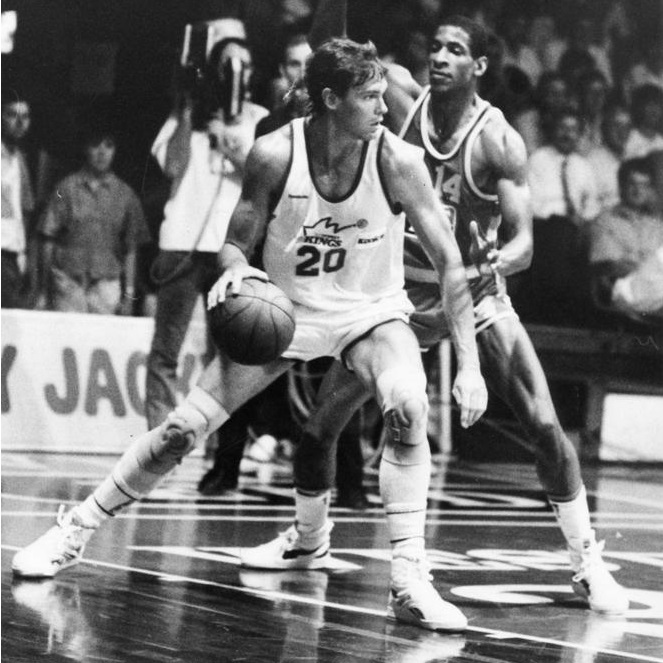
Marc Ridlen
March 19, 2021


 Brisbane Bullets2 seasons
 Canberra Cannons3 seasons
NICKNAME/S: The Ace
BIO: Emery Atkinson was born in Miami, Florida (USA).
Emery Atkinson made his NBL debut with the Brisbane Bullets at 25 years of age. He scored 15 points in his first game.
With Brisbane looking to go ‘younger, bigger and faster’ with their roster to compete with the likes of Adelaide’s Mark Davis and Perth’s James Crawford, the decision was made to release US born players Cal Bruton and Dave Nelson in favour of incoming import Emery Atkinson and giving more playing time to young local talent.
Atkinson (15.6 points, 7.3 rebounds, 1.4 assists and 1.3 steals), quickly became a fan favourite in Brisbane, whose athletic dunks had Bullets fans on their feet throughout the season. Despite standing at only 196cm (6ft 5′) he played at centre for the Bullets and was one of the best rebounders ever at his size.
The Bullets were led offensively by star Leroy Loggins (28.0 points, 7.3 rebounds, 3.2 assists, and 2.9 steals), who became the first player to win back-to-back NBL Most Valuable Player awards, sharing the award with Mark Davis of the Adelaide 36ers. Behind Loggins’s brilliance, Brisbane finished with 20 wins and 6 losses and finished in second place (behind Adelaide) during the regular season.
Beyond Loggins, the Bullets had built a roster so full of talent that the team’s second-leading scorer, Atkinson, became one of the first import players ever to come off the bench. Veterans Ron Radliff (15.4 points, 3.3 rebounds, 4.4 assists, and 1.9 steals) and team captain Larry Sengstock (12.3 points, 9.4 rebounds, and 2.1 assists) supported the two imports offensively, while 25-year-old John Dorge (11.1 points, 8.9 rebounds, and 1.2 blocks), 21-year-old Robert Sibley (11.4 points, 5.9 rebounds, and 1.1 assists), and 19-year-old Darren Perry (6.8 points, 2.6 rebounds, 2.7 assists, and 1.2 steals) all made huge contributions despite their inexperience.
Ending the season with a 20-6 record, the Bullets finished in second place (Adelaide claimed the top spot) and, as a result, received a first-round bye. There, they would face the Illawarra Hawks after they defeated the North Melbourne Giants in the elimination finals. With Illawarra advancing, the Bullets easily won game one of the semi finals (109-87) before losing game two in a nail-biter (77-78). Brisbane rebounded in game three (100-82), earning a spot in the 1987 NBL Grand Final after winning game three 100-82.
Brisbane made it to the NBL grand final for a league-record fourth consecutive season and would face off against the Perth Wildcats, who had just upset the defending champions Adelaide on the other side of the semi final bracket.
Perth was led by player/coach and former Bullets’ favourite Cal Bruton. Bruton’s exit had also come on the back of a very public falling out with coach Brian Kerle. In a surprise move, Brisbane elevated teenage point guard Darren Perry (10 points, 3 rebounds, and 3 steals) into the starting lineup for the playoffs and alongside Atkinson, who came up big in the opening game. In 28 minutes of court time, he scored 22 points (on 10/16 shooting) and hauled in 9 rebounds as the Bullets took game one in Perth by a single point alongside Loggins (17 points and 5 rebounds) as the Bullets were able to defeat Perth in a low scoring, ‘grind-it-out’, 80-79 victory. Kendall Pinder (27 points and 15 rebounds) and James Crawford (23 points, 14 rebounds and 2 blocks) led the way for the visitors.
In game two, although Pinder (25 points, 15 rebounds) and Crawford (22 points, 11 rebounds) still proved hard to stop, Brisbane’s frontcourt of Sengstock (8 points and 6 rebounds), John Dorge (7 points and 10 rebounds) and Emery Atkinson (12 points and 4 rebounds), made it almost impossible for the Wildcats’ guards to score inside. The Wildcats guard rotation of Bruton (9), Mike Ellis (6) and Alan Black (2) combined for just 17 points and after the Bullets won a tightly fought first half (47-44), they owned the Wildcat’s in the second.
Brisbane outscored Perth by 16 points, with Loggins (36 points, 6 rebounds, and 3 assists) doing most of the damage on the scoreboard.
With the final score reading 106-87 and Brisbane winning their second championship, Loggins, who averaged 26.5 points over the two games, was named Grand Final MVP.
1988
After winning their second NBL championship in 1987, Brisbane entered the 1988 season hoping to defend their title and claim a third championship in four years. Head coach Brian Kerle retained the core of his championship-winning squad, with Leroy Loggins, Emery Atkinson, Larry Sengstock, Ron Radliff, Darren Perry, Robert Sibley, John Dorge and Danny Morseu all returning. James Carr and Paul Webb departed, while rookies Shane Heal (via AIS) and Simon Kerle were added to provide further backcourt depth.
Atkinson’s highest-scoring game came against North Melbourne on March 18, when he made 13-of-20 field goals and all six of his free throws to finish with 32 points, 8 rebounds, and 1 block. Loggins (32 points, 7 rebounds, 2 assists, and 2 steals) matched his scoring output, while Radliff (16 points and 3 rebounds) provided additional support. Tim Dillon (47 points and 8 rebounds) led the Giants, but Brisbane escaped the Melbourne Sports and Entertainment Centre with a 137-132 victory, a result which would prove crucial in determining the final ladder positions.
Atkinson (16.8 points, 8.4 rebounds, and 1.2 blocks across 25 games) continued to provide Brisbane with an athletic presence around the basket during his second season with the club. After playing an important role in their 1987 championship as one of the league’s few imports coming off the bench, he increased his scoring, rebounding and minutes while shooting a career-high 61 percent from the field. His ability to finish around the basket, defend bigger opponents and rebound despite being undersized for an interior player made him one of Brisbane’s most versatile contributors.
Another of his strongest performances came against Perth at Challenge Stadium on April 29, where Atkinson (27 points, 13 rebounds, and 1 block) made 11-of-17 field goals and 5-of-7 free throws as Brisbane defeated the Wildcats 125-113. Loggins (25 points, 7 rebounds, 3 assists, and 3 steals) and Sibley (20 points and 5 rebounds) provided the main support, while James Crawford (29 points, 13 rebounds, 5 assists, and 3 steals) led Perth. The victory gave Brisbane a road win over the same opposition they had defeated in the previous year’s Grand Final.
Brisbane remained among the league’s leading teams and held second place with two rounds remaining, but a crucial home game against Canberra on July 2 would prove costly. Atkinson (14 points, 13 rebounds, 2 assists, and 2 blocks) recorded another double-double, while Sengstock (22 points and 15 rebounds) and Heal (20 points) led Brisbane offensively. Phil Smyth (29 points, 6 rebounds, and 7 assists) made five three-pointers to lead Canberra to a 105-97 victory at the Brisbane Entertainment Centre. The defeat contributed to Brisbane finishing tied with North Melbourne at 18-6, with the Giants claiming second place by nine points on head-to-head differential after the teams split their two meetings. Brisbane finished third, missing the automatic semifinal berth and being forced into a knockout quarterfinal.
Loggins (24.7 points, 7.8 rebounds, 3.9 assists, and 2.4 steals across 25 games) remained Brisbane’s leading scorer and earned his seventh consecutive All-NBL First Team selection while leading the league in free-throw percentage at 85.6 percent. Heal (15 points across 25 games) quickly established himself as one of the competition’s most exciting young players, averaging 27 minutes per game behind starting point guard Perry (10.4 points and 3.7 assists across 24 games) and winning the NBL Rookie of the Year award. Radliff (12.4 points, 3.5 assists, and 1.2 steals across 25 games) continued to provide outside shooting, while Sengstock (11.1 points and 10.2 rebounds across 25 games) led the team on the glass. Sibley (8.6 points and 4.7 rebounds across 21 games) and Dorge (7.1 points, 4.6 rebounds, and 1.4 blocks across 25 games) provided further frontcourt depth.
Brisbane faced sixth-placed Perth in the elimination final at the Brisbane Entertainment Centre on July 16, with the defending champions entering as favourites. Atkinson (12 points, 8 rebounds, and 1 assist) made 5-of-7 field goals but fouled out, while Loggins (31 points, 11 rebounds, 8 assists, and 5 steals) produced one of his finest all-around playoff performances. Sengstock (17 points and 10 rebounds) also contributed, but the Bullets struggled from outside, making only 2-of-16 three-point attempts. Former Brisbane star Calvin Bruton (31 points, 3 assists, and 3 steals) made all nine of his free throws, while Crawford (26 points, 13 rebounds, and 8 blocks) dominated inside as Perth shot 52 percent from the field. The Wildcats defeated Brisbane 113-98, eliminating the Bullets in the quarterfinals and ending their run of four consecutive Grand Final appearances.
Following the playoff defeat, Brisbane decided not to re-sign Atkinson after two seasons with the club. Despite his important role in their 1987 championship and his improved production in 1988, coach Brian Kerle described the decision as “one of the toughest decisions he had to make as a coach”. Atkinson subsequently joined Canberra (via Brisbane) for the 1989 season.
CANBERRA CANNONS
1989
After two seasons with Brisbane, Atkinson joined the defending NBL champion Canberra Cannons for 1989 under head coach Steve Breheny. Canberra retained Phil Smyth, Jamie Kennedy, Herb McEachin, Simon Cottrell, Tad Dufelmeier and John Stelzer from its championship group, with Atkinson becoming a major frontcourt addition.
On May 27, Canberra edged North Melbourne 109–108 at the AIS Arena. Jamie Kennedy (30 points) led the Cannons, while Atkinson (16 points, 14 rebounds, and 4 assists) controlled the glass. Scott Fisher (30 points and 15 rebounds) and Tim Dillon (17 rebounds) led the Giants.
On July 15, Atkinson produced one of his best games of the season with 27 points, 14 rebounds, and 3 assists against Perth, although Canberra was beaten 125–123. John Stelzer (23 points) and Jamie Kennedy (19 points) supported him, while James Crawford (26 points and 14 rebounds) and Kendal Pinder (19 rebounds) led the Wildcats.
Atkinson (18.4 points, 10.6 rebounds, and 3.7 assists) led Canberra in scoring and rebounding. Phil Smyth (17.4 points, 5.6 rebounds, and 4.9 assists), Jamie Kennedy (15.3 points and 3.1 rebounds), Willie Simmons (15.2 points and 10.0 rebounds) and Herb McEachin (13.5 points, 4.2 rebounds, and 2.2 assists) were also key contributors.
Canberra finished first in the regular season with an 18–6 record, securing the league’s best record, while Atkinson was named to the All-NBL Second Team.
In Game 1 of the semifinals on September 29, Canberra defeated Sydney 108–98. Atkinson led the Cannons with 22 points, 13 rebounds, and 7 assists, while Tim Morrissey (20 points and 14 rebounds) led the Kings.
In Game 2 on October 6, Sydney levelled the series with a 100–92 win in Canberra. Atkinson scored a game-high 30 points and added 5 assists, while Mark Ridlen led Sydney with 29 points and 19 rebounds.
Canberra closed the semifinal series with a 142–82 victory in Game 3 on October 8. Simon Cottrell scored 34 points and Atkinson led the Cannons with 15 rebounds, while Tim Morrissey scored 26 points for Sydney.
In Game 1 of the Grand Final on October 14, North Melbourne defeated Canberra 111–105. Phil Smyth led Canberra with 23 points, while Atkinson recorded 18 points, 11 rebounds, and 5 assists. Scott Fisher scored 37 points for the Giants.
North Melbourne completed the sweep in Game 2 on October 20, winning 111–97. Herb McEachin and Willie Simmons scored 20 points each for Canberra, while Atkinson finished with 12 points, 2 rebounds, and 3 assists. Scott Fisher led North Melbourne with 33 points as the Giants won the championship 2–0.
1990
Canberra returned from its 1989 Grand Final appearance with Atkinson, Phil Smyth, Jamie Kennedy, Herb McEachin, Simon Cottrell, Tad Dufelmeier and John Stelzer remaining in the rotation, while Charlie Thomas joined the frontcourt.
On April 28, Canberra lost 119–101 in Adelaide. Herb McEachin led the Cannons with 24 points and 8 rebounds, while Atkinson added 16 points, 11 rebounds, and 6 assists. Mark Davis (27 points and 12 rebounds) and Mark Bradtke (19 points and 15 rebounds) led the 36ers.
Canberra defeated Geelong 114–90 on May 12, with John Stelzer (25 points and 10 rebounds), Herb McEachin (24 points and 6 rebounds) and Atkinson (21 points, 11 rebounds, and 3 assists) leading the Cannons.
Atkinson (22.7 points, 9.1 rebounds, and 3.3 assists) led Canberra in scoring, while Charlie Thomas (19.1 points, 11.7 rebounds, and 2.9 assists), Herb McEachin (18.8 points, 4.5 rebounds, and 2.2 assists), Tad Dufelmeier (15.2 points, 2.2 rebounds, and 3.3 assists) and Jamie Kennedy (13.0 points and 2.4 rebounds) were among the team’s other primary contributors.
Canberra finished seventh with a 16–10 record and did not qualify for the playoffs.
1991
With Mel Dalgleish taking over as head coach, Canberra’s core again included Atkinson, Charlie Thomas, Jamie Kennedy, Phil Smyth, Herb McEachin, Simon Cottrell and John Stelzer.
On May 10, Canberra fell 124–120 to Geelong. Charlie Thomas led the Cannons with 34 points, 7 rebounds, and 5 assists, Jamie Kennedy scored 25 points, and Atkinson recorded 23 points, 8 rebounds, and a career-high 10 assists. Bobby Locke (26 points), Terry Dozier (22 points, 6 rebounds, and 7 assists), Vince Hinchen (22 points and 6 rebounds) and John Dorge (21 points and 16 rebounds) led Geelong.
Canberra defeated Wollongong 114–97 on September 14, with Simon Cottrell (27 points and 14 rebounds) and Atkinson (21 points, 11 rebounds, and 2 assists) leading the Cannons. Justin Withers scored 24 points for the Hawks.
Atkinson’s final NBL game came on September 21, when Canberra lost 131–118 to Brisbane. Jamie Kennedy led Canberra with 36 points, while Atkinson finished with 31 points, 8 rebounds, 3 assists, 2 steals, and 2 blocks. Leroy Loggins (24 points), Andre Moore (22 points) and Derek Rucker (21 points) led Brisbane.
Atkinson (21.2 points, 9.0 rebounds, and 3.8 assists) again led Canberra in scoring, with Charlie Thomas (21.0 points, 10.8 rebounds, and 2.6 assists), Jamie Kennedy (17.2 points and 3.3 rebounds), Phil Smyth (15.4 points, 3.6 rebounds, and 4.7 assists), Herb McEachin (13.1 points, 3.1 rebounds, and 2.8 assists) and Simon Cottrell (12.9 points and 6.0 rebounds) also contributing.
Canberra finished the season in 10th place with a 9–17 record and missed the playoffs.
Emery Atkinson played five seasons in the NBL, playing for both the Canberra Cannons and the Brisbane Bullets. He averaged 19.1 points, 8.8 rebounds, and 2.8 assists in 128 NBL games.
HIGHLIGHTS:
| SEASON | AGE | TEAM | TEAM RECORD | GP | MINS | PTS | REB | AST | OR | DR | STL | BLK | TO | PF | FGM | FGA | FG% | 3PM | 3PA | 3P% | FTM | FTA | FT% | TS% | EFG% | HS |
|---|---|---|---|---|---|---|---|---|---|---|---|---|---|---|---|---|---|---|---|---|---|---|---|---|---|---|
| 1991 | 29 | Canberra | 9-17 (10) | 26 | 1,098 | 550 | 233 | 98 | 98 | 135 | 49 | 30 | 95 | 94 | 228 | 430 | 53% | 27 | 60 | 45% | 67 | 107 | 63% | 58% | 56% | 37 |
| 1990 | 28 | Canberra | 16-10 (7) | 26 | 1,068 | 591 | 236 | 85 | 80 | 156 | 38 | 22 | 78 | 90 | 246 | 437 | 56% | 15 | 35 | 43% | 84 | 124 | 68% | 60% | 58% | 46 |
| 1989 | 27 | Canberra | 18-6 (1) | 29 | 1,085 | 533 | 307 | 107 | 109 | 198 | 43 | 43 | 96 | 95 | 235 | 409 | 57% | 0 | 6 | 0% | 63 | 85 | 74% | 60% | 57% | 30 |
| 1988 | 26 | Brisbane | 18-6 (3) | 25 | 745 | 421 | 210 | 44 | 94 | 116 | 27 | 30 | 56 | 78 | 186 | 303 | 61% | 0 | 0 | 0% | 49 | 66 | 74% | 63% | 61% | 32 |
| 1987 | 25 | Brisbane | 20-6 (2) | 22 | 604 | 344 | 146 | 30 | 50 | 96 | 28 | 14 | 54 | 76 | 154 | 283 | 54% | 0 | 1 | 0% | 36 | 59 | 61% | 56% | 54% | 22 | Totals | 128 | 4600 | 2439 | 1132 | 364 | 431 | 701 | 185 | 139 | 379 | 433 | 1049 | 1862 | 56.3% | 42 | 102 | 41.2% | 299 | 441 | 67.8% | 59% | 57% | 46 |
| SEASON | AGE | TEAM | TEAM RECORD | GP | MINS | PTS | REB | AST | OR | DR | STL | BLK | TO | PF | FGM | FGA | FG% | 3PM | 3PA | 3P% | FTM | FTA | FT% | TS% | EFG% | HS |
|---|---|---|---|---|---|---|---|---|---|---|---|---|---|---|---|---|---|---|---|---|---|---|---|---|---|---|
| 1991 | 29 | Canberra | 9-17 (10) | 26 | 42.2 | 21.2 | 9.0 | 3.8 | 3.8 | 5.2 | 1.9 | 1.2 | 3.7 | 3.6 | 8.8 | 16.5 | 53% | 1.0 | 2.3 | 45% | 2.6 | 4.1 | 63% | 58% | 56% | 37 |
| 1990 | 28 | Canberra | 16-10 (7) | 26 | 41.1 | 22.7 | 9.1 | 3.3 | 3.1 | 6.0 | 1.5 | 0.8 | 3.0 | 3.5 | 9.5 | 16.8 | 56% | 0.6 | 1.3 | 43% | 3.2 | 4.8 | 68% | 60% | 58% | 46 |
| 1989 | 27 | Canberra | 18-6 (1) | 29 | 37.4 | 18.4 | 10.6 | 3.7 | 3.8 | 6.8 | 1.5 | 1.5 | 3.3 | 3.3 | 8.1 | 14.1 | 57% | 0.0 | 0.2 | 0% | 2.2 | 2.9 | 74% | 60% | 57% | 30 |
| 1988 | 26 | Brisbane | 18-6 (3) | 25 | 29.8 | 16.8 | 8.4 | 1.8 | 3.8 | 4.6 | 1.1 | 1.2 | 2.2 | 3.1 | 7.4 | 12.1 | 61% | 0.0 | 0.0 | 0% | 2.0 | 2.6 | 74% | 63% | 61% | 32 |
| 1987 | 25 | Brisbane | 20-6 (2) | 22 | 27.5 | 15.6 | 6.6 | 1.4 | 2.3 | 4.4 | 1.3 | 0.6 | 2.5 | 3.5 | 7.0 | 12.9 | 54% | 0.0 | 0.0 | 0% | 1.6 | 2.7 | 61% | 56% | 54% | 22 | Total | 128 | 35.9 | 19.1 | 8.8 | 2.8 | 3.4 | 5.5 | 1.4 | 1.1 | 3.0 | 3.4 | 8.2 | 14.5 | 56.3% | 0.3 | 0.8 | 41.2% | 2.3 | 3.4 | 67.8% | 59% | 57% | 46 |
| POINTS | REBOUNDS | ASSISTS | STEALS | BLOCKS | TURNOVERS | TRIPLE DOUBLES | 46 | 17 | 10 | 6 | 5 | 7 | 0 |
|---|
Atkinson began his college career at Miami Dade North in Miami, Florida, where he was named a 1982 NJCAA First Team All-American.
He then transferred to UNC Charlotte and became a major frontcourt contributor in 1982–83, averaging 11.8 points, 7.0 rebounds, and 1.2 assists per game as a junior, placing him among the team’s top all-around producers that season.
He backed it up in 1983–84 with another strong year, averaging 12.4 points and 6.5 rebounds per game as a senior, and was a two-time team MVP.
Atkinson served as a Charlotte co-captain in 1983–84 alongside Reuben McDaniel.
Efficiency was a defining part of his Charlotte résumé, with school records listing Atkinson’s 1983–84 field-goal percentage at .573, which ranks among the best single-season marks in program history.
- 1x All-NBL Second Team
In 2022, he played for Explosion at the Masters Basketball Association tournament, averaging 19.4 points per game and earning another All-Tournament Team selection.
Atkinson remained active with Explosion in later Masters tournaments, earning All-Tournament Team honours again in 2024 and 2025.
Whilst we try to source as much information as we can for every player who has ever played in the NBL some information on a player profile may be missing. If you have additional information on a player you'd like us to add to a profile, please send it to us using the enquiry form below.
Submissions are then sent to info@aussiehoopla.com
HAVE A TAKE ON THE GAME?
Love Australian basketball? Have a story to tell or an opinion worth sharing? We're keen to hear from passionate basketball fans, writers and aspiring journalists. Pitch your idea and be part of the Aussie Hoopla writing team.

