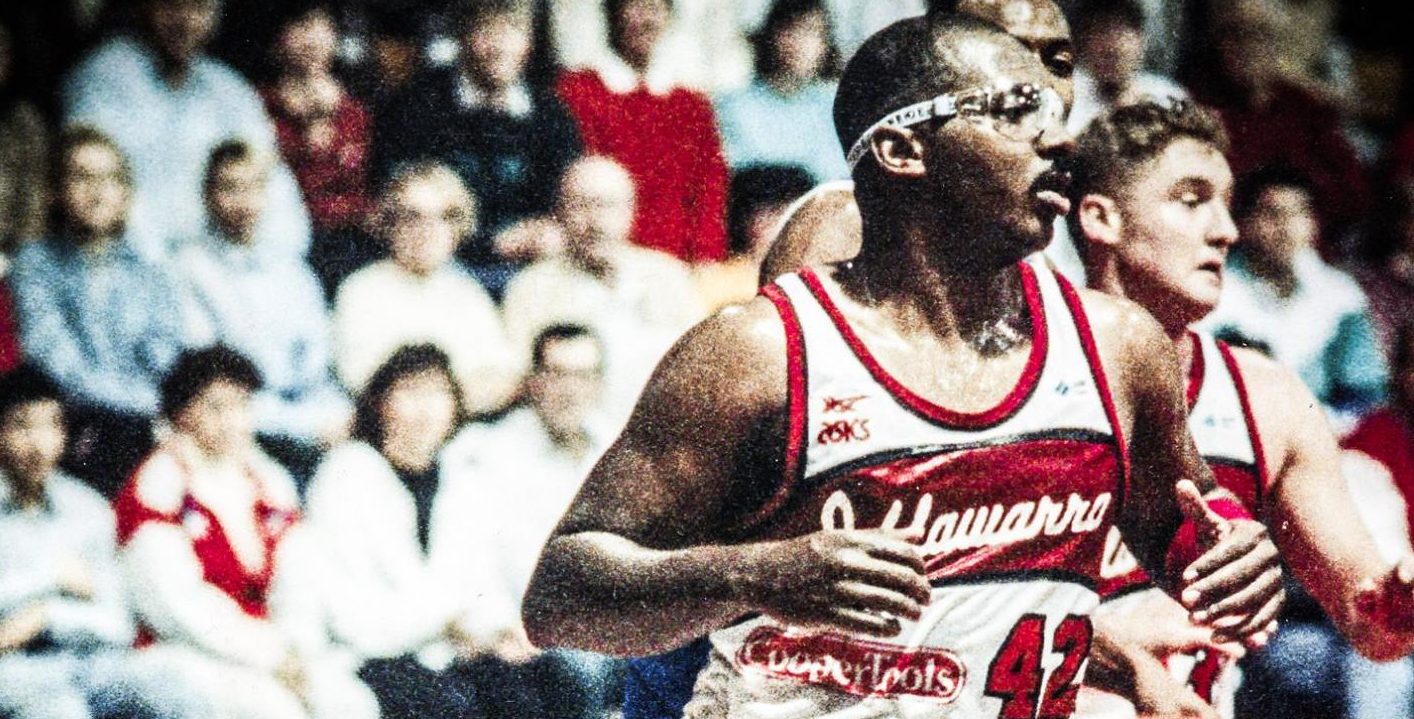
Mark Leader (North Melbourne Giants) on the 1989 and 1994 NBL championships
April 11, 2021


BIO: Tim Dillon was born in Franklin Grove, Illinois (USA).
Tim Dillon made his NBL debut with the North Melbourne Giants at 25 years of age. He scored 16 points in his first game.
It was (almost) a Cinderella season for Dillon and the Giants in 1988. This year the team added bruising import Tim Dillon to play alongside Scott Fisher, a duo that quickly became known as the ‘Twin Boulders’ by media and fans. The team also acquired US born Mark Leader from Geelong, who had become a naturalised Australian during the off-season.
The Giant’s new frontcourt saw the team skyrocket to the top of the NBL ladder, causing regular sellouts at the team’s 7,000 seat home court. Fisher (27.5 points and 11.3 rebounds) and Dillon (33.2 points and 10.9 rebounds), who produced one of the greatest statistical seasons of all time as the Giants finished the regular season finish in second place (18-6). Over the course of the season, Dillon scored 35 points or more 13 times, including a 49 point effort, nailing 22 of 29 shots (79%), against the Newcastle Falcons. He would also be selected to the All-NBL First Team at the end of the season.
in the semifinals, the Giants made easy work of the Wildcat’s and reached the Grand Final for the first time in the club’s history. 5,200 Cannons fans turned up to the AIS arena to see Phil Smyth (25 points) and Jamie Kennedy (21 points) lead the Cannons to victory in game one (120-95) as Dillon (29 points and 16 rebounds) leding the team in scoring and rebounds.
In game two, Dillon (43 points, 11 rebounds, and 3 assist) was unstoppable, helping the Giants even the series behind a home win (117-101). Dillon also delivered his best game of the series, filling the box score with 21 points, 7 rebounds, 7 assists and 2 steals in the win. 7,200 Giants fans turned up for Game 3, keen to see the team win their first championship, North Melbourne’s Cinderella season wouldn’t come to pass, with Canberra winning the series clinching game (108-101). Willie Simmons (23 points and 10 rebounds) led the way for the Cannons with alongside Simon Cottrell and Phil Smyth (both 21 points). Smyth would be awarded the Grand Final MVP after averaging 21.3 points, 3.6 rebounds, 5.6 assists, and 2.6 steals across the three-game series.
1989
Since 1986, the Giants had slowly crept closer and closer to winning their first NBL championship, with it all culminating this season. After missing the playoffs in 1986, Bruce Palmer replaced Les Riddle as coach and turned things around, coming within one game of winning the championship and come 1989, it was all business. The team added naturalised import Cecil Exum from the state league and Ray Borner (via Illawarra) to strengthen the frontcourt alongside Scott Fisher (32.1 points and 12.7 rebounds) and Tim Dillon (29.4 points and 10.0 rebounds), who delivered two of the best statistical seasons in NBL history and Dillon added 29.4 points, 10 rebounds, and 2.8 assists as the team finished second in the regular season (17-7).
Both North Melbourne and Canberra would receive a first round bye and automatic entry to the semi finals. Canberra would qualify for the semi finals after eliminating Sydney (2-1), while North Melbourne’s semi final with Perth culminated with the Giants winning by 55 points at home in game three. The final score line of 165-110 remains the highest score ever recorded in a NBL postseason game. Dillon (40 points, 8 rebounds, and 4 assists), Fisher (32 points and 14 rebounds) and David Graham (25 points, 7 rebounds, and 5 assists) all coming up big for the Giants. Wildcats captain Mike Ellis (18 points, 4 rebounds, and 3 steals) top scoring for the visitors.
Canberra, who would reach their fourth time in seven years, would host game one, where the trio of Fisher (37 points, 11 rebounds, and 2 steals), Dillon (24 points and 12 rebounds), and Borner (18 points and 9 rebounds) walked into the AIS Arena and come away with a six point win (111-105).
The Giants returned to Melbourne for game two, and similar to the season prior, the Glasshouse was a sell-out, with 7,200 Giants fans keen to see the North Melbourne go one step further than last year. Fisher (33 points and 12 rebounds) was relentless at the offensive end and finished as the game’s high scorer. Teammates Dillon (21 points and 15 rebounds), Borner (16 points and 7 rebounds), David Graham (16 points, 3 rebounds, 5 assists, and 2 steals), Exum (10 points and 8 rebounds) and Mark Leader (10 points and 12 rebounds) delivered a balanced offensive attack, the Giants finishing the game with six players scoring in double figures.
North Melbourne ensured that Canberra had no chance of repeating last years result by destroying the Cannons on the glass, with the team having collected 60 rebounds, compared to Canberra’s 39 at the final siren (111-97).
The Giants 1989 title was the first Grand Final won by a Victorian team in the modern era. Not since the St Kilda Saints won in 1980 during the league’s semi-professional years had a Melbourne team become champions. Fisher, who averaged 35 points and 12 rebounds in the series, was a easy choice for Grand Final MVP honours.
Tim Dillon played two seasons the North Melbourne Giants. He averaged 31.3 points, 10.4 rebounds, and 2.3 assists in 59 NBL games.
CAREER RANKINGS:
– 4th in points per game.
– 49th in rebounds per game.
| SEASON | AGE | TEAM | TEAM RECORD | GP | MINS | PTS | REB | AST | OR | DR | STL | BLK | TO | PF | FGM | FGA | FG% | 3PM | 3PA | 3P% | FTM | FTA | FT% | TS% | EFG% | HS |
|---|---|---|---|---|---|---|---|---|---|---|---|---|---|---|---|---|---|---|---|---|---|---|---|---|---|---|
| 1989 | 27 | North Melbourne | 17-7 (2) | 29 | 1,124 | 852 | 291 | 81 | 104 | 187 | 42 | 51 | 91 | 91 | 364 | 697 | 52% | 13 | 42 | 31% | 111 | 177 | 63% | 55% | 53% | 40 |
| 1988 | 26 | North Melbourne | 18-6 (2) | 30 | 1,238 | 995 | 327 | 58 | 139 | 188 | 45 | 30 | 90 | 113 | 436 | 771 | 57% | 9 | 25 | 36% | 114 | 154 | 74% | 59% | 57% | 49 | Totals | 59 | 2362 | 1847 | 618 | 139 | 243 | 375 | 87 | 81 | 181 | 204 | 800 | 1468 | 54.5% | 22 | 67 | 32.8% | 225 | 331 | 68.0% | 57% | 55% | 49 |
| SEASON | AGE | TEAM | TEAM RECORD | GP | MINS | PTS | REB | AST | OR | DR | STL | BLK | TO | PF | FGM | FGA | FG% | 3PM | 3PA | 3P% | FTM | FTA | FT% | TS% | EFG% | HS |
|---|---|---|---|---|---|---|---|---|---|---|---|---|---|---|---|---|---|---|---|---|---|---|---|---|---|---|
| 1989 | 27 | North Melbourne | 17-7 (2) | 29 | 38.8 | 29.4 | 10.0 | 2.8 | 3.6 | 6.4 | 1.4 | 1.8 | 3.1 | 3.1 | 12.6 | 24.0 | 52% | 0.4 | 1.4 | 31% | 3.8 | 6.1 | 63% | 55% | 53% | 40 |
| 1988 | 26 | North Melbourne | 18-6 (2) | 30 | 41.3 | 33.2 | 10.9 | 1.9 | 4.6 | 6.3 | 1.5 | 1.0 | 3.0 | 3.8 | 14.5 | 25.7 | 57% | 0.3 | 0.8 | 36% | 3.8 | 5.1 | 74% | 59% | 57% | 49 | Total | 59 | 40.0 | 31.3 | 10.5 | 2.4 | 4.1 | 6.4 | 1.5 | 1.4 | 3.1 | 3.5 | 13.6 | 24.9 | 54.5% | 0.0 | 0.0 | 32.8% | 0.4 | 1.1 | 68.0% | 57% | 55% | 49 |
| POINTS | REBOUNDS | ASSISTS | STEALS | BLOCKS | TURNOVERS | TRIPLE DOUBLES | 49 | 18 | 8 | 5 | 5 | 8 | 0 |
|---|
Tim Dillon was drafted by the Chicago Bulls with pick #49 in the 1984 NBA Draft.
Dillon joined Pallacanestro Trieste for the 1984–1985 Lega Basket Serie A season, playing in Italy with the club also known as Stefanel Trieste during that period.
In Trieste, he played alongside fellow import Ben Coleman and local rotation pieces including Gianni Bertolotti, Fischetto, Bobicchio and Lanza under coach Mario De Sisti, appearing in Italian-league coverage as part of the Stefanel Trieste lineup that season.
Dillon moved to Spain in 1985–1986 with Licor 43 Santa Coloma in the top Spanish division, where he logged 31 league games, averaged 35:56 minutes and 21.5 points per game, and shot 56.9% on two-pointers, 36.4% on threes and 72.6% at the foul line while adding 6.5 rebounds and 0.8 assists per game.
During his ACB season with Licor 43 Santa Coloma, he wore No. 10 and posted single-game highs that included 32 points (21/12/1985) and 12 rebounds (29/03/1986), while sharing the roster with teammates such as Marcelous Starks, Miguel Ángel Pou, Evaristo Blázquez and Agustín Cuesta, and playing alongside Leonard Allen during the season as another American in the team’s frontcourt group.
Dillon played college basketball at Northern Illinois University, As a freshman he appeared in 29 games and averaged 5.8 points and 3.8 rebounds while adding 1.1 assists per game as the Huskies went 17-12 overall and 10-6 in MAC play.
He scored 168 total points on 75-for-199 shooting (.377 FG) and made 18-of-28 free throws (.643 FT) while totaling 109 rebounds and 33 assists as a freshman, with 76 personal fouls recorded across the season.
As a sophomore he played 30 games and jumped to 10.3 points, 5.8 rebounds, and 1.5 assists per game while Northern Illinois finished 16-14 overall and 9-7 in the Mid-American Conference.
He produced 309 points on 125-for-240 shooting (.521 FG) and 59-of-87 free throws (.678 FT), totaling 173 rebounds and 46 assists in 1981-82.
Dillon’s sophomore season included the program’s breakthrough run to the 1982 NCAA Tournament, with Northern Illinois winning the MAC tournament to secure its first NCAA Tournament appearance and then exiting in the first round.
As a junior he played 27 games and emerged as a high-usage frontcourt scorer at 18.9 points per game with 7.5 rebounds and 1.5 assists, as Northern Illinois went 11-16 overall and 8-10 in MAC play.
He totaled 509 points on 215-for-395 shooting (.544 FG) and 79-of-112 free throws (.705 FT) while adding 202 rebounds and 41 assists in 1982-83.
As a senior he played 27 games and posted career-best averages of 21.2 points, 8.0 rebounds, and 1.7 assists per game as Northern Illinois finished 12-15 overall and 9-9 in MAC play.
He scored 573 points on 235-for-444 shooting (.529 FG) and 103-of-137 from the line (.752 FT), with 215 rebounds and 45 assists during his final season.
Across four seasons at Northern Illinois, Dillon played 113 games and finished with 1,559 points, 699 rebounds, and 165 assists, averaging 13.8 points, 6.2 rebounds, and 1.5 assists per game for his career.
He shot .509 from the field for his career (650-for-1,278) and .712 at the free-throw line (259-for-364), with 366 personal fouls recorded over his four-year run.
Dillon earned All-MAC recognition twice during his Northern Illinois career and later became the school’s first Academic All-American, highlighted by First-Team CoSIDA Academic All-America and an NCAA Postgraduate Scholarship during the 1983-84 season.
- 1x All-NBL First Team
Whilst we try to source as much information as we can for every player who has ever played in the NBL some information on a player profile may be missing. If you have additional information on a player you'd like us to add to a profile, please send it to us using the enquiry form below.
Submissions are then sent to info@aussiehoopla.com