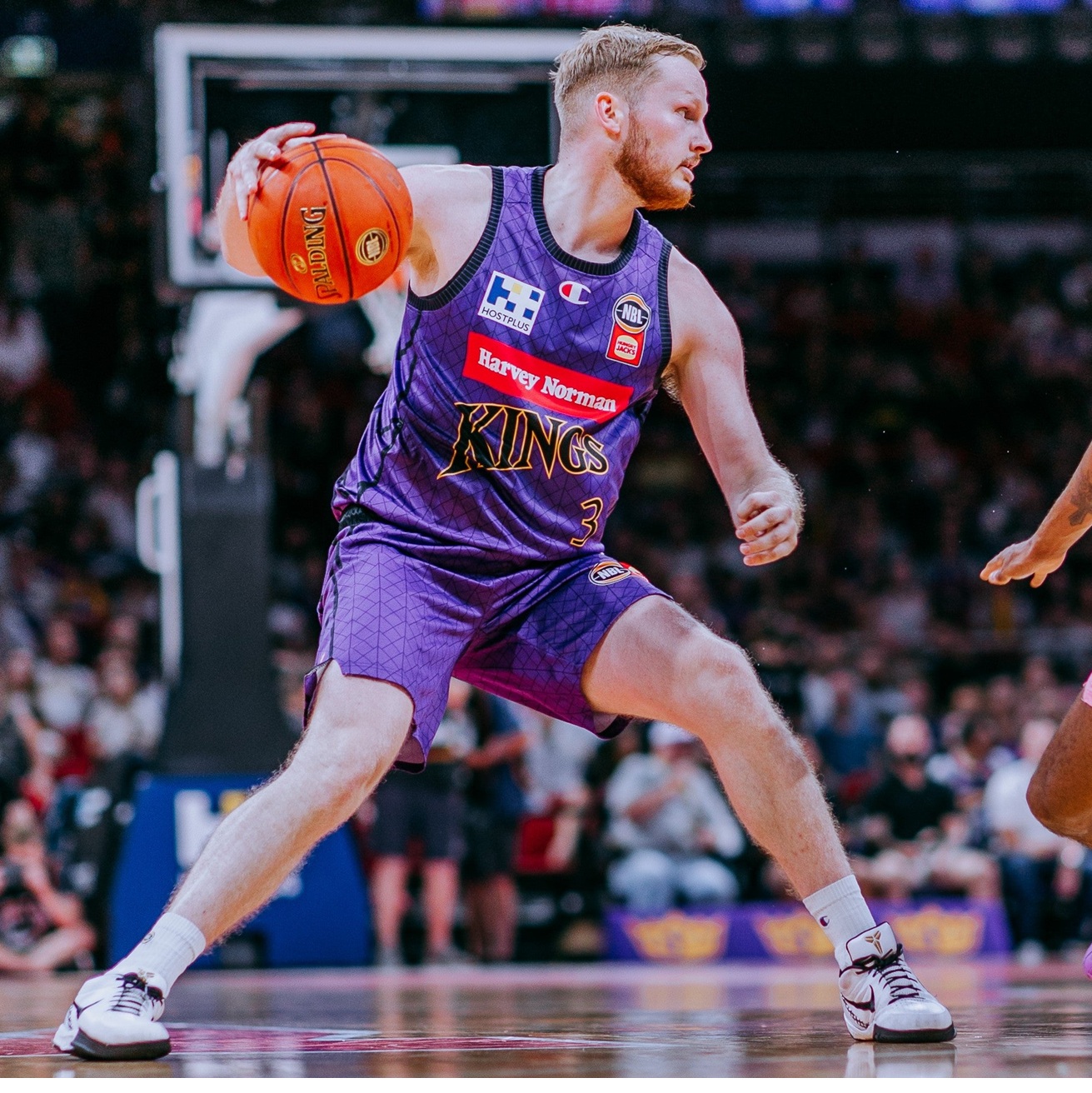
Brad Ballinger
July 2, 2025


BIO: Larry Sengstock was born in Maryborough (QLD) and began playing basketball as a junior with the Lang Park basketball club. He was a champion swimmer but was lured to the sport of basketball by his primary school teacher Ray Alloway. Larry was a tall boy for his age and Alloway thought he would be a great asset to the game of basketball. Larry was taught the fundamentals of the game by his school teacher, which led them both to succeed together in Regional, State and Australian Championships becoming the First Queensland team to win at a Australian Championship in 1975.
Larry completed his senior year at Aldridge State High School in Maryborough. Many visiting team’s from the USA made offers for him to move to the US, but he stayed in Australia.
Larry Sengstock made his NBL debut with the St. Kilda Saints at 18 years of age. He scored six points in his first game.
St Kilda entered the inaugural NBL season under coach Brian Kerle with an all-Australian roster built around Tony Barnett, Larry Sengstock, Danny Morseu, Steve Breheny and Robbie Cadee, a locally developed core whose familiarity from years in the state league translated smoothly into the new national competition.
After beginning the campaign at 3–3, the Saints quickly tightened their systems and settled into a rhythm built on execution, half-court discipline and an interior presence anchored by the 19-year-old Sengstock, whose activity around the basket complemented Barnett’s scoring reliability on the wing.
As their cohesion strengthened, St Kilda surged into a decisive run, winning their final 12 regular-season games and going a perfect 9–0 at home, a stretch in which they repeatedly controlled tempo and closed out tight contests with poise. Barnett produced several standout scoring nights during this period, including a 36-point effort against Bankstown and 35 points in a late-season victory over Canberra that effectively sealed top spot and reinforced his role as the team’s primary offensive constant.
Finishing the regular season at 15–3, the Saints advanced directly to the one-game Grand Final against the Canberra Cannons, whose attack centred on import big man Cal Stamp. In a tense and physical contest that ebbed and flowed throughout, Sengstock delivered a performance that defined both the match and his emergence as a premier young talent, scoring 33 points in a head-to-head battle with Stamp, who finished with 32.
The title came down to the final possession, where Cadee drew the defence and found Peter Vitols for a decisive basket at the buzzer, clinching a 94–93 win and securing the NBL’s first championship in dramatic fashion.
St Kilda’s 15–3 finish reflected the strength of their all-local roster, which also collected multiple state and domestic titles throughout 1979, underscoring their status as the country’s premier club during that era. Key contributors included leading scorer Tony Barnett (22.3 points), Grand Final MVP Larry Sengstock (17.6 points), Danny Morseu (15.8 points), Steve Breheny (13.3 points) and Robbie Cadee (12.3 points at a league-best 89.7 percent from the line).
Sengstock’s breakout season, in which he averaged 17.6 points and anchored the frontcourt as St Kilda reeled off 12 straight wins from a 3–3 start, culminated in his career-high 33-point Grand Final performance—an effort that began to define his long-term legacy in the league. His matchup with Stamp, alongside Canberra’s other imports Herb McEachin (23.8 points) and Jerry Lee (8.9 points), highlighted the contrast between Canberra’s import-driven build and St Kilda’s all-Australian approach, which remains the only championship core in NBL history constructed without international recruits.
1980
After winning the inaugural NBL title in 1979, St Kilda looked to back it up in 1980. Key talent Tony Barnett, Danny Morseu and Larry Sengstock would all return from the championship winning squad, and import Rocky Smith was added to inject some additional scoring power.
As the team battled it out with West Adelaide for the top position throughout the season, with five rounds to go, the Saints (10-3) added import Mike Slusher (12.3 ppg) would play the team’s last nine games of the season. Adding Slusher to the offensive brilliance of first year import Rocky Smith (33 ppg) and veteran Danny Morseau (18.5 ppg) ensured the Pumas would finish the regular season right alongside West Adelaide, with the team’s facing each other in the final game of the season to decide who would finish in top spot.
West Adelaide rode the offensive talents of Ken Richardson (31 points) and Rick Hodges (21 points) to defeat St Kilda, 88-90, resulting in both team’s ending the regular season on 17 wins and 5 losses. The Bearcats’ win equalled the team’s head to head record (1-1) but with St Kilda having won their first encounter by ten points, they retained first place on the ladder as they headed into the playoffs.
Rocky Smith, who finished the year as the league’s leading scorer, notched up 32 points in the team’s semi-final game to defeat Nunawading (101-77). In the opposite bracket, Rick Hodges (31 points) led the Bearcats to a win over Brisbane (101-94), setting up a grand final matchup with both St Kilda and West Adelaide on one win a piece.
The Grand Final resulted in a blowout, with the Saints fuelled by their end of the regular season loss and controlling the scoreboard (53-39) heading into half-time. Hodges (27 points) and Richardson (20 points) would then do everything they could for West Adelaide, but a well-balanced offensive attack saw Rocky Smith (26 points), Danny Morseu (19 points), Mike Slusher (18 points), Larry Sengstock (16 points) and Tony Barnett (14 points) all finish in double figures, making it impossible for the Bearcats to stop the Saints from scoring.
St Kilda would claim back-to-back NBL titles, winning the Grand Final 113-88.
Sengstock averaged 9.3 points for the Saints in 1980 and later that year was also named to the Australian Olympic team for the first time and played for the Boomers in 1980 Summer Olympics in Moscow, Russia.
1981
After winning the NBL’s first two championships in 1979 and 1980, St Kilda entered 1981 chasing a third straight title but lost Tony Barnett (to Geelong) and Gary Voss (retired) from the championship rotation.
Rumours persisted through the off-season that Olympians Danny Morseu and Larry Sengstock were also set to leave, but head coach Brian Kerle held the core together and both returned to chase another title with Rocky Smith, Mike Slusher and Steve Breheny back in the mix.
St Kilda opened the year as the competition benchmark after topping a pre-season poll of coaches and administrators, and Kerle’s preferred starting group featured Morseu, Sengstock, Breheny, Smith and Slusher.
Kerle added rookie Andy Blicavs to cover the holes left by Barnett and Voss, while Breheny returned after missing two seasons with injuries but appeared in only seven games across the campaign.
St Kilda’s season began on 21 February in Launceston, where they were edged by Launceston Casino City 90–88 despite Smith (26 points) and Morseu (26 points) combining for 52, with Sengstock (12 points) and Breheny (10 points) also scoring in the narrow loss.
The Saints steadied immediately with a 93–88 win over Coburg the next day, then began stacking results as their offence found its familiar rhythm around Smith, Morseu and Sengstock.
St Kilda strengthened their ladder position later in the year with a 120–95 win over Launceston Casino City at Albert Park, then produced one of their biggest statements on 14 June when they defeated Forrestville 115–98 at Albert Park behind Smith (44 points) and Slusher (16 points), with Morseu (14 points), Burbridge (12 points) and Sengstock (9 points) also contributing.
The Saints closed the regular season on 18 June with an 85–83 win over Nunawading at Kilsyth Stadium, with Smith (23 points), Blicavs (19 points) and Morseu (18 points) driving the result and Sengstock adding (11 points) in the final-round victory.
With Smith (28.8 ppg), Morseu (20.0 ppg), Sengstock (14.0 ppg) and Slusher (11.9 ppg) leading the way, St Kilda finished first on the NBL ladder (17–5), three games clear of second-place Launceston Casino City.
Other key contributors included Breheny (10.7 ppg), Blicavs (8.2 ppg) and Burbridge (5.4 ppg), as the Saints again topped the standings despite the early injury disruption to their starting backcourt.
At season’s end, Smith and Morseu were named to the All-NBL First Team after St Kilda’s first-place finish, while Sengstock’s return from the off-season uncertainty helped keep the Saints’ championship core intact across the home-and-away campaign.
With the 1981 NBL Finals approaching, St Kilda informed league officials they would instead compete in the 1981 FIBA Club World Cup in Brazil and forfeited their place in the playoffs, with Brisbane elevated into the finals in their place.
At the Club World Cup, St Kilda finished sixth behind Real Madrid (Spain), Sirio (Brazil), Clemson (USA), Atletica Francana (Brazil) and Ferro Carril Oeste (Argentina).
In the reshaped NBL Finals series, Launceston Casino City eliminated Brisbane 71–69 in the semi-finals and then defeated Nunawading 75–54 in the Grand Final as St Kilda’s season ended without an NBL playoff appearance despite the 17–5 minor premiership.
BRISBANE BULLETS
1982
In 1982, Sengstock left St Kilda to play in Brisbane under new coach Rick Harden. Sengstock (17.5 points, 10.1 rebounds, and 1 assist), despite it being only his first year with the Bullets, was named co-captain alongside import Brian Banks (22.4 points, 4.4 rebounds, and 1.8 assists).
The Bullets then finished in eighth place, missing out on qualifying for the finals.
1983
In 1983, Sengstock took over as sole team captain of the Bullets, and finished the season, putting up 13.9 points, 8.7 rebounds, and 1.8 assists per game. The Bullets recorded 10 wins and 12 losses and finished the year in fifth place.
The 1983 playoffs were played in unusual circumstances. As a cost-cutting measure, the NBL decided to play two divisional finals, a three-game round-robin tournament for the top eight team’s. This strangely saw the league’s two best team’s excluded from the NBL playoffs as both the first-placed team in the Western Divison (Sydney) and the first place team in the Eastern Division (Geelong) finished third in the three-game ‘play-in tournament’, eliminating them from the playoffs. West Adelaide and Coburg, who both had the same record (2-1) as Sydney but squeaked through to the finals thanks to a better points percentage, then faced Nunawading and Canberra in the semifinals.
The semi finals resulted in reigning champions West Adelaide defeating Nunawading 84-77 and Canberra eliminating Coburg 80-75. Canberra would go on to become champions, going undefeated in the playoffs and defeating Loggins and West Adelaide 75-73 in the championship game.
1984
Under new coach Brian Kerle the Bullets underwent a number of roster changes, the biggest being the return of Leroy Loggins, who had spent the previous two seasons with the West Adelaide Bearcats. The team then added import guard Ron ‘The Rat’ Radliff, known for his long curly hair and brilliant outside shooting, to help spread the floor for Loggins and co.
It clearly worked, as Loggins (29.3 points, 10.6 rebounds, 3.4 assists, 3.4 steals and 1.9 blocks) delivered his finest season to date, going on to be selected to the All NBL First team and voted the league’s Most Valuable Player.
Alongside Loggins and Radliff (20.0 points, 2.3 rebounds, 4.4 assists, and 2.0 steals), Sengstock added 18.6 points, 9.1 rebounds, and 3.1 assists.
The Bullets’ made their first playoff appearance since 1981, finishing the regular season in first place with a 19–5 record, a major improvement on their 10–12 record in 1983.
After defeating the Coburg Giants and the Geelong Supercats, they had reached the Grand Final for the first in Bullets history. The Grand Final would be played at a pre-determined ‘neutral’ venue that season (the last time the NBL held the Grand Final at a neutral location), the ‘Glass House’ in Melbourne.
Despite all the improvement Brisbane had delivered that season, the team ultimately fell short, losing to the defending champs Canberra 84–82. First year coach Kerle and his efforts in turning the team around were rewarded by the league voting him Coach of the Year.
1985
After falling short against Canberra Cannons in the previous year’s Grand Final, the Brisbane Bullets added the legendary Cal Bruton to the squad and a young John Dorge to the squad.
Behind the brilliance of Leroy Loggins (27.3 points, 10.3 rebounds, 3.8 assists, 3.7 steals, and 2.0 blocks), the returning Cal Bruton (17.0 points, 2.7 rebounds, and 3.6 assists) and team captain Larry Sengstock (16.9 points, 9.4 rebounds, and 1.7 assists) the Bullets emerged to be the league’s most powerful team. With head coach Brian Kerle having a season of experience behind him, he delivered a first-place finish for the second year in a row, this time with a 20–6 record.
The Bullets received a first-round bye in the NBL playoffs and would meet the winner of the elimination final between the Coburg Giants and last year’s champs, Canberra. Canberra eliminated Coburg convincingly by 23 points which would give Brisbane a chance at revenge after being beaten by the Cannons in the previous year’s Grand Final.
Loggins would lead the attack, racking up 28 points, 12 rebounds, 7 assists and 3 steals, Bruton added 16 points, 4 rebounds, and 7 assists and Sengstock finished with 11 points and 11 rebounds as Brisbane nabbed a 93-76 victory. Adelaide then defeated Newcastle by a record score of 151–103 on the other side of the semi final bracket.
With the game being held at their home venue, the Chandler Arena, the Bullets went into the series as favourites against the Adelaide 36ers, who, after merging with West Adelaide in 1985, had seen them become one of the strongest team’s in NBL history.
The grand final would be played as a single-game elimination (the last time the NBL decided a grand final this way) on Brisbane’s home court, the Sleeman Sports Centre.
Leading 78–74 and going into the last period of play, the Bullets then outscored Adelaide 42–21, setting a NBL grand final record for points scored in the final period and easily accounting for the 36ers. Sengstock recorded 23 points, 9 rebounds, and 6 assists, Bruton nearly replicated his semi final performance with 16 points, 5 rebounds, and 3 assists, and Loggins unleashed one of his finest games, notching up 41 points, 5 rebounds, 4 assists and 2 steals in Brisbane’s 121-95 championship win.
Although there was no Grand Final MVP awarded that year, Loggins was named player of the game. Loggins form also saw him selected to his fourth straight All NBL First team.
1986
The team’s major change during the 1986 season was when they moved out of the Chandler Arena (2,700 seats) and into the brand new Brisbane Entertainment Centre, which could seat up to 13,500 fans. The move easily gave the Bullets the largest and newest home arena in the NBL at the time (the next largest venue in the league was The Glass House, which could only seat 7,200). At the time, the Entertainment Centre was not only the NBL’s but also Australia’s largest indoor arena.
Brisbane finished the regular season in third place (17–8) and progressed to their third Grand Final in a row after wins over the Sydney Supersonics and regular postseason rivals, the Canberra Cannons.
The team was led by Leroy Loggins (29.8 points, 8.9 rebounds, 3.1 assists, 3.3 steals and 1.3 blocks), who would win the NBL MVP that season, alongside Cal Bruton (16.6 points, 2.5 rebounds, and 3.0 assists) and team captain Sengstock (12.7 points, 8.7 rebounds, and 2.0 assists).
This season’s Grand Final would be decided in a best-of-three series for the first time ever. Brisbane would face Adelaide in a rematch of last year’s Grand Final, who, behind coach Ken Cole, had lost only two games all year and were unbeaten at home.
In the opening game, over 11,000 fans, a then indoor sports attendance record in Australia, saw the 36ers defeat the Bullets 122–119 in overtime at the Entertainment Centre. In game two, Brisbane became the only team to defeat the 36ers in Adelaide that year winning 104–83 at the Apollo Stadium. The Bullets would lose the deciding game three in Adelaide (113–91), Delivering Adelaide their first championship. Sengstock had a great individual game, contributing 12 points and 14 rebounds and crucially, Loggins fouled out of both game one and 3 of the Grand Final series, which limited his on-court impact. 1987 The Bullets were led by star Leroy Loggins (28.0 points, 7.3 rebounds, 3.2 assists, and 2.9 steals), who became the first player to win back-to-back NBL Most Valuable Player awards, sharing the award with Mark Davis of the Adelaide 36ers. Behind Loggins’s brilliance, Brisbane finished with 20 wins and 6 losses and finished in second place (behind Adelaide) during the regular season. Beyond Loggins, the Bullets had built a roster so full of talent that the team’s second-leading scorer, import Emery Atkinson (15.6 points, 6.6 rebounds and 1.3 steals), came off the bench. Veterans Ron Radliff (15.4 points, 3.3 rebounds, 4.4 assists, and 1.9 steals) and team captain Larry Sengstock (12.3 points, 9.4 rebounds, and 2.1 assists) supported the two imports offensively, while 25-year-old John Dorge (11.1 points, 8.9 rebounds, and 1.2 blocks), 21-year-old Robert Sibley (11.4 points, 5.9 rebounds, and 1.1 assists), and 19-year-old Darren Perry (6.8 points, 2.6 rebounds, 2.7 assists, and 1.2 steals) all made huge contributions despite their inexperience. Ending the season with a 20-6 record, the Bullets finished in second place (Adelaide claimed top spot) and, as a result, received a first-round bye. There, they would face the Illawarra Hawks after they defeated the North Melbourne Giants in the elimination finals. With Illawarra advancing, the Bullets easily won game one of the semi finals (109-87) before losing game two in a nail-biter (77-78). Brisbane rebounded in game three (100-82), earning a spot in the 1987 NBL Grand Final after winning game three 100-82. Brisbane made it to the NBL grand final for a league-record fourth consecutive season and would face off against the Perth Wildcats, who had just upset the defending champions Adelaide on the other side of the semi final bracket. Perth was led by player/coach and former Bullets’ favourite Cal Bruton. Bruton’s exit had also come on the back of a very public falling out with coach Brian Kerle. In a surprise move, Brisbane elevated teenage point guard Darren Perry (10 points, 3 rebounds, and 3 steals) into the starting lineup for the playoffs and alongside Atkinson (22 points on 10/16 shooting and 9 rebounds) and Loggins (17 points and 5 rebounds) the Bullets defeated Perth in a low scoring, grind it out, 80-79 victory. Kendall Pinder (27 points and 15 rebounds) and James Crawford (23 points, 14 rebounds and 2 blocks) led the way for the visitors. In game two, although Pinder (25 points, 15 rebounds) and Crawford (22 points, 11 rebounds) still proved hard to stop, Brisbane’s frontcourt of Sengstock (8 points and 6 rebounds), John Dorge (7 points and 10 rebounds) and Emery Atkinson (12 points and 4 rebounds), made it almost impossible for the Wildcats’ guards to score inside. The Wildcats guard rotation of Bruton (9), Mike Ellis (6) and Alan Black (2) combined for just 17 points and after the Bullets won a tightly fought first half (47-44), they owned the Wildcat’s in the second. Brisbane outscored Perth by 16 points, with Loggins (36 points, 6 rebounds, and 3 assists) doing most of the damage on the scoreboard. With the final score reading 106-87 and Brisbane winning their second championship, Loggins, who averaged 26.5 points over the two games, was named Grand Final MVP. 1988 Brisbane remained a top-tier contender all season long and were sitting second on the ladder with two rounds left. However, a costly 97–105 loss to Canberra at home saw them slip into a tie with the North Melbourne Giants at 18–6. With both teams splitting their regular season series 1–1, North Melbourne edged ahead based on points differential (+9), dropping Brisbane to third place. Leroy Loggins (24.7 points, 7.8 rebounds, 3.9 assists, and 2.4 steals) led the way once again, securing his seventh consecutive All-NBL First Team nod while also finishing first in the league in free throw percentage (85.6%). Import Emery Atkinson (16.8 points, 8.4 rebounds, 1.1 steals, and 1.2 blocks) played a major role in the paint, while veterans Larry Sengstock (11.1 points, 10.2 rebounds, and 2.2 assists) and Ron Radliff (12.4 points, 2.2 rebounds, 3.5 assists, and 1.2 steals) continued to deliver consistent performances. Rookie guard Shane Heal (15.0 points, 1.4 rebounds, and 2.2 assists) was a revelation in his debut season, becoming one of the league’s most talked-about young players. Averaging 27 minutes per game while backing up starting point guard Darren Perry (6.8 points, 2.6 rebounds, 2.7 assists, and 1.2 steals), Heal capped off his breakout year by earning NBL Rookie of the Year honours. Brisbane’s third-place finish meant they missed out on an automatic semi-final berth and instead hosted the sixth-seeded Perth Wildcats in a knockout quarterfinal at the Brisbane Entertainment Centre. Leroy Loggins turned in a monster performance with 31 points, 11 rebounds, 8 assists, and 5 steals in 45 minutes. Larry Sengstock added 17 points and 10 rebounds, while Emery Atkinson contributed 12 points and 8 rebounds. Despite their efforts, the Bullets struggled mightily from long range, hitting just 2-of-16 from beyond the arc. Perth, on the other hand, executed with precision, shooting 52% from the field. Former Bullets champion Calvin Bruton returned to haunt his old club with 31 points, 4 assists, and a flawless 9-of-9 showing at the line. James Crawford was equally dominant, piling up 26 points, 13 rebounds, and 8 blocks to completely shut down Brisbane’s interior game. The 98–113 defeat eliminated Brisbane in the quarterfinals and ended their bid for a fifth straight Grand Final appearance. 1989 Leroy Loggins (22.8 points, 6.2 rebounds, 4.2 assists, 2.8 steals, and 1.1 blocks) remained the team’s standout performer, leading the Bullets in both scoring and defense. However, despite another strong individual season, Loggins was left out of the All-NBL First Team for the first time since 1981—his omission likely linked to the team’s struggles. New import Winston Crite (20.8 points, 7.5 rebounds, and 1.4 blocks) delivered impressive stats but lacked the chemistry with Loggins that previous international recruits had developed. Veteran mainstays Larry Sengstock (12.6 points, 7.5 rebounds, and 2.6 assists) and Ron Radliff (12.0 points, 1.8 rebounds, 3.1 assists, and 1.4 steals) continued to contribute at a high level, though both showed signs of wear as their production began to decline. One of the season’s major positives was the emergence of Robert Sibley (15.4 points, 6.4 rebounds, and 1.9 assists), who stepped up in a big way after a more limited role the previous year. Sibley’s breakout campaign provided Brisbane with a key scoring option in the paint and much-needed offensive depth. Despite those individual bright spots, the Bullets were unable to recapture the rhythm and depth that had defined their success in previous years. They closed out the regular season with an 11–13 record, finishing in eighth place and missing the playoffs for the first time since 1983. GOLD COAST COUGARS The team would be led by its imports Leroy Combs (23.2 points, 8.2 rebounds, 3.9 assists, 1.7 steals and 2.3 blocks) and Brian Kellybrew (14.6 points, 8.6 rebounds, 5.2 assists) as well as US born Eric Bailey (17.8 points, 2.6 rebounds, and 2.4 assists), who after playing a number of seasons in both the NBL and the state league, had become a naturalised Australian. Australian Boomers big man Paul Kuiper (15.3 points and 8.7 rebounds), who had been playing for the St Kilda Saints, was also added to the roster while Radliff (13.8 points, 2.0 rebounds, 4.6 assists, and 2.0 steals) and team captain Sengstock (11.2 points, 7.5 rebounds, and 2.5 assists) provided veteran leadership. Overall, the team struggled to deliver wins over the league’s more successful team’s and replaced Wiseman with rookie coach Brian Lester mid-way through the season. The Cougars then finished their first NBL season with a record of 9 wins, 17 losses with Combs being named the team’s MVP. 1991 Under Claxton, they recorded their best team result ever, finishing with 14 wins and 12 losses. The team was headlined by import stars Mike Mitchell (29 points, 7.3 rebounds, 3.4 assists, 2.5 steals and 1.0 blocks) and Andre LaFleur (22 points, 3.1 rebounds, 7.9 assists, and 2.6 steals), while veterans like Paul Kuiper (13.1 points and 7.3 rebounds) and team captain Larry Sengstock (12.6 points, 10.4 rebounds, and 2.8 assists) provided leadership from the bench. The team also got a added boost from the development of talented youngster Rodger Smith (8.2 points, 3.7 rebounds, and 5 assists), who developed into one of the league’s most exciting young guards. Despite the winning record, the Rollers would not qualify for the postseason. 1992 Gold Coast also re-signed stars Mike Mitchell and Andre LaFleur and looked to return to the playoffs for a second straight season. Nine games into the season, however, the Rollers suffered a huge blow when they lost Mitchell on May 31, 1992, after he suffered a horrific injury after a loss in Illawarra. Mitchell had punched a wire-reinforced glass panel of a locker-room door after Gold Coast narrowly lost to the Illawarra Hawks, which saw his arm almost severed, and his muscle cut from the bone. Mitchell was found slumped on the floor in a pool of blood by Rollers teammate Ron Radliff. Doubt was initially cast over whether Mitchell would ever play again, miraculously he recovered, making his return to the court the following season. Mitchell (26.8 points, 7.8 rebounds, 3.0 assists, and 1.9 steals) left a huge hole at both ends of the court. Willie Jennette, who had averaged 37.3 points over three seasons in the state league (SEABL) was then signed as his replacement, and the team looked to LaFleur (22.8 points, 2.8 rebounds, 9.6 assists, and 2.2 steals) and Sengstock (13.3 points, 8.8 rebounds, and 3.3 assists) to step things up in Mitchell’s absence. The Rollers struggles to cover Mitchell’s loss saw them lose nearly all games against the league’s top team’s and end the year with tenth-place finish (11-13) in a disappointing season for Gold Coast fans. NORTH MELBOURNE GIANTS Brown began his search for Fisher’s replacement first with import Chuckie White, who failed to cut it during pre-season, before settling on Jason Reese. Reese was known around the league as ‘workhorse’ and dominant inside scorer that had spent the past two seasons with Hobart (1991) and Canberra (1992) and Mark Leader, who had became a naturalised Australian in 1993, replaced Fisher as team captain. Reese went on to lead the team in scoring (26.4 ppg and 8.9 rpg), fellow import Paul Maley led the team in rebounding (22.5 ppg and 9.1 rpg) and Sengstock also contributed 5.4 points, 5.9 rebounds, and 1.5 assists per game. The Giants finished the season with a 13-13 record and just managed to sneak into the playoffs with the final eighth spot. The would then familiar face familiar foes, Scott Fisher and the Perth Wildcats (21-5), who finished the season in first place. Despite winning game one at home, 105-101, the Giants would lose games two (98-108) and three (104-117) to Perth to put a end to their season. 1994 – ONE GIANT LEAP The Giants’ roster had aged considerably in the years between its 1989 championship and 1994, with its roster now being the oldest roster in the league. Their decision to replace high-scoring forward Jason Reese with a 30-year-old point guard named Darryl McDonald was met with much surprise. The media and betting agencies promptly wrote off the Giants’ season, most tipping them to finish dead last. The pundits couldn’t have been more wrong, however, with McDonald (17.6 points, 5.7 rebounds, 10 assists and 3.0 steals per game) leading the league in steals and assists and when the Giants came home undefeated after the ‘Doomsday Double’, first avenging a home loss to Perth then holding off Adelaide at the Clipsal Powerhouse (a feat which hadn’t been achieved since 1986) fans really started to become excited. Pat Reidy (19.7 ppg, 6.8 rpg and 3.4) and Paul Maley (19.4 ppg and 6.7 rpg) became the main beneficiaries of many of McDonald’s flashy assists, while Sengstock finished the season averaging 9.4 points, 6.9 rebounds, and 2.2 assists. The Giants would finish the season in second place, winning 19 of their 26 games. At season’s end, Brown would be named Coach of the Year. Also, quite controversially, McDonald finished second in both the NBL MVP (behind Andrew Gaze) and Best Defensive Player (Darren Lucas) awards, but McDonald responded by taking his game to a entirely new level for the playoffs. After Sydney blitzed the Giants (131–109) in the opening game of the quarter-finals, McDonald led the Giants to a 112-91 victory in game two and a 104-95 victory in game three. In the deciding game, ‘D-Mac’ played all 48 minutes and filled the stat sheet with 17 points, 13 rebounds, 7 assists while shooting 70% (7/10) from the field. On the other side of the bracket, South East Melbourne eliminated Perth before being knocked out by the Giants after a Adonis Jordan three-point heave (he could have found a open David Graham for a better shot but missed him) in the game’s closing moments missed its mark and the chance to force a third game. Game one of the Grand Final series was held at the Clipsal Powerhouse in Adelaide and after Robert Rose had dragged the Sixers back into the match when they still had trailed by 14 inside the last six minutes of regulation the ball ended up in McDonald’s hands before he nailed the game-winning shot in overtime, delivering a 95–93 win. As the series moved to the Glasshouse in Melbourne for game two Rose would come out firing, his 31 point effort would see him finish as the game’s high scoring. Still, a balanced attack from North Melbourne proved too strong for the 36ers. The Giants would control the first half, the scoreboard reading 51-41 at halftime, and with 36ers forward Mark Davis in serious pain, the Giants were able to put the foot down in the third quarter and then closed out the game with a 117-97 victory. Paul Rees, who benefitted greatly from McDonald’s passing all series, finished up earning the Finals MVP award after delivering 17 points and 5 rebounds in game one and 20 points (making all seven of his shots) and 7 rebounds in game two. The 1994 NBL season made history bypassed the one-million spectator mark during the regular season for the first time. 1995 North Melbourne opened the season on April 22 against Gold Coast, where Sengstock (5.7 points and 4.4 rebounds across 28 games) finished with 12 points, 5 rebounds, 1 assist, and 1 steal as the Giants defeated the Rollers 118-97. Jent (33 points, 10 rebounds, 6 assists, 1 steal, and 1 block) immediately justified the late move, becoming the first reigning NBA champion to play in the NBL. Sengstock’s first strong defensive game came on June 16 against eventual champion Perth, where he finished with 10 points, 5 rebounds, 2 steals, and 4 blocks as North Melbourne continued to rely on his experience and interior defence in a reduced role. Sengstock’s best regular-season game came on June 24 against Brisbane, where he grabbed a season-high 12 rebounds and added 9 points as the Giants battled one of the teams that spent time on top of the ladder during a year where Brisbane, Sydney, North Melbourne, South East Melbourne and Melbourne all led the league at different stages. On August 25, Sengstock produced another valuable all-around game against Geelong, finishing with 7 points, 10 rebounds, 6 assists, and 2 blocks as North Melbourne continued to push towards the postseason. North Melbourne closed the regular season in Brisbane on September 16, where Sengstock finished with 12 points, 4 rebounds, 1 assist, and 1 block, while McDonald (26 points, 8 rebounds, 15 assists, and 9 steals) filled the stat sheet as the Giants defeated the Bullets 122-109, closed on a five-game winning streak and finished third with a 18-8 record. Jent (25.7 points, 6.9 rebounds, and 1.9 steals) led North Melbourne in scoring after replacing Maley and earned All-NBL Third Team honours, while Reidy (20.7 points, 7.9 rebounds, 4.1 assists, and 1.5 steals) remained a major scoring and rebounding option on the wing. McDonald (17.5 points, 5.6 rebounds, 10.4 assists, and 3.8 steals) led the NBL in assists and steals for a second consecutive season, earned All-NBL First Team honours and won the Good Hands Award. Rees (14.6 points, 7.7 rebounds, and 1.5 blocks) anchored the middle, Johnson (11.5 points) gave the Giants another scoring option, while Sengstock’s role shifted further into the veteran support group alongside Pearce (5.7 points) and Leader (4.6 points). The quarterfinals opened in Brisbane, where Jent (34 points and 7 rebounds), Reidy (25 points, 10 rebounds, 5 assists, and 2 steals), Johnson (20 points and 4 assists), Sengstock (15 points, 9 rebounds, and 2 assists) and McDonald (7 points, 6 rebounds, 19 assists, and 6 steals) led North Melbourne to a 115-105 win, while Leroy Loggins (42 points, 7 rebounds, 4 assists, 3 steals, and 1 block), Mike Mitchell (17 points, 5 rebounds, 3 assists, and 3 steals) and Shane Heal (16 points, 12 assists, and 5 steals) kept Brisbane within reach. Game two moved to Melbourne, where McDonald (32 points, 3 rebounds, 9 assists, and 2 steals), Reidy (28 points, 13 rebounds, and 5 assists), Jent (21 points and 5 rebounds) and Rees (18 points, 4 rebounds, and 5 blocks) dominated as North Melbourne completed the sweep with a 130-99 win, while Sengstock (2 points, 6 rebounds, 1 assist, and 3 blocks) added rim protection and Loggins (25 points and 8 rebounds), Mitchell (22 points, 4 rebounds, 4 assists, and 5 steals) and Heal (14 points and 5 assists) led Brisbane. The semifinals opened against South East Melbourne, where Jent (24 points, 11 rebounds, 1 assist, 1 steal, and 1 block), Reidy (23 points, 14 rebounds, 6 assists, 1 steal, and 1 block), Rees (17 points, 6 rebounds, 1 assist, 2 steals, and 1 block), McDonald (11 points, 5 rebounds, 12 assists, 2 steals, and 1 block) and Sengstock (3 points, 5 rebounds, and 1 block) helped North Melbourne hold the Magic to 77 points and take game one 98-77. Game two moved to South East Melbourne, where Sengstock (10 points, 2 rebounds, and 1 steal), Jent (17 points, 10 rebounds, 5 assists, and 2 steals), McDonald (17 points, 8 rebounds, 6 assists, and 3 steals) and Rees (12 points, 4 rebounds, 1 assist, 1 steal, and 2 blocks) contributed, but the Magic responded with a 98-79 win and forced a deciding game. Game three remained in Melbourne, where Reidy (27 points, 12 rebounds, 6 assists, and 2 steals), Jent (25 points, 6 rebounds, 5 assists, and 2 steals), Sengstock (14 points, 3 rebounds, and 1 assist) and McDonald (14 points, 5 rebounds, 13 assists, and 8 steals) led North Melbourne to a 107-92 win and moved the Giants into the Grand Final for a second consecutive season. The Grand Final series opened at the Perth Entertainment Centre, where Jent (29 points, 3 rebounds, 7 assists, and 3 steals), Johnson (21 points and 3 assists), Reidy (21 points, 6 rebounds, 7 assists, and 2 steals), McDonald (18 points, 4 rebounds, 7 assists, and 3 steals) and Sengstock (3 points, 3 rebounds, 3 assists, 1 steal, and 1 block) powered North Melbourne to a 104-97 win over Perth, while James Crawford (24 points and 9 rebounds) led the Wildcats. Game two moved to Melbourne, where Perth trailed 53-45 at halftime and faced elimination before lifting its defensive pressure in the second half. Andrew Vlahov (29 points, 7 rebounds, and 5 assists) led the Wildcats, while Jent (28 points, 8 rebounds, 2 steals, and 1 block), McDonald (17 points, 3 rebounds, 10 assists, 3 steals, and 1 block), Reidy (17 points, 11 rebounds, 4 assists, and 1 steal) and Sengstock (9 points, 3 rebounds, and 2 blocks) kept North Melbourne close before Perth won 97-88 and levelled the series. Game three returned to Perth, where the Wildcats scored 30 points while holding North Melbourne to 15 in the opening quarter, limited the Giants’ leading scorer to 5-of-14 shooting and forced North Melbourne to shoot 29-of-77 from the field. Crawford (32 points, 10 rebounds, 1 assist, 2 steals, and 5 blocks) made 15-of-18 shots and powered Perth to a 108-88 win, with Vlahov named Grand Final MVP after averaging 24 points across the series. Sengstock (2 points, 4 rebounds, and 1 block) played 21:55 minutes in the 108-88 loss. 1996 North Melbourne opened the season in Sydney on April 12, where Sengstock (2 points and 5 rebounds) played 14:50 minutes, but the Kings defeated the Giants 102-97 despite Maley (20 points, 7 rebounds, and 3 steals), McDonald (16 points, 4 rebounds, 12 assists, and 2 steals) and Reidy (16 points, 8 rebounds, and 4 assists) keeping North Melbourne close. Sengstock (4.9 points and 4.8 rebounds) remained part of Brown’s frontcourt rotation in what became his final NBL season, and four days later produced 6 points, 10 rebounds, 2 assists, 1 steal, and 1 block as North Melbourne defeated Melbourne 105-85 at Melbourne Park. McDonald (20 points, 10 rebounds, 12 assists, 1 steal, and 1 block) recorded a triple-double, while Reidy (27 points and 10 rebounds), Jensen (28 points) and Rees (17 points, 13 rebounds, and 4 blocks) helped the Giants claim their first win of the season. Sengstock (11 points, 6 rebounds, and 2 assists) gave North Melbourne strong minutes against Wollongong on May 31 as the Giants defeated the Hawks 117-107, with Reidy (34 points and 5 rebounds), Maley (27 points and 11 rebounds) and McDonald (12 points, 8 rebounds, 12 assists, and 3 steals) leading the way. Sengstock (13 points, 2 rebounds, 1 assist, 1 steal, and 1 block) added another useful game against Canberra on June 15, giving North Melbourne production from the bench as McDonald (19 points, 5 rebounds, and 7 assists) and Reidy (21 points and 5 assists) carried the main load. Sengstock’s best game of the season came against Melbourne on July 5, where Sengstock (17 points and 9 rebounds) played 31:13 minutes, with McDonald (15 points, 5 rebounds, and 15 assists) and Maley (25 points and 4 rebounds) leading North Melbourne’s offence. Reidy (20.8 points, 6.9 rebounds, 3.6 assists, and 1.5 steals) led North Melbourne in scoring, while McDonald (17.5 points, 5.3 rebounds, 10 assists, and 3.9 steals) again led the NBL in assists, earned All-NBL First Team honours, won the Good Hands Award and was named NBL All-Star Game MVP. Maley (17.3 points, 7 rebounds, and 1.7 steals) returned strongly after missing the previous season, Jensen (14.6 points) gave the Giants another perimeter scorer, while Rees (14 points, 7.5 rebounds, and 1.7 blocks), Johnson (9.1 points and 1.3 steals), Shanahan (5 points) and Stelzer (2.1 points) completed Brown’s rotation as North Melbourne finished seventh with a 15-11 record in a tight ladder where only two games separated third place and eighth. The quarterfinals opened at the Melbourne Sports and Entertainment Centre, where South East Melbourne defeated North Melbourne 96-82 behind Andrew Parkinson (19 points). Rees (28 points, 9 rebounds, and 3 blocks), Reidy (19 points, 8 rebounds, 4 assists, and 3 steals) and McDonald (11 points, 6 rebounds, 5 assists, and 1 block) led the Giants, while Sengstock played 19:34 minutes as the Magic took control of the series. Game two moved to Melbourne Park, where Tony Ronaldson (25 points, 4 rebounds, 5 assists, and 2 steals) and Mike Kelly (17 points, 8 rebounds, and 5 assists) led South East Melbourne to an 87-77 win and completed the sweep. Sengstock (3 points and 7 rebounds) played 31:30 minutes in the 87-77 loss. At the end of the season Sengstock, who began his career during the NBL’s inaugural season, retired as the only player to have won five championships (this has since eclipsed by both CJ Bruton and David Stiff, who have six championships). 20 years after being named Most Valuable Player in the 1979 Grand Final, the NBL would rename the Grand Final MVP award to be the Larry Sengstock Medal in his honour.Larry Sengstock played eighteen seasons across four NBL teams. This included the St. Kilda Saints, Gold Coast Cougars, Gold Coast Rollers, Brisbane Bullets and North Melbourne Giants. He averaged 11.9 points, 7 rebounds, and 1.8 assists in 456 NBL games. CAREER RANKINGS: HIGHLIGHTS:
With Brisbane looking to go ‘younger, bigger and faster’ with their roster to compete with the likes of Adelaide’s Mark Davis and Perth’s James Crawford, the decision was made to release US born players Cal Bruton and Dave Nelson in favour of incoming import Emery Atkinson and giving more playing time to young local talent.
The Brisbane Bullets entered the 1988 NBL season with hopes of going back-to-back and claiming a third championship in four years. Led once again by head coach Brian Kerle, the team kept its championship core intact from the 1987 title run. The only roster changes came in the form of rookie additions, as 17-year-old Shane Heal and Simon Kerle stepped in to replace departing bench players James Carr and Paul Webb.
Brisbane Bullets entered the 1989 NBL season in a transitional phase, having lost two of their top three scorers from the year prior—emerging guard Shane Heal (to Geelong) and import forward Emery Atkinson (to Canberra). To fill the void, the club brought in American recruits Winston Crite and Greg Giddings, who were expected to bring scoring strength and a physical inside presence.
1990
In 1990, Sengstock left Brisbane and travelled a hour down the Pacific Motorway to play for the Gold Coast Cougars in their inaugural NBL season. Tom Wiseman was named the team’s first-ever head coach, and his first move was filling his roster with a number of players from state rival club Brisbane. In their inaugural season, Gold Coast boasted four ex-Bullets, veterans Sengstock and Ron Radliff, as well as 1989 Bullets rookie Rodger Smith and early 1980s bench player Mark Kitching.
In 1991, Gold Coast re-branded themselves from the Cougars to the Rollers, a effort to engage with Jupiter’s Casino at the time. After replacing inaugural head coach Tom Wiseman with Brian Lester mid-way through the team’s first year, the Rollers looked for stability and brought in Gold Coast local Dave Claxton, who had previously coached the Brisbane Bullets, as the team’s new coach.
Larry Sengstock would sign a three-year deal worth $300,000 to play for the South Melbourne Saints which was voided soon after as a result of the merger with the Eastside Spectres. The new club, the South East Melbourne Magic honoured only 15% of his contract, forcing him to return to the Rollers for this season.
1993
In 1993, the Giants chose not to re-sign long-term head coach Bruce Palmer who, since taking over in 1987, had led them to the semi finals five of six years and to the 1989 championship. His successor would be found in young Melbourne Tigers assistant Brett Brown whose appointment was deemed a cash-saving move by a team beginning to face years of financial uncertainty. Another sign of the Giant’s financial struggles became evident when they lost star import Scott Fisher to the ‘deeper pockets’ of the Perth Wildcats.
North Melbourne’s financial struggles publicly came to light after 1993, but a group of new investors saved the team at the eleventh hour from its burgeoning financial woes. The new ownership made a number of changes, including a uniform design change, tossing away the team’s maroon uniforms and switching to the colours of the NBA’s most marketable outfit, the Charlotte Hornets.
North Melbourne’s bid to defend its 1994 championship began with Brett Brown keeping almost every major piece of the title roster, with Darryl McDonald, Pat Reidy, Paul Rees, Paul Maley, Larry Sengstock, Rod Johnson, Darryl Pearce, Mark Leader and John Stelzer all returning. The only major setback came in the final weeks before the season when Maley (back injury) was ruled out for the year, forcing Brown to find a late replacement before the Giants signed former Ohio State forward Chris Jent (via Houston Rockets), who had won the 1994 NBA championship only months earlier.
After falling one win short of back-to-back championships, North Melbourne returned most of its roster for Brett Brown’s fourth season. Darryl McDonald, Pat Reidy, Paul Rees, Paul Maley, Rod Johnson, Larry Sengstock, Matthew Shanahan and John Stelzer all remained in place, while Mark Leader and Darryl Pearce retired and Chris Jent (to New York Knicks) exited after his one-season stint with the Giants. Australian Boomers guard Tonny Jensen (via Townsville) joined the roster, while Maley returned from the back injury that had ruled him out for the entire 1995 season.
– 31st in total games played.
– 40th in total points
– 14th in total rebounds
– 22nd in total blocks
| SEASON | AGE | TEAM | TEAM RECORD | GP | MINS | PTS | REB | AST | OR | DR | STL | BLK | TO | PF | FGM | FGA | FG% | 3PM | 3PA | 3P% | FTM | FTA | FT% | TS% | EFG% | HS |
|---|---|---|---|---|---|---|---|---|---|---|---|---|---|---|---|---|---|---|---|---|---|---|---|---|---|---|
| 1996 | 36 | North Melbourne | 15-11 (7) | 28 | 584.0 | 137 | 134 | 34 | 40 | 94 | 13 | 21 | 28 | 96 | 57 | 129 | 44% | 8 | 39 | 21% | 15 | 34 | 44% | 47% | 47% | 17 |
| 1995 | 35 | North Melbourne | 18-8 (2) | 28 | 529.0 | 159 | 124 | 30 | 40 | 84 | 13 | 21 | 24 | 91 | 67 | 126 | 53% | 9 | 36 | 25% | 16 | 34 | 47% | 56% | 57% | 15 |
| 1994 | 34 | North Melbourne | 19-7 (3) | 33 | 964.0 | 310 | 229 | 73 | 84 | 145 | 58 | 36 | 46 | 139 | 127 | 269 | 47% | 15 | 46 | 33% | 41 | 69 | 59% | 51% | 50% | 18 |
| 1993 | 33 | North Melbourne | 13-13 (8) | 29 | 609.0 | 158 | 172 | 43 | 66 | 106 | 24 | 12 | 30 | 95 | 68 | 174 | 39% | 2 | 9 | 22% | 20 | 29 | 69% | 42% | 40% | 17 |
| 1992 | 32 | Gold Coast | 11-13 (10) | 24 | 849.0 | 320 | 210 | 79 | 76 | 134 | 28 | 22 | 56 | 104 | 138 | 291 | 47% | 0 | 2 | 0% | 44 | 70 | 63% | 49% | 47% | 32 |
| 1991 | 31 | Gold Coast | 14-12 (8) | 26 | 971.0 | 328 | 271 | 72 | 104 | 167 | 31 | 29 | 39 | 118 | 147 | 278 | 53% | 1 | 3 | 33% | 33 | 64 | 52% | 53% | 53% | 23 |
| 1990 | 30 | Gold Coast | 9-17 (11) | 24 | 720.0 | 269 | 179 | 60 | 83 | 96 | 21 | 16 | 33 | 74 | 117 | 241 | 49% | 10 | 26 | 38% | 25 | 62 | 40% | 50% | 51% | 21 |
| 1989 | 29 | Brisbane | 11-13 (8) | 23 | 735.0 | 289 | 172 | 60 | 67 | 105 | 20 | 16 | 38 | 72 | 128 | 275 | 47% | 7 | 10 | 70% | 26 | 42 | 62% | 49% | 48% | 29 |
| 1988 | 28 | Brisbane | 18-6 (3) | 25 | 804.0 | 277 | 255 | 56 | 85 | 170 | 19 | 15 | 53 | 76 | 123 | 282 | 44% | 2 | 12 | 17% | 29 | 41 | 71% | 46% | 44% | 22 |
| 1987 | 27 | Brisbane | 20-6 (2) | 28 | 950.0 | 343 | 262 | 60 | 83 | 179 | 25 | 16 | 78 | 101 | 153 | 390 | 39% | 10 | 20 | 50% | 27 | 52 | 52% | 41% | 41% | 28 |
| 1986 | 26 | Brisbane | 17-9 (3) | 29 | 0.0 | 367 | 251 | 59 | 102 | 149 | 44 | 25 | 57 | 116 | 166 | 388 | 43% | 1 | 8 | 13% | 34 | 62 | 55% | 44% | 43% | 22 |
| 1985 | 25 | Brisbane | 20-6 (1) | 28 | 0.0 | 472 | 262 | 48 | 87 | 175 | 48 | 25 | 43 | 98 | 200 | 434 | 46% | 3 | 8 | 38% | 69 | 98 | 70% | 49% | 46% | 27 |
| 1984 | 24 | Brisbane | 19-5 (2) | 27 | 0.0 | 503 | 246 | 85 | 91 | 155 | 34 | 30 | 52 | 98 | 213 | 469 | 45% | 4 | 10 | 40% | 73 | 107 | 68% | 48% | 46% | 36 |
| 1983 | 23 | Brisbane | 10-12 (11) | 22 | 0.0 | 306 | 191 | 40 | 66 | 125 | 17 | 12 | 47 | 84 | 125 | 313 | 40% | 0 | 0 | 0% | 56 | 109 | 51% | 42% | 40% | 22 |
| 1982 | 22 | Brisbane | 12-14 (8) | 26 | 0.0 | 454 | 263 | 25 | 99 | 164 | 0 | 0 | 58 | 97 | 188 | 387 | 49% | 0 | 0 | 0% | 78 | 121 | 64% | 51% | 49% | 33 |
| 1981 | 21 | St. Kilda | 17-5 (1) | 22 | 0 | 309 | 0 | 0 | 0 | 0 | 0 | 0 | 0 | 90 | 134 | 268 | 50% | 0 | 0 | 0% | 41 | 68 | 60% | 51% | 50% | 26 |
| 1980 | 20 | St. Kilda | 17-5 (1) | 16 | 0 | 149 | 0 | 0 | 0 | 0 | 0 | 0 | 0 | 49 | 64 | 128 | 50% | 0 | 0 | 0% | 21 | 34 | 62% | 52% | 50% | 16 |
| 1979 | 19 | St. Kilda | 15-3 (1) | 18 | 0 | 316 | 0 | 0 | 0 | 0 | 0 | 0 | 0 | 63 | 130 | 260 | 50% | 0 | 0 | 0% | 56 | 80 | 70% | 53% | 50% | 33 | Totals | 456 | 7715 | 5466 | 3221 | 824 | 1173 | 2048 | 395 | 296 | 682 | 1661 | 2345 | 5102 | 46.0% | 72 | 229 | 31.4% | 704 | 1176 | 59.9% | 49% | 47% | 36 |
| SEASON | AGE | TEAM | TEAM RECORD | GP | MINS | PTS | REB | AST | OR | DR | STL | BLK | TO | PF | FGM | FGA | FG% | 3PM | 3PA | 3P% | FTM | FTA | FT% | TS% | EFG% | HS |
|---|---|---|---|---|---|---|---|---|---|---|---|---|---|---|---|---|---|---|---|---|---|---|---|---|---|---|
| 1996 | 36 | North Melbourne | 15-11 (7) | 28 | 20.9 | 4.9 | 4.8 | 1.2 | 1.4 | 3.4 | 0.5 | 0.8 | 1.0 | 3.4 | 2.0 | 4.6 | 44% | 0.3 | 1.4 | 21% | 0.5 | 1.2 | 44% | 47% | 47% | 17 |
| 1995 | 35 | North Melbourne | 18-8 (2) | 28 | 18.9 | 5.7 | 4.4 | 1.1 | 1.4 | 3.0 | 0.5 | 0.8 | 0.9 | 3.3 | 2.4 | 4.5 | 53% | 0.3 | 1.3 | 25% | 0.6 | 1.2 | 47% | 56% | 57% | 15 |
| 1994 | 34 | North Melbourne | 19-7 (3) | 33 | 29.2 | 9.4 | 6.9 | 2.2 | 2.5 | 4.4 | 1.8 | 1.1 | 1.4 | 4.2 | 3.8 | 8.2 | 47% | 0.5 | 1.4 | 33% | 1.2 | 2.1 | 59% | 51% | 50% | 18 |
| 1993 | 33 | North Melbourne | 13-13 (8) | 29 | 21.0 | 5.4 | 5.9 | 1.5 | 2.3 | 3.7 | 0.8 | 0.4 | 1.0 | 3.3 | 2.3 | 6.0 | 39% | 0.1 | 0.3 | 22% | 0.7 | 1.0 | 69% | 42% | 40% | 17 |
| 1992 | 32 | Gold Coast | 11-13 (10) | 24 | 35.4 | 13.3 | 8.8 | 3.3 | 3.2 | 5.6 | 1.2 | 0.9 | 2.3 | 4.3 | 5.8 | 12.1 | 47% | 0.0 | 0.1 | 0% | 1.8 | 2.9 | 63% | 49% | 47% | 32 |
| 1991 | 31 | Gold Coast | 14-12 (8) | 26 | 37.3 | 12.6 | 10.4 | 2.8 | 4.0 | 6.4 | 1.2 | 1.1 | 1.5 | 4.5 | 5.7 | 10.7 | 53% | 0.0 | 0.1 | 33% | 1.3 | 2.5 | 52% | 53% | 53% | 23 |
| 1990 | 30 | Gold Coast | 9-17 (11) | 24 | 30.0 | 11.2 | 7.5 | 2.5 | 3.5 | 4.0 | 0.9 | 0.7 | 1.4 | 3.1 | 4.9 | 10.0 | 49% | 0.4 | 1.1 | 38% | 1.0 | 2.6 | 40% | 50% | 51% | 21 |
| 1989 | 29 | Brisbane | 11-13 (8) | 23 | 32.0 | 12.6 | 7.5 | 2.6 | 2.9 | 4.6 | 0.9 | 0.7 | 1.7 | 3.1 | 5.6 | 12.0 | 47% | 0.3 | 0.4 | 70% | 1.1 | 1.8 | 62% | 49% | 48% | 29 |
| 1988 | 28 | Brisbane | 18-6 (3) | 25 | 32.2 | 11.1 | 10.2 | 2.2 | 3.4 | 6.8 | 0.8 | 0.6 | 2.1 | 3.0 | 4.9 | 11.3 | 44% | 0.1 | 0.5 | 17% | 1.2 | 1.6 | 71% | 46% | 44% | 22 |
| 1987 | 27 | Brisbane | 20-6 (2) | 28 | 33.9 | 12.3 | 9.4 | 2.1 | 3.0 | 6.4 | 0.9 | 0.6 | 2.8 | 3.6 | 5.5 | 13.9 | 39% | 0.4 | 0.7 | 50% | 1.0 | 1.9 | 52% | 41% | 41% | 28 |
| 1986 | 26 | Brisbane | 17-9 (3) | 29 | 0.0 | 12.7 | 8.7 | 2.0 | 3.5 | 5.1 | 1.5 | 0.9 | 2.0 | 4.0 | 5.7 | 13.4 | 43% | 0.0 | 0.3 | 13% | 1.2 | 2.1 | 55% | 44% | 43% | 22 |
| 1985 | 25 | Brisbane | 20-6 (1) | 28 | 0.0 | 16.9 | 9.4 | 1.7 | 3.1 | 6.3 | 1.7 | 0.9 | 1.5 | 3.5 | 7.1 | 15.5 | 46% | 0.1 | 0.3 | 38% | 2.5 | 3.5 | 70% | 49% | 46% | 27 |
| 1984 | 24 | Brisbane | 19-5 (2) | 27 | 0.0 | 18.6 | 9.1 | 3.1 | 3.4 | 5.7 | 1.3 | 1.1 | 1.9 | 3.6 | 7.9 | 17.4 | 45% | 0.1 | 0.4 | 40% | 2.7 | 4.0 | 68% | 48% | 46% | 36 |
| 1983 | 23 | Brisbane | 10-12 (11) | 22 | 0.0 | 13.9 | 8.7 | 1.8 | 3.0 | 5.7 | 0.8 | 0.5 | 2.1 | 3.8 | 5.7 | 14.2 | 40% | 0.0 | 0.0 | 0% | 2.5 | 5.0 | 51% | 41.9% | 40% | 22 |
| 1982 | 22 | Brisbane | 12-14 (8) | 26 | 0.0 | 17.5 | 10.1 | 1.0 | 3.8 | 6.3 | 0.0 | 0.0 | 2.2 | 3.7 | 7.2 | 14.9 | 49% | 0.0 | 0.0 | 0% | 3.0 | 4.7 | 64% | 51.1% | 49% | 33 |
| 1981 | 21 | St. Kilda | 17-5 (1) | 22 | 0.0 | 14.0 | 0.0 | 0.0 | 0.0 | 0.0 | 0.0 | 0.0 | 0.0 | 4.1 | 6.1 | 12.2 | 50% | 0.0 | 0.0 | 0% | 1.9 | 3.1 | 60% | 51.4% | 50% | 26 |
| 1980 | 20 | St. Kilda | 17-5 (1) | 16 | 0.0 | 9.3 | 0.0 | 0.0 | 0.0 | 0.0 | 0.0 | 0.0 | 0.0 | 3.1 | 4.0 | 8.0 | 50% | 0.0 | 0.0 | 0% | 1.3 | 2.1 | 62% | 51.7% | 50% | 16 |
| 1979 | 19 | St. Kilda | 15-3 (1) | 18 | 0.0 | 17.6 | 0.0 | 0.0 | 0.0 | 0.0 | 0.0 | 0.0 | 0.0 | 3.5 | 7.2 | 14.4 | 50% | 0.0 | 0.0 | 0% | 3.1 | 4.4 | 70% | 53.0% | 50% | 33 | Total | 456 | 16.9 | 12.0 | 7.1 | 1.8 | 2.6 | 4.5 | 0.9 | 0.6 | 1.5 | 3.6 | 5.1 | 11.2 | 46.0% | 0.0 | 0.0 | 31.4% | 0.2 | 0.5 | 59.9% | 49% | 47% | 36 |
| POINTS | REBOUNDS | ASSISTS | STEALS | BLOCKS | TURNOVERS | TRIPLE DOUBLES | 36 | 21 | 12 | 6 | 5 | 8 | 0 |
|---|
Sengstock joined St Kilda for the 1978 Victorian Basketball Association season after moving to Melbourne to play for the club, having spent school-holiday periods training with the Saints during his final two years of high school.
Sengstock remained with St Kilda for the 1979 Victorian Basketball Association season as part of Brian Kerle’s senior club group with Tony Barnett, Danny Morseu, Steve Breheny and Robbie Cadee. The Saints carried a locally developed core from state league basketball into the new national era and also collected multiple state and domestic titles during 1979.
St Kilda continued with Sengstock for the 1980 Victorian Basketball Association season, when the Saints’ senior group included Sengstock, Danny Morseu, Rocky Smith and Steve Breheny and finished ahead of Nunawading in the VBA championship race.
No verified separate state league stint was found for Sengstock after his St Kilda/VBA period. His Australian Basketball Hall of Fame induction in 2001 and NBL 25th Anniversary Team selection in 2003 were career honours rather than separate state league playing stops.
Sengstock went on to play with the national team at the 1984 Olympics in Los Angeles, where Australia finished seventh. The seventh place finish in 1984 being the Boomers best Olympic result to that date and the 1988 Olympics.
Sengstock continued his run with the Boomers, playing for Australia at the 1986 FIBA World Championships, a year where the Boomers struggled against much stronger competition. Australia finished with a 2-3 record and failed to progress past the initial stages.
Sengstocks next tournament with the national team was the 1990 FIBA World Championships were Australia delivered another poor showing. With Andrew Gaze (24.3 ppg) leading the team in scoring, finishing the fourth highest scorer at the tournament, the Boomers defeated Brazil in the first stage to advance to the quarterfinals. There they lost to both Puerto Rico (89-79) and USA, which featured Alonzo Mourning, Christian Laettner and Kenny Anderson, by a single point (78-79). The loss saw Australia fail to reach the medal rounds and finish in seventh place overall.
Sengstock was then selected for the Australia team that played at the 1992 Olympic Games in Barcelona. Alongside Luc Longley, Andrew Gaze, Phil Smyth, Andrew Vlahov and Mark Bradtke the team finished in 6th-place finish with a 4–4 record.
| YEAR | AGE | GP | MINS | PTS | REB | AST | OR | DR | STL | BLK | TO | PF | FGM | FGA | FG% | 3PM | 3PA | 3P% | FTM | FTA | FT% |
|---|---|---|---|---|---|---|---|---|---|---|---|---|---|---|---|---|---|---|---|---|---|
| 1992 | 32 | 6 | 49 | 13 | 14 | 4 | 2 | 12 | 8 | 0 | 3 | 9 | 5 | 11 | 45.5% | 0 | 2 | 0.0% | 3 | 6 | 50.0% |
| 1990 | 30 | 8 | 0 | 27 | 0 | 0 | 0 | 0 | 0 | 0 | 0 | 13 | 0 | 0 | 0.0% | 0 | 0 | 0.0% | 3 | 6 | 50.0% |
| 1988 | 28 | 8 | 181 | 42 | 45 | 17 | 10 | 35 | 3 | 2 | 14 | 21 | 18 | 32 | 56.3% | 1 | 4 | 25.0% | 5 | 10 | 50.0% |
| 1986 | 26 | 5 | 0 | 64 | 0 | 0 | 0 | 0 | 0 | 0 | 0 | 20 | 0 | 0 | 0.0% | 0 | 0 | 0.0% | 4 | 8 | 50.0% |
| 1984 | 24 | 8 | 180 | 53 | 39 | 12 | 0 | 39 | 10 | 1 | 12 | 32 | 19 | 41 | 46.3% | 0 | 0 | 0.0% | 13 | 23 | 56.5% |
| 1982 | 22 | 8 | 0 | 73 | 0 | 0 | 0 | 0 | 0 | 0 | 0 | 36 | 0 | 0 | 0.0% | 0 | 0 | 0.0% | 7 | 16 | 43.8% |
| 1980 | 20 | 7 | 0 | 71 | 62 | 10 | 33 | 29 | 5 | 0 | 10 | 24 | 29 | 65 | 44.6% | 0 | 0 | 0.0% | 13 | 32 | 40.6% |
| 1978 | 18 | 10 | 0 | 0 | 0 | 0 | 0 | 0 | 0 | 0 | 0 | 23 | 0 | 0 | 0.0% | 0 | 0 | 0.0% | 11 | 17 | 64.7% | Total | 60 | 410 | 343 | 160 | 43 | 45 | 115 | 26 | 3 | 39 | 178 | 71 | 149 | 48% | 1 | 6 | 17% | 59 | 118 | 50% |
| YEAR | AGE | GP | MINS | PTS | REB | AST | OR | DR | STL | BLK | TO | PF | FGM | FGA | FG% | 3PM | 3PA | 3P% | FTM | FTA | FT% |
|---|---|---|---|---|---|---|---|---|---|---|---|---|---|---|---|---|---|---|---|---|---|
| 1992 | 32 | 6 | 8.2 | 2.2 | 2.3 | 0.7 | 0.3 | 2.0 | 1.3 | 0.0 | 0.5 | 1.5 | 0.8 | 1.8 | 45.5% | 0.0 | 0.3 | 0.0% | 0.5 | 1.0 | 50.0% |
| 1990 | 30 | 8 | 0.0 | 3.4 | 0.0 | 0.0 | 0.0 | 0.0 | 0.0 | 0.0 | 0.0 | 1.6 | 0.0 | 0.0 | 0.0% | 0.0 | 0.0 | 0.0% | 0.4 | 0.8 | 50.0% |
| 1988 | 28 | 8 | 22.6 | 5.3 | 5.6 | 2.1 | 1.3 | 4.4 | 0.4 | 0.3 | 1.8 | 2.6 | 2.3 | 4.0 | 56.3% | 0.1 | 0.5 | 25.0% | 0.6 | 1.3 | 50.0% |
| 1986 | 26 | 5 | 0.0 | 12.8 | 0.0 | 0.0 | 0.0 | 0.0 | 0.0 | 0.0 | 0.0 | 4.0 | 0.0 | 0.0 | 0.0% | 0.0 | 0.0 | 0.0% | 0.8 | 1.6 | 50.0% |
| 1984 | 24 | 8 | 22.5 | 6.6 | 4.9 | 1.5 | 0.0 | 4.9 | 1.3 | 0.1 | 1.5 | 4.0 | 2.4 | 5.1 | 46.3% | 0.0 | 0.0 | 0.0% | 1.6 | 2.9 | 56.5% |
| 1982 | 22 | 8 | 0.0 | 9.1 | 0.0 | 0.0 | 0.0 | 0.0 | 0.0 | 0.0 | 0.0 | 4.5 | 0.0 | 0.0 | 0.0% | 0.0 | 0.0 | 0.0% | 0.9 | 2.0 | 43.8% |
| 1980 | 20 | 7 | 0.0 | 10.1 | 8.9 | 1.4 | 4.7 | 4.1 | 0.7 | 0.0 | 1.4 | 3.4 | 4.1 | 9.3 | 44.6% | 0.0 | 0.0 | 0.0% | 1.9 | 4.6 | 40.6% |
| 1978 | 18 | 10 | 0.0 | 0.0 | 0.0 | 0.0 | 0.0 | 0.0 | 0.0 | 0.0 | 0.0 | 2.3 | 0.0 | 0.0 | 0.0% | 0.0 | 0.0 | 0.0% | 1.1 | 1.7 | 64.7% | Total | 60 | 6.8 | 5.7 | 2.7 | 0.7 | 0.8 | 1.9 | 0.4 | 0.1 | 0.7 | 3.0 | 1.2 | 2.5 | 48% | 0.0 | 0.1 | 17% | 1.0 | 2.0 | 50% |
- 1x time NBL Finals MVP (1979)
- 1x time NBL Best Defensive Player (1979)
- 1x All-NBL First Team- Member of NBL 25th Anniversary Team (named 2003)
-
Australian Basketball Hall of Fame (2001)
He was the CEO of Basketball Australia and the NBL until April 2012.
Whilst we try to source as much information as we can for every player who has ever played in the NBL some information on a player profile may be missing. If you have additional information on a player you'd like us to add to a profile, please send it to us using the enquiry form below.
Submissions are then sent to info@aussiehoopla.com