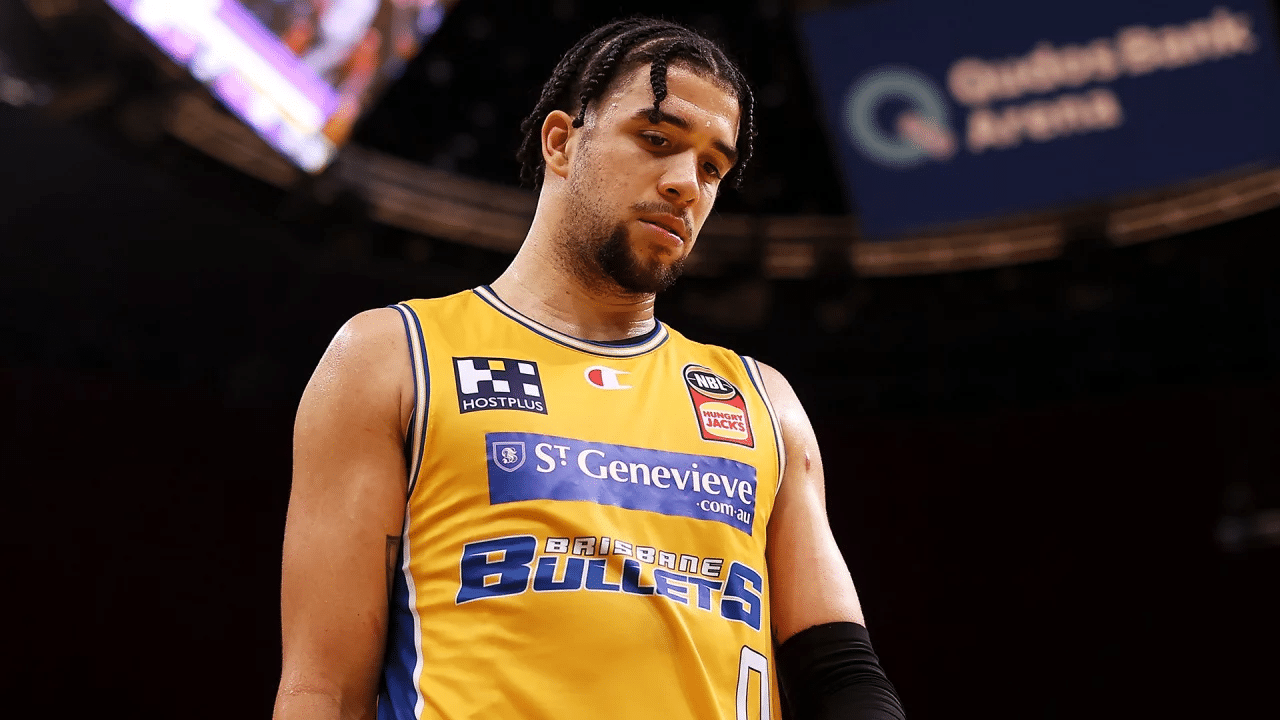
DJ Mitchell (Brisbane Bullets) on navigating a difficult rookie season, playing in his dad’s NBL shadow and the Polish league championship
June 4, 2023



BIO: Michael Eric Mitchell was born in Los Angeles, California, and attended Mater Dei High School in Santa Ana, California. After graduating he attended Fresno State University from 1985-1988 before transferring to Colorado State for 1989 and 1990 where he made the 1990 All-Western Athletic Conference First-team.
Mike Mitchell made his NBL debut with the Gold Coast Rollers at 24 years of age. He scored 21 points in his first game.
After going undrafted in the 1990 NBA Draft, Mitchell travelled to Australia in 1991 to play for the Gold Coast Rollers.
In 1991, Gold Coast re-branded themselves from the Cougars to the Rollers and under new head coach Dave Claxton they recorded their best team result ever, finishing with 14 wins and 12 losses. Mitchell was paired with Andre LaFleur (22 points per game) and together would form one of the best import duo’s of the 1990s. Despite the winning record the Rollers would not qualify for the post season. Mitchell averaged 29.1 points, 7.3 rebounds, and 3.4 assists in what would be the most successful year of the franchise’s six years of existance.
Mitchell would also earn selection to the All-NBL first team, becoming the only Gold Coast player to earn a first team selection in league history.
1992
After narrowly missing out on the playoffs in 1991 the Gold Coast re-signed both Mitchell and Andre LaFleur as they looked to take things one step further.
The team suffered a huge blow when they lost Mitchell on May 31, 1992, after he suffered a horrific injury when he smashed his right arm in anger against a wire-reinforced glass panel of a locker-room door after Gold Coast narrowly lost away to the Illawarra Hawks.
With his arm almost severed, Mitchell was found slumped on the floor in a pool of blood by Rollers teammate Ron Radliff. Doubt was initially cast over whether Mitchell would ever play again, but he recovered in time for the following season.
Mitchell played in only 9 games and averaged 26.8 points, 7.8 rebounds, and 3 assists prior to the injury. Unable to cover for Mitchell’s loss the team finished in 10th place, with a record of 11-13.
1993
In 1993, Mitchell averaged 23.6 points, 7.4 rebounds, and 3.9 assists during a season where the Rollers struggled to generate wins, finishing with a 12-14 record and their second consecutive tenth place finish.
1994
1994 was the third season in a row where the Rollers finished in 10th place, although they had won fewer and fewer games each year. Mitchell averaged 23 points, 8.5 rebounds, and 3.2 assists this season, which would end in a major revamp at the end of the year with the team not re-signing either Mitchell or LaFleur for the next season.
BRISBANE BULLETS
1995
In 1995 Mitchell moved to the Brisbane Bullets, the nearby rival of his former team and averaged 20.9 points and 6.8 rebounds for the season. He guided the Bullets to a fifth place and a record of 16-10.
1996
During the 1996 season, Mitchell averaged 20 points and 7.5 rebounds, and helped guide the Bullets to a eighth place finish in the regular season with a 14-12 record.
Mike Mitchell played seven seasons across three NBL teams. This included the Gold Coast Rollers, Brisbane Bullets and North Melbourne Giants. He averaged 22 points, 7.2 rebounds, and 2.7 assists in 176 NBL games.
– 29th in steals per game.
HIGHLIGHTS:
| SEASON | AGE | TEAM | TEAM RECORD | GP | MINS | PTS | REB | AST | OR | DR | STL | BLK | TO | PF | FGM | FGA | FG% | 3PM | 3PA | 3P% | FTM | FTA | FT% | TS% | EFG% | HS |
|---|---|---|---|---|---|---|---|---|---|---|---|---|---|---|---|---|---|---|---|---|---|---|---|---|---|---|
| 1997 | 30 | North Melbourne | 18-12 (3) | 32 | 1,104 | 504 | 195 | 51 | 86 | 109 | 53 | 13 | 75 | 126 | 181 | 419 | 43% | 33 | 103 | 32% | 109 | 151 | 72% | 51% | 47% | 27 |
| 1996 | 29 | Brisbane | 14-12 (8) | 29 | 1,135 | 580 | 218 | 54 | 119 | 99 | 55 | 15 | 82 | 117 | 207 | 480 | 43% | 15 | 55 | 27% | 151 | 203 | 74% | 50% | 45% | 31 |
| 1995 | 28 | Brisbane | 16-10 (6) | 28 | 1,059 | 584 | 189 | 79 | 87 | 102 | 65 | 21 | 109 | 129 | 215 | 403 | 53% | 6 | 28 | 21% | 148 | 200 | 74% | 59% | 54% | 39 |
| 1994 | 27 | Gold Coast | 10-16 (10) | 26 | 1,146 | 598 | 222 | 84 | 87 | 135 | 63 | 19 | 105 | 103 | 221 | 463 | 48% | 20 | 81 | 25% | 136 | 179 | 76% | 55% | 50% | 35 |
| 1993 | 26 | Gold Coast | 12-14 (10) | 26 | 1,102 | 613 | 192 | 102 | 86 | 106 | 65 | 27 | 112 | 100 | 237 | 497 | 48% | 8 | 33 | 24% | 131 | 178 | 74% | 53% | 48% | 36 |
| 1992 | 25 | Gold Coast | 11-13 (10) | 9 | 392 | 241 | 70 | 27 | 18 | 52 | 17 | 5 | 36 | 36 | 85 | 178 | 48% | 20 | 42 | 48% | 51 | 69 | 74% | 57% | 53% | 39 |
| 1991 | 24 | Gold Coast | 14-12 (8) | 26 | 1,161 | 757 | 190 | 89 | 73 | 117 | 66 | 26 | 115 | 106 | 299 | 589 | 51% | 24 | 74 | 32% | 135 | 196 | 69% | 55% | 53% | 46 | Totals | 176 | 7099 | 3877 | 1276 | 486 | 556 | 720 | 384 | 126 | 634 | 717 | 1445 | 3029 | 47.7% | 126 | 416 | 30.3% | 861 | 1176 | 73.2% | 55% | 50% | 46 |
| SEASON | AGE | TEAM | TEAM RECORD | GP | MINS | PTS | REB | AST | OR | DR | STL | BLK | TO | PF | FGM | FGA | FG% | 3PM | 3PA | 3P% | FTM | FTA | FT% | TS% | EFG% | HS |
|---|---|---|---|---|---|---|---|---|---|---|---|---|---|---|---|---|---|---|---|---|---|---|---|---|---|---|
| 1997 | 30 | North Melbourne | 18-12 (3) | 32 | 34.5 | 15.8 | 6.1 | 1.6 | 2.7 | 3.4 | 1.7 | 0.4 | 2.3 | 3.9 | 5.7 | 13.1 | 43% | 1.0 | 3.2 | 32% | 3.4 | 4.7 | 72% | 51% | 47% | 27 |
| 1996 | 29 | Brisbane | 14-12 (8) | 29 | 39.1 | 20.0 | 7.5 | 1.9 | 4.1 | 3.4 | 1.9 | 0.5 | 2.8 | 4.0 | 7.1 | 16.6 | 43% | 0.5 | 1.9 | 27% | 5.2 | 7.0 | 74% | 50% | 45% | 31 |
| 1995 | 28 | Brisbane | 16-10 (6) | 28 | 37.8 | 20.9 | 6.8 | 2.8 | 3.1 | 3.6 | 2.3 | 0.8 | 3.9 | 4.6 | 7.7 | 14.4 | 53% | 0.2 | 1.0 | 21% | 5.3 | 7.1 | 74% | 59% | 54% | 39 |
| 1994 | 27 | Gold Coast | 10-16 (10) | 26 | 44.1 | 23.0 | 8.5 | 3.2 | 3.3 | 5.2 | 2.4 | 0.7 | 4.0 | 4.0 | 8.5 | 17.8 | 48% | 0.8 | 3.1 | 25% | 5.2 | 6.9 | 76% | 55% | 50% | 35 |
| 1993 | 26 | Gold Coast | 12-14 (10) | 26 | 42.4 | 23.6 | 7.4 | 3.9 | 3.3 | 4.1 | 2.5 | 1.0 | 4.3 | 3.8 | 9.1 | 19.1 | 48% | 0.3 | 1.3 | 24% | 5.0 | 6.8 | 74% | 53% | 48% | 36 |
| 1992 | 25 | Gold Coast | 11-13 (10) | 9 | 43.6 | 26.8 | 7.8 | 3.0 | 2.0 | 5.8 | 1.9 | 0.6 | 4.0 | 4.0 | 9.4 | 19.8 | 48% | 2.2 | 4.7 | 48% | 5.7 | 7.7 | 74% | 57% | 53% | 39 |
| 1991 | 24 | Gold Coast | 14-12 (8) | 26 | 44.7 | 29.1 | 7.3 | 3.4 | 2.8 | 4.5 | 2.5 | 1.0 | 4.4 | 4.1 | 11.5 | 22.7 | 51% | 0.9 | 2.8 | 32% | 5.2 | 7.5 | 69% | 55% | 53% | 46 | Total | 176 | 40.3 | 22.0 | 7.3 | 2.8 | 3.2 | 4.1 | 2.2 | 0.7 | 3.6 | 4.1 | 8.2 | 17.2 | 47.7% | 0.0 | 0.0 | 30.3% | 0.7 | 2.4 | 73.2% | 55% | 50% | 46 |
| POINTS | REBOUNDS | ASSISTS | STEALS | BLOCKS | TURNOVERS | TRIPLE DOUBLES | 46 | 19 | 9 | 8 | 4 | 9 | 0 |
|---|
Mitchell joined Dragons Rhöndorf for the 1997–98 Basketball Bundesliga season, playing his first season in Germany.
Mitchell remained with Rhöndorf through 1998–99, giving him a two-season stint at the club that included the 1998–99 campaign listed in your notes, before moving on at the end of that run.
He shifted to France in 1999–2000 with Besançon BCD in LNB Pro A, and he was named to the All-Bosman 1st Team for the 1999–2000 Pro A season.
Mitchell returned to Germany in 2000–01 with the Gießen 46ers and stayed with the club through 2003–04, playing alongside teammates such as Brian Lynch, Thorsten Leibenath, Jason Maile, James Shields, and Gerrit Terdenge during that period.
During his final Gießen season in 2003–04, a shoulder injury led to surgery in late summer 2004, and that issue prevented him from playing on into the following season after his four-year run with the 46ers.
Mitchell played college basketball at Fresno State during the 1986-87 season before transferring to Colorado State, where he competed from 1987-88 through 1989-90 and completed his collegiate eligibility prior to 1991.
In 1986-87 at Fresno State, Mitchell appeared as a freshman guard in 28 games off the bench as the Bulldogs finished 16-13 overall and 9-7 in Pacific Coast Athletic Association play, and he averaged 4.8 points and 1.9 rebounds per game while shooting 43.2% from the field and 73.1% from the free-throw line in limited minutes.
Following that freshman campaign, he transferred to Colorado State and sat out the 1987-88 season due to NCAA transfer regulations while the Rams went 12-17 overall under head coach Boyd Grant.
Mitchell became eligible in 1988-89 and immediately stepped into the rotation, appearing in 29 games with 18 starts as Colorado State finished 14-15 overall and 6-10 in Western Athletic Conference play, and he averaged 12.6 points, 3.4 rebounds, and 2.7 assists per game while shooting 46.8% from the field and 38.5% from three-point range.
That 1988-89 season included nine games of 15 or more points and a 24-point performance against Wyoming on January 28, and he logged over 30 minutes in 14 contests as he became one of the team’s primary perimeter scoring threats.
As a junior in 1989-90, Mitchell started all 30 games and led Colorado State in scoring at 18.9 points per game while adding 4.1 rebounds and 3.5 assists per contest, helping the Rams to a 20-10 overall record and an 11-5 mark in WAC competition.
During that 1989-90 season, he totaled 567 points on 207-for-441 shooting from the field (46.9%), connected on 64-of-159 three-point attempts (40.3%), and converted 89-of-112 free throws (79.5%), ranking among the WAC leaders in scoring and three-point accuracy.
Mitchell recorded 14 games of at least 20 points as a junior, including a season-high 31 points against UTEP on February 10 and 28 points versus BYU on February 24, and he played 35.6 minutes per game while serving as a team captain during his final year.
Across his three active collegiate seasons at Fresno State and Colorado State, Mitchell appeared in 87 games with 48 starts, totaled 1,045 career points, 261 rebounds, and 189 assists, and finished with 88 career three-pointers while shooting above 46% from the field over his final two seasons.
He concluded his college career at Colorado State as one of the program’s top scorers of the late 1980s and completed his degree requirements prior to 1991 after finishing his eligibility in the Western Athletic Conference.
- 1x All-NBL First Team
- 1x All-NBL Third Team
In 2008, Mitchell was named an assistant coach with the Women's National Basketball Association's Chicago Sky. Prior to that, he was an assistant coach at the University of California, Riverside, and the head coach for the Ramona High School boys' basketball team. He is currently coaching the Santiago High School girls varsity team in Corona, California.
Whilst we try to source as much information as we can for every player who has ever played in the NBL some information on a player profile may be missing. If you have additional information on a player you'd like us to add to a profile, please send it to us using the enquiry form below.
Submissions are then sent to info@aussiehoopla.com

