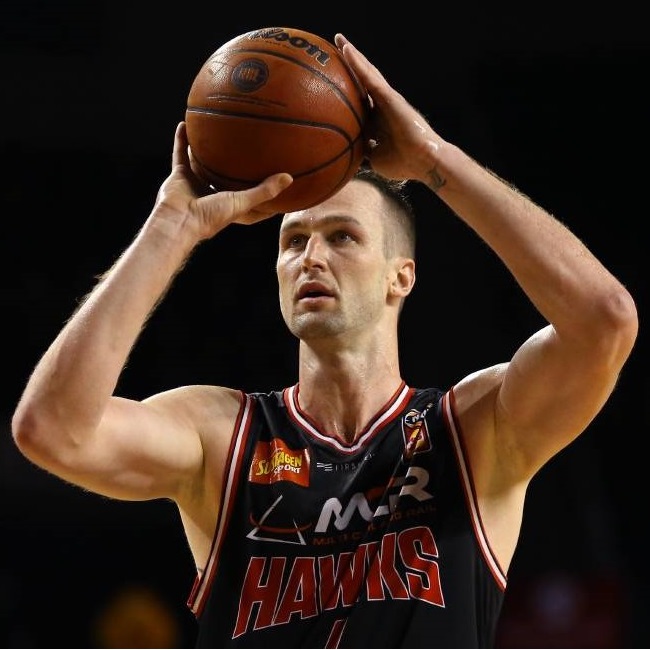
Derek Cooke Jr
June 8, 2023


BIO: Born in Burnie, Tasmania, Knight played both basketball and Australian rules football as a junior. He was a talented footballer growing up, following in the steps of his father, Scott, who played five games for Collingwood in the VFL in 1984 before carving out a accomplished career in Tasmania.
Knight attended Smithton High School in 1997 and 1998 before linking up with the Tasmanian Institute of Sport (TIS) and joining the TIS Basketball Elite Development Squad.
During his junior basketball career, Knight played for the Tasmania under-16 team in 1999 and 2000, the under-18 team in 2001 and 2002, and the under-20 team in 2003. He was also a member of the All-Australian Junior Camp in 2002 and 2003. Knight received a scholarship to attend the Australian Institute of Sport (Canberra) in 2003. He spent one year there and played for the program’s state league team.
FAMILY: His father Scott played five games for Collingwood in the VFL in 1984 before carving out an accomplished career in Tasmania. In 2013, Knight considered a switch to Australian Rules football in order to follow in his father’s footsteps after attracting interest from WAFL club West Perth.
Matthew Knight made his NBL debut with the West Sydney Razorbacks at 22 years of age. He scored 16 points in his first game.
Knight and his Loyola-Marymount teammate Damian Martin, both joined Rob Beveridge at the West Sydney Razorbacks for the 2007/08 NBL season.
Razorbacks coach Rob Beveridge had also coached the duo during the Under 23 World Championships in 2003.
In his rookie season, Knight appeared in 25 of the team’s 30 games and averaged 12.0 points, 8.6 rebounds, and 1.1 assist per game. He also recorded six double-doubles. The Razorbacks finished the regular season in tenth place with a 10–20 record.
2008/09
For the 2008/09 season, the Razorbacks were renamed the Sydney Spirit in a bid to broaden their supporter base after the collapse of the Sydney Kings. Knight, Martin and Beveridge continued on with the Spirit, but financial difficulties soon besieged the club mid-season. After team owner Greg Evans was served a default notice, all players were asked to take a 50 percent pay cut. This led to the league having to step in and provide assistance in order for the club to play out the season.
The move saw the subsequent departure of Julian Khazzouh and import Derrick Low, to higher paying deals in Europe and the Spirit stumbled through the season and finished with a 11–19 record, missing the playoffs with a eighth-place finish.
Despite the struggles of the Spirit both on and off the court, Knight managed to have a very productive season, averaging 16.6 points, 8.4 rebounds, and 1.2 assists per game, as he played and started in every game throughout the season.
For his efforts, he earned NBL Most Improved Player honours and was named in the All-NBL third team. He also finished second in MVP voting.
PERTH WILDCATS
2010/11
During free agency, the Wildcats were able to retain star import Kevin Lisch despite several European clubs offering him much larger contracts, re-sign Shawn Redhage to a three-year deal and added Matthew Knight. Knight, who had previously played with Damian Martin and Rob Beveridge with the Sydney Spirit before they folded, leaving him to pursue a career overseas.
Knight’s debut season for the Wildcats began positively before a left calf injury suffered on 12 December 2010 against the Melbourne Tigers ruled him out for two months. Further injuries to both Jesse Wagstaff (11.4 points per game) and Shawn Redhage (18 points per game) threw the Wildcats’ season into even further disarray. Redhage’s injury in particular, which was originally feared to be career-ending after he dislocated his left hip during the Wildcats’ 77–76 loss to the Adelaide 36ers in Adelaide and he potentially required a hip replacement. The injury occurred after Redhage lunged for a contested ball in a way that punched the head of his femur through his pelvis, breaking the bone and dislocating the joint. Behind the multiple injuries the team stumbled through the regular season with
Kevin Lisch (13.5 points per game) delivering another impressive season, scoring in double figures in all but nine games, as the Wildcats finished in fourth place with a 16–12 record.
Perth would face the first-placed New Zealand Breakers in the semifinals and behind a 29-point effort from Lisch won game one of the series in Auckland in a blowout 101-78 win. The Breakers would rebound and win Games 2 (93-89) and game three (99-83), then go on to defeat Cairns to win the 2011 NBL championship. Knight was relatively injury free In 2011/12, and averaged 12.4 points, 6.7 rebounds, and 1.2 assists per game, while Kevin Lisch and Shawn Redhage were named co-MVPs for the Wildcats. This season would also see Damian Martin win the NBL Best Defensive Player award for the first time.
2011/12
Perth looked to get back on top in 2011 by adding 7’2 centre Luke Nevill with the aim of re-creating the ‘Perth Wall’ alongside Knight, who was relatively injury free in 2011/12, Jesse Wagstaff and Shawn Redhage, who was returning to action returned to action after a career threatening injury during the 2010/11 season.
Knight would average 10.8 points, 5.4 rebounds, and 1.3 assists for the season while Kevin Lisch became the first Wildcats player to lead the NBL in scoring as well as becoming the second Wildcat to ever win the NBL MVP.
The 2011/12 season saw the Wildcats jostle over top spot for the majority of the season with the New Zealand Breakers before the two teams met in the Grand Final
the Wildcat’s lost game one 104–98 in overtime but behind a 20 point game from Shawn Redhage and a final-second block on Breakers star CJ Bruton set up a third game to decide the championship. In game three the Breakers defeated the Wildcat’s 79–73 in front of 9,258 New Zealand faithful, the largest NBL crowd during the season.
2012/13
Prior to the season beginning, the state-of-the-art Perth Arena was finally completed and the 13,500 seat stadium become the new home of the Wildcats, starting with the 2012/13 season.
After undergoing off-season shoulder surgery, Matthew Knight entered season with the expectation that he was going to be the team’s go-to guy in the paint. Knight embraced the responsibility and excelled in the Wildcats’ season-opening win over the New Zealand Breakers, earning the NBL’s Player of the Week award for a 20-point, nine-rebound effort.
Kevin Lisch, who re-signed with the Wildcats (two-year deal), was coined the ‘best import in the league’ by coach Rob Beveridge at the start of the year, and he certainly proved that during the five rounds of the season. With Damian Martin injured Lisch ran the point for the first few weeks and averaged 22.0 points, 3.5 rebounds, 2.8 assists and 1.3 steals per game during October, guiding the Wildcat’s to a 3–1 record.
Additionally, against the Townsville Crocodiles on October 14, Lisch played his 100th consecutive NBL games which, not coincidentally, was Rob Beveridge’s 100th game for the Wildcats as coach.
Import Michael Dunigan was brought in as a short-term replacement for Knight while he missed four games to injury and became a fan-favourite with his thunderous dunks and athletic blocks.
The team then faced another hurdle when co-captain Brad Robbins abruptly retired just eight games into the season, citing he had lost his motivation and passion for the game. Not long after, Cameron Tovey also announced he would retire after the 2012/13 season.
Despite the turmoil, Knight averaged 13.7 points, 7.2 rebounds, and 0.7 assists helping the Wildcat’s finish second on the ladder with a 19–9 record. Lisch and Knight were named in the All-NBL First Team, and the Wildcats finished second on the ladder with a 22–6 record. Perth swept the Wollongong Hawks in the semifinals to move on to the 2013 NBL Grand Final series, a re-match from last season against the New Zealand Breakers which would be their third time facing the Breakers in a playoff series in as many years.
Another injury hurdle struck the Wildcat’s when Damian Martin was ruled out of the grand final series with a Achilles injury. To cover his loss Brad Robbins was subsequently rushed back into the team to take Martin’s place, but with the team missing Martin the Breakers defeated Perth in two straight games, winning their third consecutive championship in 2013.
In late May 2013, Lisch and coach Rob Beveridge parted ways with the Wildcats after four seasons. Lisch ended his four-year tenure in Perth to pursue his European aspirations, finishing with career averages of 14.6 points, 3.1 rebounds, and 2.7 assists per game.
In 2013, Knight considered a switch to Australian Rules football in order to follow in his father’s footsteps after attracting interest from WAFL club West Perth.
2013/14
“Having been defeated by the New Zealand Breakers in the previous two Grand Final series and then losing star import Kevin Lisch (to France), the Wildcat’s revamped their roster, looking to bring a new look squad and style that would deliver the team a sixth championship.
Team changes included the departure of Rob Beveridge, Kevin Lisch (who would follow Beveridge to Illawarra) and Cameron Tovey. The Wildcats’ then reloaded first by appointing Trevor Gleeson as head coach and signing two new imports in small forward James Ennis, who had just been selected as the 50th overall pick in the 2013 NBA draft, and shooting guard Jermaine Beal. Hard-nosed point guard Damian Martin would be named team captain, and Perth’s core group of Shawn Redhage, Jesse Wagstaff, Matthew Knight and Greg Hire all returned. Tom Jervis, as well as guards Drake U’U and Erik Burdon, were also signed to bolster the team’s bench.
A search to replace a former NBL MVP is never easy, but when Wildcats managing director Nick Marvin and head coach Trevor Gleeson witnessed his ability first hand at the NBA Summer League, they knew they had a star.
Ennis opened the season with 25 points and 4 rebounds on debut, a three-point victory over arch-rivals Adelaide, the most points scored by a Wildcat on NBL debut at the time. Ennis would earn player of the month in his first month as a Wildcat as Perth began the season with a 8-0 start.
Injuries to Knight forced the club to sign Jarrad Prue and Jeremiah Trueman as short-term injury replacements in October and January, but the Wildcats were still the clear pacesetters for the league. By the league’s mid-season break for the All-Star game, they sat in first place with a 12-1 record, and it was clear that Perth possessed the league’s best import duo that season. James Ennis (21.2 points, 7.1 rebounds, 2.1 assists, and 1.4 steals) and Jermaine Beal (15.6 points, 2.4 rebounds, and 3.4 assists), perfectly complemented the league’s best defender Damian Martin (7.6 points, 4.7 rebounds, and 4.1 assists 2.2 steals) and best villain Shawn Redhage (13.6 points, 4.5 rebounds, and 2.6 assists) and to no surprise, Perth finished the season on top of the ladder and reached the postseason for their 28th year in a row. Ennis and Beal were named to the All-NBL first and second team’s respectively.
Once into the postseason, the Wildcat’s eliminated the Wollongong Hawks first in straight sets, while on the other side of the bracket, their historic rivals Adelaide eliminated Melbourne in three games to see both team’s progress to the 2014 Grand Final.
The grand final would see first-placed Perth face second-ranked Adelaide with game one held in Perth. Wildcats star import James Ennis (30 points, 10 rebounds, and 4 assists) would lead Perth in points, rebounds, and assists, resulting in Perth claiming the win (92-85) and taking a 1-0 series lead.
Game two saw the 36ers force a deciding third game in front of 8,127 fans (their largest crowd of the season) rally their team to a 89-84 win behind high scoring from Gary Ervin (23 points) and a all-round game from Adam Gibson (18 points, 9 rebounds, and 7 assists) to even the series (1-1).
In response, 13,498 of Perth’s ‘red army’ would show up to see Perth defeat Adelaide and win their sixth NBL title. With James Ennis subdued by foul trouble, the Wildcat’s most experienced duo, Shawn Redhage and Damian Martin, were relied upon to pick up the slack. Redhage, scored 10 of his 16 points in the first term to help his team settle into the contest, while Martin produced a superb defensive effort on 36ers star Gary Ervin, limiting Adelaide’s game two hero to just four points while adding 14 points and six rebounds to the stat sheet. Greg Hire (9 rebounds, 5 assists) and Jermaine Beal (15 points) provided key contributions to help Perth bury the demons of successive grand final defeats in the past two seasons.
While Anthony Petrie (20 points) gave up for the 36ers, he lacked the support from fellow starters Adam Gibson (8 points) and Daniel Johnson (9 points), both of whom had been influential in the first two games of the series.
After his huge opening game, Ennis struggled to make a impact in Games two and three, and Beal would go on to win Finals MVP after averaging 17.6 points per game, shooting 48% from beyond the three-point line. Knight would finish the season by playing in 18 games and averaging 10.1 points, 5.5 rebounds, and 1.3 assists.
2014/15
After winning the 2014 NBL championship with a 21-7 regular-season record and defeating Adelaide in the Grand Final, Perth entered the 2014/15 season looking to win back-to-back titles. Trevor Gleeson returned as head coach, with the Wildcats retaining almost their entire championship roster. James Ennis (to Miami) and Erik Burdon (to Mount Gambier) departed, while Jermaine Beal, Damian Martin, Shawn Redhage, Matthew Knight, Jesse Wagstaff, Greg Hire, Tom Jervis and Drake U’u returned. Perth added DeAndre Daniels (via Connecticut), who had been selected with the 37th pick in the 2014 NBA Draft, and Earnest Ross (via Missouri) as its new imports, with Martin continuing as captain.
After missing much of the previous season through injury, Knight returned for another championship campaign as Perth’s starting centre. He remained in the second year of the three-year contract he had signed in May 2013, having played just 18 games during the Wildcats’ championship-winning season.
Perth opened its title defence against New Zealand at Perth Arena on October 10, where Redhage (20 points) and Daniels (19 points, 6 rebounds, 3 steals, and 2 blocks) led the Wildcats, while Beal (12 points and 5 assists) struggled through a 2-of-17 shooting performance. Cedric Jackson (22 points, 5 rebounds, and 5 assists) led the Breakers, who built a 49-26 halftime advantage before holding off Perth’s comeback to win 80-70 in front of 12,903 fans.
Knight (10.5 points and 7 rebounds across 24 games) remained Perth’s main interior scoring and rebounding presence, providing a physical presence alongside Daniels and Redhage. Although his previous season had been heavily disrupted by injuries, he entered the new campaign healthy and was able to contribute consistently throughout the opening three months, with his post scoring and rebounding becoming increasingly important as the Wildcats battled injuries elsewhere in the frontcourt.
One of the season’s first significant team performances came against Sydney at Perth Arena on October 24, where Knight (10 points, 8 rebounds, and 5 assists) provided strong interior support as Beal (16 points) and Wagstaff (15 points and 2 rebounds) led the Wildcats to an 84-63 victory. Martin (2 points, 9 rebounds, 8 assists, and 9 steals) produced the second-most steals in a game by a Wildcat, behind Ricky Grace’s 10, while Ben Madgen (15 points and 5 rebounds) led Sydney. The game also became remembered for Josh Childress delivering a raised forearm across Wagstaff’s upper body after the Perth forward had set an off-ball screen. An NBL tribunal later suspended Childress for one game and fined him $3,750 for unduly rough play, with another $3,750 fine imposed for bringing the game into disrepute.
Knight reached a personal milestone against Sydney on November 16, playing his 100th game for Perth in an 85-66 victory at the Sydney Olympic Park Sports Centre. Knight (16 points, 8 rebounds, 1 steal, and 1 block) made 7-of-13 field goals in almost 30 minutes, while Beal (27 points, 3 rebounds, 4 assists, and 1 steal) and Daniels (19 points, 8 rebounds, and 3 blocks) led the Wildcats’ offence. Josh Childress (23 points, 12 rebounds, 3 assists, and 2 blocks) was Sydney’s best as Perth completed a four-game winning streak and improved to 7-2.
His best overall performance came against Adelaide at Perth Arena on December 14, where Knight (16 points, 16 rebounds, 4 assists, and 2 blocks) produced a dominant performance inside, collecting four offensive rebounds and making six of his nine field-goal attempts. Drake U’u (20 points and 4 rebounds) made all five of his three-point attempts, while Daniels (17 points, 8 rebounds, and 2 assists) provided further support. Jamar Wilson (26 points) led Adelaide, but Perth controlled the rebounding battle 55-33 and recorded a convincing 97-76 victory to improve to 10-4.
Perth’s season became increasingly difficult as injuries disrupted the rotation. Hire (3.5 points across 11 games) tore his left calf at training shortly after the season opener and was sidelined for three months, leading to Mathiang Muo (1.9 points across 15 games) being activated as his injury replacement. Muo was deactivated on January 15 following Hire’s return, while Ross (3.3 points across 18 games) suffered a season-ending Achilles injury against Cairns on January 9. Luke Martin (via the state league) was signed as Ross’s injury replacement on January 16.
Knight’s own season was interrupted when he fractured the big toe on his left foot during training in early January. The injury was confirmed on January 9 and he was initially expected to miss up to six weeks, potentially ruling him out for the remainder of the regular season. With Perth already missing several players, Gleeson was forced to move Jervis into a larger starting role and consider additional frontcourt replacements. The Wildcats struggled without their starting centre, winning only one of six games during his absence and dropping from 12-5 to 13-10.
Knight made a surprise return against Sydney at Perth Arena on February 1, coming off the bench after missing six games and producing 12 points, 9 rebounds, 1 assist, and 1 block in just under 20 minutes. Martin (13 points, 7 rebounds, and 4 assists) and Jervis (12 points, 6 rebounds, and 2 blocks) provided support, while Tom Garlepp (17 points) led Sydney as Perth won 80-61 and revived its playoff hopes. Gleeson praised the impact of having his starting centre available again, saying, “We’ve missed that muscle inside, that toughness… it gives the guys confidence. He’s a great teammate.”
Knight produced his highest-scoring game of the season against Adelaide on February 20, finishing with 20 points as Beal (23 points) and Redhage (17 points) provided the Wildcats’ other major contributions. Brock Motum (25 points) and Wilson (25 points) led the 36ers, with Motum making six three-pointers as Adelaide overcame a halftime deficit to win 101-94 at the Adelaide Arena. The defeat left Perth with a 15-12 record and struggling to regain the consistency that had delivered the previous season’s championship.
Perth completed the regular season against Townsville at Perth Arena on February 22, with Daniels (24 points, 11 rebounds, 4 steals, and 2 blocks), Redhage (16 points) and Jervis (14 points) leading the Wildcats to an 81-71 victory over the Crocodiles, while Brian Conklin (17 points) led Townsville. The win secured fourth place with a 16-12 record and extended Perth’s consecutive postseason appearance streak to 29 seasons.
Beal (16.4 points across 30 games) became Perth’s primary offensive weapon following Ennis’s departure, finishing among the NBL’s top five regular-season scorers, leading the league with 69 made three-pointers and winning the Gordon Ellis Medal as the Wildcats’ club MVP. Daniels (14.8 points and 7.7 rebounds across 30 games) provided athleticism, scoring and rebounding from the forward position and finished second in Perth’s MVP voting, while Redhage (11.4 points and 3.9 rebounds across 28 games) remained one of the team’s most experienced offensive contributors.
Wagstaff (8.5 points and 4 rebounds across 30 games) continued providing scoring and outside shooting from the bench, while Jervis (7.1 points and 4.9 rebounds across 30 games) became increasingly important when Knight was sidelined. Martin (6.2 points, 5.8 rebounds, 4.1 assists, and 2.7 steals across 30 games) anchored the defence and led the NBL in steals.
Despite missing six regular-season games, Knight’s performances earned him selection to the All-NBL Second Team and Perth’s Coaches Award. Jervis was named the club’s Most Improved Player, while Martin won the NBL Best Defensive Player award for the fifth consecutive year, drawing level with Darnell Mee for the most wins in league history at the time. Perth’s injury problems continued into the postseason when Redhage suffered a stress fracture of the navicular bone in his right foot during the final regular-season game against Townsville, ruling him out of the entire finals campaign.
Perth opened its semifinal series against minor premier Cairns at the Cairns Convention Centre on February 27 without Redhage, where Knight (8 points, 9 rebounds, and 1 assist) battled inside but struggled with his shooting, making four of his 13 field-goal attempts. Beal (20 points, 4 rebounds, 2 assists, and 1 steal) and Daniels (14 points, 4 rebounds, 1 steal, and 2 blocks) led the Wildcats’ scoring, while Martin (7 points, 8 rebounds, 5 assists, and 6 steals) helped spark an 18-2 third-quarter run that brought Perth back from a 13-point halftime deficit. Scottie Wilbekin (23 points, 10 rebounds, and 4 assists) and Cameron Tragardh (16 points, 7 rebounds, and 3 assists) led Cairns, which recovered in the fourth quarter to win 71-64. Hire suffered another calf injury during the game and was ruled out of game two.
Game two moved to Perth Arena on March 1 with both Redhage and Hire sidelined, where Knight (18 points and 10 rebounds) produced a double-double and was Perth’s most consistent offensive threat inside. Beal (21 points and 4 assists) and Martin (9 points, 3 rebounds, and 2 assists) provided support, while Wilbekin (16 points, 11 rebounds, and 6 assists) and Stephen Weigh (16 points) led Cairns. With Perth trailing by eight points entering the final quarter, Beal sparked a comeback and eventually levelled the scores with a three-pointer, but Weigh immediately answered from long range to ignite a decisive 10-0 run. Cairns defeated Perth 80-68 to complete the semifinal sweep and end the Wildcats’ championship defence.
2015/16
After a injury-riddled season in 2014/15 saw the Wildcats suffer a semi-final defeat, much like in 2010/11 coach Trevor Gleeson was confident heading into the 2015/16 season that he had assembled a team capable of winning the club’s seventh championship. After conceding his side struggled with chemistry issues in 2014/15 the Wildcat’s added high-profile recruits Casey Prather and Nathan Jawai as well as backup guard Jarrod Kenny to correct team balance.
With the team’s acquisition of Nathan Jawai a injury-free Matthew Knight was able to move to his natural position of power forward for the first time and together with Tom Jervis the Wildcats would feature a formidable frontcourt. The Wildcats battled with Melbourne United for top spot on the ladder all season, including Jermaine Beal notching up a career high 40 points, sinking 10 three-pointers as Perth dismantled Melbourne 113-83 in December.
Knight would average 11.6 points, 7.9 rebounds, and 1.4 assists as Perth remained relatively injury-free and finished the regular season in second place with a 18–10 record. The Wildcats extended their string of consecutive playoff appearances to 30 and made light work of the Rob Beveridge-led Illawarra Hawks in game one of the semi finals. Caey Prather would score 19 points and lead the Wildcats to a 80-68 victory.
Game 2, the Hawks would even the score behind perhaps Oscar Forman best playoff game, one where he barely missed and finished with 21 points to defeat the Wildcat’s in convincing fashion, 104–87.
Back at home, Perth would win the series, 2-1 with a 89-74 victory. Jermaine Beal would lead the team in scoring with 17 points and Prather would add 15 points, including a thunderous one-handed slam over AJ Ogilvy early in the fourth quarter to set up a NBL Finals series against reigning champs, the New Zealand Breakers.
In the NBL Grand Final series, Prather helped the Wildcat’s defeat the New Zealand Breakers 2–1 to win the championship, as he had a team-high 19 points in the series-clinching 75–52 game three win.
Knight appeared in 33 of the team’s 34 games in 2015/16, averaging 11.6 points, 7.9 rebounds, and 1.4 assists per game. At the conclusion of the regular season, Knight was named in the All-NBL second team for the second straight year.
In game one, the Wildcats would rely on Jawai’s presence inside, Prather’s athleticism, tough defence and ability to finish at the rim and Kenny being able to support captain Damian Martin admirably, all the critical areas they were missing the season prior, to take a 1-0 lead behind a six point win (82–76).
With game two back in New Zealand, the Breakers evened the score, winning 72–68 on the back of a near triple-double from import Cedric Jackson who finished with 13 points, 9 rebounds, and 8 assists.
With the deciding game in Perth and 13,090 of the ‘Red Army’ in attendance, the Wildcats’ core of Redhage, Wagstaff, Knight, Hire, Beal and Jervis made sure history didn’t repeat itself. Casey Prather (19 points) and Jermaine Beal (14 points) did most of the damage on the scoreboard for the Wildcats, but it was Martin’s inspirational display in defence that shone the brightest. Martin would be named Grand Final MVP after keeping star Breakers guard Cedric Jackson scoreless in the deciding game as the Wildcat’s claimed their seventh championship in a blowout win (75–52).
2016/17
After finishing fourth with a 16-12 record in 2014/15 and being swept by Cairns in the semifinals, Perth entered the 2015/16 season under Trevor Gleeson looking to rebound from an injury-riddled year where the coach felt the Wildcats had also struggled with chemistry. DeAndre Daniels (to Toronto), Drake U’U (opted out) and Earnest Ross (released following his Achilles injury) departed, while Gleeson added Casey Prather (via Bakersfield), Nathan Jawai (via Andorra) and Hugh Greenwood (via New Mexico). Greenwood then requested a release before the season to pursue an AFL career, with Jarrod Kenny (via Hawke’s Bay) signed on September 1 as his replacement.
Knight entered the third and final season of the three-year extension he signed in May 2013, a deal which kept him with the Wildcats through 2016.
Perth opened the season in Adelaide on October 10, where Knight (6 points, 10 rebounds, and 2 assists) started as the Wildcats defeated the 36ers 79-66. Beal (18 points, 4 rebounds, and 2 assists) and Wagstaff (11 points, 8 rebounds, and 2 assists) provided support, while Daniel Johnson (18 points, 10 rebounds, 1 steal, and 1 block) led Adelaide.
Knight (11.6 points and 7.9 rebounds across 33 games) started every one of his appearances, with Jawai (10.3 points and 4.1 rebounds across 32 games) allowing him to move to his natural position of power forward and giving Perth one of the league’s deepest frontcourts. Knight still had to manage a troublesome left shoulder which had bothered him for much of the season. He missed only Perth’s January 15 meeting with Sydney to rest the shoulder and aggravated it again at training on February 12, but still played the final regular-season game and all six playoff games. “I just landed on it awkwardly and it popped in and out so it’s done it a couple times throughout the season,” Knight said, with surgery considered likely once the season finished. Perth made no mid-season contracted roster additions or releases and did not use an injury-replacement player, instead relying on the development players already attached to the squad.
Knight’s best scoring game came in Wollongong on October 25, where he made nine of 14 field goals and finished with 22 points, 10 rebounds, 1 assist, and 1 steal without committing a turnover as Perth defeated Illawarra 106-99. Beal (25 points and 7 assists) and Wagstaff (18 points, 9 rebounds, and 2 assists) provided support, while AJ Ogilvy (21 points, 4 rebounds, 1 assist, 2 steals, and 1 block) led the Hawks.
One of Perth’s biggest wins came against Melbourne on December 10, where Knight (14 points, 9 rebounds, 3 assists, and 1 steal) made seven of nine field goals as the Wildcats dismantled United 113-83 and moved to the top of the ladder. Beal (40 points, 2 rebounds, 7 assists, and 2 steals) was held scoreless in the opening quarter before making a club-record ten three-pointers, while Prather (20 points, 6 rebounds, 4 assists, 2 steals, and 1 block) provided support and Daniel Kickert (23 points and 3 rebounds) led Melbourne.
Knight produced another double-double against Melbourne on December 27, finishing with 19 points, 10 rebounds, and 2 assists as the Wildcats fell 92-87. Prather (24 points, 7 rebounds, 1 assist, and 2 steals) and Jawai (15 points, 4 rebounds, and 3 assists) provided support, while Chris Goulding (27 points, 2 rebounds, and 2 assists) led United. The loss pushed Perth into third place for the only time during the season.
Prather (16.3 points, 4.5 rebounds, and 1.2 steals across 27 games) led Perth in scoring despite missing time with knee, ankle and hamstring problems and was named the Wildcats MVP, while Beal (15.6 points and 3.6 assists across 33 games) remained the team’s other major scoring option. Wagstaff (9.3 points and 4 rebounds across 34 games), Jervis (6.7 points, 5 rebounds, and 1.2 blocks across 34 games) and Redhage (6.6 points and 3.1 rebounds across 34 games) provided experienced depth, with Redhage averaging under 10 points for the first time in his NBL career and playing his 350th game in January. Martin (5.5 points, 4.4 rebounds, 3.3 assists, and 1.8 steals across 24 games) missed time after an elbow from Townsville’s Brian Conklin broke his jaw and dislodged teeth, but returned before the end of November and played his 200th game for Perth in February. Knight was named to the All-NBL Second Team for the second consecutive season.
Perth completed the regular season against Adelaide at Perth Arena on February 14, where Knight (8 points, 1 rebound, and 2 assists) played despite aggravating his shoulder at training two days earlier as the Wildcats defeated the 36ers 100-84. Beal (15 points, 5 rebounds, and 3 assists) and Prather (15 points and 6 rebounds) led Perth, while Mitch Creek (17 points, 4 rebounds, 2 assists, and 1 steal) was Adelaide’s best. The victory left the Wildcats second with an 18-10 record and extended their run of consecutive playoff appearances to 30.
Perth opened its semifinal series against the Rob Beveridge-led Illawarra Hawks at Perth Arena, where Knight (9 points, 6 rebounds, and 1 assist) contributed inside as Prather (19 points, 2 rebounds, and 2 assists) and Beal (18 points, 1 rebound, and 2 assists) led the Wildcats to an 80-68 victory. Tim Coenraad (23 points and 3 rebounds) and Ogilvy (14 points, 11 rebounds, 1 assist, 1 steal, and 2 blocks) were Illawarra’s best.
Game two moved to Wollongong, where Knight (15 points, 4 rebounds, 1 assist, 1 steal, and 1 block) made six of seven field goals, while Prather (21 points, 4 rebounds, 1 assist, and 2 steals) and Beal (20 points, 4 rebounds, and 4 assists) led Perth. Oscar Forman (21 points, 5 rebounds, 1 steal, and 2 blocks) and Ogilvy (20 points, 7 rebounds, 3 assists, 1 steal, and 3 blocks) helped Illawarra win 104-87 and force a deciding game.
Game three returned to Perth Arena, where Knight (15 points, 9 rebounds, 1 assist, and 1 steal), Beal (17 points, 3 rebounds, and 3 assists) and Wagstaff (17 points and 7 rebounds) led the Wildcats, while Prather (15 points, 4 rebounds, and 4 assists) added a thunderous one-handed slam over Ogilvy early in the fourth quarter. Kirk Penney (18 points, 2 rebounds, and 5 assists) led Illawarra, but Perth won 89-74 and advanced to the Grand Final with a 2-1 series victory.
New Zealand finished the regular season third with a 16-12 record before sweeping top-seeded Melbourne in the semifinals, setting up another Grand Final series between the Wildcats and the reigning champions.
The Grand Final opened at Perth Arena, where Knight (14 points, 5 rebounds, 1 steal, and 1 block) was one of Perth’s best as Jawai (15 points, 1 steal, and 1 block) provided a strong presence inside, Prather (11 points, 6 rebounds, 2 assists, and 2 blocks) attacked the rim and Martin (9 points, 10 rebounds, and 5 assists) controlled the game late. Kenny (8 points, 2 rebounds, and 1 steal) also provided support from the bench, while Corey Webster (19 points, 1 rebound, 2 assists, and 2 steals) and Cedric Jackson (14 points, 6 rebounds, 4 assists, and 2 steals) led New Zealand. Perth won 82-76 to take a 1-0 series lead.
Game two moved to Auckland, where Knight (7 points and 6 rebounds) contributed inside as Beal (20 points, 4 rebounds, and 4 assists) and Wagstaff (13 points and 2 rebounds) led Perth, but a costly late turnover from Beal helped New Zealand close out a 72-68 victory. Cedric Jackson (13 points, 9 rebounds, 8 assists, and 2 steals) produced a near triple-double and Abercrombie (12 points, 5 rebounds, and 1 assist) provided support as the Breakers levelled the series.
The deciding game returned to Perth Arena in front of 13,090 fans, where Knight (4 points and 11 rebounds) helped Perth dominate the glass as Prather (19 points, 5 rebounds, 1 steal, and 1 block), Beal (14 points, 4 rebounds, 4 assists, and 1 steal) and Martin (10 points, 8 rebounds, 1 assist, 2 steals, and 1 block) led the Wildcats, while Abercrombie (21 points, 6 rebounds, 1 assist, and 4 steals) and Charles Jackson (7 points and 12 rebounds) were New Zealand’s best. Martin kept Cedric Jackson scoreless and was named Grand Final MVP as Perth won 75-52 to claim its seventh NBL championship.
2017/18
Following consecutive championship seasons, Perth re-signed Grand Final MVP Bryce Cotton but lost two-time club MVP Casey Prather (to Melbourne), Jameel McKay (to Spain) and Shawn Redhage (retired). Devondrick Walker (via Delaware) initially signed as Prather’s replacement, but fractured his left foot during the preseason and was ruled out before playing a regular-season game, with JP Tokoto (via Rio Grande Valley) signed as his replacement. Derek Cooke Jr (via Northern Arizona) replaced McKay, while Lucas Walker was elevated from training player to the full-time roster.
Before the season, the veteran centre announced the 2017/18 campaign would be his last after battling shoulder problems and concussion during the previous season. He was cleared to continue playing after being assessed by neuropsychologist Helen Clausen, but his final preseason was disrupted when he suffered a small fracture and ligament damage in his right thumb during Perth’s opening game of the NBL Blitz. The Wildcats opted against surgery and he missed the remainder of the preseason.
Perth opened the regular season against Brisbane at Perth Arena on October 7, where Knight (2 points) played just over five minutes as the Wildcats defeated the Bullets 96-86 in front of an NBL opening-round record crowd of 13,403. Travis Trice (23 points, 5 rebounds, and 3 assists) and Perrin Buford (17 points and 5 rebounds) led Brisbane, while a collision with Buford left Knight with a fractured cheekbone.
Knight (5.4 points across 5 games) was able to return for Perth’s next game and appeared in each of the Wildcats’ first five games despite playing through the fractured thumb and cheekbone.
Knight recorded his highest-scoring game of the season against Melbourne at Perth Arena on October 20, finishing with 9 points and 2 rebounds as Perth defeated United 89-84 to improve to 3-0. Angus Brandt (16 points, 6 rebounds, and 2 steals) provided support, while Casper Ware (15 points) was among Melbourne’s best.
Knight’s best game of the season came against Cairns on October 22, where Knight (8 points, 2 rebounds, 3 assists, and 1 steal) made four of seven field goals in 17 minutes as the Taipans handed Perth its first loss of the season with a 90-69 victory. Mitch McCarron (18 points, 4 rebounds, and 3 assists) and Michael Carrera (15 points and 5 rebounds) led Cairns, while Knight suffered another head knock during the game and was forced to sit out part of the loss.
Four days later, Knight (4 points and 5 rebounds) produced his best rebounding game of the season as Perth responded with a 105-74 win over Illawarra at Perth Arena. Cotton (24 points, 3 assists, and 3 steals) led the Wildcats, while Demitrius Conger (25 points and 3 rebounds) was Illawarra’s leading scorer. It proved to be Knight’s final NBL game.
During training on October 30, Knight received an accidental elbow to the head and suffered another concussion, leaving him unable to train and ruling him out of Perth’s November 3 game against Sydney. After experiencing headaches from what he described as only a slight knock, the repeated concussions and concerns over his long-term health led him to bring forward his planned retirement. “With the injuries and the head knock, it was a pretty easy decision in the end to walk away,” he said.
Video: Matt Knight gives a tearful farewell to Perth Wildcats
Knight officially retired on November 6, ending a 236-game NBL career with 2,800 points and 1,646 rebounds. He retired as a three-time NBL champion with Perth (2014, 2016 and 2017) and a four-time All-NBL Team selection. Clint Steindl (via Greece), who had spent time with Perth during the preseason before joining Panionios, was released after three games in Greece and signed a two-year deal with the Wildcats on November 11 as Knight’s replacement.
Without Knight, Perth went on to open the season 10-3 before injuries disrupted the rotation and contributed to the Wildcats falling to 13-9 by the middle of January. Damian Martin missed two games with an ankle injury and Greg Hire missed seven games across two calf injuries, while Cooke Jr faced repeated criticism over his production but remained with the team. Perth recovered to finish third with a 16-12 record and qualify for the postseason for a 32nd consecutive season.
Cotton (19.5 points and 1.2 steals across 30 games) and Tokoto (15.2 points, 5.8 rebounds, and 1.6 steals across 30 games) led Perth offensively, while Brandt (9.6 points and 4.3 rebounds across 30 games), Jesse Wagstaff (9 points and 3.1 rebounds across 29 games), Walker (8.4 points and 5.6 rebounds across 30 games), Cooke Jr (5.6 points and 5.3 rebounds across 30 games) and Martin (4.6 points, 3.8 rebounds, 3.3 assists, and 1.5 steals across 28 games) were the other major contributors. Cotton was named NBL MVP and selected to the All-NBL First Team, Tokoto earned All-NBL Second Team honours and Martin won the NBL Best Defensive Player Award for a record sixth time.
Perth opened the semifinals in Adelaide, where Cotton (22 points, 4 rebounds, and 3 steals), Brandt (8 points and 6 rebounds) and Cooke Jr (8 points, 6 rebounds, and 2 steals) were unable to prevent the 36ers from winning 109-74. Josh Childress (22 points and 9 rebounds), Mitch Creek (20 points and 11 rebounds), Shannon Shorter (18 points and 7 assists), Daniel Johnson (16 points and 10 rebounds) and Nathan Sobey (15 points and 4 assists) led Adelaide, with the 35-point defeat becoming Perth’s second-biggest finals loss behind its 55-point defeat to North Melbourne in 1989.
Game two moved to Perth Arena, where Cotton (31 points and 3 assists) scored a Wildcats finals-record 19 points during the opening quarter and helped Perth build an 18-point lead. Tokoto (14 points, 6 rebounds, and 5 assists), Brandt (14 points, 9 rebounds, 3 assists, 2 steals, and 1 block) and Jarrod Kenny (12 points) provided support, while Childress (25 points and 11 rebounds) scored the go-ahead basket with 24 seconds remaining and Creek (22 points, 6 rebounds, and 3 assists) and Sobey (13 points, 8 rebounds, and 5 assists) helped Adelaide recover from five points down during the final minute to defeat Perth 89-88 and complete the semifinal sweep.
Matthew Knight played ten seasons across three NBL teams. This included the West Sydney Razorbacks, Sydney Spirit and Perth Wildcats. He averaged 11.9 points, 7 rebounds, and 1.3 assists in 236 NBL games.
| SEASON | AGE | TEAM | TEAM RECORD | GP | MINS | PTS | REB | AST | OR | DR | STL | BLK | TO | PF | FGM | FGA | FG% | 3PM | 3PA | 3P% | FTM | FTA | FT% | TS% | EFG% | HS |
|---|---|---|---|---|---|---|---|---|---|---|---|---|---|---|---|---|---|---|---|---|---|---|---|---|---|---|
| 2017-18 | 32 | Perth | 16-12 (3) | 5 | 63 | 27 | 11 | 3 | 4 | 7 | 2 | 1 | 2 | 5 | 13 | 24.00 | 54% | 0 | 0 | 0% | 1 | 5 | 20% | 54% | 9 | |
| 2016-17 | 31 | Perth | 15-13 (3) | 27 | 632 | 254 | 164 | 43 | 69 | 95 | 11 | 14 | 35 | 44 | 107 | 238 | 45% | 2 | 5 | 40% | 38 | 61 | 62% | 48% | 45% | 24 |
| 2015-16 | 30 | Perth | 18-10 (2) | 33 | 842 | 383 | 260 | 46 | 100 | 160 | 14 | 10 | 34 | 55 | 164 | 340 | 48% | 0 | 3 | 0% | 55 | 89 | 62% | 50% | 48% | 22 |
| 2014-15 | 29 | Perth | 16-12 (4) | 24 | 608 | 251 | 169 | 40 | 65 | 104 | 16 | 20 | 27 | 45 | 104 | 220 | 47% | 1 | 4 | 25% | 42 | 65 | 65% | 50% | 48% | |
| 2013-14 | 28 | Perth | 21-7 (1) | 18 | 385 | 181 | 99 | 24 | 48 | 51 | 11 | 21 | 14 | 48 | 75 | 152 | 49% | 0 | 0 | 0% | 31 | 47 | 66% | 52% | 49% | |
| 2012-13 | 27 | Perth | 22-6 (2) | 27 | 688 | 370 | 195 | 20 | 67 | 128 | 17 | 18 | 30 | 54 | 159 | 319 | 50% | 1 | 5 | 20% | 51 | 83 | 61% | 52% | 50% | 21 |
| 2011-12 | 26 | Perth | 19-9 (2) | 29 | 571 | 313 | 157 | 37 | 67 | 90 | 13 | 17 | 28 | 47 | 131 | 259 | 51% | 2 | 6 | 33% | 49 | 63 | 78% | 54% | 51% | 24 |
| 2010-11 | 25 | Perth | 16-12 (4) | 18 | 459 | 223 | 121 | 21 | 44 | 77 | 8 | 7 | 17 | 45 | 87 | 191 | 46% | 2 | 12 | 17% | 47 | 66 | 71% | 50% | 46% | 21 |
| 2008-09 | 23 | Sydney | 11-19 (8) | 30 | 923 | 498 | 253 | 36 | 97 | 156 | 14 | 14 | 38 | 58 | 216 | 418 | 52% | 9 | 32 | 28% | 57 | 88 | 65% | 54% | 53% | 35 |
| 2007-08 | 22 | West Sydney | 10-20 (10) | 25 | 700 | 300 | 214 | 27 | 88 | 126 | 6 | 2 | 25 | 29 | 132 | 280 | 47% | 1 | 3 | 33% | 35 | 62 | 56% | 48% | 47% | 23 | Totals | 236 | 5871 | 2800 | 1643 | 297 | 649 | 994 | 112 | 124 | 250 | 430 | 1188 | 2441 | 48.7% | 18 | 70 | 25.7% | 406 | 629 | 64.5% | 52% | 49% | 35 |
| SEASON | AGE | TEAM | TEAM RECORD | GP | MINS | PTS | REB | AST | OR | DR | STL | BLK | TO | PF | FGM | FGA | FG% | 3PM | 3PA | 3P% | FTM | FTA | FT% | TS% | EFG% | HS |
|---|---|---|---|---|---|---|---|---|---|---|---|---|---|---|---|---|---|---|---|---|---|---|---|---|---|---|
| 2017-18 | 32 | Perth | 16-12 (3) | 5 | 12.6 | 5.4 | 2.2 | 0.6 | 0.8 | 1.4 | 0.4 | 0.2 | 0.4 | 1.0 | 2.6 | 4.8 | 54% | 0.0 | 0.0 | 0% | 0.2 | 1.0 | 20% | 54% | 9 | |
| 2016-17 | 31 | Perth | 15-13 (3) | 27 | 23.4 | 9.4 | 6.1 | 1.6 | 2.6 | 3.5 | 0.4 | 0.5 | 1.3 | 1.6 | 4.0 | 8.8 | 45% | 0.1 | 0.2 | 40% | 1.4 | 2.3 | 62% | 48% | 45% | 24 |
| 2015-16 | 30 | Perth | 18-10 (2) | 33 | 25.5 | 11.6 | 7.9 | 1.4 | 3.0 | 4.8 | 0.4 | 0.3 | 1.0 | 1.7 | 5.0 | 10.3 | 48% | 0.0 | 0.1 | 0% | 1.7 | 2.7 | 62% | 50% | 48% | 22 |
| 2014-15 | 29 | Perth | 16-12 (4) | 24 | 25.3 | 10.5 | 7.0 | 1.7 | 2.7 | 4.3 | 0.7 | 0.8 | 1.1 | 1.9 | 4.3 | 9.2 | 47% | 0.0 | 0.2 | 25% | 1.8 | 2.7 | 65% | 50% | 48% | |
| 2013-14 | 28 | Perth | 21-7 (1) | 18 | 21.4 | 10.1 | 5.5 | 1.3 | 2.7 | 2.8 | 0.6 | 1.2 | 0.8 | 2.7 | 4.2 | 8.4 | 49% | 0.0 | 0.0 | 0% | 1.7 | 2.6 | 66% | 52% | 49% | |
| 2012-13 | 27 | Perth | 22-6 (2) | 27 | 25.5 | 13.7 | 7.2 | 0.7 | 2.5 | 4.7 | 0.6 | 0.7 | 1.1 | 2.0 | 5.9 | 11.8 | 50% | 0.0 | 0.2 | 20% | 1.9 | 3.1 | 61% | 52% | 50% | 21 |
| 2011-12 | 26 | Perth | 19-9 (2) | 29 | 19.7 | 10.8 | 5.4 | 1.3 | 2.3 | 3.1 | 0.4 | 0.6 | 1.0 | 1.6 | 4.5 | 8.9 | 51% | 0.1 | 0.2 | 33% | 1.7 | 2.2 | 78% | 54% | 51% | 24 |
| 2010-11 | 25 | Perth | 16-12 (4) | 18 | 25.5 | 12.4 | 6.7 | 1.2 | 2.4 | 4.3 | 0.4 | 0.4 | 0.9 | 2.5 | 4.8 | 10.6 | 46% | 0.1 | 0.7 | 17% | 2.6 | 3.7 | 71% | 50% | 46% | 21 |
| 2008-09 | 23 | Sydney | 11-19 (8) | 30 | 30.8 | 16.6 | 8.4 | 1.2 | 3.2 | 5.2 | 0.5 | 0.5 | 1.3 | 1.9 | 7.2 | 13.9 | 52% | 0.3 | 1.1 | 28% | 1.9 | 2.9 | 65% | 54% | 53% | 35 |
| 2007-08 | 22 | West Sydney | 10-20 (10) | 25 | 28.0 | 12.0 | 8.6 | 1.1 | 3.5 | 5.0 | 0.2 | 0.1 | 1.0 | 1.2 | 5.3 | 11.2 | 47% | 0.0 | 0.1 | 33% | 1.4 | 2.5 | 56% | 48% | 47% | 23 | Total | 236 | 24.9 | 11.9 | 7.0 | 1.3 | 2.8 | 4.2 | 0.5 | 0.5 | 1.1 | 1.8 | 5.0 | 10.3 | 48.7% | 0.0 | 0.0 | 25.7% | 0.1 | 0.3 | 64.5% | 52% | 49% | 35 |
| POINTS | REBOUNDS | ASSISTS | STEALS | BLOCKS | TURNOVERS | TRIPLE DOUBLES | 35 | 16 | 6 | 3 | 4 | 4 | 0 |
|---|
Knight joined NW Tasmania for the 2002 SEABL season, playing for the Brewers in the South East Australian Basketball League and earning ABA Youth Player of the Year honours, also recorded as SEABL South Australian Youth Player of the Year honours for that season.
Matthew Knight joined the Australian Institute of Sport for the 2003 SEABL season, playing for the AIS mens team after moving to Canberra, with the AIS stint forming the second state league stop in his early senior career before he left the Australian state league pathway.
Matthew Knight joined Rockingham for the 2010 State Basketball League season, playing a three-game stint with the Flames in mid-July after moving to Perth. Rockingham finished the 2010 SBL mens regular season 11th with an 8–18 record, outside the finals places.
Matthew Knight joined Willetton for the 2011 State Basketball League season, returning to the SBL after the 2010–11 NBL season and becoming a dominant force for the Tigers over his first seven games. In his eighth appearance for the club on 17 June, he suffered a slight calf strain to the same calf he tore on 12 December 2010, which ruled him out for a month of action before he returned on 16 July for a four-minute stint.
Matthew Knight played nine games for Willetton in 2011 and averaged 18.9 points, 7.7 rebounds, 1.4 assists and 1.1 steals per game. Willetton finished the 2011 SBL mens regular season seventh with a 15–11 record, while Knight was named the mens Player of the Week in Round 13 during his Tigers stint.
Knight was also part of the history-making, gold medal-winning Australian Emus Under 19 team that included the likes of Andrew Bogut, Damian Martin and Aleks Maric, and coached by Rob Beveridge.
Knight was included in Australias Under 21 team for the FIBA Under 21 World Championships in 2005 which finished fourth.
In May 2007, Knight had his sights set on entering the NBA and even had a work-out with the Los Angeles Clippers. However, he went undrafted in the 2007 NBA draft and subsequently switched his attention to the NBL.
Knight played games in the NBA. He averaged 0 points, 0 rebounds, and 0 assists per game over his NBA career.
With the demise of the Spirit following the 2008/09 season, Knight moved to Hungary and played the remainder of the 2008/09 season for Knight joined Kecskeméti KSE for the remainder of the 2008–09 Hungarian League season after the demise of the Spirit following the 2008/09 season, playing six games between March 14 and April 18 and averaging 16.2 points, 7.0 rebounds, 1.2 assists and 1.7 steals per game.
Knight signed a one-year deal with Soproni KC in August 2009, returning to Hungary for the 2009–10 Hungarian League season.
He was named an International All-Star in March 2010 and played in the leagues all-star game against the national team of Hungary.
Knight led Soproni KC to a playoff berth in 2009–10, with Körmend sweeping the first-round series 3–0.
In 27 games for Soproni KC, including 24 regular season games and three playoff games, he averaged 15.9 points, 7.9 rebounds and 1.7 steals per game.
After a year at the Australian Institute of Sport in 2003, Knight ventured to the United States where he played four years of college basketball for Loyola Marymount University (LMU).
On 10 June 2003, Knight and future Perth Wildcats teammate Damian Martin signed National Letters of Intent to join the Loyola Marymount University men’s basketball program.
Knight’s freshman season (2003/04) was impacted by ankle surgery following the 2003 FIBA World Championship, and he missed the first six games of the season before working into the rotation and appearing in 18 games for the Lions.
As a freshman, Knight averaged 4.9 points and 3.5 rebounds per game, with his 3.5 rebounds per game ranking 11th all-time among LMU freshmen, and after playing limited minutes early, he finished strongly by averaging 21.4 minutes across 10 of the team’s final 11 games while producing 8.0 points and 4.7 rebounds per game over that stretch.
Knight’s first game as a Lion came against UCLA on 13 December 2003, and his shortened first season also included a concussion suffered against Pepperdine that forced him to miss an additional game against Saint Mary’s.
As a sophomore in 2004/05, Knight started all 28 games and emerged as LMU’s primary scorer, earning All-West Coast Conference honorable mention honours while finishing the regular season with team-best averages of 15.4 points and 5.9 rebounds per game and leading the Lions in minutes played at 28.9 per game.
During 2004/05, Knight led LMU in scoring in 18 contests, recorded double figures in all but four games, ranked sixth in the WCC in shooting percentage at 51.2%, and ranked second in the league in offensive rebounds at 2.82 per game as he produced the WCC’s best scoring jump with a 10.5-point per game improvement from his freshman year.
On 18 December 2004, Knight scored 30 points on 13-of-21 shooting (4-of-4 free throws) against San Diego State while adding a then career-high nine rebounds, becoming the first Lion to score 30 points in a regular season game since January 1998.
Knight’s sophomore year also included a first career double-double at Virginia on 23 December 2004 with 27 points and 10 rebounds, a 19-point, 12-rebound performance against Northern Arizona on 29 December 2004, a 25-point game on 10-of-16 shooting at San Diego on 3 February 2005 (with eight rebounds and 5-of-5 free throws), and an 8-for-8 free-throw game in a 20-point outing against Saint Mary’s on 17 February 2005.
In the 2005/06 season, Knight became a West Coast Conference Player of the Year candidate and earned first-team All-WCC honours while ranking seventh in the league in scoring at 16.2 points per game and leading the WCC in rebounding at 10.0 per game, including a rise to 17.6 points and 10.6 rebounds per game in conference play.
Knight’s 2005/06 season featured 17 double-doubles, including stretches of six straight and four straight, and he added production beyond points and rebounds by ranking fourth in the WCC in field-goal percentage at .519 while also sitting ninth in the league in blocked shots at 0.77 per game and leading the conference in offensive rebounds at 3.73 per game.
Early in 2005/06, Knight opened the season with 22 points and 10 rebounds against BYU on 18 November 2005, attempted a personal-record 15 free throws against Montana on 21 November 2005 while making 10, and followed with 22 points and 11 rebounds against Montana on 6 December 2005 as part of a run that included four consecutive double-doubles.
On 30 November 2005 against Long Beach State, Knight produced a career-best 32 points and 18 rebounds, becoming just the seventh player in LMU history to record at least 30 points and 15 rebounds in a game, and he did it with a major second-half surge after nine points and six rebounds at halftime before finishing the second half with 23 points and 12 rebounds.
In conference play in 2005/06, Knight posted 22 points, nine rebounds, and three steals against San Diego on 7 January 2006, followed with 22 points and 15 rebounds on 11-for-15 shooting in a double-overtime win over San Francisco on 9 January 2006, and those performances helped him earn West Coast Conference Player of the Week honours.
Knight reached major career milestones in 2005/06 by recording his 1,000th career point against Gonzaga on 6 March 2006 and by joining LMU’s 500-rebound club with five rebounds against Saint Mary’s on 27 February 2006, making him one of the few Lions to reach both 1,000 points and 500 rebounds in a career.
In the 2006 West Coast Conference tournament, Knight contributed 15 points and 16 rebounds against Saint Mary’s on 5 March 2006 in the semifinals and followed with 11 points and 11 rebounds against Gonzaga on 6 March 2006, earning West Coast Conference All-Tournament team recognition and becoming the first LMU player to receive that honour since 1997.
Prior to the 2006/07 season, LMU was picked by many to challenge for the WCC title, but the year was marked by late-game defeats (including a loss to Long Beach State on a half-court buzzer-beater and three other WCC losses on shots at the buzzer), key injuries (including Brandon Worthy’s ACL), and an 1–6 start in conference play as the Lions finished 13–18 overall.
LMU’s season ended in the first round of the West Coast Conference Championships with a loss to the University of Portland at the Chiles Center, and in his final college game Knight recorded 15 points and seven rebounds.
As a senior in 2006/07, Knight averaged 16.5 points, 7.7 rebounds, 1.1 assists, and 1.1 steals per game across 28 games and earned first-team All-WCC honours for the second straight season while closing his LMU career with 1,466 points and 743 rebounds to rank 10th in school history in scoring and sixth in rebounds, making him the fifth player in LMU history to sit in the program’s top-10 for both career points and career rebounds.
Across Knight’s four-year LMU career, the double-double was a defining theme, as he had two as a sophomore, surged to 17 in 2005/06, added six as a senior for 25 total, and he earned his 25th career double-double with 20 points and 10 rebounds against Santa Clara on 27 January 2007 to move into fifth all-time in LMU history for career double-doubles, with his 17 in 2005/06 also standing as the program’s highest single-season total since Hank Gathers recorded 26 in 1988–89.
- NBL Most Improved Player (2009)
- 1x All-NBL First Team
- 2x All-NBL Second Team
- 1x All-NBL Third Team- Hungarian League All-Star (2010)
- 2× First-team All-WCC (2006, 2007)
- ABA Youth Player of the Year (2002)
Whilst we try to source as much information as we can for every player who has ever played in the NBL some information on a player profile may be missing. If you have additional information on a player you'd like us to add to a profile, please send it to us using the enquiry form below.
Submissions are then sent to info@aussiehoopla.com