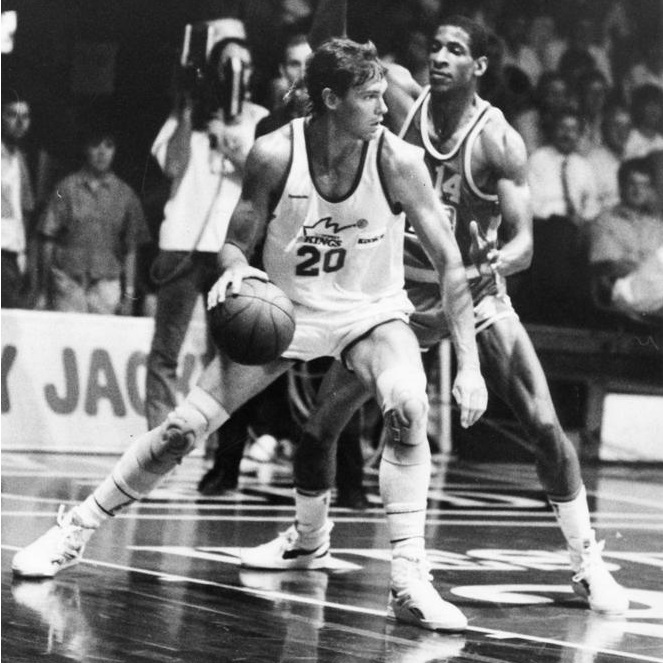
Mario Donaldson
September 7, 2026


NICKNAME/S: Three-O Keogh
BIO: Damian Keogh was born in Melbourne (VIC) and began playing basketball as a junior with the Nunawading basketball program.
Damian Keogh made his NBL debut with the Nunawading Spectres at 18 years of age. He scored two points in his first game.
As a 18 year old rookie, Keogh averaged 3.7 points for the Nunawading Spectres after being elevated from the team’s junior program, to their NBL roster. The Spectres finished with a record of 14-9 that season and in fourth place.
1981
In 1981, Keogh averaged 6.4 points, playing a key role in the Spectres rotation and helping the team finish in fourth place with a 13-9 record.
1982
The 1982 season saw Keogh average 7 points, 2.6 rebounds, and 2.4 assists and continue to improve aas a player. The Spectres finished in third place during the regular season with a 19-7 record.
1983
During the 1983 season Keogh averaged 8.3 points, 1.8 rebounds, and 3.3 assists and helped the Spectres finish with a record of 15-7 and end the regular season in fifth place.
1984
Coach Barry Barnes led the Spectres to a record of 14 wins, 9 losses in 1984 which saw them finish in fourth place in the NBL’s Western Division. Due to the size of the league (the NBL featured 17 team’s at this time), the NBL finals series in 1984 consisted of the elimination-style divisional finals, two semi-final games, and one championship-deciding grand final.
Nunawading would defeat Adelaide, 108–101 in their Elimination Final before losing to Geelong in the Qualifying Finals, 91–115, in the next game.
Keogh delivered a brreak out season this year, averaging 20 points, 4 rebounds, and 7.9 assists alongside Dean Uthoff, who would lead the league in rebounding and average 20.1 points, 18.5 rebounds, and 4.9 assists per game.
BANKSTOWN BRUINS
1985
By 1985, the divide between fully professional and semi-professional NBL franchises had widened dramatically. Bankstown, unable to match the spending power of the league’s top clubs, entered the season in a precarious financial position. After farewelling key imports Eric Claus and Cliff Martin—cornerstones of the Bruins’ earlier success—the club brought in high-scoring Americans Vince Kelley and Vince Hinchen to fill the void.
Despite their off-court constraints, Bankstown managed to land a marquee local signing in Damian Keogh. Fresh off winning NBL Rookie of the Year honours with Nunawading, Keogh arrived in Sydney seeking increased minutes and responsibilities. The former Spectre had just completed a breakout season, averaging over 20 points per game, and was expected to form a new on-court identity for the Bruins under the returning guidance of coach Robbie Cadee.
The season tipped off against Keogh’s former team, Nunawading. In a tough return, Bankstown fell 109–96 despite strong performances from Hinchen (36 points) and Kelley (30 points, 13 rebounds). Keogh struggled with efficiency but still posted a respectable stat line. A narrow 92–89 loss to Canberra followed before the Bruins recorded their first win of the season, a 107–103 victory over Geelong. In that contest, Keogh tallied 17 points and 9 assists, while Kelley dominated with 37 points and 22 rebounds, and Hinchen added 30 points.
However, any momentum quickly faded. A brutal 115–144 defeat to Coburg headlined a nine-game losing streak. Keogh contributed 10 points, 6 assists, and 4 rebounds in the loss, but was outshone by Kelley (30 points) and Hinchen (21 points). The Bruins’ porous defense was again exposed as Bennie Lewis torched them for 43 points and 14 assists.
The following week, Bankstown fell 117–110 to Adelaide in a shootout. The “Two Vinces” were again dominant, combining for 83 points—Hinchen exploding for 43, and Kelley posting 40 points and 15 rebounds. Keogh added 2 points, 6 assists, and 1 rebound in a subdued performance.
Throughout the season, Keogh’s transition proved challenging. Though he remained a starter, his output dipped from his 1984 highs, finishing the year with averages of 13.1 points, 5.3 rebounds, and 5.3 assists. Still, he was a consistent presence and occasionally flashed his offensive upside.
Beyond the marquee trio, second-year forward Andrew Svaldenis delivered a solid campaign (11.7 points, 8.0 rebounds), and Tony Barnett (8.0 points, 4.9 rebounds), Greg Hemmings (6.4 points, 2.1 assists), and Mark Cumberbatch (5.1 points, 3.8 rebounds) offered support in a rotation that lacked consistent depth.
With the team at 2–13, Hinchen departed the club midseason and the Bruins limped through the remainder of the year, but managed to close on a rare highlight.
In their final game of the season, Bankstown edged the Sydney Supersonics 90–89. Keogh erupted for 24 points on 9-of-14 shooting—including a perfect 6-of-6 from three-point range—and added 3 rebounds, 4 assists, and 4 steals. It was a fitting performance to cap an otherwise inconsistent campaign. Kelley chipped in with 35 points and 9 boards, while Svaldenis added 13 points and 9 rebounds in the upset win.
The Bruins wrapped up 1985 with a 6–20 record, finishing twelfth in the standings. Despite fielding two of the league’s most potent scorers, poor defense, instability, and financial hardship proved too great to overcome. The club was subsequently rebranded as the West Sydney Westars, bringing the Bankstown Bruins’ time in the NBL to a close.
WEST SYDNEY WESTARS
1986
In 1986, Keogh averaged 15.9 points, 6.5 rebounds, and 5.3 assists, playing a key role in the Westars rotation, helping the team finish reach a fourth place finish in the regular season with a 5-12record.
1987
The 1987 season saw Keogh average 18.3 points, 4 rebounds, and 6.8 assists and play a key role in helping the Westars to a first place finish in the regular season with a 8-18 record.
SYDNEY KINGS
1988
In 1988, Keogh averaged 14 points, 4.2 rebounds, and 4.3 assists as the Kings finished with a record of 10-14 and in ninth place during the regular season.
1989
In 1989, Keogh averaged 17.5 points, 4.7 rebounds, and 4.3 assists, playing a key role in the King’s rotation, helping the team finish reach a fifth place finish in the regular season with a 15-9 record.
1990
The 1990 season saw Keogh average 20.9 points, 3.8 rebounds, and 5.2 assists and play a key role in helping the Kings to a sixth-place finish during the regular season with a 16-10 record.
1991
During the 1991 season Keogh averaged 16.8 points, 4 rebounds, and 4.8 assists and helped the Kings finish with a record of 14-12 and end the regular season in seventh place.
1992
During the 1992 season, Keogh averaged 14.3 points, 3.6 rebounds, and 7.2 assists and was a part of the Kings squad which finished in second place with a record of 17-7 .
1993
In 1993 Keogh averaged 10.7 points and 4 rebounds, and helped guide the Kings to a first place finish in the regular season with a 11-15 record.
1994
After missing the playoffs with an 11-15 record the previous year, Sydney coach Bob Turner reshaped the Kings roster by moving on from long-time import duo Dwayne McClain and Ken McClary, who were not re-signed as Turner looked for younger talent. Tony De Ambrosis (to Gold Coast), Wayne Womack, James Carr, John Blake and Mike Kenny also departed, while Greg Hubbard, Dean Uthoff, Mark Dalton, Tim Morrissey and Jody Austin returned alongside the team’s captain. Turner added Mario Donaldson (via Omaha), who he had spotted playing during the 1993 CBA championship season, and paired him with Leon Trimmingham, a Briar Cliff University product who had been recommended by former Hobart coach Dr David Atkins. Neil Turner and rookie Brad Williams were also added to the roster.
Sydney opened the season at the Sydney Entertainment Centre on April 9, where Keogh (11 points, 4 rebounds, and 5 assists) helped the Kings defeat defending champions South East Melbourne 110-100, with Trimmingham (32 points, 14 rebounds, 3 steals, and 2 blocks) and Donaldson (28 points, 6 rebounds, 8 assists, and 2 blocks) leading the scoring while Bruce Bolden (25 points, 11 rebounds, and 5 assists) was best for the Magic. Sydney won its first three games before suffering its first loss against Perth.
Keogh (11.4 points, 3.7 rebounds, 5.8 assists, and 1.9 steals across 29 games) remained a key part of Sydney’s backcourt and appeared in every game the Kings played, including all 26 regular-season games and all three playoff games, with no games missed through injury or illness. During the NBL season he also represented Australia at the 1994 FIBA World Championship, appearing in all eight games as the Boomers finished fifth overall, equalling their best finish at a World Championship.
Keogh’s best scoring game of the season came at Beaton Park on July 9, where Keogh (24 points and 6 assists) and Trimmingham (29 points) led Sydney to an 88-79 road win over Illawarra, while Melvin Thomas (27 points) was the Hawks’ leading scorer.
Keogh produced one of his best all-round performances against Brisbane on June 25, finishing with 20 points, 6 rebounds, 11 assists, and 3 steals as Sydney defeated the Bullets 117-106 at the Sydney Entertainment Centre. Donaldson (37 points, 6 rebounds, and 3 steals) and Trimmingham (27 points, 13 rebounds, and 4 blocks) provided the scoring punch while Leroy Loggins (25 points and 9 rebounds) led Brisbane.
Sydney reached the halfway mark with an 8-3 record and looked like a championship contender, but the lack of experience amongst the roster began to show as the Kings went 8-7 over the remainder of the regular season. Sydney closed the regular season against Geelong on September 24, where Keogh (12 assists) directed the offence as Trimmingham (29 points and 12 rebounds), Hubbard (22 points) and Donaldson (18 points and 4 assists) carried the Kings to a 102-97 win, while Stephens (22 points and 4 steals) led the Supercats. The victory left Sydney seventh with a 16-10 record.
Trimmingham (27.3 points, 10.7 rebounds, 1.3 steals, and 2.2 blocks across 29 games) led Sydney in scoring, rebounding and blocks, was named Kings team MVP, finished second in the NBL in scoring behind Andrew Gaze and earned All-NBL First Team honours. Donaldson (22.1 points, 5.2 rebounds, 3.8 assists, and 1.8 steals across 29 games) and Hubbard (18.2 points, 3.1 rebounds, 3.6 assists, and 2.2 steals across 29 games) provided the additional scoring, while Uthoff (8.3 points and 9.3 rebounds across 29 games) and Dalton (8.2 points, 6.1 rebounds, and 1.4 steals across 29 games) anchored the frontcourt.
Sydney entered its quarterfinal series against second-placed North Melbourne as decided underdogs after the Giants had beaten them in both regular-season meetings. In front of 9,092 fans at the Sydney Entertainment Centre, the Kings exploded to an 11-0 lead inside the opening 71 seconds and led 43-25 at quarter-time before receiving a standing ovation as they headed to halftime ahead 77-51. Hubbard (32 points) made eight of nine three-pointers, Donaldson (27 points) made three of four and Keogh (18 points, 8 rebounds, and 10 assists) made four of five as Sydney connected on 15 of 18 three-pointers, an extraordinary 83.3 per cent, while Paul Maley (26 points and 6 rebounds) and Darryl McDonald (11 points, 9 rebounds, 9 assists, and 4 steals) led North Melbourne in Sydney’s 131-109 win.
Game two moved to Melbourne, where Trimmingham (22 points and 10 rebounds) and Donaldson (18 points) led Sydney while Keogh (5 assists and 2 steals) contributed in the backcourt, but McDonald (14 points, 5 rebounds, 10 assists, and 2 steals), Pat Reidy (28 points) and Maley (17 points and 9 rebounds) carried North Melbourne to a 112-91 win and levelled the series.
Game three remained in Melbourne, where Trimmingham (31 points) led Sydney and Keogh (5 rebounds) hit three three-pointers and eight free throws, but Maley (33 points, 4 rebounds, 5 assists, and 4 steals), Reidy (24 points, 4 rebounds, 5 assists, and 4 steals) and McDonald (17 points, 13 rebounds, and 7 assists) led North Melbourne to a 104-95 win and ended Sydney’s season.
1995
After a great start to the 1994 season, the Kings collapsed during the second half of the year with the team’s young roster felt to be the cause. Veteran talent Phil Smyth (Adelaide), Justin Withers (Canberra) and import Bruce Bolden (SE Melbourne), who would replace fan favourite Mario Donaldson, would bring the experience required in spades.
The Kings starting lineup had increased from the average age of 28 to 31, which meant although they had added a ton of experience, this roster would only have one or two years to make it count.
The season started with a narrow 85-86 loss to Bolden’s former team, the Magic, before a up-and-down season, where the Kings defeated a number of league’s top team’s but failed to close out games against those at the bottom of the ladder. Sydney would start the season with a 3-6 record, which included wins over Perth and North Melbourne, who would finish first and third, respectively, but suffered back-to-back losses to Canberra (who would finish tenth) and lost games to Townsville (finished 12th) and Gold Coast (finished 13th).
Leon Trimmingham (27.5 points, 11.2 rebounds, 1.8 assists, 2.1 steals and 2.2 blocks) was named Kings team MVP after leading the team in scoring, rebounds, steals and blocks as Bolden (20.5 points, 10.8 rebounds, 2.3 assists and 1.3 steals) and captain Damian Keogh (14.4 points, 4.0 rebounds, 6.1 assists and 1.6 steals) provided the additional scoring power. Sydney finished the season in tenth place with a record of 10-16 and failed to reach the playoffs.
Damian Keogh played sixteen seasons across four NBL teams. This included the Nunawading Spectres, Bankstown Bruins, West Sydney Westars and Sydney Kings. He averaged 13.6 points, 3.6 rebounds, and 4.9 assists in 406 NBL games.
CAREER RANKINGS:
– 39th in total points
– 8th in total assists
– 12th in total steals
| SEASON | AGE | TEAM | TEAM RECORD | GP | MINS | PTS | REB | AST | OR | DR | STL | BLK | TO | PF | FGM | FGA | FG% | 3PM | 3PA | 3P% | FTM | FTA | FT% | TS% | EFG% | HS |
|---|---|---|---|---|---|---|---|---|---|---|---|---|---|---|---|---|---|---|---|---|---|---|---|---|---|---|
| 1995 | 33 | Sydney | 10-16 (11) | 26 | 992 | 374 | 103 | 158 | 29 | 74 | 42 | 0 | 78 | 82 | 131 | 302 | 43% | 58 | 154 | 38% | 54 | 71 | 76% | 56% | 53% | 41 |
| 1994 | 32 | Sydney | 16-10 (7) | 29 | 1,108 | 330 | 108 | 169 | 15 | 93 | 54 | 1 | 90 | 97 | 110 | 286 | 38% | 46 | 142 | 32% | 64 | 85 | 75% | 51% | 47% | 24 |
| 1993 | 31 | Sydney | 11-15 (11) | 24 | 978 | 257 | 96 | 135 | 15 | 81 | 50 | 1 | 59 | 78 | 82 | 242 | 34% | 57 | 168 | 34% | 36 | 50 | 72% | 48% | 46% | 25 |
| 1992 | 30 | Sydney | 17-7 (2) | 29 | 1,222 | 415 | 105 | 208 | 11 | 94 | 70 | 2 | 90 | 95 | 139 | 348 | 40% | 83 | 222 | 37% | 54 | 75 | 72% | 54% | 52% | 29 |
| 1991 | 29 | Sydney | 14-12 (7) | 26 | 1,007 | 436 | 104 | 126 | 27 | 77 | 52 | 3 | 60 | 74 | 145 | 346 | 42% | 78 | 191 | 41% | 68 | 88 | 77% | 56% | 53% | 28 |
| 1990 | 28 | Sydney | 16-10 (6) | 28 | 1,149 | 584 | 105 | 145 | 27 | 78 | 64 | 2 | 76 | 74 | 197 | 466 | 42% | 96 | 227 | 42% | 94 | 116 | 81% | 56% | 53% | 34 |
| 1989 | 27 | Sydney | 15-9 (5) | 29 | 1,110 | 508 | 137 | 108 | 41 | 96 | 59 | 4 | 74 | 88 | 183 | 412 | 44% | 74 | 171 | 43% | 68 | 91 | 75% | 56% | 53% | 34 |
| 1988 | 26 | Sydney | 10-14 (9) | 24 | 904 | 336 | 100 | 102 | 26 | 74 | 34 | 1 | 47 | 66 | 132 | 309 | 43% | 26 | 78 | 33% | 46 | 57 | 81% | 50% | 47% | 30 |
| 1987 | 25 | West Sydney | 8-18 (11) | 24 | 1,065 | 440 | 97 | 162 | 19 | 78 | 52 | 1 | 64 | 78 | 162 | 377 | 43% | 32 | 103 | 31% | 84 | 113 | 74% | 51% | 47% | 35 |
| 1986 | 24 | West Sydney | 15-12 (4) | 27 | 0 | 428 | 176 | 216 | 37 | 139 | 46 | 5 | 84 | 74 | 169 | 414 | 41% | 36 | 101 | 36% | 54 | 69 | 78% | 48% | 45% | 35 |
| 1985 | 23 | Bankstown | 6-20 (12) | 26 | 0 | 341 | 137 | 137 | 42 | 95 | 64 | 7 | 94 | 84 | 126 | 342 | 37% | 26 | 74 | 35% | 63 | 87 | 72% | 44% | 41% | 30 |
| 1984 | 22 | Nunawading | 14-9 (7) | 25 | 0 | 501 | 100 | 197 | 36 | 64 | 52 | 4 | 72 | 83 | 204 | 409 | 50% | 13 | 44 | 30% | 80 | 101 | 79% | 55% | 51% | 35 |
| 1983 | 21 | Nunawading | 15-7 (5) | 25 | 0 | 208 | 45 | 83 | 16 | 29 | 32 | 3 | 40 | 55 | 88 | 205 | 43% | 0 | 0 | 0% | 32 | 56 | 57% | 45% | 43% | 16 |
| 1982 | 20 | Nunawading | 19-7 (3) | 27 | 0 | 188 | 70 | 66 | 20 | 50 | 0 | 0 | 41 | 53 | 77 | 196 | 39% | 0 | 0 | 0% | 34 | 50 | 68% | 43% | 39% | 18 |
| 1981 | 19 | Nunawading | 13-9 (4) | 23 | 0 | 147 | 0 | 0 | 0 | 0 | 0 | 0 | 0 | 38 | 64 | 126 | 51% | 0 | 0 | 0% | 19 | 23 | 83% | 54% | 51% | 13 |
| 1980 | 18 | Nunawading | 14-9 (4) | 14 | 0 | 52 | 0 | 0 | 0 | 0 | 0 | 0 | 0 | 17 | 24 | 48 | 50% | 0 | 0 | 0% | 4 | 6 | 67% | 51% | 50% | 12 | Totals | 406 | 9535 | 5545 | 1483 | 2012 | 361 | 1122 | 671 | 34 | 969 | 1136 | 2033 | 4828 | 42.1% | 625 | 1675 | 37.3% | 854 | 1138 | 75.0% | 52% | 49% | 41 |
| SEASON | AGE | TEAM | TEAM RECORD | GP | MINS | PTS | REB | AST | OR | DR | STL | BLK | TO | PF | FGM | FGA | FG% | 3PM | 3PA | 3P% | FTM | FTA | FT% | TS% | EFG% | HS |
|---|---|---|---|---|---|---|---|---|---|---|---|---|---|---|---|---|---|---|---|---|---|---|---|---|---|---|
| 1995 | 33 | Sydney | 10-16 (11) | 26 | 38.2 | 14.4 | 4.0 | 6.1 | 1.1 | 2.8 | 1.6 | 0.0 | 3.0 | 3.2 | 5.0 | 11.6 | 43% | 2.2 | 5.9 | 38% | 2.1 | 2.7 | 76% | 56% | 53% | 41 |
| 1994 | 32 | Sydney | 16-10 (7) | 29 | 38.2 | 11.4 | 3.7 | 5.8 | 0.5 | 3.2 | 1.9 | 0.0 | 3.1 | 3.3 | 3.8 | 9.9 | 38% | 1.6 | 4.9 | 32% | 2.2 | 2.9 | 75% | 51% | 47% | 24 |
| 1993 | 31 | Sydney | 11-15 (11) | 24 | 40.8 | 10.7 | 4.0 | 5.6 | 0.6 | 3.4 | 2.1 | 0.0 | 2.5 | 3.3 | 3.4 | 10.1 | 34% | 2.4 | 7.0 | 34% | 1.5 | 2.1 | 72% | 48% | 46% | 25 |
| 1992 | 30 | Sydney | 17-7 (2) | 29 | 42.1 | 14.3 | 3.6 | 7.2 | 0.4 | 3.2 | 2.4 | 0.1 | 3.1 | 3.3 | 4.8 | 12.0 | 40% | 2.9 | 7.7 | 37% | 1.9 | 2.6 | 72% | 54% | 52% | 29 |
| 1991 | 29 | Sydney | 14-12 (7) | 26 | 38.7 | 16.8 | 4.0 | 4.8 | 1.0 | 3.0 | 2.0 | 0.1 | 2.3 | 2.8 | 5.6 | 13.3 | 42% | 3.0 | 7.3 | 41% | 2.6 | 3.4 | 77% | 56% | 53% | 28 |
| 1990 | 28 | Sydney | 16-10 (6) | 28 | 41.0 | 20.9 | 3.8 | 5.2 | 1.0 | 2.8 | 2.3 | 0.1 | 2.7 | 2.6 | 7.0 | 16.6 | 42% | 3.4 | 8.1 | 42% | 3.4 | 4.1 | 81% | 56% | 53% | 34 |
| 1989 | 27 | Sydney | 15-9 (5) | 29 | 38.3 | 17.5 | 4.7 | 3.7 | 1.4 | 3.3 | 2.0 | 0.1 | 2.6 | 3.0 | 6.3 | 14.2 | 44% | 2.6 | 5.9 | 43% | 2.3 | 3.1 | 75% | 56% | 53% | 34 |
| 1988 | 26 | Sydney | 10-14 (9) | 24 | 37.7 | 14.0 | 4.2 | 4.3 | 1.1 | 3.1 | 1.4 | 0.0 | 2.0 | 2.8 | 5.5 | 12.9 | 43% | 1.1 | 3.3 | 33% | 1.9 | 2.4 | 81% | 50% | 47% | 30 |
| 1987 | 25 | West Sydney | 8-18 (11) | 24 | 44.4 | 18.3 | 4.0 | 6.8 | 0.8 | 3.3 | 2.2 | 0.0 | 2.7 | 3.3 | 6.8 | 15.7 | 43% | 1.3 | 4.3 | 31% | 3.5 | 4.7 | 74% | 51% | 47% | 35 |
| 1986 | 24 | West Sydney | 15-12 (4) | 27 | 0.0 | 15.9 | 6.5 | 8.0 | 1.4 | 5.1 | 1.7 | 0.2 | 3.1 | 2.7 | 6.3 | 15.3 | 41% | 1.3 | 3.7 | 36% | 2.0 | 2.6 | 78% | 48% | 45% | 35 |
| 1985 | 23 | Bankstown | 6-20 (12) | 26 | 0.0 | 13.1 | 5.3 | 5.3 | 1.6 | 3.7 | 2.5 | 0.3 | 3.6 | 3.2 | 4.8 | 13.2 | 37% | 1.0 | 2.8 | 35% | 2.4 | 3.3 | 72% | 44% | 41% | 30 |
| 1984 | 22 | Nunawading | 14-9 (7) | 25 | 0.0 | 20.0 | 4.0 | 7.9 | 1.4 | 2.6 | 2.1 | 0.2 | 2.9 | 3.3 | 8.2 | 16.4 | 50% | 0.5 | 1.8 | 30% | 3.2 | 4.0 | 79% | 55% | 51% | 35 |
| 1983 | 21 | Nunawading | 15-7 (5) | 25 | 0.0 | 8.3 | 1.8 | 3.3 | 0.6 | 1.2 | 1.3 | 0.1 | 1.6 | 2.2 | 3.5 | 8.2 | 43% | 0.0 | 0.0 | 0% | 1.3 | 2.2 | 57% | 44.9% | 43% | 16 |
| 1982 | 20 | Nunawading | 19-7 (3) | 27 | 0.0 | 7.0 | 2.6 | 2.4 | 0.7 | 1.9 | 0.0 | 0.0 | 1.5 | 2.0 | 2.9 | 7.3 | 39% | 0.0 | 0.0 | 0% | 1.3 | 1.9 | 68% | 42.8% | 39% | 18 |
| 1981 | 19 | Nunawading | 13-9 (4) | 23 | 0.0 | 6.4 | 0.0 | 0.0 | 0.0 | 0.0 | 0.0 | 0.0 | 0.0 | 1.7 | 2.8 | 5.5 | 51% | 0.0 | 0.0 | 0% | 0.8 | 1.0 | 83% | 53.7% | 51% | 13 |
| 1980 | 18 | Nunawading | 14-9 (4) | 14 | 0.0 | 3.7 | 0.0 | 0.0 | 0.0 | 0.0 | 0.0 | 0.0 | 0.0 | 1.2 | 1.7 | 3.4 | 50% | 0.0 | 0.0 | 0% | 0.3 | 0.4 | 67% | 51.1% | 50% | 12 | Total | 406 | 23.5 | 13.7 | 3.7 | 5.0 | 0.9 | 2.8 | 1.7 | 0.1 | 2.4 | 2.8 | 5.0 | 11.9 | 42.1% | 0.0 | 0.0 | 37.3% | 1.5 | 4.1 | 75.0% | 52% | 49% | 41 |
| POINTS | REBOUNDS | ASSISTS | STEALS | BLOCKS | TURNOVERS | TRIPLE DOUBLES | 41 | 14 | 18 | 7 | 2 | 9 | 0 |
|---|
Damian Keogh was selected into Nunawading’s senior men’s program in both 1980 and 1981. During those seasons he played with the Nunawading No. 2 team at Box Hill under coach Barry Barnes.
Keogh played for national team again at the 1984 Olympics in Los Angeles, where Australia finished seventh. The seventh place finish in 1984 being the Boomers best Olympic result to that date.
Keogh continued to play for the national team, playing for Australia at the 1988 Olympics in Seoul, South Korea. There he helped the team record its best ever finish of fourth place at that time with a 4–4 record. Australia would lose the bronze medal game 49–78 to a United States team which included future NBA players David Robinson and Mitch Richmond as well as NBA players Dan Majerle, Danny Manning and Hersey Hawkins.
Keoghs next tournament with the national team was the 1990 FIBA World Championships were Australia delivered another poor showing. With Andrew Gaze (24.3 ppg) leading the team in scoring, finishing the fourth highest scorer at the tournament, the Boomers defeated Brazil in the first stage to advance to the quarterfinals. There they lost to both Puerto Rico (89-79) and USA, which featured Alonzo Mourning, Christian Laettner and Kenny Anderson, by a single point (78-79). The loss saw Australia fail to reach the medal rounds and finish in seventh place overall.
Keoghs final Boomers appearance was the 1992 Olympic Games in Barcelona. There he played alongside Luc Longley, Andrew Gaze, Phil Smyth, Andrew Vlahov and Mark Bradtke the team finished in 6th-place finish with a 4–4 record.
The next major tournament for Keogh was the 1994 FIBA World Championships where alongside Andrew Gaze, who led the tournament in scoring (23.9 ppg), he helped Australia finish second in their pool to advance to the quarterfinals. There they lost to Russia (76–103) in a game which eliminated them from the medal rounds. The Boomers would finish fifth overall, equalling their best ever result at a World Championship.
| YEAR | AGE | GP | MINS | PTS | REB | AST | OR | DR | STL | BLK | TO | PF | FGM | FGA | FG% | 3PM | 3PA | 3P% | FTM | FTA | FT% |
|---|---|---|---|---|---|---|---|---|---|---|---|---|---|---|---|---|---|---|---|---|---|
| 1994 | 32 | 8 | 70 | 14 | 11 | 8 | 4 | 7 | 2 | 0 | 6 | 6 | 5 | 13 | 38.5% | 1 | 5 | 20.0% | 3 | 5 | 60.0% |
| 1992 | 30 | 8 | 125 | 39 | 11 | 13 | 2 | 9 | 9 | 0 | 5 | 12 | 13 | 36 | 36.1% | 8 | 21 | 38.1% | 5 | 7 | 71.4% |
| 1990 | 28 | 8 | 0 | 75 | 0 | 0 | 0 | 0 | 0 | 0 | 0 | 18 | 0 | 0 | 0.0% | 0 | 0 | 0.0% | 11 | 13 | 84.6% |
| 1988 | 26 | 8 | 145 | 46 | 11 | 9 | 4 | 7 | 5 | 0 | 8 | 14 | 18 | 41 | 43.9% | 4 | 8 | 50.0% | 6 | 11 | 54.5% |
| 1984 | 22 | 5 | 44 | 8 | 4 | 9 | 0 | 4 | 0 | 0 | 2 | 5 | 2 | 7 | 28.6% | 0 | 0 | 0.0% | 4 | 8 | 50.0% |
| 1982 | 20 | 6 | 0 | 11 | 0 | 0 | 0 | 0 | 0 | 0 | 0 | 4 | 0 | 0 | 0.0% | 0 | 0 | 0.0% | 7 | 8 | 87.5% | Total | 43 | 384 | 193 | 37 | 39 | 10 | 27 | 16 | 0 | 21 | 59 | 38 | 97 | 39% | 13 | 34 | 38% | 36 | 52 | 69% |
| YEAR | AGE | GP | MINS | PTS | REB | AST | OR | DR | STL | BLK | TO | PF | FGM | FGA | FG% | 3PM | 3PA | 3P% | FTM | FTA | FT% |
|---|---|---|---|---|---|---|---|---|---|---|---|---|---|---|---|---|---|---|---|---|---|
| 1994 | 32 | 8 | 8.8 | 1.8 | 1.4 | 1.0 | 0.5 | 0.9 | 0.3 | 0.0 | 0.8 | 0.8 | 0.6 | 1.6 | 38.5% | 0.1 | 0.6 | 20.0% | 0.4 | 0.6 | 60.0% |
| 1992 | 30 | 8 | 15.6 | 4.9 | 1.4 | 1.6 | 0.3 | 1.1 | 1.1 | 0.0 | 0.6 | 1.5 | 1.6 | 4.5 | 36.1% | 1.0 | 2.6 | 38.1% | 0.6 | 0.9 | 71.4% |
| 1990 | 28 | 8 | 0.0 | 9.4 | 0.0 | 0.0 | 0.0 | 0.0 | 0.0 | 0.0 | 0.0 | 2.3 | 0.0 | 0.0 | 0.0% | 0.0 | 0.0 | 0.0% | 1.4 | 1.6 | 84.6% |
| 1988 | 26 | 8 | 18.1 | 5.8 | 1.4 | 1.1 | 0.5 | 0.9 | 0.6 | 0.0 | 1.0 | 1.8 | 2.3 | 5.1 | 43.9% | 0.5 | 1.0 | 50.0% | 0.8 | 1.4 | 54.5% |
| 1984 | 22 | 5 | 8.8 | 1.6 | 0.8 | 1.8 | 0.0 | 0.8 | 0.0 | 0.0 | 0.4 | 1.0 | 0.4 | 1.4 | 28.6% | 0.0 | 0.0 | 0.0% | 0.8 | 1.6 | 50.0% |
| 1982 | 20 | 6 | 0.0 | 1.8 | 0.0 | 0.0 | 0.0 | 0.0 | 0.0 | 0.0 | 0.0 | 0.7 | 0.0 | 0.0 | 0.0% | 0.0 | 0.0 | 0.0% | 1.2 | 1.3 | 87.5% | Total | 43 | 8.9 | 4.5 | 0.9 | 0.9 | 0.2 | 0.6 | 0.4 | 0.0 | 0.5 | 1.4 | 0.9 | 2.3 | 39% | 0.3 | 0.8 | 38% | 0.8 | 1.2 | 69% |
- 1x All-NBL Second Team
- 1x NBL Assists Leader
Whilst we try to source as much information as we can for every player who has ever played in the NBL some information on a player profile may be missing. If you have additional information on a player you'd like us to add to a profile, please send it to us using the enquiry form below.
Submissions are then sent to info@aussiehoopla.com