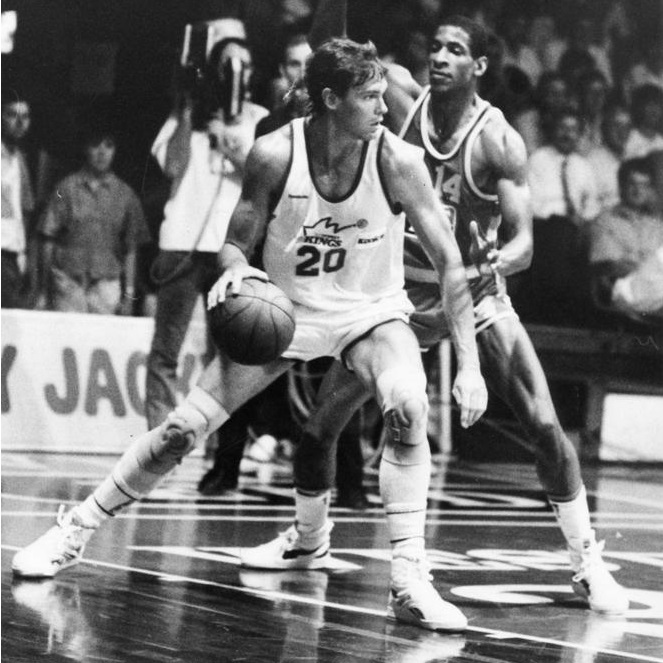
Marc Ridlen
March 19, 2021


BIO: Mike Kenny was born in Sydney (NSW)
FAMILY: Mike’s son Scott Kenny also played 15 games in the NBL.
Mike Kenny made his NBL debut with the Sydney Supersonics on 25/4/1987. He scored four points in his first game.
In 1986, the Adelaide 36ers, led by coach Ken Cole, produced the most dominant season in NBL history (24–2), claiming the championship amid significant controversy. Cole publicly acknowledged marijuana use and was stood down ahead of the Grand Final, only to be reinstated following player threats of boycott. After leading Adelaide to the title, the club’s board terminated his contract, citing concerns over image and sponsor perception.
The decision opened the door for the Sydney Supersonics, who swiftly appointed Cole to replace Owen Wells as head coach. Known for his charismatic leadership and bold coaching philosophy, “King” Cole arrived in Sydney aiming to replicate the success of his Adelaide squad. He rebuilt the Supersonics in a similar mould, pairing two dominant bigs—Marc Ridlen and Derick Polk—in a “twin towers” system, while installing 22-year-old Scott Fenton as his lead guard. The roster was reshaped with key arrivals including Bruce Hope (via Geelong), Robert Croker, James Hewlett, and Mike Kenny, the latter brought in to add backcourt stability and spot shooting.
Kenny opened the season off the bench in a 98–76 home loss to Eastside Melbourne on April 25. In 21 minutes, he managed 4 points (1-6 FG), 2 rebounds, and 1 steal, but his limited efficiency mirrored Sydney’s team-wide struggles, as the Supersonics shot just 32% from the field. Derick Polk (21 points, 14 rebounds), Curt Forrester (14 points), and Andrew Svaldenis (12 points, 11 rebounds) were the standouts in a flat season opener.
In Round 2, Kenny provided a spark despite another home defeat, this time 124–104 to the West Sydney Westars. Playing 18 minutes, he shot a perfect 4-of-6 from the field to tally 8 points, adding 1 rebound and 1 steal. Marc Ridlen dominated with 35 points and 17 rebounds, while Polk added 24 points and 13 boards, and Hope chipped in 16 points.
Kenny’s minutes fluctuated throughout the season, typically functioning as a reliable backup guard. In Sydney’s 86–81 Round 6 win over West Sydney on May 29, he again played efficiently, contributing 5 points on 2-of-2 shooting along with 1 rebound in 8 minutes. Bruce Hope (15 points), Polk (18 points, 7 rebounds), and Ridlen (16 points, 17 rebounds) led the charge as the Supersonics claimed their only back-to-back wins of the season.
A key outing came on August 22 when Sydney produced its most dominant victory of the year—demolishing the Melbourne Tigers 129–76 at home. Kenny played 14 minutes, recording 6 points (3-4 FG), 1 rebound, 3 assists, and 1 steal. He helped orchestrate ball movement in a complete team performance that saw Ridlen (36 points, 16 rebounds), Matthews (28 points, 12 rebounds), and Polk (17 rebounds) dominate across all areas.
Kenny’s ability to play within the system and provide efficient minutes continued in the final game of the regular season on September 18. In Sydney’s 118–98 home win over the Westside Saints, Kenny tallied 4 points, 3 rebounds, and 1 assist in 15 minutes. The Supersonics capped off their year with a commanding performance featuring Ridlen (40 points, 26 rebounds), Polk (18 points, 21 rebounds, 5 blocks), Forrester (17 points), and Matthews (17 points), giving fans a memorable send-off before the franchise’s merger with the West Sydney Westars to form the Sydney Kings.
Across 20 games, Mike Kenny averaged (2.8 points, 1.4 rebounds, and 0.4 assists), functioning primarily as a secondary playmaker behind Fenton and Hope. Though not a high-volume scorer, Kenny’s efficient shooting (50% FG in limited attempts) and steady minutes added stability to Sydney’s second unit.
Kenny’s role may not have been flashy, but his contributions were emblematic of Cole’s system—players knowing their responsibilities and supporting the stars. While Ridlen (30.5 points, 16.1 rebounds), Polk (20.2 points, 12.8 rebounds, 3.0 blocks), and Hope (13.0 points, 2.6 rebounds, 2.9 assists, 2.9 steals) shouldered the load, Kenny played his role with discipline, composure, and efficiency.
The Supersonics finished with a 9–17 record, missing the playoffs in their final season before becoming the Sydney Kings. For Mike Kenny, 1987 marked a solid campaign as a trusted role player on a team defined by transformation and the emergence of several NBL standouts under Ken Cole’s stewardship.
Mike Kenny played two seasons in the NBL, playing for both the Sydney Kings and the Sydney Supersonics. He averaged 2.5 points, 1.1 rebounds, and 0.3 assists in 24 NBL games.
| SEASON | AGE | TEAM | TEAM RECORD | GP | MINS | PTS | REB | AST | OR | DR | STL | BLK | TO | PF | FGM | FGA | FG% | 3PM | 3PA | 3P% | FTM | FTA | FT% | TS% | EFG% | HS |
|---|---|---|---|---|---|---|---|---|---|---|---|---|---|---|---|---|---|---|---|---|---|---|---|---|---|---|
| 1993 | 0 | Sydney | 11-15 (11) | 4 | 17 | 4 | 1 | 0 | 1 | 0 | 1 | 0 | 0 | 3 | 1 | 2 | 50% | 0 | 0 | 0% | 2 | 4 | 50% | 53% | 50% | 2 |
| 1987 | 0 | Sydney | 9-17 (10) | 20 | 221 | 56 | 27 | 8 | 15 | 12 | 8 | 3 | 17 | 31 | 24 | 60 | 40% | 0 | 1 | 0% | 8 | 14 | 57% | 42% | 40% | Totals | 24 | 238 | 60 | 28 | 8 | 16 | 12 | 9 | 3 | 17 | 34 | 25 | 62 | 40.3% | 0 | 1 | 0.0% | 10 | 18 | 55.6% | 43% | 40% | 8 |
| SEASON | AGE | TEAM | TEAM RECORD | GP | MINS | PTS | REB | AST | OR | DR | STL | BLK | TO | PF | FGM | FGA | FG% | 3PM | 3PA | 3P% | FTM | FTA | FT% | TS% | EFG% | HS |
|---|---|---|---|---|---|---|---|---|---|---|---|---|---|---|---|---|---|---|---|---|---|---|---|---|---|---|
| 1993 | 0 | Sydney | 11-15 (11) | 4 | 4.3 | 1.0 | 0.3 | 0.0 | 0.3 | 0.0 | 0.3 | 0.0 | 0.0 | 0.8 | 0.3 | 0.5 | 50% | 0.0 | 0.0 | 0% | 0.5 | 1.0 | 50% | 53% | 50% | 2 |
| 1987 | 0 | Sydney | 9-17 (10) | 20 | 11.1 | 2.8 | 1.4 | 0.4 | 0.8 | 0.6 | 0.4 | 0.2 | 0.9 | 1.6 | 1.2 | 3.0 | 40% | 0.0 | 0.1 | 0% | 0.4 | 0.7 | 57% | 42% | 40% | Total | 24 | 9.9 | 2.5 | 1.2 | 0.3 | 0.7 | 0.5 | 0.4 | 0.1 | 0.7 | 1.4 | 1.0 | 2.6 | 40.3% | 0.0 | 0.0% | 0.0 | 55.6% | 43% | 40% | 8 |
| POINTS | REBOUNDS | ASSISTS | STEALS | BLOCKS | TURNOVERS | TRIPLE DOUBLES | 8 | 4 | 3 | 2 | 2 | 2 | 0 |
|---|
Whilst we try to source as much information as we can for every player who has ever played in the NBL some information on a player profile may be missing. If you have additional information on a player you'd like us to add to a profile, please send it to us using the enquiry form below.
Submissions are then sent to info@aussiehoopla.com

