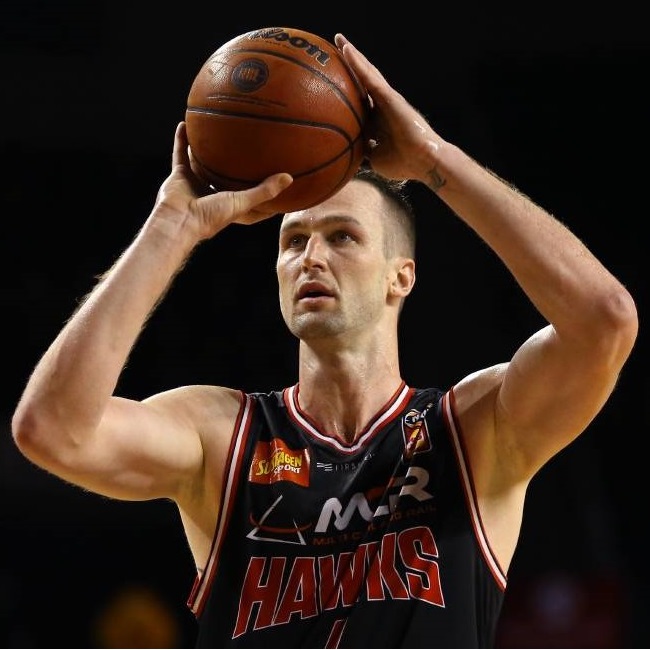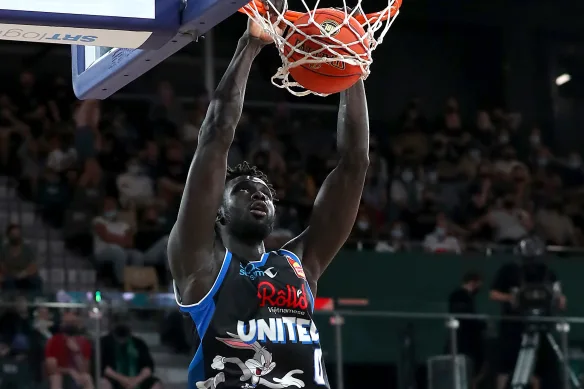
Jo Lual-Acuil Jr
October 27, 2025


NICKNAME/S: The Chief, Pledgehammer
BIO: Alex Pledger was born in Blenheim (New Zealand).
Alex Pledger made his NBL debut with the New Zealand Breakers at 22 years of age. He went scoreless in his first NBL game.
Having achieved their first-ever playoff appearance the season prior, coach Andrej Lemanis returned with the majority of Breakers roster intact, losing only Phill Jones (to Cairns) and Tim Behrendorff (to Wollongong). Having played with one import last season, Rick Rickert, the Breakers added Dave Thomas (via Cairns) to add veteran leadership to the club but prior to the season starting, he was forced to retire from playing in the NBL due to injury. Former NBA talent Awvee Storey was then signed as his replacement and development player Thomas Abercrombie was elevated to the full squad.
New Zealand struggled through the first half of the season, mainly due to missing their leading scorer Kirk Penney (23.2 points, 5.2 rebounds, and 2.7 assists) due to a back injury that saw him sidelined for nine games. In addition to this, Storey (7.8 points, 5.1 rebounds, and 0.8 assists) fell well short of expectations and was released after nine games with the club stating ‘things weren’t working out’. John Rillie (4.3 points and 1.6 rebounds), who had been released by Townsville the season prior, signed with the club as a interim replacement and appeared in 12 games.
New Zealand was then boosted by the midseason addition of import Kevin Braswell (9.7 points, 2.1 rebounds, 5.4 assists, and 2.3 steals), who played in the Breakers final seven games, winning the last six in a row.
New Zealand’s late-season surge proved to be in vain, as the Breakers missed the playoffs during one of the closest NBL seasons of all-time. Despite New Zealand being only two games behind league leaders Perth, they would miss the playoffs and finish in fifth place (15-13).
Pledger would see limited playing opportunities in his first year with the Breakers, appearing in only 9 games, averaging 1.7 points and 1.4 rebounds.
2010/11
A key to the Breakers’ success this season were the return of both Kevin Braswell and Mika Vukona. Braswell initially decided to play the 2010/11 season with Turkish team Aliağa Belediyesi SK but before the season could start, left the team to play a second season with the New Zealand Breakers. Vukona, who had won a championship with the South Dragons in 2009, returned to the team and replaced Paul Henare as team captain. Another key move saw declining import Rick Rickert replaced with former Utah State University standout Gary Wilkinson.
The season began with Kirk Penney missing the start of the season while he attempted to earn a NBA contract. Failing to do that, he re-joined the Breakers after the season’s first month. Despite missing Penney, the Breakers won their first five games of the season before losing to the Wildcat’s in Perth (114–74).
Kirk Penney (20.0 points, 4.0 rebounds, and 2.3 assists) would finish as the team’s leading scorer, with the Breakers finishing the regular season on top of the ladder (22–6). Wilkinson (15.8 points, 5.7 rebounds, and 1.3 assists), CJ Bruton (11.0 points, 1.7 rebounds, and 1.8 assists), Thomas Abercrombie (10.5 points, 5.4 rebounds, and 1.6 assists) and Vukona (8.3 points, 7.6 rebounds, and 1.9 assists) rounded out New Zealand’s starting lineup, while Braswell (10.2 points, 2.6 rebounds, and 4.2 assists) add a spark from the bench, a role that would see him selected the NBL’s Best Sixth Man at the end of the year.
This season was also notable for the impact of 22-year-old Corey Webster (4.0 points, 0.7 rebounds, and 0.9 assists), who was elevated into the Breakers’ full-time roster this season and started to steal time away from legendary point guard CJ Bruton this season. Bruton played seven minutes less than the season prior, a testament to New Zealand much improved, much deeper roster.
New Zealand met fourth seed Perth in the semifinals and lost the opening game to the Wildcat’s at home. The Breakers returned to New Zealand for games two and three and recovered by winning both games, qualifying for their first-ever NBL Grand Final.
There, the Breakers met Cairns in the championship series and coasting to a easy win in game one (85–67) after leading by as much as 31 in the third quarter. The team’s then fought out a gripping game two in Cairns, which saw the game tied at the end of regulation (60-60) and at the end of the first overtime (73–73), before Cairns prevailed (85–81), sending the series to a third and deciding game.
With the final game played back on New Zealand soil, the Breakers recorded a comfortable win (71–53) and became the first team non-Australian team to win a NBL championship.
Thomas Abercrombie collected Grand Final MVP honours and while Bruton etched his name into Breakers folklore after he nailed two three-pointers in the fourth quarter to seal the game against the Cairns Taipans, winning his fourth NBL title.
Pledger’s development saw him become a regular part of the Breakers’ rotation, backing up starting centre Wilkinson and averaging 6.1 points, 4.6 rebounds, and 0.6 blocks across 34 games.
2011/12
After winning their first NBL championship, the Breakers suffered two major losses, the first being leading scorer Kirk Penney’s decision to play in Europe and a off-season achilles injury to Kevin Braswell that saw him still unable to play at the beginning of the 2011/12 season. Coach Andrej Lemanis would replace him with Cedric Jackson and then finalised their roster by adding Daryl Corletto, who the Melbourne Tigers had just released to make room for NBA star Patty Mills.
Jackson (12.8 points, 5.4 rebounds, 6.5 assists, and 2.2 steals) would lead the league in both assists and steals and ensure the Breakers didn’t skip a beat as the defending champs. Gary Wilkinson (16.6 points, 5.8 rebounds, and 1.2 assists) and Thomas Abercrombie (15.2 points, 4.6 rebounds, and 1.6 assists) both boosting their offensive output in the absence of Penney, propelling New Zealand to a first-place finish (21-7) for the second consecutive season.
New Zealand would meet Townsville in the semifinals where they would lose the opening contest (82-99) behind big games from Crocodiles stars Peter Crawford (26 points) and Eddie Gill (21 points and 4 steals).
The Breakers re-grouped with CJ Bruton (18 points) top scoring in a game two win (94-83) that saw five New Zealand players all score in double figures. Bruton (20 points) continued to lead the way offensively in game three (97-80), winning the series for New Zealand and propelling them into the Grand Final.
New Zealand would go on to face Perth, winning the opening game in a overtime victory at home (104–98). Bruton (20 points and 3 assists) and Jackson (25 points and 8 assists) led the way in scoring, while Pledger added 8 points, 4 rebounds, and 1 assists, and 2 steals.
Despite Wilkinson (28 points, 7 rebounds, and 5 assists) delivering his best game of the season, the Wildcats would rebound from the loss and claim a narrow victory in their second meeting (87-86). Jesse Wagstaff (15 points) and Kevin Lisch (15 points and 5 rebounds) led the way for Perth, while six other Wildcats players also scored in double figures. This set up a third game back in Auckland, where the Wildcat’s built up a slight lead in the second quarter through some brilliant play from Matthew Knight (17 points and 6 rebounds), who had 11 points in the quarter. With centre Luke Nevill (4 points and 3 rebounds in 9 mins) getting into foul trouble and the Breakers defence all but neutralising Shawn Redhage (18 points, 4 rebounds and 3 assists), the Breakers clinched back-to-back titles with a six-point victory (79–73) in front of 9,000 fans.
After Perth levelled the score with seven minutes to go, Abercrombie (12 points and 4 rebounds) pulled in a offensive rebound and set up Bruton (16 points, 3 rebounds, 3 assists, and 2 steals), who nailed a three-point dagger to extend the lead to seven with less than two minutes to play. Gary Wilkinson (23 points) led all scorers, while Alex Pledger (13 points on 4-of-6 shooting) made huge contributions from the bench. The Breakers became the first side to win consecutive titles since Sydney in 2002-2005, a championship team that Bruton was also a part of. Bruton finished 4-of-7 from downtown and was awarded the Larry Sengstock Medal for the Most Valuable Player of the series.
This season, Lemanis was recognised as Coach of the Year, Jackson and Abercrombie were selected to the All-NBL First Team, and Wilkinson gained All-NBL Second Team recognition as well. Pledger improved on his production for the third season in a row, lifting his numbers to 8.6 points, 5.3 rebounds, and 0.8 blocks across 34 games.
2012/13
In 2012, the Breakers looked to become the second team in league history to record a three-peat. While Cedric Jackson, Leon Henry, Thomas Abercrombie, Dillon Boucher, Mika Vukona, CJ Bruton, and Daryl Corletto all re-signed, a major decision made this off-season was to not re-sign leading scorer Gary Wilkinson (to Europe) in favour of elevating promising Kiwi centre Alex Pledger into the starting lineup. Import forward Will Hudson (via Gold Coast) signed as his replacement, while Corey Webster, who had sat out the previous season due to a 12-month suspension for the use of banned substances.
The Breakers recorded a number of historic moments this season, beginning with Jackson recording his first career triple-double with 28 points, 10 rebounds and 10 assists against the Melbourne Tigers (November 30, 2012). It was only the second triple-double recorded since the NBL went to 40-minute games at the start of the 2009/10 season.
By February, the Breakers extended their longest winning streak record to 11, a record that by mid-March had been extended to fifteen straight games.
New Zealand (24-4) finished on top of the ladder for a second consecutive season with Jackson (14.6 points, 5.9 rebounds, 6.8 assists, and 2.8 steals) leading the league in assists and steals for the second straight season. Jackson was a obvious choice for the league’s Most Valuable Player and was also selected to the All-NBL First Team for the second consecutive season. Mika Vukona and Thomas Abercrombie were selected to the All-NBL Second and Third team’s, respectively, and Andrej Lemanis was voted the Coach of the Year.
New Zealand faced Sydney in the semifinals and swiftly eliminated them in two games. Abercrombie (15 points and 3 rebounds) and Jackson (11 points, 9 rebounds, 6 assists, and 3 steals) leading the Breakers in game one (81-64) and Bruton (21 points, 3 rebounds, and 3 assists) and Pledger (18 points and 12 rebounds) taking charge in game two (99-88).
New Zealand progressed to the Grand Final series, where they would face off against Perth in a Grand Final re-match of the previous year. The Wildcats entered the series shorthanded, having lost starting guard Damian Martin to a Achilles injury prior to the playoffs. Brad Robbins came out of retirement to cover the loss, but with the team missing Martin, the Breakers defeated Perth easily in two straight games. Game one (79-67) saw Corletto (19 points on 7-10 shooting) catch fire and in game two (70-66), the Breakers were led by Bruton (16 points) and Jackson (14 points, 6 rebounds, 5 assists, and 3 steals). Jackson was subsequently named Grand Final MVP as the team delivered a historic three-peat win.
In his first season as a starter, Pledger appeared in 31 games and averaged 10.7 points, 7.3 rebounds, and 0.4 assists. This included his career high 22-point scoring night against Melbourne.
2013/14
After winning three consecutive championships with New Zealand, Lemanis was named head coach of the Australian men’s national basketball team. His departure saw assistant Dean Vickerman elevated to head coach and tasked with extending the Breakers championship streak.
Vickerman was taking over a Breakers squad that had lost star import Cedric Jackson (Europe) and Dillon Boucher through retirement and, as a result, started the season poorly, losing three out of their first four games. The poor start led to Vickerman sending out a SOS to former Breakers favourite and two-time champion Gary Wilkinson (15.4 points, 6.7 rebounds and 1.1 assists), who joined the team in late October. Then in December, perhaps motivated by the team’s sluggish start, veteran CJ Bruton (6.1 points, 1.2 rebounds, and 2.1 assists) let it be known he would retire at the end of the season just prior to playing the 500th game of his career. By January, the Breakers made a second move and brought in Casey Frank (5.8 points, 2.8 rebounds, and 1.6 assists) to replace Pledger (10.0 points, 7.3 rebounds and 1.7 blocks), who had multiple stints on the sidelines and only managed to appear in 13 games.
American guard Kerron Johnson (12.6 points, 2.8 rebounds, 4.3 assists, and 1.1 steals), who had signed as a replacement for Jackson, struggled to fill the large void left at the point guard spot, and Thomas Abercrombie (15.5 points, 3.9 rebounds, 1.2 assists) had to shoulder the load for much of the season, finding himself with a lack of space due to Johnson’s lacklustre range. After not being able to put more than two consecutive wins together all year, they ended their season in seventh place (11–17).
The positives for the season came in the form of career-high scoring efforts from young guard duo Corey Webster (8.5 points, 1.9 rebounds, and 2.2 assists) and Reuben Te Rangi (5.4 points, 2.0 rebounds, and 0.6 assists) whose improving play showed promise for the Breakers future.
On 21 March 2014, Bruton played his final NBL game in front of a huge Breakers’ crowd at Vector Arena in a loss to Cairns (83-95). With his family and friends in attendance, he recorded 11 points, 3 assists and 1 rebound in what was his 516th NBL game.
2014/15
After a dismal season the year prior, where the team missed out on the NBL playoffs despite having won the previous three seasons in a row, the Breakers regrouped by replacing imports Kerron Johnson and Gary Wilkinson with big man Ekene Ibekwe and fan favourite Cedric Jackson, who had led the team to back-to-back titles previously (2012, 2013).
This season saw the exits of CJ Bruton (retired) and Daryl Corletto (to Melbourne) and replaced with Rhys Carter (via Adelaide) and Tai Wesley, who qualified as a local player due to being born in Guam under the league’s Asian player rule.
The Breakers kickstarted the season with back-to-back wins over Perth and Adelaide before suffering back-to-back losses to Cairns and Melbourne. In what was a highly competitive season, New Zealand was able to reel off multiple five game winning streaks behind the offensive talent of both Jackson (14.9 points, 5.8 rebounds, 6.0 assists and 2.2 steals) and Corey Webster (15.3 points, 2.4 rebounds and 1.7 assists), who moved into the starting lineup and become one of the league’s premier scorers.
Pledger would average 5.5 points, 3.7 rebounds, and 0.5 assists as the Breakers battled all season long for top spot alongside Perth and Cairns, eventually finishing in second place (19–9).
in the semifinals, New Zealand would face third-placed Adelaide, who had won their final ten regular season games and entered the playoffs as the hottest team in the competition. Despite the 36ers’ hot form, the Breakers made light work of them in game one (111–82), with Webster (24 points) delivering a career-high scoring effort at Vector Arena. Game two then moved to Adelaide, where they again had the upper hand the entire game, defeating the 36ers (94–83) and moving on to the Grand Final.
There, they met the Cairns Taipans, who had become the first regional centre team to win the minor premiership since the Geelong Cats did so in 1984. Despite Cairns having home-court advantage, New Zealand easily claimed game one (86–71), with Jackson (22 points) top scoring. Game two shifted to Auckland, where after a tight contest the entire game, Taipans guard Scottie Wilbekin tied the game behind two free throws with 1.2 seconds left in regulation. Coming out of a timeout, Ibekwe caught a inbounds pass, turned and hit a game-winning fade-away shot to lift the Breakers over the Taipans (83–81) and clinch New Zealand’s fourth title in five seasons.
Jackson (15 points) claimed his third championship and second Grand Final MVP award, becoming the first player in NBL history to win three NBL championships from his first three seasons.
2015/16
Fresh from securing their fourth NBL championship in five years, New Zealand retained most of its title-winning roster under coach Dean Vickerman, with Rhys Carter (to Sydney) and Ekene Ibekwe (to Melbourne, then Europe) departing. Ibekwe initially signed with Melbourne before being released on compassionate grounds and returning to Europe before the NBL season began. Vickerman added Australian point guard Shane McDonald (via Nunawading – SEABL) and rookie American big man Charles Jackson (via Tennessee Tech), while Shea Ili and Tai Wynyard were elevated as development players and Finn Delany joined the development group. New Zealand’s preseason was disrupted by Alex Pledger recovering from off-season toe surgery, Thomas Abercrombie being sidelined with a nagging hamstring strain and Corey Webster leaving for the United States to trial with the NBA’s New Orleans Pelicans, leading to Everard Bartlett (via Hawke’s Bay) being brought in as Webster’s temporary replacement.
New Zealand opened the season in Adelaide on October 7 with the centre still sidelined as he completed his recovery, while Jackson (14 points and 6 assists) and Bartlett (13 points, 4 rebounds, and 3 steals) led the Breakers. Matthew Hodgson (18 points, 9 rebounds, and 3 blocks) led Adelaide to a 90-71 victory, with New Zealand managing only 26 points in the first half and trailing 51-26 at halftime, giving the club its second-lowest first-half score and second-largest halftime deficit at the time.
Pledger (6.5 points, 5.7 rebounds, and 1.5 blocks across 31 games) returned four days later and appeared in 26 of New Zealand’s 28 regular-season games before playing in all five playoff games. His only other absence came in Perth on October 17 when foot soreness forced him out, meaning the lingering problem from his offseason surgery accounted for both games he missed. Pledger started 12 times, initially working mainly from the bench before moving permanently into the starting five on January 23 and starting New Zealand’s final six regular-season games and every playoff game.
Pledger’s return came against Townsville on October 11, where Pledger (6 points, 6 rebounds, 2 assists, and 3 blocks) provided almost 15 minutes from the bench as New Zealand recorded its first win of the season, 89-81. Bartlett (19 points and 2 steals) led the scoring and Cedric Jackson (14 points, 10 rebounds, 14 assists, and 2 steals) recorded a triple-double, while Jordair Jett (17 points and 4 rebounds) led Townsville.
Pledger’s best game came against Sydney on December 27, where Pledger (8 points, 10 rebounds, and 6 blocks) made all six of his free throws and set a career-high with six blocked shots as New Zealand defeated the Kings 93-83. Webster (38 points, 5 rebounds, and 2 steals) produced one of the biggest scoring games of his career and Abercrombie (14 points and 7 rebounds) provided support, while Tom Garlepp (25 points and 4 rebounds) led Sydney. The victory completed New Zealand’s first 4-0 season sweep of the Kings.
Pledger’s highest-scoring game came in Adelaide on February 3, where Pledger (17 points, 6 rebounds, 2 assists, and 1 block) made five of six field goals and all seven free throws as the Breakers defeated the 36ers 106-84. Cedric Jackson (31 points, 10 rebounds, and 6 assists) and Webster (28 points, 3 rebounds, and 3 assists) dominated the backcourt, while Mitchell Creek (16 points and 2 steals) led Adelaide. The victory was New Zealand’s second in a row after a six-game losing streak and kept its late-season playoff push moving.
During the opening month, Webster (19.8 points across 28 games) returned after failing to secure a roster position with New Orleans, forcing New Zealand to create a full-time roster spot. Duane Bailey (0.7 points across 3 games; to Plymouth) was released after appearing in three of the first four games and was offered the chance to remain with the Breakers as a training player and provide injury cover, but later signed with the Plymouth Raiders. Bartlett (4.7 points across 32 games; via Hawke’s Bay), who had initially joined only as Webster’s temporary replacement, was retained for the remainder of the season after playing an important role during the opening four games. Vickerman said, “Everard deserves a full-time spot on the roster.” New Zealand recovered from its 1-3 start by winning nine of the next eleven games to improve to 10-5, before a midseason downturn eventually produced six consecutive losses, including five during January, and left its title defence in danger.
Alongside Webster, Abercrombie (14 points and 6.3 rebounds across 31 games), Cedric Jackson (12.8 points, 6 rebounds, 6.3 assists, and 1.3 steals across 33 games), Tai Wesley (11.7 points and 4.9 rebounds across 26 games), Charles Jackson (10.2 points and 7.7 rebounds across 33 games) and Mika Vukona (6.2 points and 7.4 rebounds across 29 games) formed New Zealand’s main rotation. Webster earned All-NBL Second Team honours, while Cedric Jackson led the NBL in assists for the fourth time in his four seasons in the league.
New Zealand completed the regular season against minor premiers Melbourne at Hisense Arena on February 14, where Pledger (1 point and 3 rebounds) started but sat out the entire second half after feeling dizzy at halftime. Wesley (23 points, 5 rebounds, 2 steals, and 2 blocks) scored the go-ahead basket with 5.4 seconds remaining and Vukona (10 points, 10 rebounds, and 3 assists) recorded a double-double, while Chris Goulding (22 points and 3 assists) led Melbourne. The Breakers won 70-68 to complete a five-game winning streak and finished fourth with a 16-12 record, edging Adelaide for the final playoff position.
New Zealand opened its semifinal series against Melbourne at Hisense Arena, where Pledger (8 points, 12 rebounds, and 3 blocks) returned from the dizziness that had ended his previous game and controlled the glass during a 91-82 victory. Cedric Jackson (20 points, 4 rebounds, and 2 steals), Abercrombie (16 points, 4 rebounds, and 1 block) and Vukona (11 points, 13 rebounds, 5 assists, and 4 steals) led New Zealand, while Hakim Warrick (24 points, 13 rebounds, and 4 blocks) and Goulding (23 points and 5 rebounds) led Melbourne.
Game two moved to Vector Arena, where Pledger (8 points, 5 rebounds, and 1 block) started as Abercrombie (23 points and 4 rebounds), Cedric Jackson (19 points, 8 rebounds, 5 assists, and 2 steals) and Wesley (16 points, 6 rebounds, and 2 blocks) led New Zealand. Goulding (23 points, 4 rebounds, and 3 assists) and Warrick (17 points, 6 rebounds, and 2 blocks) led Melbourne, but the Breakers pulled away during the fourth quarter for a 91-78 victory, completing the 2-0 sweep and advancing to their fifth Grand Final in six seasons.
Perth hosted game one of the Grand Final at Perth Arena, where Pledger (4 points and 3 rebounds) picked up two fouls inside the opening 90 seconds and spent most of the first quarter on the bench, allowing Nathan Jawai (15 points) and Matthew Knight (14 points and 5 rebounds) to establish Perth’s interior advantage. Webster (19 points and 2 steals), Cedric Jackson (14 points, 6 rebounds, 4 assists, and 2 steals) and Charles Jackson (11 points, 10 rebounds, and 2 blocks) helped New Zealand recover from a 13-point deficit and briefly move ahead during the second half, while Damian Martin (9 points, 10 rebounds, and 5 assists) helped Perth regain control late as the Wildcats won 82-76.
Game two returned to Auckland, where Pledger (11 points, 4 rebounds, and 1 block) produced his highest-scoring game of the playoffs as New Zealand kept its season alive. Cedric Jackson (13 points, 9 rebounds, 8 assists, and 2 steals), Abercrombie (12 points and 5 rebounds) and Wesley (11 points and 2 steals) provided support, while Jermaine Beal (20 points, 4 rebounds, and 4 assists) and Jesse Wagstaff (13 points) led Perth. Webster (10 points) made a three-pointer with 18 seconds remaining to push the Breakers four points ahead before New Zealand held on for a 72-68 victory and tied the series 1-1.
The deciding game returned to Perth Arena in front of 13,090 fans, where Pledger (6 points, 7 rebounds, 1 steal, and 1 block) started and made both of his field-goal attempts, while Abercrombie (21 points, 6 rebounds, and 4 steals) was New Zealand’s only player to reach double figures and Charles Jackson (7 points, 12 rebounds, and 1 block) battled inside. Casey Prather (19 points, 5 rebounds, 1 steal, and 1 block), Beal (14 points, 4 rebounds, 4 assists, and 1 steal) and Martin (10 points, 8 rebounds, 2 steals, and 1 block) led Perth, with Martin holding Cedric Jackson (0 points, 5 rebounds, and 2 assists) scoreless on five field-goal attempts before he fouled out early in the fourth quarter. Martin was named Grand Final MVP as Perth defeated New Zealand 75-52 to claim its seventh NBL championship, handing the Breakers their first playoff series loss to the Wildcats and their first Grand Final series defeat.
NBL Grand Final Game 3 Perth Wildcats vs. New Zealand Breakers Highlights #Hardball @PerthWildcats @NZBreakers https://t.co/TByADa2Xzn
— NBL (@NBL) March 6, 2016
2016/17
A 16-12 regular season had taken New Zealand from fourth place to the 2016 Grand Final, where Perth won the deciding game to claim the series 2-1. The Breakers then underwent significant changes, with chief executive Richard Clarke and coach Dean Vickerman departing and Paul Henare promoted from assistant to head coach, while Dillon Boucher took over as general manager. Cedric Jackson (to Melbourne) and Tai Wesley (to Melbourne) also left, while Thomas Abercrombie, Corey Webster, Alex Pledger and captain Mika Vukona returned. Kirk Penney (via Illawarra), Robert Loe (via Limburg United), Ben Woodside (via Türk Telekom) and Akil Mitchell (via Antibes) were added, while Finn Delany, Shea Ili and Jordan Ngatai were elevated from development player roles.
Pledger had re-signed with New Zealand on a three-year deal in April despite receiving interest from other teams, with Henare describing him as “the only big I was after.” After two seasons affected by injuries, Pledger also chose to sit out the Tall Blacks’ Olympic qualifying campaign during the offseason to concentrate on getting his body right for the Breakers season. “Ultimately it came down to the Breakers is home for me,” Pledger said.
New Zealand opened the season against Melbourne at Vector Arena on October 7, where Pledger (6 points, 4 rebounds, 1 assist, and 1 steal) started at centre. Abercrombie (14 points, 5 rebounds, and 2 assists) and Vukona (12 points, 4 rebounds, 1 assist, and 1 steal) led New Zealand, while former Breaker Cedric Jackson (14 points, 13 rebounds, and 6 assists) was Melbourne’s best as the Breakers began Henare’s coaching tenure with a 76-71 victory.
Pledger (8.8 points, 6.8 rebounds, and 1.3 blocks across 28 games) played in every game for New Zealand, making 17 starts and shooting 58.2 percent from the field. His best game came against Melbourne at Hisense Arena on November 4, where Pledger (20 points, 10 rebounds, 1 assist, and 1 block) made nine of ten shots and led all scorers. Penney (17 points, 3 rebounds, and 4 assists) and Abercrombie (17 points, 8 rebounds, 1 assist, 1 steal, and 1 block) provided support, while Kyle Adnam (19 points) led Melbourne as New Zealand recovered to win 98-92 in overtime for its first road victory of the season. The 10 rebounds also took Pledger to 1,000 rebounds for the Breakers, making him the third player in club history to reach the mark.
Less than 48 hours later, Pledger (12 points, 12 rebounds, 1 assist, and 3 blocks) recorded another double-double as New Zealand defeated Brisbane 86-70 at Vector Arena for its third consecutive victory. Penney (30 points, 7 rebounds, and 4 assists) led all scorers and Isaih Tueta (13 points, 1 rebound, 1 assist, and 1 steal) produced a career-high, while Jermaine Beal (16 points and 1 steal) led Brisbane. Pledger’s three blocks took him beyond 200 blocks for the Breakers, becoming the first player in club history to reach the milestone.
One of Pledger’s strongest defensive performances came against defending champion Perth on December 15. Pledger (16 points, 9 rebounds, 1 assist, 1 steal, and 6 blocks) made seven of nine shots and matched his career-high for blocks, while Penney (16 points, 4 rebounds, and 1 assist) and Abercrombie (15 points and 11 rebounds) helped New Zealand control the boards 54-38. Casey Prather (23 points and 3 steals) was Perth’s best as the Breakers held the Wildcats to 57 points in a 69-57 victory.
New Zealand’s season was repeatedly disrupted by injuries and changes to its import combination. Woodside (8.8 points, 3.5 rebounds, 5.8 assists, and 1.3 steals across 6 games) ruptured the plantar fascia in his right foot in November and was ruled out for six to eight weeks, leading to David Stockton (via Cedevita Zagreb) joining as his injury replacement. Stockton (8.3 points and 4.2 assists across 10 games) initially made an impact before battling a lower-back injury and declining production. Webster (11.7 points across 15 games) continued to struggle with hip and back problems before being shut down to undergo season-ending hip surgery, while Abercrombie (11.7 points and 5.2 rebounds across 21 games) missed time with a broken hand. Paul Carter (via Alba Berlin) (9.1 points and 4.5 rebounds across 11 games) arrived in late December as Webster’s injury replacement while also providing cover for Abercrombie. New Zealand then released Stockton and the still-injured Woodside in January and signed Kevin Dillard (via Pınar Karşıyaka) for the remainder of the season.
After winning only eight of its first 20 games, New Zealand recovered behind Dillard (18.1 points, 4 rebounds, 4.8 assists, and 1.6 steals across 9 games) and Penney (17.4 points and 3.4 rebounds across 28 games), putting together four consecutive victories to improve to 12-12 and revive its playoff hopes. Mitchell (9.5 points and 7.2 rebounds across 25 games) led the team in rebounding average before suffering the eye injury which ended his season, while Loe (7.1 points and 3.4 rebounds across 26 games) and Vukona (6.5 points and 5.1 rebounds across 27 games) provided the other major contributions. Penney was named the Breakers’ club MVP. Pledger produced his best statistical season since 2013/14, led New Zealand with 190 total rebounds and 35 blocks and finished second to Mitchell in rebounding average.
Pledger remained healthy throughout the season and entered New Zealand’s final game having appeared in all 27 previous contests. Pledger (12 points, 6 rebounds, and 2 assists) started against Melbourne at Vector Arena on February 10 and scored all 12 of his points in the first half, while Dillard (16 points, 5 rebounds, 8 assists, 1 steal, and 1 block) and Penney (15 points, 7 rebounds, 2 assists, and 1 block) led New Zealand and Casper Ware (23 points, 3 rebounds, 1 assist, and 1 steal) was Melbourne’s best as the Breakers won 88-70 and finished fifth with a 14-14 record.
2017/18
After an injury-riddled 2016/17 season saw New Zealand miss the playoffs with a 14-14 record, the Breakers entered Paul Henare’s second season without Kevin Dillard, Akil Mitchell, Paul Carter and David Stockton, while Ben Woodside retired. Corey Webster (to Perth) also departed after New Zealand declined the third-year option on his contract, although he was released by the Wildcats before the season began. With NBL teams able to carry three imports, New Zealand added Edgar Sosa, DJ Newbill and James Hunter while initially leaving its third import position open.
Pledger entered 2017/18 in the second season of the three-year contract he had signed with New Zealand on April 9, 2016. Henare had identified retaining his established centre as a priority when the deal was completed, and Pledger remained part of the Breakers’ frontcourt rotation entering the new season.
New Zealand opened the season against Cairns at Spark Arena on October 8, where Pledger (2 points and 4 rebounds) started and played 17 minutes as the Breakers lost 82-71. Thomas Abercrombie (23 points, 7 rebounds, and 4 blocks) and Sosa (15 points) led New Zealand, while Dayshon Smith (18 points and 5 rebounds) was Cairns’ leading scorer.
Pledger (6.4 points and 5.1 rebounds across 28 games) appeared in New Zealand’s first 26 regular-season games before an injury late in the schedule and returned for both playoff games. The Breakers responded to their opening loss by winning nine consecutive games to reach 9-1, the best start in franchise history.
Pledger’s best scoring game came against Sydney at Spark Arena on October 19, where Pledger (19 points, 6 rebounds, and 2 assists) made 9-of-11 shots from the field and his only free throw as New Zealand defeated the Kings 90-73. Sosa (19 points and 7 assists) and Mika Vukona (10 points and 12 rebounds) provided support, while Perry Ellis (16 points) led Sydney as the Breakers improved to 2-1.
Another of Pledger’s strongest games came against Perth at Spark Arena on December 1, where Pledger (15 points, 4 rebounds, and 3 blocks) made 7-of-8 shots from the field, but the Wildcats defeated New Zealand 89-73. Shea Ili (14 points and 7 rebounds) provided support, while JP Tokoto (25 points, 5 rebounds, and 9 assists) led Perth as the loss ended New Zealand’s nine-game winning streak and gave the Wildcats their first victory in New Zealand since 2013.
The Breakers slipped from 9-1 to 12-6 before using their vacant third import position on January 8 to sign Rakeem Christmas for the remainder of the season. Hunter (2.5 points across 2 games) was released to create the roster spot despite Henare stressing that the decision was not performance related, while Christmas (7.6 points and 5.7 rebounds across 12 games) was added to provide another interior option. Henare said, “Releasing Jimmy was extremely hard, he is a victim of circumstance.”
A rib injury then sidelined Pledger for New Zealand’s final two regular-season games. With the Breakers’ playoff position already secured, Henare said Pledger was improving but added, “we won’t risk anyone at this stage of the season with the playoffs around the corner.” They were the only two NBL games Pledger missed during the campaign, with New Zealand finishing fourth at 15-13 after losing its final four regular-season games.
Sosa (15.8 points and 3.8 assists across 28 games) led New Zealand in scoring and earned All-NBL Second Team honours, while Newbill (13.9 points, 4.3 rebounds, 3.2 assists, and 1.4 steals across 30 games), Kirk Penney (10.1 points across 22 games), Abercrombie (9.9 points, 4.8 rebounds, and 1.4 blocks across 30 games), Ili (9.3 points and 3.1 assists across 30 games), Robert Loe (7.3 points and 4.3 rebounds across 30 games), Vukona (6.2 points and 6.1 rebounds across 30 games) and Finn Delany (5.1 points and 3.4 rebounds across 28 games) supplied the other main contributions. Ili was named the NBL Most Improved Player.
Pledger returned from his rib injury for game one of New Zealand’s semifinal series against Melbourne at Hisense Arena, finishing with 4 points, 10 rebounds, and 1 block in 22 minutes. Newbill (19 points and 3 steals) and Ili (16 points and 5 assists) led the Breakers, while Casper Ware (33 points, 6 rebounds, and 3 assists) and Casey Prather (15 points and 5 rebounds) led Melbourne to an 88-77 win.
Game two moved to Spark Arena, where Pledger (6 points, 7 rebounds, and 1 assist) played 12 minutes as New Zealand pushed Melbourne into overtime. Newbill (21 points, 8 rebounds, and 4 assists) and Penney (17 points) led the Breakers, while Josh Boone (33 points, 15 rebounds, 2 steals, and 2 blocks) and Ware (15 points and 6 assists) led United. Boone scored the winning put-back with less than a second remaining as Melbourne won 88-86 and completed the 2-0 semifinal sweep in Penney’s final NBL game.
MELBOURNE UNITED
2018/19
After finishing first with a 20-8 record and defeating Adelaide 3-2 in the 2018 Grand Final series, Melbourne entered the season looking to defend its championship. Casey Prather (to BC Khimki), Tai Wesley (to New Zealand), David Andersen (to Illawarra), Majok Majok (to New Zealand) and Kyle Adnam (to Sydney) departed, while captain Chris Goulding (two-year deal), David Barlow (one-year deal), Josh Boone (one-year deal) and Casper Ware (one-year deal) returned. DJ Kennedy (via Turkey), Mitch McCarron (via Cairns) and Daniel Trist (via Spain) were also added as Dean Vickerman reshaped the championship roster.
On May 18, Alex Pledger (via New Zealand) signed with Melbourne after mutually parting ways with the New Zealand Breakers and being released from the final year of his contract. He had spent almost a decade with the Breakers and had been part of all four of the club’s championships, with the move reuniting him with former Breakers coach Vickerman. “He’s a high-level defender, has a solid post game and certainly creates a presence on the offensive boards as well,” Vickerman said.
During the preseason, Melbourne travelled to North America for two NBLxNBA games. The new centre (19 points and 13 rebounds) led United against Philadelphia before the 76ers won 104-84, then finished with 9 points and 5 rebounds against Toronto as the Raptors defeated Melbourne 120-82, with Goulding (17 points) and Ware (17 points) leading United in scoring.
Melbourne opened the NBL season in Wollongong on October 12 and survived four overtimes to defeat Illawarra 123-122. The new centre (3 points and 2 rebounds) played 8:38 off the bench, while Boone (24 points, 12 rebounds, and 5 blocks) and Goulding (23 points and 3 assists) led United and Todd Blanchfield (26 points, 7 rebounds, 4 assists, and 1 block) led the Hawks.
Pledger (6.4 points and 4.4 rebounds across 33 games) provided size, rebounding and rim protection behind Boone and appeared in 27 of Melbourne’s 28 regular-season games before playing in all six playoff games. His only absence came against Cairns on November 11 because of illness, with a virus also affecting him in the days that followed, and he did not miss a game through injury during the season. Melbourne began the season 3-2 before going 6-1 through November and remaining among the league leaders.
Pledger’s best game came against Brisbane on December 10, where Pledger (13 points, 7 rebounds, 1 steal, and 2 blocks) shot 6-of-9 from the field in a 90-74 loss at Melbourne Arena. Ware (22 points and 4 assists) led United in scoring, while Lamar Patterson (17 points, 8 rebounds, and 1 steal) and Cameron Gliddon (17 points and 3 rebounds) led Brisbane.
He matched his season-high against Adelaide on December 26, with Pledger (13 points, 4 rebounds, and 3 blocks) providing a strong contribution from the bench as Melbourne fell 103-101. Ware (26 points, 3 rebounds, 5 assists, and 1 steal) and Goulding (16 points and 3 assists) led United, while Ramone Moore (18 points, 5 rebounds, 5 assists, 2 steals, and 1 block) and Jacob Wiley (18 points, 5 rebounds, and 2 blocks) led Adelaide.
Pledger (10 points, 5 rebounds, and 3 blocks) delivered another strong defensive game against Illawarra on January 23 as Melbourne defeated the Hawks 113-89. Ware (25 points and 4 assists) and Kennedy (17 points, 10 rebounds, 4 assists, and 1 steal) led United, while Blanchfield (22 points and 1 steal) was Illawarra’s leading scorer.
Ware (18.8 points and 4.5 assists) led Melbourne in scoring, while Goulding (14.4 points), Kennedy (12.6 points, 7.2 rebounds, 3.2 assists, and 1.2 steals), McCarron (11.6 points and 5.1 rebounds), Barlow (11.1 points and 4.6 rebounds) and Boone (10.5 points, 8.3 rebounds, and 1.4 blocks) formed the main rotation around him. Melbourne added Venky Jois (via Germany) (1.7 points across 11 games) in late January to provide additional frontcourt depth. Ware finished second in MVP voting with 77 votes, six behind Sydney’s Andrew Bogut, and was named to the All-NBL First Team, while Vickerman became the third coach in league history to win consecutive Coach of the Year awards as Melbourne finished second with an 18-10 record.
Melbourne opened the semifinals against Sydney with a 95-73 win at Melbourne Arena. Pledger (5 points, 4 rebounds, and 1 steal) provided reserve minutes behind Boone, while Ware (22 points, 4 rebounds, and 7 assists) and Kennedy (20 points, 6 rebounds, 2 steals, and 1 block) led United. Brad Newley (17 points, 3 rebounds, 3 assists, and 1 steal), Kevin Lisch (13 points, 3 assists, and 2 steals) and Jerome Randle (13 points) led Sydney, while league MVP Bogut (7 points, 7 rebounds, and 3 blocks) was held quiet offensively.
Game two moved to Qudos Bank Arena, where Pledger (2 points, 1 rebound, and 1 block) played 7:46 as Melbourne completed the semifinal sweep with a 90-76 victory. Ware (30 points and 5 rebounds) and Goulding (23 points, 3 assists, and 1 steal) led United, while Lisch (13 points, 4 rebounds, and 4 assists), Adnam (13 points and 1 steal) and Bogut (10 points, 12 rebounds, 5 assists, and 2 blocks) led Sydney.
Perth opened the Grand Final series with an 81-71 victory at RAC Arena. Pledger (9 points, 6 rebounds, and 1 block) provided one of his strongest playoff performances, while Ware (19 points, 5 rebounds, 4 assists, and 1 steal) and Goulding (15 points and 1 steal) led Melbourne. Terrico White (19 points, 8 rebounds, 3 assists, and 2 steals), Angus Brandt (14 points and 7 rebounds) and Bryce Cotton (10 points, 8 rebounds, 8 assists, and 2 steals) led Perth.
Melbourne responded in game two with a 92-74 victory at Melbourne Arena to level the series. Pledger (8 points and 7 rebounds) helped United control the interior, while Goulding (14 points), Ware (14 points), McCarron (13 points, 5 rebounds, and 4 assists) and Kennedy (12 points, 14 rebounds, 4 assists, and 2 steals) contributed to the balanced win. Cotton (19 points, 6 rebounds, and 4 assists) and White (17 points, 4 rebounds, and 4 assists) led Perth.
The series returned to Perth for game three, where Pledger (3 points, 3 rebounds, and 1 block) played 13:58 as the Wildcats defeated Melbourne 96-67. Kennedy (13 points, 10 rebounds, 6 assists, and 1 steal) and Barlow (13 points and 5 rebounds) were United’s leading scorers, while White (31 points, 7 rebounds, and 3 assists) made seven three-pointers and Cotton (16 points, 4 rebounds, 10 assists, 3 steals, and 1 block) controlled the game for Perth.
In game four, Pledger (5 points and 2 rebounds) played 13:27 as Melbourne’s attempt to defend its championship ended with a 97-84 loss. Ware (18 points, 5 rebounds, 4 assists, and 1 block), Goulding (15 points, 4 rebounds, 4 assists, and 2 steals) and Barlow (15 points, 4 rebounds, and 3 steals) led United, while Cotton (28 points, 3 rebounds, 4 assists, and 4 steals), White (20 points, 8 rebounds, and 3 assists) and Nick Kay (12 points, 10 rebounds, 4 assists, 1 steal, and 1 block) led Perth, with White named Grand Final MVP after averaging 21.8 points, 6.8 rebounds, and 3.3 assists across the four games.
2019/20
Melbourne entered the 2019/20 season after finishing second with an 18-10 record and losing the Grand Final series to Perth 3-1. Casper Ware (to Sydney), Josh Boone (to Illawarra), Daniel Trist (to South East Melbourne) and Craig Moller (to Sydney) departed, while coach Dean Vickerman added Melo Trimble (via Cairns), Shawn Long (via New Zealand), Shea Ili (via New Zealand), Jo Lual-Acuil Jr (via Israel) and development player Jack Purchase (via Melbourne Tigers). David Barlow and Tohi Smith-Milner returned, while Casey Prather (via Patras) signed a two-year deal to begin his second stint with United.
Pledger re-signed with Melbourne on April 30 on a one-year deal, returning for his second season with United.
Melbourne opened the season against expansion side South East Melbourne on October 3, where Pledger (2 points and 4 rebounds) played six minutes off the bench. Goulding (27 points and 3 steals) and Long (26 points, 13 rebounds, and 2 blocks) led United, while Mitchell Creek (28 points, 11 rebounds, and 4 assists) carried the Phoenix to a 91-88 win in the inaugural Throwdown.
Pledger (3.2 points across 17 games) remained a reserve centre behind Long and Lual-Acuil Jr, appearing in 14 regular-season games and all three semifinals without making a start. It would ultimately be his final NBL season. United lost four of its first five games amid reports of internal problems and pressure on Vickerman, before recovering behind a six-game winning streak to sit third at 7-4 by late November.
Pledger’s best game came against Perth at RAC Arena on October 5, where he made all six of his field-goal attempts and finished with 12 points, 4 rebounds, and 1 block. Trimble (25 points, 7 rebounds, and 5 assists) and McCarron (17 points, 5 rebounds, 3 assists, and 2 steals) also contributed, while Bryce Cotton (21 points, 5 rebounds, and 4 assists) led Perth to a 94-93 win.
Following Melbourne’s November 16 game against South East Melbourne, Pledger underwent surgery on November 18 to repair a right ankle injury and was ruled out for six-to-eight weeks. He missed United’s next eight games before returning against Brisbane on December 29, where Pledger (2 points and 2 rebounds) played three minutes in a 102-96 loss. Long (25 points, 8 rebounds, and 4 steals) and Goulding (16 points) led Melbourne, while Lamar Patterson (35 points and 6 rebounds) was Brisbane’s best. No further injury was reported after his return, although his minutes remained limited behind Long and Lual-Acuil Jr.
Prather (9.3 points and 3.2 rebounds across 6 games) had already missed Melbourne’s opening seven games after undergoing a knee clean-out and, after returning for six appearances, suffered a right hamstring tear which ended his season. United signed former NBA forward Stanton Kidd (8.9 points and 3.7 rebounds across 14 games; via Utah Jazz) as his injury replacement.
Trimble (19.9 points, 3.3 rebounds, 4.5 assists, and 1.3 steals across 31 games) led United in scoring, alongside Long (18.5 points and 9.5 rebounds across 31 games) and captain Goulding (17 points across 30 games). McCarron (8.7 points, 6 rebounds, and 3.3 assists across 31 games), Barlow (7.2 points and 3.9 rebounds across 29 games), Ili (6.4 points across 29 games) and Lual-Acuil Jr (5.8 points and 3.7 rebounds across 31 games) formed the remainder of Melbourne’s main rotation. Long was named United’s MVP, Ili won Best Defensive Player and Ili and McCarron shared the Coaches Award as Melbourne recovered to finish fourth with a 15-13 record.
Melbourne opened its semifinal series against Sydney at Qudos Bank Arena, where Pledger (0 points in 1:11) saw limited action as Trimble (34 points, 5 assists, and 3 steals) and Long (23 points and 10 rebounds) led United. Jae’Sean Tate (23 points and 5 rebounds), Brad Newley (17 points and 5 rebounds) and Xavier Cooks (13 points, 9 rebounds, and 4 assists) led Sydney, which finished the game on a 24-2 run to erase Melbourne’s 16-point fourth-quarter lead and win 86-80.
Game two moved to Melbourne Arena, where Pledger (8 points, 2 rebounds, and 1 block) played 10 minutes and made all three of his field-goal attempts as United responded with a 125-80 victory. Long (26 points and 11 rebounds), Trimble (21 points and 2 steals) and Kidd (18 points and 4 rebounds) led Melbourne, while Tate (18 points and 6 rebounds) and Didi Louzada (10 points, 3 rebounds, and 3 steals) led Sydney. United outscored the Kings 32-7 in the second quarter and produced a 38-0 run, with the 45-point victory the largest winning margin in an NBL game since the league moved to 40-minute games.
The series returned to Qudos Bank Arena for game three, where Pledger (0 points in 1:42) made what proved to be his final NBL appearance. Goulding (19 points, 3 assists, and 2 steals), McCarron (18 points, 5 rebounds, and 2 blocks) and Long (17 points and 9 rebounds) led Melbourne, while Tate (20 points, 6 rebounds, and 3 assists), Ware (15 points and 4 rebounds) and Cooks (14 points and 9 rebounds) led Sydney to an 89-87 win and a 2-1 series victory.
Alex Pledger played eleven seasons across three NBL teams. This included the New Zealand Breakers, and Melbourne United. He averaged 7 points, 5.1 rebounds, and 0.3 assists in 288 NBL games.
CAREER RANKINGS:
– 29th in total blocks
| SEASON | AGE | TEAM | TEAM RECORD | GP | MINS | PTS | REB | AST | OR | DR | STL | BLK | TO | PF | FGM | FGA | FG% | 3PM | 3PA | 3P% | FTM | FTA | FT% | TS% | EFG% | HS |
|---|---|---|---|---|---|---|---|---|---|---|---|---|---|---|---|---|---|---|---|---|---|---|---|---|---|---|
| 2019-20 | 33 | Melbourne | 15-13 (4) | 17 | 118 | 54 | 37 | 3 | 20 | 17 | 1 | 4 | 5 | 25 | 22 | 36 | 61% | 0 | 0 | 0% | 10 | 11 | 91% | 65% | 61% | 12 |
| 2018-19 | 32 | Melbourne | 18-10 (2) | 33 | 440 | 210 | 145 | 8 | 63 | 82 | 6 | 28 | 18 | 69 | 75 | 140 | 54% | 0 | 1 | 0% | 60 | 82 | 73% | 59% | 54% | 13 |
| 2017-18 | 31 | New Zealand | 15-13 (4) | 28 | 439 | 180 | 138 | 13 | 52 | 86 | 4 | 29 | 16 | 54 | 76 | 132 | 58% | 0 | 0 | 0% | 76 | 132 | 58% | 46% | 58% | 19 |
| 2016-17 | 30 | New Zealand | 14-14 (5) | 28 | 575 | 247 | 190 | 22 | 75 | 115 | 9 | 35 | 36 | 54 | 107 | 184 | 58% | 0 | 1 | 0% | 33 | 55 | 60% | 59% | 58% | 20 |
| 2015-16 | 29 | New Zealand | 16-12 (4) | 31 | 592 | 202 | 176 | 10 | 63 | 113 | 6 | 45 | 24 | 74 | 72 | 126 | 57% | 0 | 0 | 0% | 72 | 126 | 57% | 54% | 57% | 17 |
| 2014-15 | 28 | New Zealand | 19-9 (2) | 30 | 420 | 164 | 110 | 14 | 43 | 67 | 7 | 31 | 19 | 42 | 66 | 117 | 56% | 0 | 0 | 0% | 32 | 46 | 70% | 59% | 56% | |
| 2013-14 | 27 | New Zealand | 11-17 (7) | 13 | 337 | 130 | 95 | 10 | 40 | 55 | 3 | 22 | 26 | 34 | 50 | 103 | 49% | 0 | 0 | 0% | 30 | 39 | 77% | 53% | 49% | |
| 2012-13 | 26 | New Zealand | 24-4 (1) | 31 | 727 | 331 | 227 | 11 | 99 | 128 | 8 | 46 | 52 | 62 | 131 | 255 | 51% | 0 | 1 | 0% | 69 | 106 | 65% | 54% | 51% | 22 |
| 2011-12 | 25 | New Zealand | 21-7 (1) | 34 | 520 | 291 | 180 | 11 | 84 | 96 | 12 | 26 | 45 | 46 | 121 | 206 | 59% | 0 | 0 | 0% | 49 | 70 | 70% | 61% | 59% | 18 |
| 2010-11 | 24 | New Zealand | 22-6 (1) | 34 | 417 | 206 | 158 | 9 | 71 | 87 | 6 | 20 | 36 | 57 | 82 | 152 | 54% | 0 | 0 | 0% | 42 | 71 | 59% | 55% | 54% | 16 |
| 2009-10 | 23 | New Zealand | 15-13 (5) | 9 | 38 | 15 | 13 | 0 | 5 | 8 | 0 | 2 | 2 | 8 | 5 | 10 | 50% | 0 | 0 | 0% | 5 | 8 | 63% | 54% | 50% | 4 | Totals | 288 | 4623 | 2030 | 1469 | 111 | 615 | 854 | 62 | 288 | 279 | 525 | 807 | 1461 | 55.2% | 0 | 3 | 0.0% | 478 | 746 | 64.1% | 57% | 55% | 22 |
| SEASON | AGE | TEAM | TEAM RECORD | GP | MINS | PTS | REB | AST | OR | DR | STL | BLK | TO | PF | FGM | FGA | FG% | 3PM | 3PA | 3P% | FTM | FTA | FT% | TS% | EFG% | HS |
|---|---|---|---|---|---|---|---|---|---|---|---|---|---|---|---|---|---|---|---|---|---|---|---|---|---|---|
| 2019-20 | 33 | Melbourne | 15-13 (4) | 17 | 7.0 | 3.2 | 2.2 | 0.2 | 1.2 | 1.0 | 0.1 | 0.2 | 0.3 | 1.5 | 1.3 | 2.1 | 61% | 0.0 | 0.0 | 0% | 0.6 | 0.6 | 91% | 65% | 61% | 12 |
| 2018-19 | 32 | Melbourne | 18-10 (2) | 33 | 13.3 | 6.4 | 4.4 | 0.2 | 1.9 | 2.5 | 0.2 | 0.8 | 0.5 | 2.1 | 2.3 | 4.2 | 54% | 0.0 | 0.0 | 0% | 1.8 | 2.5 | 73% | 59% | 54% | 13 |
| 2017-18 | 31 | New Zealand | 15-13 (4) | 28 | 15.7 | 6.4 | 4.9 | 0.5 | 1.9 | 3.1 | 0.1 | 1.0 | 0.6 | 1.9 | 2.7 | 4.7 | 58% | 0.0 | 0.0 | 0% | 2.7 | 4.7 | 58% | 46% | 58% | 19 |
| 2016-17 | 30 | New Zealand | 14-14 (5) | 28 | 20.5 | 8.8 | 6.8 | 0.8 | 2.7 | 4.1 | 0.3 | 1.3 | 1.3 | 1.9 | 3.8 | 6.6 | 58% | 0.0 | 0.0 | 0% | 1.2 | 2.0 | 60% | 59% | 58% | 20 |
| 2015-16 | 29 | New Zealand | 16-12 (4) | 31 | 19.1 | 6.5 | 5.7 | 0.3 | 2.0 | 3.6 | 0.2 | 1.5 | 0.8 | 2.4 | 2.3 | 4.1 | 57% | 0.0 | 0.0 | 0% | 2.3 | 4.1 | 57% | 54% | 57% | 17 |
| 2014-15 | 28 | New Zealand | 19-9 (2) | 30 | 14.0 | 5.5 | 3.7 | 0.5 | 1.4 | 2.2 | 0.2 | 1.0 | 0.6 | 1.4 | 2.2 | 3.9 | 56% | 0.0 | 0.0 | 0% | 1.1 | 1.5 | 70% | 59% | 56% | |
| 2013-14 | 27 | New Zealand | 11-17 (7) | 13 | 25.9 | 10.0 | 7.3 | 0.8 | 3.1 | 4.2 | 0.2 | 1.7 | 2.0 | 2.6 | 3.8 | 7.9 | 49% | 0.0 | 0.0 | 0% | 2.3 | 3.0 | 77% | 53% | 49% | |
| 2012-13 | 26 | New Zealand | 24-4 (1) | 31 | 23.5 | 10.7 | 7.3 | 0.4 | 3.2 | 4.1 | 0.3 | 1.5 | 1.7 | 2.0 | 4.2 | 8.2 | 51% | 0.0 | 0.0 | 0% | 2.2 | 3.4 | 65% | 54% | 51% | 22 |
| 2011-12 | 25 | New Zealand | 21-7 (1) | 34 | 15.3 | 8.6 | 5.3 | 0.3 | 2.5 | 2.8 | 0.4 | 0.8 | 1.3 | 1.4 | 3.6 | 6.1 | 59% | 0.0 | 0.0 | 0% | 1.4 | 2.1 | 70% | 61% | 59% | 18 |
| 2010-11 | 24 | New Zealand | 22-6 (1) | 34 | 12.3 | 6.1 | 4.6 | 0.3 | 2.1 | 2.6 | 0.2 | 0.6 | 1.1 | 1.7 | 2.4 | 4.5 | 54% | 0.0 | 0.0 | 0% | 1.2 | 2.1 | 59% | 55% | 54% | 16 |
| 2009-10 | 23 | New Zealand | 15-13 (5) | 9 | 4.2 | 1.7 | 1.4 | 0.0 | 0.6 | 0.9 | 0.0 | 0.2 | 0.2 | 0.9 | 0.6 | 1.1 | 50% | 0.0 | 0.0 | 0% | 0.6 | 0.9 | 63% | 54% | 50% | 4 | Total | 288 | 16.1 | 7.0 | 5.1 | 0.4 | 2.1 | 3.0 | 0.2 | 1.0 | 1.0 | 1.8 | 2.8 | 5.1 | 55.2% | 0.0 | 0.0 | 0.0% | 0.0 | 64.1% | 57% | 55% | 22 |
| POINTS | REBOUNDS | ASSISTS | STEALS | BLOCKS | TURNOVERS | TRIPLE DOUBLES | 22 | 14 | 3 | 2 | 6 | 6 | 0 |
|---|
Pledger joined Keilor for the 2020 Big V season after signing on 14 March 2020, while he was playing with Melbourne United. Shortly after the 2020 Big V season was cancelled due to the COVID-19 shutdowns in Victoria.
Pledger was selected for the Tall Blacks to compete at the 2019 FIBA World Cup, in what was a rebuilding year for New Zealand, with legends Kirk Penney, Mika Vukona, Phil Jones and Pero Cameron all retiring since the previous World Cup campaign. In the opening round New Zealand would defeat Montenegro (83–93) but lose to Brazil (94–102) and Greece (97–103) which eliminated them from proceeding to the second round. The Tall Blacks, led by Corey Webster (22.8 ppg and 5.6 apg), would beat Japan (111–81) and Turkey (102–101) in the classification games to finish in nineteenth place.
| YEAR | AGE | GP | MINS | PTS | REB | AST | OR | DR | STL | BLK | TO | PF | FGM | FGA | FG% | 3PM | 3PA | 3P% | FTM | FTA | FT% |
|---|---|---|---|---|---|---|---|---|---|---|---|---|---|---|---|---|---|---|---|---|---|
| 2019 | 32 | 5 | 24 | 6 | 7 | 2 | 2 | 5 | 0 | 3 | 0 | 0 | 3 | 8 | 37.5% | 0 | 0 | 0.0% | 0 | 0 | 0.0% |
| 2010 | 23 | 3 | 26 | 9 | 6 | 3 | 4 | 2 | 0 | 0 | 3 | 9 | 4 | 8 | 50.0% | 0 | 0 | 0.0% | 1 | 5 | 20.0% | Total | 8 | 50 | 15 | 13 | 5 | 6 | 7 | 0 | 3 | 3 | 9 | 7 | 16 | 44% | 0 | 0 | 0% | 1 | 5 | 20% |
| YEAR | AGE | GP | MINS | PTS | REB | AST | OR | DR | STL | BLK | TO | PF | FGM | FGA | FG% | 3PM | 3PA | 3P% | FTM | FTA | FT% |
|---|---|---|---|---|---|---|---|---|---|---|---|---|---|---|---|---|---|---|---|---|---|
| 2019 | 32 | 5 | 4.8 | 1.2 | 1.4 | 0.4 | 0.4 | 1.0 | 0.0 | 0.6 | 0.0 | 0.0 | 0.6 | 1.6 | 37.5% | 0.0 | 0.0 | 0.0% | 0.0 | 0.0 | 0.0% |
| 2010 | 23 | 3 | 8.7 | 3.0 | 2.0 | 1.0 | 1.3 | 0.7 | 0.0 | 0.0 | 1.0 | 3.0 | 1.3 | 2.7 | 50.0% | 0.0 | 0.0 | 0.0% | 0.3 | 1.7 | 20.0% | Total | 8 | 6.3 | 1.9 | 1.6 | 0.6 | 0.8 | 0.9 | 0.0 | 0.4 | 0.4 | 1.1 | 0.9 | 2.0 | 44% | 0.0 | 0.0 | 0% | 0.1 | 0.6 | 20% |
Pledger joined the Waikato Pistons for the 2009 New Zealand NBL season, playing his first season in New Zealand, and he averaged 3.3 points and 3.1 rebounds in eight games while helping Waikato win the 2009 NZNBL championship.
Pledger returned to the Waikato Pistons for the 2010 New Zealand NBL season and averaged 11.7 points, 11.8 rebounds, and 1.9 blocks in 21 games while helping the Pistons reach the NBL Finals series.
Pledger joined the Waikato Pistons for the 2011 New Zealand NBL season and averaged 16.8 points, 11.7 rebounds, 1.2 assists, and 2.4 blocks in 12 games while winning NZNBL MVP, Most Outstanding NZ Forward/Centre, and All-Star Five honours.
Pledger joined the Auckland Pirates for the 2012 New Zealand NBL season and helped Auckland win the NZNBL championship behind a Finals MVP performance.
In 2016, Alex Pledger played in New Zealand for the Southland Sharks and averaged 16.5 points and led the league in rebounds with 11.3 rebounds per game, and in 19 games he also averaged 1.5 assists and 1.4 blocks while earning NZNBL All-Star Five honours.
In 2017, Pledger played a second season for the Southland Sharks and averaged 13.2 points as well as again led the league in rebounding with 10 rebounds per game, and across 17 games he also averaged 1.2 assists and 1.8 blocks after spending part of the season sidelined by concussion-related problems.
In 2018 Pledger averaged 12.9 points, 7.6 rebounds, and 0.8 assists across 18 games for the Sharks, and Southland won the 2018 New Zealand NBL championship.
Pledger averaged 14.9 points, 8.2 rebounds, and 1.2 assists for the Sharks in 2019.
In 2021 Alex Pledger played in one game for the Southland Sharks, making a cameo appearance after being told he had overcome his battle with colorectal cancer, and in that appearance he recorded 3 points and 3 rebounds in the Sharks’ final home regular-season game.
Pledger returned to the Southland Sharks for the 2023 New Zealand NBL season and averaged 4.6 points, 2.1 rebounds, and 0.7 assists across seven games before announcing his retirement on 5 July 2023, after which Southland retired his No. 35 jersey on 6 July 2023.
Alex Pledger played NCAA basketball in the United States with UMKC from 2005–06 through 2007–08, before transferring to Belmont Abbey for the 2008–09 season.
As a freshman at UMKC in 2005–06, Pledger appeared in eight games and averaged 0.9 points and 1.3 rebounds in 6.3 minutes per game, recording early scoring action with five points and three rebounds against Southern Utah.
He took a major step forward in 2006–07, playing 29 of UMKC’s 32 games with 23 starts and averaging 5.2 points and 4.7 rebounds in 17.6 minutes per game while shooting .569 from the field, and he added 31 blocks (1.1 per game) to rank third in the Mid-Con in blocks.
That 2006–07 season included strong work on the glass, as he totaled 136 rebounds with 52 offensive boards and ranked 10th in the league at 1.79 offensive rebounds per game, while leading or tying UMKC for the team rebounding lead in 12 games and recording four games with 10 or more rebounds.
Pledger produced a defining stretch in early January 2007, posting UMKC’s first double-double of the season with 16 points and 11 rebounds versus Chicago State on January 4, then earning Mid-Con Player of the Week honours on January 8 after scoring in double figures in three straight games and continuing that run with a career-high 19 points on a perfect 8-of-8 shooting against Centenary on January 11.
His Centenary performance also included a career-most five blocks, which UMKC notes is tied for the third-most blocks in a single game in school history, and he was later listed by Kansas City’s record material among the program’s “Player of the Week” honourees for that season.
In 2007–08, Pledger’s UMKC season was cut short when a foot injury limited him to one game, logging four minutes in the season-opener at Kansas on November 11, and he was named to the Summit League Winter/Spring Academic all-league team.
After leaving UMKC, Pledger transferred to Belmont Abbey for the 2008–09 season and averaged 12.1 points and 5.9 rebounds in 12 games, stepping into a high-usage role at the NCAA Division II level.
His Belmont Abbey season included immediate impact games such as 15 points and 11 rebounds with four blocks in the season-opening win over Mars Hill on November 19, and 17 points against Erskine on February 14 where he hit 11 free throws in a low-scoring conference grind.
Belmont Abbey finished 20–9 overall and 15–5 in Conference Carolinas in 2008–09, and Pledger’s rim protection stood out enough that the school record book credits him with 42 blocks that season, a total that sits among the best single-season shot-blocking marks in program history.
- 1x NBL Blocks Leader
- NZNBL MVP (2011)
Whilst we try to source as much information as we can for every player who has ever played in the NBL some information on a player profile may be missing. If you have additional information on a player you'd like us to add to a profile, please send it to us using the enquiry form below.
Submissions are then sent to info@aussiehoopla.com