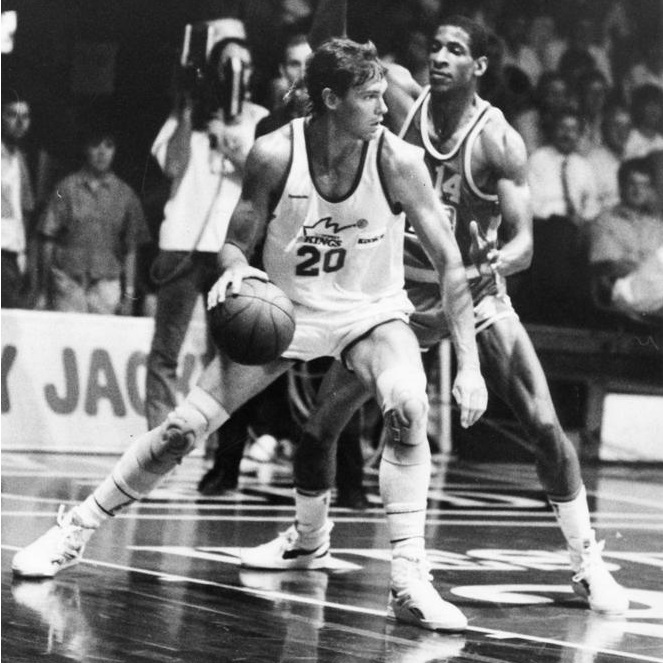
Marc Ridlen
March 19, 2021


BIO: Fenton was born in Sydney, New South Wales, and grew up in the suburb of Lugarno. He made his debut in the NBL in 1982 with the Bankstown Bruins. Fenton received a scholarship to attend the Australian Institute of Sport (Canberra) in 1983. He spent one year there and played for the program’s state league team.
Scott Fenton made his NBL debut with the Bankstown Bruins at 17 years of age. He went scoreless in his first NBL game.
1984
After a remarkable turnaround in 1983 under head coach Robbie Cadee—where the Bankstown Bruins improved from a league-worst 2–24 to a respectable 12–10 record—expectations were raised heading into 1984. The sixth year of the NBL saw the competition expand to 17 teams and split into two divisions. Bankstown, placed in the Eastern Division, retained the majority of their core roster and aimed to build on the momentum of the previous season.
Cadee officially transitioned from player-coach to full-time head coach prior to the season. Veteran guards Robbie Cadee and Wayne Ricarte departed, as did Peter Sheehan, opening the door for the return of Scott Fenton—who rejoined the team after a development year at the Australian Institute of Sport. He was joined by rookie Andrew Svaldenis and new scoring forward Tony Barnett (via Geelong), rounding out a refreshed backcourt and bench rotation.
The season began on a sour note with three straight losses. Fenton was solid in the season opener against Newcastle, tallying 8 points, 6 rebounds and 1 assist, but Bankstown still fell 91–81 despite strong performances from Eric Claus (22 points, 8 rebounds) and Cliff Martin (19 points). They were then blown out by Brisbane (117–89) and narrowly edged by Frankston (80–78), dropping to 0–3.
Bankstown’s breakthrough came on the road in Hobart. Claus (27 points, 10 rebounds) and Martin (25 points, 7 rebounds) dominated, while Fenton contributed 6 points and 3 rebounds in the 118–95 win. The victory sparked a three-game winning streak that included a 104–96 road win over Devonport and a 114–102 home win against the Sydney Supersonics. Claus (25 points, 10 rebounds) and Barnett (19 points, 5 rebounds) were standouts in both games, while Fenton chipped in steady support from the guard position.
While that mid-season surge revived hopes, Bankstown’s inconsistency returned. They suffered heavy road losses to Coburg (147–112), Brisbane (113–74), Canberra (97–76), and Geelong (103–96), ultimately finishing with a poor 3–9 record away from home. Still, the Bruins managed several notable home wins, including against Coburg (100–94), Melbourne (102–97), Frankston (99–84), and St Kilda (76–74).
They closed the season strongly, defeating Sydney again (130–85), upsetting West Adelaide (108–89), and finishing with a 104–95 victory over Perth. In the season finale, Fenton contributed 11 points, 2 rebounds, and 3 steals, backing up Claus (26 points), Barnett (19), and Martin (18).
The Bruins concluded the 1984 season seventh in the Eastern Division with a 10–14 record, falling short of the playoffs. Once again, the team’s offensive engine was powered by Claus (25.7 points, 10.2 rebounds, 2.2 assists, 1.5 blocks) and Martin (20.4 points, 5.5 rebounds, 2.6 assists, 1.3 steals). Barnett emerged as a dependable third option (17.0 points, 6.1 rebounds), while Fenton’s return gave the team added depth at guard and perimeter stability. He averaged 8.6 points, 2.6 rebounds, and 2.6 assists across 23 games, often bringing energy and ball movement to the second unit.
Role players like Ray Dawson (6.1 points, 5.0 rebounds, 1.7 assists, 1.5 blocks) and Mark Cumberbatch (6.5 points, 3.8 rebounds, 1.1 blocks) rounded out a squad that could score in bunches but lacked the defensive consistency and roster depth required to sustain a playoff campaign.
1986
Coming off a disappointing 1985 campaign, the Sydney Supersonics entered 1986 in full rebuild mode. Star imports Wayne Kreklow and Jerry Steurer departed, alongside locals Brett Flanigan, Graham Davis, and Tony Wilkerson. In their place, Sydney brought in dominant American center Derrick Polk, all-around forward Audie Matthews (from Brisbane), and promising youngster Andrew Svaldenis (via Bankstown).
Kendal “Tiny” Pinder, who led the NBL in scoring in 1985 and was named to the All-NBL First Team, returned for his second season. Core contributors Wayne Burden, Curt Forrester, Darren Shaw, Zoran Zunic, Gavin Kelly, Nick Stenstrom, and lead guard Scott Fenton were all retained to provide continuity.
Coaching duties also shifted, with Owen Wells returning to lead the Supersonics, replacing Paul Coughter. Wells, a former NBL MVP with Sydney, was brought back to oversee a revamped unit and push the team back into playoff relevance.
Sydney began the season strongly with a 99–91 road victory over Perth, where Polk (25 points, 13 rebounds) and Pinder (19 points, 18 boards) controlled the paint. Despite the early win, the Supersonics soon slid into a slump, losing eight of their next nine, including agonising one-point losses to Brisbane (84–85) and Geelong (99–100).
Scott Fenton initially played a support role off the bench but gradually became pivotal in orchestrating the offense. His ability to handle the ball, set up teammates, and defend on the perimeter saw him earn a permanent spot in the rotation. By early June, with the team languishing at 2–8, Coach Wells adjusted the lineup, shifting more playmaking responsibility to Fenton while continuing to run the offense through the dominant frontcourt of Pinder and Polk.
The tactical adjustment sparked a turnaround. Sydney surged with a 12–4 record across the final 16 rounds, finishing the regular season 14–12 and clinching 6th place on the ladder—only their second playoff appearance ever and first since 1983. Key wins during this stretch included a 117–80 demolition of Perth and a thrilling 110–109 road win over West Sydney, sealed by a last-second tip-in from Pinder.
Pinder (21.4 points, 16.0 rebounds, 3.6 assists) and Polk (21.9 points, 13.7 rebounds, 2.7 blocks) were among the league’s elite inside duo. Wayne Burden (14.6 points), Audie Matthews (10.0 points), and Zoran Zunic (9.0 points) provided reliable scoring on the wings. Fenton finished with averages of 6.1 points, 3.7 rebounds, and a team-leading 4.2 assists per game.
Fenton had multiple standout performances in the second half of the season. In a vital Round 16 win over Perth, he contributed 8 points, 7 rebounds, and 3 assists. Against Hobart in Round 19, he tallied 11 points on 4-of-9 shooting, adding 9 rebounds and 3 steals to cap off a complete floor game. He also posted double-digit assists in several contests, showing improved court vision as the year progressed.
In the Elimination Final, Sydney travelled to Brisbane to face the 3rd-seeded Bullets. Despite double-doubles from Pinder (20 points, 14 rebounds) and Polk (18 points, 12 rebounds), the Supersonics fell 100–82. Fenton chipped in 5 points, 4 rebounds, and 3 assists in the loss.
Though their finals campaign was short-lived, the 1986 season marked a significant step forward for Sydney. Coach Wells drew praise for transforming the squad mid-season, and Scott Fenton’s emergence as a steady playmaker helped solidify a dangerous backcourt. With Pinder and Polk anchoring the frontcourt and a reliable support cast, Sydney closed the season as one of the league’s most improved teams.
Fenton’s growth as a floor general was a key storyline. His ability to direct traffic, lead transition opportunities, and defend multiple guard positions gave the Supersonics a consistent presence on both ends. With 4.2 assists per game, he finished just outside the NBL’s top 10 in dimes—an impressive feat for a player who began the season as a role player.
1987
In 1986, the Adelaide 36ers, led by coach Ken Cole, produced the most successful season in NBL history (24–2), winning the championship amidst significant controversy. During the campaign, Cole publicly admitted to smoking marijuana and was suspended by Adelaide’s management prior to the Grand Final. A wave of player support and threats of boycott led to his reinstatement, and Cole delivered the title. However, the Adelaide board—concerned about sponsor perception—terminated his contract immediately after the championship.
Adelaide’s loss became Sydney’s gain, with the Supersonics swiftly installing Cole as head coach to replace Owen Wells. Known for his magnetic personality and proven winning formula, “King” Cole wasted no time reshaping the Supersonics’ identity. He modelled the team on his 1986 Adelaide blueprint, with a twin towers frontcourt in Marc Ridlen and Derick Polk, and a young point guard, Scott Fenton, cast in the role of floor leader akin to Al Green.
Fenton entered the season as a 22-year-old guard with the poise and responsibility of orchestrating Cole’s fast-paced, high-possession offense. His defensive instincts and steady shooting helped him carve out a full-time starting role across all 26 games. The Supersonics opened with a 98–76 loss to Eastside Melbourne, but Fenton (5 points, 6 assists, 4 rebounds) made his presence known early despite Sydney’s poor shooting and turnover issues. Derick Polk (21 points, 14 rebounds) led the team in scoring, while Curt Forrester (14 points) and Andrew Svaldenis (12 points, 11 rebounds) also contributed inside.
In Round 3, Sydney notched their first win of the year, defeating Hobart 116–105 behind Ridlen (20 points, 16 rebounds), Polk (24 points, 13 rebounds), and Bruce Hope (19 points), with Fenton (7 points, 4 assists, and 3 rebounds), contributing through efficient playmaking and steady ball-handling.
June 13, Fenton delivered a break out game against Wollongong, when Sydney stunned the third-placed Hawks 104–90. Fenton was a key factor in the upset, scoring 15 points on 5-of-8 shooting from three, adding 6 assists and 4 steals in one of his most complete games of the season.
Over the season, Fenton consistently demonstrated his all-around value, averaging 10.5 points, 4.1 rebounds, 4.3 assists, and 4.3 steals per game, while leading the entire NBL in free throw shooting percentage. His ability to guard opposing guards, hit outside shots, and push tempo made him a trusted figure in Cole’s system.
He played a key role in several of Sydney’s best performances, including the Supersonics’ most dominant win of the year— a 129–76 demolition of the Melbourne Tigers on August 22. Fenton finished with 10 points, 4 assists, 2 steals, and 6 rebounds in 35 minutes, supporting Ridlen (36 points, 16 rebounds) and Polk (25 rebounds) in an all-around team clinic.
In Sydney’s emotional final regular season game on September 18—a 118–98 win over the Westside Saints that would mark the franchise’s last appearance before merging into the Sydney Kings—Fenton went scoreless but still dished out 5 assists and grabbed 2 rebounds in 13 minutes, helping direct the offense in the decisive victory. Marc Ridlen (40 points, 26 rebounds) top-scored in the contest, delivering a dominant performance in his final outing as a Supersonic. Coach Cole praised the team’s unity and execution, saying the group had “finally put it all together for 48 minutes.”
While overshadowed at times by the dominant frontcourt pairing of Ridlen (30.5 points, 16.1 rebounds) and Polk (20.2 points, 12.8 rebounds, 3.0 blocks), Fenton’s leadership at the point was critical to keeping Sydney competitive throughout their 9–17 campaign. His high basketball IQ, defensive activity, and league-best free throw percentage solidified his role as a cornerstone in Cole’s reimagined system.
Although Sydney missed the playoffs and the Supersonics era came to an end, Fenton emerged as one of the NBL’s top young guards. His steady development and consistency laid the groundwork for what would soon become a new chapter in Sydney basketball with the launch of the Sydney Kings.
1988/B>
In 1988, he moved to Western Australia to join the Perth Wildcats.
1989
During the 1989 NBL season, Fenton and his fiancée Tina Christie (a player for Perth’s female basketball team, the WAIS Breakers) were killed in a horrific car accident. Fenton and Christie were turning into Marmion Avenue in the Perth suburb of Hillarys when reportedly two cars racing down that street with no headlights on slammed into their car. Both Fenton and Christie died instantly.
In his honour, his #14 jersey became the first jersey to be retired by the club and will not be used by any future player of the club.
Scott Fenton played seven seasons across three NBL teams. This included the Bankstown Bruins, Sydney Supersonics and Perth Wildcats. He averaged 7 points, 2.6 rebounds, and 3.6 assists in 139 NBL games.
CAREER RANKINGS:
– 43rd in total steals
– 4th in steals per game.
| SEASON | AGE | TEAM | TEAM RECORD | GP | MINS | PTS | REB | AST | OR | DR | STL | BLK | TO | PF | FGM | FGA | FG% | 3PM | 3PA | 3P% | FTM | FTA | FT% | TS% | EFG% | HS |
|---|---|---|---|---|---|---|---|---|---|---|---|---|---|---|---|---|---|---|---|---|---|---|---|---|---|---|
| 1989 | 24 | Perth | 16-8 (3) | 13 | 174 | 44 | 14 | 21 | 7 | 7 | 2 | 0 | 10 | 14 | 17 | 53 | 32% | 7 | 21 | 33% | 3 | 4 | 75% | 40% | 39% | 13 |
| 1988 | 23 | Perth | 13-11 (6) | 24 | 384 | 116 | 23 | 54 | 8 | 15 | 16 | 1 | 25 | 53 | 45 | 97 | 46% | 16 | 36 | 44% | 10 | 11 | 91% | 57% | 55% | 14 |
| 1987 | 22 | Sydney | 8-18 (10) | 24 | 828 | 253 | 99 | 102 | 34 | 65 | 102 | 8 | 55 | 64 | 84 | 215 | 39% | 48 | 127 | 38% | 37 | 40 | 93% | 54% | 50% | |
| 1986 | 21 | Sydney | 14-11 (6) | 26 | 0 | 159 | 96 | 108 | 36 | 60 | 108 | 1 | 59 | 65 | 59 | 157 | 38% | 23 | 64 | 36% | 18 | 29 | 62% | 47% | 45% | |
| 1985 | 20 | Sydney | 9-17 (11) | 26 | 0 | 213 | 77 | 165 | 30 | 47 | 165 | 2 | 77 | 66 | 79 | 177 | 45% | 19 | 41 | 46% | 36 | 44 | 82% | 54% | 50% | 13 |
| 1984 | 19 | Bankstown | 10-14 (11) | 23 | 0 | 197 | 60 | 60 | 19 | 41 | 19 | 1 | 51 | 67 | 77 | 153 | 50% | 5 | 17 | 29% | 38 | 45 | 84% | 56% | 52% | 19 |
| 1982 | 17 | Bankstown | 2-24 (14) | 3 | 0 | 4 | 0 | 0 | 0 | 0 | 0 | 0 | 2 | 2 | 2 | 3 | 67% | 0 | 0 | 0% | 0 | 0 | 0% | 67% | 0% | 4 | Totals | 139 | 1386 | 986 | 369 | 510 | 134 | 235 | 412 | 13 | 279 | 331 | 363 | 855 | 42.5% | 118 | 306 | 38.6% | 142 | 173 | 82.1% | 53% | 49% | 28 |
| SEASON | AGE | TEAM | TEAM RECORD | GP | MINS | PTS | REB | AST | OR | DR | STL | BLK | TO | PF | FGM | FGA | FG% | 3PM | 3PA | 3P% | FTM | FTA | FT% | TS% | EFG% | HS |
|---|---|---|---|---|---|---|---|---|---|---|---|---|---|---|---|---|---|---|---|---|---|---|---|---|---|---|
| 1989 | 24 | Perth | 16-8 (3) | 13 | 13.4 | 3.4 | 1.1 | 1.6 | 0.5 | 0.5 | 0.2 | 0.0 | 0.8 | 1.1 | 1.3 | 4.1 | 32% | 0.5 | 1.6 | 33% | 0.2 | 0.3 | 75% | 40% | 39% | 13 |
| 1988 | 23 | Perth | 13-11 (6) | 24 | 16.0 | 4.8 | 1.0 | 2.3 | 0.3 | 0.6 | 0.7 | 0.0 | 1.0 | 2.2 | 1.9 | 4.0 | 46% | 0.7 | 1.5 | 44% | 0.4 | 0.5 | 91% | 57% | 55% | 14 |
| 1987 | 22 | Sydney | 8-18 (10) | 24 | 34.5 | 10.5 | 4.1 | 4.3 | 1.4 | 2.7 | 4.3 | 0.3 | 2.3 | 2.7 | 3.5 | 9.0 | 39% | 2.0 | 5.3 | 38% | 1.5 | 1.7 | 93% | 54% | 50% | |
| 1986 | 21 | Sydney | 14-11 (6) | 26 | 0.0 | 6.1 | 3.7 | 4.2 | 1.4 | 2.3 | 4.2 | 0.0 | 2.3 | 2.5 | 2.3 | 6.0 | 38% | 0.9 | 2.5 | 36% | 0.7 | 1.1 | 62% | 47% | 45% | |
| 1985 | 20 | Sydney | 9-17 (11) | 26 | 0.0 | 8.2 | 3.0 | 6.3 | 1.2 | 1.8 | 6.3 | 0.1 | 3.0 | 2.5 | 3.0 | 6.8 | 45% | 0.7 | 1.6 | 46% | 1.4 | 1.7 | 82% | 54% | 50% | 13 |
| 1984 | 19 | Bankstown | 10-14 (11) | 23 | 0.0 | 8.6 | 2.6 | 2.6 | 0.8 | 1.8 | 0.8 | 0.0 | 2.2 | 2.9 | 3.3 | 6.7 | 50% | 0.2 | 0.7 | 29% | 1.7 | 2.0 | 84% | 56% | 52% | 19 |
| 1982 | 17 | Bankstown | 2-24 (14) | 3 | 0.0 | 1.3 | 0.0 | 0.0 | 0.0 | 0.0 | 0.0 | 0.0 | 0.7 | 0.7 | 0.7 | 1.0 | 67% | 0.0 | 0.0 | 0% | 0.0 | 0.0 | 0% | 66.7% | 0% | 4 | Total | 139 | 10.0 | 7.1 | 2.7 | 3.7 | 1.0 | 1.7 | 3.0 | 0.1 | 2.0 | 2.4 | 2.6 | 6.2 | 42.5% | 0.0 | 0.0 | 38.6% | 0.8 | 2.2 | 82.1% | 53% | 49% | 28 |
| POINTS | REBOUNDS | ASSISTS | STEALS | BLOCKS | TURNOVERS | TRIPLE DOUBLES | 28 | 10 | 18 | 11 | 2 | 8 | 0 |
|---|
Scott Fenton passed away on August 21, 1989 as a result of a car crash.
Whilst we try to source as much information as we can for every player who has ever played in the NBL some information on a player profile may be missing. If you have additional information on a player you'd like us to add to a profile, please send it to us using the enquiry form below.
Submissions are then sent to info@aussiehoopla.com

