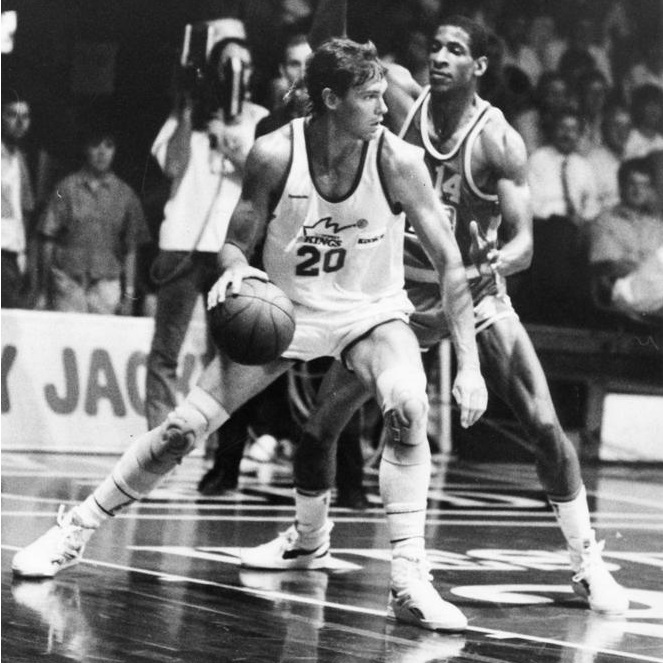
Marc Ridlen
March 19, 2021


BIO: Audie Matthews was born in Chicago, Illinois (USA).
Audie Matthews made his NBL debut with the Brisbane Bullets on 7/2/1982. He scored 35 points in his first game.
In 1982, Larry Sengstock left St Kilda to join the Brisbane Bullets under new head coach Rick Harden. Sengstock (17.5 points, 10.1 rebounds, and 1.0 assist per game), despite it being his first year with the Bullets, was named co-captain alongside import Brian Banks (22.4 points, 4.4 rebounds, and 1.8 assists per game). New import Audie Matthews (19.0 points, 6.2 rebounds, and 0.9 assists) was also added to the squad.
The Bullets finished in eighth place, missing out on finals qualification. Citing personal, mental, and financial reasons, Leroy Loggins opted not to continue with the Bullets after the 1981 season.
1985
After falling short against the Canberra Cannons in the previous year’s Grand Final, the Brisbane Bullets strengthened their roster by adding the legendary Cal Bruton and a young John Dorge. Import Audie Matthews also returned to the team after spending three years overseas.
Behind the brilliance of Leroy Loggins (27.3 points, 10.3 rebounds, 3.8 assists, 3.7 steals, and 2.0 blocks), the returning Cal Bruton (17.0 points, 2.7 rebounds, and 3.6 assists), and team captain Larry Sengstock (16.9 points, 9.4 rebounds, and 1.7 assists), the Bullets emerged as the league’s most powerful team. With head coach Brian Kerle in his second season at the helm, Brisbane secured a first-place finish for the second consecutive year—this time with a 20–6 record.
Audie Matthews also delivered a strong season, contributing 19.0 points, 6.2 rebounds, and 0.9 assists per game.
The Bullets earned a first-round bye in the NBL playoffs and awaited the winner of the elimination final between the Coburg Giants and reigning champions, Canberra. The Cannons dispatched Coburg convincingly, winning by 23 points and setting up a rematch with Brisbane—giving the Bullets a chance at redemption.
In the 93–76 win over Canberra, which earned them a Grand Final berth against the Adelaide 36ers, Loggins led the charge with 28 points, 12 rebounds, 7 assists, and 3 steals. Bruton added 16 points, 4 rebounds, and 7 assists, while Matthews contributed 13 points and 8 rebounds. On the other side of the bracket, Adelaide crushed Newcastle 151–103 in a record-breaking semifinal performance.
With the Grand Final held at their home venue, the Sleeman Sports Centre (Chandler Arena), the Bullets entered as favourites against the Adelaide 36ers—who, after merging with West Adelaide in 1985, had become one of the strongest teams in NBL history.
The 1985 Grand Final was decided in a single-game format—the last time the championship would be settled this way. Brisbane led 78–74 heading into the final quarter before exploding for 42 points, outscoring the 36ers 42–21 to set a Grand Final record for points in a final period and cruising to a dominant 121–95 victory.
Sengstock delivered 23 points, 9 rebounds, and 6 assists; Bruton nearly repeated his semifinal performance with 16 points, 5 rebounds, and 3 assists; and Loggins turned in one of the greatest Grand Final displays in NBL history, finishing with 41 points, 5 rebounds, 4 assists, and 2 steals.
Matthews capped off his strong season with another standout performance in the Grand Final, recording 16 points (6-of-12 shooting), 5 rebounds, 3 assists, and 2 steals as Brisbane claimed their first NBL championship on their home court at the Sleeman Sports Centre.
Although no official Grand Final MVP was awarded, Loggins was named player of the game. His stellar form also earned him selection to the All-NBL First Team for the fourth consecutive season.
SYDNEY SUPERSONICS
1986
Following a challenging 1985 campaign, the Sydney Supersonics entered 1986 in full rebuild mode. The offseason saw imports Wayne Kreklow and Jerry Steurer depart the squad, along with locals Brett Flanigan, Graham Davis, and Tony Wilkerson. To address those gaps, Sydney signed dominant American center Derrick Polk, recruited versatile forward Audie Matthews from Brisbane, and added promising young Australian Andrew Svaldenis via Bankstown.
Returning to lead the charge was star big man Kendal “Tiny” Pinder, who had led the NBL in scoring the previous season and earned All-NBL First Team honours in his debut campaign. Veterans Wayne Burden, Curt Forrester, Scott Fenton, Darren Shaw, Zoran Zunic, Gavin Kelly, and Nick Stenstrom remained on the roster, giving the Supersonics a mix of fresh blood and experience.
There was also a change at the helm. Owen Wells, a former NBL MVP during his playing days with Sydney, returned as head coach after a one-year absence, taking over from Paul Coughter. Wells was tasked with transforming the reshaped roster into a playoff-calibre unit.
The season began with promise, as the Supersonics opened with a 99–91 away win over the Perth Wildcats. Polk (25 points, 13 rebounds) and Pinder (19 points, 18 rebounds) were immediately impactful, while Matthews added 11 points and 6 rebounds on perfect free throw shooting in his Sydney debut.
However, the team stumbled in the weeks that followed, losing eight of their next nine outings. Matthews continued to contribute consistently, including a 9-point, 6-rebound performance in a tough 96–107 loss to Adelaide and an 8-rebound effort against Newcastle. Despite the early struggles, Sydney’s core remained competitive, with Polk (21.9 points, 13.7 rebounds) and Pinder (21.4 points, 16.0 rebounds) establishing themselves as one of the league’s most formidable inside pairings.
By early June, the Supersonics sat at 2–8 and appeared unlikely to reach the postseason. Coach Wells responded by recalibrating his rotation, placing greater emphasis on the inside-out dynamic between Pinder and Polk, and elevating Scott Fenton’s playmaking responsibilities. The turnaround was dramatic. Sydney went on to win 12 of their final 16 games, closing the regular season with a 14–12 record and clinching sixth place on the NBL ladder — their first playoff berth since 1983.
Matthews was instrumental during the team’s resurgence, providing dependable two-way play at forward. He averaged 10.0 points, 6.5 rebounds, and 2.5 assists across the season, including standout efforts such as 16 points (6-of-9 FG, 6-of-6 FT) in a commanding 117–80 win over Perth, and a 20-point, 10-rebound performance against Hobart in Round 19.
Throughout the campaign, Matthews’ hustle and versatility complemented the Supersonics’ high-powered frontcourt. He joined Pinder and Polk as one of the team’s key statistical contributors, alongside Wayne Burden (14.6 points, 3.3 rebounds) and Zoran Zunic (9.0 points, 2.2 rebounds). Offensively, Matthews often played a connecting role, facilitating fast breaks and contributing on the glass.
In the Elimination Final, Sydney travelled to Brisbane to face the third-seeded Bullets. Although Matthews scored 7 points and grabbed 5 rebounds, the Supersonics fell 100–82, with Brisbane’s Leroy Loggins pouring in 28 points to end Sydney’s postseason run.
Despite the first-round exit, Matthews’ arrival was a key part of Sydney’s 1986 revival. His consistent two-way impact gave Coach Wells reliability on the wing, and his effort level helped set the tone during Sydney’s mid-season push.
1987
In 1986, the Adelaide 36ers, led by coach Ken Cole, produced the most successful season in NBL history (24–2), winning the championship amidst significant controversy. During the campaign, Cole publicly admitted to smoking marijuana and was suspended by Adelaide’s management prior to the Grand Final. A wave of player support and threats of boycott led to his reinstatement, and Cole delivered the title. However, the Adelaide board—concerned about sponsor perception—terminated his contract immediately after the championship.
Adelaide’s loss quickly became Sydney’s gain, with the Supersonics acting swiftly to appoint the flamboyant and inspirational Cole as head coach, replacing Owen Wells. Known for his motivational prowess and championship credentials, Cole remodelled the Supersonics in the image of his 1986 Adelaide team, implementing a system built around dual interior threats and fast-paced offense.
The team saw major roster changes. Import Kendal Pinder left for Perth, while Wayne Burden also departed. In came unheralded American Marc Ridlen and veteran swingman Bruce Hope (via Geelong), joined by bench additions Mike Kenny, Robert Croker, and James Hewlett. Returning big man Derick Polk reformed the frontcourt alongside Ridlen, while Scott Fenton and promising forward Andrew Svaldenis rounded out a younger, more athletic core. Veteran wing Audie Matthews returned as a key figure and defensive leader, entering his second year with Sydney.
Matthews opened the season with a modest outing in Sydney’s 98–76 loss to Eastside Melbourne on April 25, contributing (10 points, 9 rebounds, 2 steals) in 37 minutes of action.
He followed that with another solid performance—(14 points, 6 rebounds, 2 assists) in 41 minutes—during a tough 124–104 loss to West Sydney on May 1. Though the Supersonics started 0–2, their offensive weapons began to click, with Ridlen (35 points, 17 rebounds) and Polk (24 points, 13 rebounds) leading the way, while Matthews provided two-way support from the wing.
In Sydney’s first win of the season—a 116–105 victory over Hobart in Round 3—Matthews contributed (19 points, 5 rebounds, 1 assist) across 43 minutes in a balanced team performance that saw Ridlen (20 points, 16 rebounds) and Polk (24 points, 13 rebounds) again dominate inside. Matthews’ ability to crash the boards and apply defensive pressure helped swing momentum in Sydney’s favour.
One of the Supersonics’ biggest triumphs came on June 13, when they stunned the third-placed Wollongong Hawks with a 104–90 victory. Matthews starred with (18 points, 9 rebounds, 3 steals) in 43 minutes—one of his best outings of the year—supporting Ridlen (31 points, 21 rebounds) and Polk (18 points, 7 rebounds) in the upset. Scott Fenton added (15 points, 6 assists) to round out a complete team performance.
Matthews was again a key contributor in Sydney’s 86–81 win over West Sydney on May 29, posting (14 points, 6 rebounds, 2 steals) over 41 minutes. It marked the team’s second consecutive win following an earlier upset of North Melbourne (105–98). In both games, Matthews’ defense and composure in transition allowed the Supersonics to hold firm against more favoured opponents.
His most explosive game of the season came during a 129–76 demolition of the Melbourne Tigers on August 22. Matthews poured in 28 points on 11-of-22 shooting, while adding 12 rebounds, 4 assists, and a steal. Ridlen (36 points, 16 rebounds) and Polk (17 points, 25 rebounds) were also both impressive in the win..
Matthews remained productive throughout the second half of the season, scoring in double digits in multiple games while maintaining consistent rebounding numbers. In Sydney’s final game of the year—a 118–98 win over the Westside Saints on September 18—Matthews delivered 17 points and 6 rebounds in a strong closing performance alongside Ridlen (40 points, 26 rebounds), Polk (18 points, 21 rebounds, 5 blocks), and Forrester (17 points).
Across 24 games in 1987, Audie Matthews averaged 12.8 points, 7.0 rebounds, 2.6 assists, and 2.6 steals. He provided veteran leadership, perimeter scoring, and critical defensive effort, helping to stabilise a roster that struggled for cohesion at times under Cole’s high-pressure system. His consistency on both ends of the floor made him a vital presence on a team defined by its high-powered offense and defensive inconsistencies.
While Sydney missed the playoffs with a 9–17 record, they ended the season with a resounding win and closed the chapter on the Supersonics era. The franchise merged with the West Sydney Westars soon after, giving birth to the Sydney Kings. “The Sonics are dead – long live the Kings,” declared local press.
Audie Matthews played four seasons in the NBL, playing for both the Brisbane Bullets and the Sydney Supersonics. He averaged 13.9 points, 6.7 rebounds, and 2.2 assists in 89 NBL games.
| SEASON | AGE | TEAM | TEAM RECORD | GP | MINS | PTS | REB | AST | OR | DR | STL | BLK | TO | PF | FGM | FGA | FG% | 3PM | 3PA | 3P% | FTM | FTA | FT% | TS% | EFG% | HS |
|---|---|---|---|---|---|---|---|---|---|---|---|---|---|---|---|---|---|---|---|---|---|---|---|---|---|---|
| 1987 | 0 | Sydney | 9-17 (10) | 24 | 822 | 306 | 167 | 63 | 87 | 80 | 63 | 6 | 78 | 73 | 128 | 292 | 44% | 0 | 3 | 0% | 50 | 64 | 78% | 47% | 44% | |
| 1986 | 0 | Sydney | 14-12 (6) | 26 | 0 | 260 | 170 | 66 | 72 | 98 | 66 | 3 | 69 | 62 | 112 | 230 | 49% | 0 | 1 | 0% | 36 | 56 | 64% | 51% | 49% | |
| 1985 | 0 | Brisbane | 20-6 (1) | 24 | 0 | 390 | 169 | 57 | 74 | 95 | 31 | 4 | 79 | 58 | 151 | 320 | 47% | 0 | 0 | 0% | 88 | 115 | 77% | 52% | 47% | 30 |
| 1982 | 0 | Brisbane | 12-14 (8) | 15 | 0 | 285 | 93 | 13 | 40 | 53 | 0 | 0 | 35 | 40 | 120 | 215 | 56% | 0 | 0 | 0% | 45 | 71 | 63% | 57% | 56% | 35 | Totals | 89 | 822 | 1241 | 599 | 199 | 273 | 326 | 160 | 13 | 261 | 233 | 511 | 1057 | 48.3% | 0 | 4 | 0.0% | 219 | 306 | 71.6% | 52% | 48% | 35 |
| SEASON | AGE | TEAM | TEAM RECORD | GP | MINS | PTS | REB | AST | OR | DR | STL | BLK | TO | PF | FGM | FGA | FG% | 3PM | 3PA | 3P% | FTM | FTA | FT% | TS% | EFG% | HS |
|---|---|---|---|---|---|---|---|---|---|---|---|---|---|---|---|---|---|---|---|---|---|---|---|---|---|---|
| 1987 | 0 | Sydney | 9-17 (10) | 24 | 34.3 | 12.8 | 7.0 | 2.6 | 3.6 | 3.3 | 2.6 | 0.3 | 3.3 | 3.0 | 5.3 | 12.2 | 44% | 0.0 | 0.1 | 0% | 2.1 | 2.7 | 78% | 47% | 44% | |
| 1986 | 0 | Sydney | 14-12 (6) | 26 | 0.0 | 10.0 | 6.5 | 2.5 | 2.8 | 3.8 | 2.5 | 0.1 | 2.7 | 2.4 | 4.3 | 8.8 | 49% | 0.0 | 0.0 | 0% | 1.4 | 2.2 | 64% | 51% | 49% | |
| 1985 | 0 | Brisbane | 20-6 (1) | 24 | 0.0 | 16.3 | 7.0 | 2.4 | 3.1 | 4.0 | 1.3 | 0.2 | 3.3 | 2.4 | 6.3 | 13.3 | 47% | 0.0 | 0.0 | 0% | 3.7 | 4.8 | 77% | 52% | 47% | 30 |
| 1982 | 0 | Brisbane | 12-14 (8) | 15 | 0.0 | 19.0 | 6.2 | 0.9 | 2.7 | 3.5 | 0.0 | 0.0 | 2.3 | 2.7 | 8.0 | 14.3 | 56% | 0.0 | 0.0 | 0% | 3.0 | 4.7 | 63% | 57.3% | 56% | 35 | Total | 89 | 9.2 | 13.9 | 6.7 | 2.2 | 3.1 | 3.7 | 1.8 | 0.1 | 2.9 | 2.6 | 5.7 | 11.9 | 48.3% | 0.0 | 0.0 | 0.0% | 0.0 | 71.6% | 52% | 48% | 35 |
| POINTS | REBOUNDS | ASSISTS | STEALS | BLOCKS | TURNOVERS | TRIPLE DOUBLES | 35 | 14 | 11 | 5 | 1 | 11 | 0 |
|---|
Audie Matthews was drafted by the Detroit Pistons with pick #117 in the 1978 NBA Draft.
Audie Matthews had a productive four-year career at the University of Illinois, playing 110 games from 1974 to 1978. After a limited freshman season, he emerged as a key starter, averaging double figures in each of his final three seasons. His best year came as a junior in 1976–77, when he averaged 16.0 points, 5.0 rebounds, and 2.5 assists while shooting 51% from the field and nearly 80% from the line. Matthews was known for his athleticism, consistency, and ability to score in transition.
Over his career, he posted averages of 11.0 points, 4.3 rebounds, and 1.8 assists per game, while shooting 46.5% from the floor.
Whilst we try to source as much information as we can for every player who has ever played in the NBL some information on a player profile may be missing. If you have additional information on a player you'd like us to add to a profile, please send it to us using the enquiry form below.
Submissions are then sent to info@aussiehoopla.com

