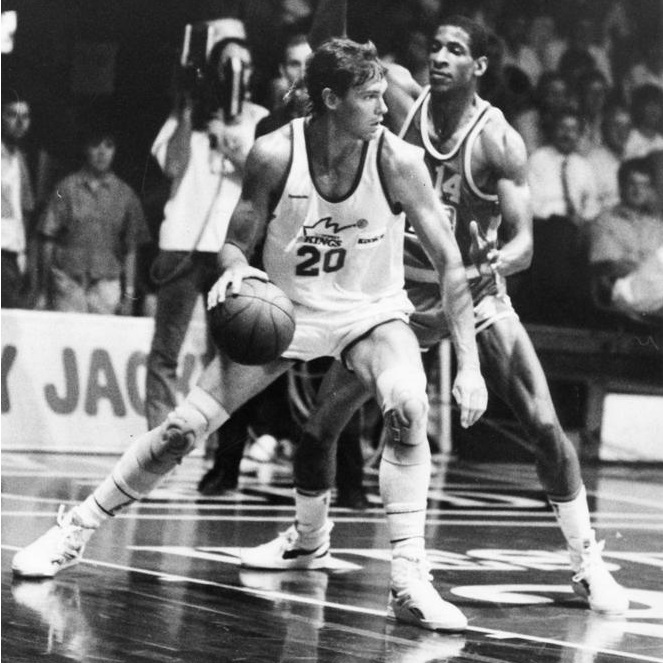
Larry Davidson (Born 1958)
March 31, 2025


BIO: Owen Wells was born in Providence, Rhode Island (USA).
Owen Wells made his NBL debut with the Newcastle Falcons at 30 years of age. He scored 20 points in his first game.
SYDNEY SUPERSONICS
1983
1983 saw the City of Sydney Astronauts become the Sydney Supersonics, with legendary import Owen Wells returning to Australia after a year overseas to take on the role of player-coach. The team added Gordie McLeod (9.6 points, 2.2 rebounds, and 3.9 assists) from the Illawarra Hawks and import Ronnie Cavenall (15.0 points, 8.0 rebounds, and 2.0 blocks) to pair with Wells, who delivered an outstanding season (24.3 points, 6.8 rebounds, and 4.1 assists) and was ultimately named the 1983 NBL Most Valuable Player.
Together, the trio led Sydney to a record-breaking 16-game winning streak, finishing first in the regular season with a league-best 19–3 record.
The 1983 NBL Finals, however, were played under unusual circumstances. As a cost-cutting measure, the league introduced two divisional finals—a three-game round-robin tournament for the top eight teams. This format controversially resulted in the exclusion of the league’s top two teams from the playoffs.
Despite Sydney (Western Division) and Geelong (Eastern Division) finishing the round-robin with identical 2–1 records, both were eliminated due to points percentage tiebreakers, with two other teams progressing instead.
In the semifinals, defending champions West Adelaide defeated Nunawading 84–77, while Canberra overcame Coburg 80–75. Canberra would go on to win the championship, edging out West Adelaide 75–73 in a thrilling Grand Final.
The Supersonics didn’t decide to bring Cavenall which saw him return to the US and later become the first player to go from the NBL to the NBA.
1984
Player coach Owen Wells (27.6 points, 10.6 rebounds, and 3.8 assists) chose to go with a more experienced big man in Brian Devincenzi (26.3 points and 7.6 rebounds) who would put up much better numbers the following year but the Supersonics delivered only three wins in comparison.
Sydney chose not to re-sign Wells in a coach or player role the following season.
Owen Wells played three seasons in the NBL, playing for both the Newcastle Falcons and the Sydney Supersonics. He averaged 24.9 points, 4.9 rebounds, and 2.5 assists in 55 NBL games.
CAREER RANKINGS:
– 40th in points per game.
| SEASON | AGE | TEAM | TEAM RECORD | GP | MINS | PTS | REB | AST | OR | DR | STL | BLK | TO | PF | FGM | FGA | FG% | 3PM | 3PA | 3P% | FTM | FTA | FT% | TS% | EFG% | HS |
|---|---|---|---|---|---|---|---|---|---|---|---|---|---|---|---|---|---|---|---|---|---|---|---|---|---|---|
| 1984 | 33 | Sydney | 3-21 (17) | 10 | 0 | 276 | 102 | 38 | 31 | 71 | 38 | 7 | 54 | 39 | 102 | 223 | 46% | 8 | 28 | 29% | 64 | 83 | 77% | 53% | 48% | |
| 1983 | 32 | Sydney | 19-3 (1) | 25 | 0 | 608 | 170 | 103 | 62 | 108 | 56 | 13 | 101 | 63 | 252 | 521 | 48% | 0 | 0 | 0% | 104 | 139 | 75% | 52% | 48% | 45 |
| 1981 | 30 | Newcastle | 13-9 (6) | 20 | 0 | 488 | 0 | 0 | 0 | 0 | 0 | 0 | 0 | 57 | 196 | 393 | 50% | 0 | 0 | 0% | 96 | 113 | 85% | 55% | 50% | 38 | Totals | 55 | 0 | 1372 | 272 | 141 | 93 | 179 | 94 | 20 | 155 | 159 | 550 | 1137 | 48.4% | 8 | 28 | 28.6% | 264 | 335 | 78.8% | 53% | 49% | 50 |
| SEASON | AGE | TEAM | TEAM RECORD | GP | MINS | PTS | REB | AST | OR | DR | STL | BLK | TO | PF | FGM | FGA | FG% | 3PM | 3PA | 3P% | FTM | FTA | FT% | TS% | EFG% | HS |
|---|---|---|---|---|---|---|---|---|---|---|---|---|---|---|---|---|---|---|---|---|---|---|---|---|---|---|
| 1984 | 33 | Sydney | 3-21 (17) | 10 | 0.0 | 27.6 | 10.2 | 3.8 | 3.1 | 7.1 | 3.8 | 0.7 | 5.4 | 3.9 | 10.2 | 22.3 | 46% | 0.8 | 2.8 | 29% | 6.4 | 8.3 | 77% | 53% | 48% | |
| 1983 | 32 | Sydney | 19-3 (1) | 25 | 0.0 | 24.3 | 6.8 | 4.1 | 2.5 | 4.3 | 2.2 | 0.5 | 4.0 | 2.5 | 10.1 | 20.8 | 48% | 0.0 | 0.0 | 0% | 4.2 | 5.6 | 75% | 51.8% | 48% | 45 |
| 1981 | 30 | Newcastle | 13-9 (6) | 20 | 0.0 | 24.4 | 0.0 | 0.0 | 0.0 | 0.0 | 0.0 | 0.0 | 0.0 | 2.9 | 9.8 | 19.7 | 50% | 0.0 | 0.0 | 0% | 4.8 | 5.7 | 85% | 54.6% | 50% | 38 | Total | 55 | 0.0 | 24.9 | 4.9 | 2.6 | 1.7 | 3.3 | 1.7 | 0.4 | 2.8 | 2.9 | 10.0 | 20.7 | 48.4% | 0.0 | 0.0 | 28.6% | 0.1 | 0.5 | 78.8% | 53% | 49% | 50 |
| POINTS | REBOUNDS | ASSISTS | STEALS | BLOCKS | TURNOVERS | TRIPLE DOUBLES | 50 | 21 | 10 | 7 | 2 | 12 | 0 |
|---|
Owen Wells was drafted by the Houston Rockets with pick #77 in the 1974 NBA Draft.
Wells often gets mistaken by another Owen Wells who played multiple seasons in the NBA. Although he had NBA opportunities with multiple teams Wells never played in an NBA game.
Wells joined Kinzo Amstelveen for the 1975–76 Dutch Eredivisie season, playing his first season in the Netherlands and helping the club win the league title in 1975–76 while being named to the First-team All-Eredivisie that season.
During the 1976–77 FIBA European Champions Cup, Wells featured for Kinzo Amstelveen in an 88–86 win over ASPO Tours on 28 October 1976, scoring 20 points while sharing the floor with Joe Wallace, Ron Kruidhof, Al Faber, Herman Pluym, Everett Fopma, and Mark ten Hoeve under coach Theo Kinsbergen.
Wells moved to Italy in the 1978–79 season with Sinudyne Bologna, arriving on 20 December 1978 as a replacement signing and playing alongside Kresimir Cosic in a championship campaign that ended with Bologna winning the 1978–79 Serie A title.
He returned to Kinzo Amstelveen for the 1979–80 Dutch Eredivisie season and again received First-team All-Eredivisie recognition in 1980.
In 1982, Wells played in the Dutch NBL, leading his team to the playoffs.
Owen Wells attended Detroit Mercy, where available season-by-season records show his freshman season listed as 1970–71 with freshman statistics not available, before he began compiling documented varsity numbers from 1971–72 onward.
In the 1971–72 season, Wells appeared in 22 games for Detroit Mercy on an 18–6 team, averaging 4.4 points and 3.0 rebounds per game while shooting 47.9% from the field and 65.9% at the free-throw line.
In the 1972–73 season, Detroit Mercy went 16–9, and Wells’ production jumped as he played 24 games and averaged 14.2 points and 9.0 rebounds per game, shooting 48.2% from the field and 76.9% at the stripe.
In the 1973–74 season, Wells served as team captain and led Detroit Mercy in scoring at 20.6 points per game as the Titans finished 17–9; across 26 games he averaged 20.6 points and 8.8 rebounds per contest while shooting 45.7% from the field and 75.2% on free throws.
During that 1973–74 campaign, Detroit Mercy’s first recorded meeting with Oakland came on December 15, 1973, when the Titans won 101–75 at Calihan Hall and Wells scored 20 points in the victory (matching Wilbur Ross’ 20).
Across the Detroit Mercy seasons with published per-game splits, Wells’ Division I totals are listed as 72 games with 46.7% field-goal shooting, 74.3% free-throw shooting, and 7.1 rebounds per game, with the provided additional info listing his college as Detroit Mercy.
- 1x time NBL Most Valuable Player (1983)
- 1x All-NBL First Team
Wells returned to the Sydney Supersonics as a coach in 1986 and added Claude Williams as his assistant.
Whilst we try to source as much information as we can for every player who has ever played in the NBL some information on a player profile may be missing. If you have additional information on a player you'd like us to add to a profile, please send it to us using the enquiry form below.
Submissions are then sent to info@aussiehoopla.com