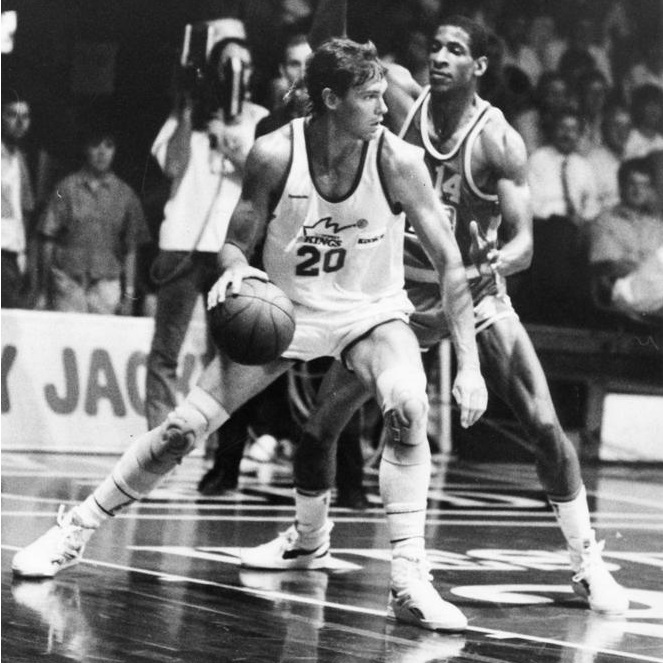
Marc Ridlen
March 19, 2021


BIO: Born in Camperdown, NSW, and a student at Cleveland Street High School, Claude Williams was a rare sporting talent who excelled across multiple disciplines. He first made waves in cricket, starring as both an opening batsman and bowler for Sydney Cricket Club in the AW Green Shield competition. His athletic promise soon caught the eye of the NSW Tennis Association, who invited him to join their elite development squad.
As he matured, Williams shifted his focus to rugby league, where he played 12 games for the South Sydney Rabbitohs between 1973 and 1974. All the while, he maintained his deep passion for basketball—moonlighting as a guard for Eastern Suburbs in Sydney’s top-tier competition. His weekly schedule was intense: basketball training on Mondays and Fridays, games on Wednesdays, and league commitments consuming Tuesdays, Thursdays, and weekends.
Though selected to represent New South Wales at the national basketball championships in 1974 and 1975, his Rabbitohs contract prevented him from taking part. Once fully committed to basketball, Williams became a mainstay in the state team, representing NSW at the national titles in 1976, 1977, 1979, and 1981.
After officially switching codes, Williams made his mark in basketball, playing 101 games for the City of Sydney Astronauts and Supersonics—long before the NBL was formed—while also starring in the Australian Club Championships and National Titles. His versatility, leadership, and elite-level contributions across four major sports cement his legacy as one of Australia’s great multi-sport pioneers.
FAMILY: The son of country musician Claude “Candy” Williams, and first cousin to Harry Williams, the first Indigenous soccer player to represent the Socceroos at a World Cup, in 1974.
Claude Williams made his NBL debut with the City of Sydney Astronauts at 27 years of age. He scored eight points in his first game.
Whilst playing for the City of Sydney Astronauts, Williams also worked a day job as a clerk with the council.
Claude Williams played a key role for the City of Sydney Astronauts in the inaugural 1979 NBL season under coach Charlie Zammit. The Astronauts made history by competing in the first-ever NBL game, a 68–65 loss to the Glenelg Tigers at the Apollo Entertainment Centre. David Leslie (25 points) led the way, while Williams contributed a strong all-around performance with 8 points on 50% shooting and a perfect 4-of-4 from the free-throw line. Ian Robilliard (8 points) also chipped in for Sydney, while Glenelg was led by Rick Hodges (16 points) and David Smyth (15 points).
After a rough 0–5 start to the season, City of Sydney finally broke through in a thrilling 81–80 win over Glenelg in the rematch. Williams stepped up again with 16 points on 6-of-12 shooting, supported by Peter Donnelly (14 points), Brad Dalton (12 points), and David Leslie (12 points). The Tigers were paced by Steve Sparrow (24 points) and Gerry Clarke (23 points).
Following that breakthrough win, the Astronauts caught fire with a six-game winning streak that featured victories over Brisbane, Canberra, and Wollongong. Williams remained a consistent force throughout the season, finishing as the team’s second-leading scorer behind Leslie with 14.7 points per game across 15 appearances.
Despite their mid-season surge, Sydney’s momentum faded late in the year. The Astronauts won just one of their final six contests and dropped their last three games to finish the season at 8–10, placing seventh overall in the NBL standings.
1980
1981
1982
1983
By 1983, the Astronauts became the Sydney SuperSonics, and the legendary American import Owen Wells signed on as player-coach. Wells fired a rocket up Australian basketball, and with Williams in the team, lead the SuperSonics to a record-breaking 16-game winning streak.
1984
1985
1986
Coming off a disappointing 1985 season, the Sydney Supersonics entered 1986 in full rebuild mode. Imports Wayne Kreklow, Jerry Steurer, along with local players like Brett Flanigan, Graham Davis, Tony Wilkerson all departed. To fill the void, Sydney recruited powerful American big man Derrick Polk, versatile forward Audie Matthews (via Brisbane), and young Australian Andrew Svaldenis (via Bankstown).
Last season’s leading scorer for the Supersonics, Kendal “Tiny” Pinder returned for a second NBL season after leading the league in scoring and earning All-NBL First Team honours the previous year. Veterans Wayne Burden, Curt Forrester, Scott Fenton, Darren Shaw, Zoran Zunic, Gavin Kelly, and Nick Stenstrom also returned to provide stability.
Coaching responsibilities shifted as well, with Owen Wells returning for a second stint as Supersonics coach, taking over the helm from Paul Coughter. Wells, a former NBL MVP with the Supersonics, was tasked with guiding a revamped squad back to contention.
Claude Williams was brought in late in the year as an injury replacement but saw minimal court time across four games and did not score. His brief return helped bolster depth during a heavy fixture stretch but was ultimately a short-lived stint.
The Supersonics recovered from a 2–8 start to finish 14–12 and reach the playoffs for the first time since 1983. Pinder (21.4 points, 16.0 rebounds) and Polk (21.9 points, 13.7 rebounds, 2.7 blocks) formed one of the league’s elite frontcourts,
In 2021, the Sydney Kings have announced the inaugural Claude Williams Most Valuable Player award which from that year forward, would be presented to the best player on court during the Kings annual Indigenous Round clash.
The Claude Williams MVP is a initiative that honours and pays tribute the incredible sporting achievements of one of the NBL’s first Indigenous players and former Kings Head Coach, Claude Williams.
Claude Williams played six seasons in the NBL, playing for both the City of Sydney Astronauts and the Sydney Supersonics. He averaged 9.8 points, 1.7 rebounds, and 1.2 assists in 101 NBL games.
| SEASON | AGE | TEAM | TEAM RECORD | GP | MINS | PTS | REB | AST | OR | DR | STL | BLK | TO | PF | FGM | FGA | FG% | 3PM | 3PA | 3P% | FTM | FTA | FT% | TS% | EFG% | HS |
|---|---|---|---|---|---|---|---|---|---|---|---|---|---|---|---|---|---|---|---|---|---|---|---|---|---|---|
| 1986 | 34 | Sydney | 14-12 (6) | 4 | 0 | 0 | 0 | 0 | 0 | 0 | 0 | 0 | 0 | 0 | 0 | 0 | 0% | 0 | 0 | 0% | 0 | 0 | 0% | 0% | 0% | 0 |
| 1985 | 33 | Sydney | 9-17 (11) | 16 | 0 | 60 | 26 | 22 | 10 | 16 | 22 | 0 | 17 | 22 | 23 | 56 | 41% | 1 | 9 | 11% | 13 | 19 | 68% | 46% | 42% | |
| 1984 | 32 | Sydney | 3-21 (17) | 17 | 0 | 327 | 63 | 50 | 19 | 44 | 50 | 2 | 69 | 37 | 129 | 303 | 43% | 9 | 23 | 39% | 60 | 80 | 75% | 48% | 44% | |
| 1983 | 31 | Sydney | 19-3 (1) | 25 | 0 | 123 | 31 | 17 | 14 | 17 | 10 | 0 | 17 | 29 | 52 | 111 | 47% | 0 | 0 | 0% | 19 | 30 | 63% | 49% | 47% | 15 |
| 1982 | 30 | Sydney | 7-19 (12) | 24 | 0 | 269 | 53 | 37 | 20 | 33 | 0 | 0 | 46 | 50 | 109 | 236 | 46% | 0 | 0 | 0% | 51 | 74 | 69% | 50% | 46% | |
| 1979 | 27 | City of Sydney | 8-10 (7) | 15 | 0 | 220 | 0 | 0 | 0 | 0 | 0 | 0 | 0 | 32 | 93 | 186 | 50% | 0 | 0 | 0% | 34 | 47 | 72% | 53% | 50% | 26 | Totals | 101 | 0 | 999 | 173 | 126 | 63 | 110 | 82 | 2 | 149 | 170 | 406 | 892 | 45.5% | 10 | 32 | 31.3% | 177 | 250 | 70.8% | 50% | 46% | 39 |
| SEASON | AGE | TEAM | TEAM RECORD | GP | MINS | PTS | REB | AST | OR | DR | STL | BLK | TO | PF | FGM | FGA | FG% | 3PM | 3PA | 3P% | FTM | FTA | FT% | TS% | EFG% | HS |
|---|---|---|---|---|---|---|---|---|---|---|---|---|---|---|---|---|---|---|---|---|---|---|---|---|---|---|
| 1986 | 34 | Sydney | 14-12 (6) | 4 | 0.0 | 0.0 | 0.0 | 0.0 | 0.0 | 0.0 | 0.0 | 0.0 | 0.0 | 0.0 | 0.0 | 0.0 | 0% | 0.0 | 0.0 | 0% | 0.0 | 0.0 | 0% | 0% | 0% | 0 |
| 1985 | 33 | Sydney | 9-17 (11) | 16 | 0.0 | 3.8 | 1.6 | 1.4 | 0.6 | 1.0 | 1.4 | 0.0 | 1.1 | 1.4 | 1.4 | 3.5 | 41% | 0.1 | 0.6 | 11% | 0.8 | 1.2 | 68% | 46% | 42% | |
| 1984 | 32 | Sydney | 3-21 (17) | 17 | 0.0 | 19.2 | 3.7 | 2.9 | 1.1 | 2.6 | 2.9 | 0.1 | 4.1 | 2.2 | 7.6 | 17.8 | 43% | 0.5 | 1.4 | 39% | 3.5 | 4.7 | 75% | 47.9% | 44% | |
| 1983 | 31 | Sydney | 19-3 (1) | 25 | 0.0 | 4.9 | 1.2 | 0.7 | 0.6 | 0.7 | 0.4 | 0.0 | 0.7 | 1.2 | 2.1 | 4.4 | 47% | 0.0 | 0.0 | 0% | 0.8 | 1.2 | 63% | 49.1% | 47% | 15 |
| 1982 | 30 | Sydney | 7-19 (12) | 24 | 0.0 | 11.2 | 2.2 | 1.5 | 0.8 | 1.4 | 0.0 | 0.0 | 1.9 | 2.1 | 4.5 | 9.8 | 46% | 0.0 | 0.0 | 0% | 2.1 | 3.1 | 69% | 49.6% | 46% | |
| 1979 | 27 | City of Sydney | 8-10 (7) | 15 | 0.0 | 14.7 | 0.0 | 0.0 | 0.0 | 0.0 | 0.0 | 0.0 | 0.0 | 2.1 | 6.2 | 12.4 | 50% | 0.0 | 0.0 | 0% | 2.3 | 3.1 | 72% | 52.8% | 50% | 26 | Total | 101 | 0.0 | 9.9 | 1.7 | 1.2 | 0.6 | 1.1 | 0.8 | 0.0 | 1.5 | 1.7 | 4.0 | 8.8 | 45.5% | 0.0 | 0.0 | 31.3% | 0.1 | 0.3 | 70.8% | 50% | 46% | 39 |
| POINTS | REBOUNDS | ASSISTS | STEALS | BLOCKS | TURNOVERS | TRIPLE DOUBLES | 39 | 12 | 7 | 6 | 1 | 9 | 0 |
|---|
- Inductee of the Aboriginal and Torres Strait Islander Sports Hall of Fame (1994)
- Inaugural Claude Williams Most Valuable Player award announced by the Sydney Kings, presented to the best player during the annual Indigenous Round (2021)
Following his playing days, Claude Williams transitioned into coaching, initially taking on the role of assistant coach with the Sydney Supersonics during the 1986–87 season. When the Sydney Kings were formed in 1988, team owner Mike Wrublewski appointed Williams as the franchise’s inaugural head coach—making history as the first, and still only, Aboriginal head coach in NBL history.
“It was a huge honour for me to be appointed the inaugural Head Coach of the Sydney Kings back in 1987,” Williams said. “Since then, I’ve been the first and only Aboriginal to be a Head Coach in the NBL, which I’m very proud of, but I’m looking forward to hopefully seeing a few more following in my footsteps.”
Despite the prestige of the position, Williams’ time with the Kings was challenging. Wrublewski’s passionate, hands-on approach, coupled with persistent interference from club board members, made the role increasingly difficult. By the end of the season, Williams accepted a position with the Newcastle Falcons, serving as assistant coach during the 1989–90 season.
Williams is widely believed to be the second Aboriginal head coach in any top-level Australian sport, following rugby league legend Arthur Beetson’s stint with the Eastern Suburbs in the 1970s.
By 2015, Williams was actively engaged with youth development through his work in the after-school program at the National Centre of Indigenous Excellence in Redfern. He has remained deeply committed to mentoring the next generation, volunteering his time as a basketball coach with the Young Indigenous Basketball Academy (YIBA) in Mount Gravatt, where he works alongside fellow NBL legend Brian Kerle.
In 2021, the Sydney Kings honoured Williams' lifelong contribution to sport and culture by introducing the Claude Williams Most Valuable Player Award, presented annually to the best on court during the club’s Indigenous Round game. The award acknowledges Williams’ pioneering achievements across multiple sports and his trailblazing role in Australian basketball.
“I’m very humbled by the Kings naming this award after me,” Williams said. “When they told me they wanted to create an award in my name, it was something I never dreamed of.”
The recipient of the Claude Williams MVP receives a custom artwork piece by Indigenous artist Bruce Shillingsworth Snr—who also designed the Kings’ Indigenous Round jersey. A panel, including Williams himself, selects the winner, with the award presented post-game on court.
Now an Aboriginal and Torres Strait Islander Sports Hall of Fame inductee, Williams continues to inspire through grassroots coaching and community leadership, shaping the future of young Indigenous athletes across Australia.
Whilst we try to source as much information as we can for every player who has ever played in the NBL some information on a player profile may be missing. If you have additional information on a player you'd like us to add to a profile, please send it to us using the enquiry form below.
Submissions are then sent to info@aussiehoopla.com

