Marc Ridlen
March 19, 2021


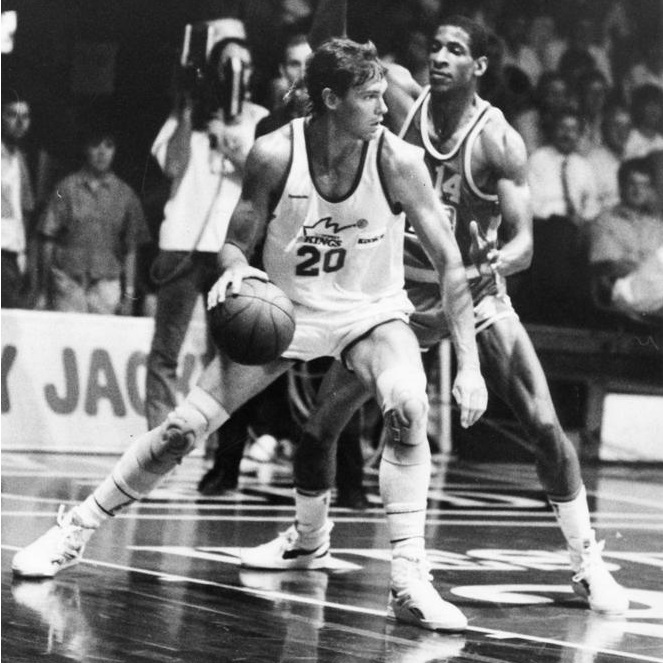
Curt Forrester made his NBL debut with the City of Sydney Astronauts on 22/2/1981. He scored 30 points in his first game.
1986
Following a frustrating 1985 campaign, the Sydney Supersonics entered 1986 in full rebuild mode. Imports Wayne Kreklow, Jerry Steurer, and Tony Wilkerson, as well as local contributors Brett Flanigan and Graham Davis, departed the team. In their place, Sydney introduced a refreshed lineup that included American centre Derrick Polk, athletic forward Audie Matthews (via Brisbane), and rising local talent Andrew Svaldenis (via Bankstown).
The Supersonics retained several key figures, including 1985 league-leading scorer Kendal “Tiny” Pinder, who returned for a second season after earning All-NBL First Team honours. Core veterans such as Wayne Burden, Curt Forrester, Scott Fenton, Darren Shaw, Zoran Zunic, Gavin Kelly, and Nick Stenstrom also returned, providing continuity and experience.
Coaching responsibilities shifted as well, with Owen Wells returning for a second stint as Supersonics head coach, taking the reins from Paul Coughter. Wells, a former NBL MVP and club favourite, was charged with leading a retooled group back into playoff contention.
Sydney’s season began with promise, notching a 99–91 road win over the Perth Wildcats. Pinder (19 points, 18 rebounds) and Polk (25 points, 13 rebounds) dominated the interior. Forrester made an early impact off the bench, scoring 10 points on 5-of-10 shooting and pulling down 4 rebounds in the season opener.
Despite the strong start, Sydney faltered through May, dropping eight of their next nine games. Narrow defeats, including an 84–85 loss to Brisbane and a 99–100 stumble against Geelong, left the Supersonics with a 2–8 record. Still, the contributions from Pinder (21.4 points, 16.0 rebounds) and Polk (21.9 points, 13.7 rebounds) kept Sydney competitive. During this period, Curt Forrester provided much-needed energy off the bench, highlighted by an 8-point, 5-rebound outing in a close defeat to Newcastle.
Coach Wells recalibrated the rotation in June, emphasizing an interior-focused offense led by Pinder and Polk, while empowering Scott Fenton to handle more playmaking duties. The shift turned Sydney’s season around. The Supersonics went 12–4 over their final 16 games, closing the regular season at 14–12 and securing 6th place on the ladder — their first postseason berth since 1983.
Sydney’s surge featured major wins, including a 117–80 demolition of Perth and a thrilling 110–109 derby triumph over the West Sydney Westars. In the Perth blowout, Forrester played one of his finest games of the season, going a perfect 5-of-5 from the floor, adding 12 points and 4 rebounds in just 16 minutes of action.
Pinder and Polk established themselves as the league’s premier big man duo, combining for over 43 points and nearly 30 rebounds per game. Complementing them were consistent scorers Wayne Burden (14.6 points), Audie Matthews (10.0 points, 6.5 rebounds), and Zoran Zunic (9.0 points).
Curt Forrester (6.3 points, 2.9 rebounds, 1.3 assists) embraced his role as a key bench contributor, providing physicality and hustle. He posted multiple standout efforts during Sydney’s mid-season run, including a 9-point, 6-rebound performance against Brisbane and 8 rebounds in a road win over Newcastle. Forrester shot efficiently throughout the season and provided occasional scoring bursts to supplement the frontcourt tandem.
Scott Fenton (6.1 points, 3.7 rebounds, 4.2 assists) emerged as the team’s lead facilitator, while Polk and Pinder continued to deliver nightly double-doubles. The Supersonics’ defensive intensity also improved, and Forrester’s ability to switch and box out added versatility in the paint.
In the playoffs, Sydney met the third-seeded Brisbane Bullets in a single-game Elimination Final. Despite strong showings from Pinder (20 points, 14 rebounds) and Polk (18 points, 12 rebounds), the Supersonics were unable to contain Leroy Loggins (28 points) and fell 100–82. Forrester added 9 points, 6 rebounds, and 1 assist in the loss, capping off a solid season of consistent contribution.
While the playoff run was short-lived, Sydney’s 1986 campaign was seen as a major step forward. Turning a 2–8 start into a finals berth highlighted the squad’s resilience, and Coach Wells drew praise for unlocking the full potential of his rotation. Forrester’s steady presence off the bench proved crucial in the Supersonics’ resurgence.
1987
In 1986, the Adelaide 36ers, led by coach Ken Cole, produced the most successful season in NBL history (24–2), winning the championship amidst significant controversy. During the season, Cole publicly admitted to smoking marijuana and was suspended by the 36ers’ board just before the Grand Final. Massive player backlash, including threats of boycott, forced his reinstatement, and he guided Adelaide to the title. Nevertheless, the club’s board—concerned about public image and sponsor reaction—terminated his contract immediately after the championship, despite strong support from fans and players.
That dismissal opened the door for the Sydney Supersonics to hire the reigning Coach of the Year. Cole replaced Owen Wells and arrived in Sydney with a reputation for flair, charisma, and winning. He quickly began reshaping the Supersonics in the image of his championship-winning Adelaide squad. His first moves included the signing of import Marc Ridlen, who replaced Kendal Pinder (to Perth), and the addition of Bruce Hope (via Geelong) to cover the scoring void left by Wayne Burden. Veteran forward Curt Forrester returned as a key frontcourt presence alongside Derick Polk, while Mike Kenny, Robert Croker, and James Hewlett filled out the rotation.
Cole’s blueprint mirrored his Adelaide model—relying on twin towers inside with Polk and Ridlen replicating the roles of Mark Davis and Bill Jones. Young guard Scott Fenton was tasked with running the point, while Curt Forrester became a stabilizing presence in the frontcourt with his toughness and rebounding.
Forrester opened the season with a solid showing in the Round 1 loss to Eastside Melbourne (98–76), contributing 14 points on 6-of-11 shooting and adding 2 rebounds in 35:20 of court time. Despite the defeat, Forrester’s efficient scoring complemented Polk (21 points, 14 rebounds) and Andrew Svaldenis (12 points, 11 rebounds) in the frontcourt. The Supersonics then dropped their second game to the West Sydney Westars (124–104), where Forrester again delivered, shooting 6-of-11 for 12 points, with 3 rebounds and 2 blocks in 32 minutes.
On May 23, Sydney broke a 1–5 start with their most impressive win of the season—a 105–98 victory over playoff-bound North Melbourne. Ridlen (31 points, 13 rebounds) and Polk (29 points, 17 rebounds) led the charge, while Forrester chipped in 11 points on 4-of-7 shooting and grabbed 12 rebounds in 39:20 minutes of action, his best rebounding performance to that point in the year.
One week later, Sydney triumphed over the West Sydney Westars (86–81) in a gritty “Battle of Sydney” encounter. Forrester contributed 8 points and 5 rebounds, providing physicality and rim protection as the Supersonics notched their only winning streak of the season. His ability to clean the glass and defend against the Westars’ bigs helped secure the club’s fourth win.
Another major highlight came on June 13 when the Supersonics stunned the third-placed Wollongong Hawks (104–90). Forrester posted 9 points on 3-of-7 shooting, grabbed 4 rebounds, and added 2 steals and 3 assists in 32:29 minutes. He played a key role defensively, guarding a rotation of bigs including Ray Borner and Jim Bateman, and helped the Supersonics control the paint alongside Ridlen (31 points, 21 rebounds) and Polk (18 points, 7 rebounds).
While Sydney continued to post strong offensive numbers, a mid-season slump followed, including consecutive losses to Canberra (142–117), North Melbourne (138–104), Geelong (102–98), and Newcastle (140–137), which effectively ended playoff aspirations. Through this stretch, Forrester remained consistent. In the 140–137 loss to Newcastle, he delivered 13 points, 9 rebounds, and 1 steal in a tight encounter, showcasing his continued value inside.
On August 22, Sydney delivered their biggest win of the year—a 129–76 thrashing of the Melbourne Tigers. Forrester scored 17 points on 8-of-12 shooting, added 5 rebounds, and recorded a block in 35:45. His frontcourt dominance, combined with Ridlen’s 36 points and Polk’s 25 rebounds, overwhelmed Melbourne. Forrester’s efficiency and ability to finish inside made him a perfect complement to Sydney’s perimeter attack and rebounding core.
He followed that up with a 17-point outing in the final game of the season on September 18, when Sydney defeated the Westside Saints 118–98 in the franchise’s farewell under the Supersonics name. Forrester shot 8-of-12 from the floor, grabbed 5 rebounds, and added a steal in 35:45. The performance was a fitting end to a strong campaign, with Forrester once again showcasing his reliability and composure in the frontcourt. Ridlen (40 points, 26 rebounds) and Polk (18 points, 21 rebounds, 5 blocks) led the way, but Forrester’s efforts were crucial in keeping the pressure on the Saints throughout.
Over 26 games, Forrester averaged (12.1 points, 4.5 rebounds, and 1.7 steals), giving the Supersonics consistent production inside. His ability to score efficiently in the paint, combined with his willingness to defend and hit the glass, provided balance to a roster heavily reliant on its imports. Forrester’s presence in the lineup allowed Cole to maintain a steady interior rotation, especially when Polk or Ridlen were in foul trouble.
Despite a final record of 9–17 and missing the playoffs, Forrester was a key contributor in several of Sydney’s best performances. His performances against North Melbourne, Wollongong, and Melbourne stood out, and he finished the season with double-digit scoring in 16 games. Alongside Ridlen (30.5 points, 16.1 rebounds), Polk (20.2 points, 12.8 rebounds, 3.0 blocks), Hope (13.0 points, 2.6 rebounds, 2.9 assists, 2.9 steals), Matthews (12.8 points, 7.0 rebounds), and Fenton (10.5 points, 4.3 assists), Forrester helped form a competitive nucleus despite Sydney’s defensive flaws and inconsistency.
Coach Cole’s final comments after the season-ending win reflected on the group’s growth: “We finally put it all together for 48 minutes.” The Supersonics closed the 1987 season—and their existence as a franchise—on a high. The following month, Sydney merged with the West Sydney Westars to form the Sydney Kings. Forrester’s 1987 campaign stood as a testament to his resilience, consistency, and value as a complementary piece in a team full of emerging stars and league-leading talent.
Curt Forrester played seven seasons in the NBL, playing for both the City of Sydney Astronauts and the Sydney Supersonics. He averaged 15.1 points, 5.6 rebounds, and 0.9 assists in 151 NBL games.
| SEASON | AGE | TEAM | TEAM RECORD | GP | MINS | PTS | REB | AST | OR | DR | STL | BLK | TO | PF | FGM | FGA | FG% | 3PM | 3PA | 3P% | FTM | FTA | FT% | TS% | EFG% | HS |
|---|---|---|---|---|---|---|---|---|---|---|---|---|---|---|---|---|---|---|---|---|---|---|---|---|---|---|
| 1987 | 0 | Sydney | 9-17 (10) | 23 | 675 | 279 | 104 | 40 | 46 | 58 | 40 | 2 | 52 | 61 | 106 | 247 | 43% | 16 | 54 | 30% | 51 | 62 | 82% | 50% | 46% | |
| 1986 | 0 | Sydney | 14-12 (6) | 24 | 0 | 150 | 70 | 30 | 36 | 34 | 30 | 3 | 33 | 50 | 68 | 140 | 49% | 3 | 14 | 21% | 11 | 17 | 65% | 51% | 50% | |
| 1985 | 0 | Sydney | 9-17 (11) | 25 | 0 | 332 | 192 | 30 | 77 | 115 | 30 | 6 | 62 | 82 | 141 | 281 | 50% | 3 | 8 | 38% | 47 | 70 | 67% | 53% | 51% | 30 |
| 1984 | 0 | Sydney | 3-21 (17) | 8 | 0 | 165 | 65 | 10 | 28 | 37 | 10 | 1 | 21 | 25 | 69 | 125 | 55% | 5 | 17 | 29% | 22 | 25 | 88% | 60% | 57% | |
| 1983 | 0 | Sydney | 19-3 (1) | 23 | 0 | 298 | 127 | 18 | 53 | 74 | 16 | 2 | 32 | 54 | 126 | 232 | 54% | 0 | 0 | 0% | 46 | 58 | 79% | 57% | 54% | 25 |
| 1982 | 0 | Sydney | 7-19 (12) | 26 | 0 | 564 | 290 | 19 | 136 | 154 | 0 | 0 | 54 | 98 | 225 | 415 | 54% | 0 | 0 | 0% | 114 | 151 | 75% | 58% | 54% | |
| 1981 | 0 | City of Sydney | 8-14 (9) | 22 | 0 | 501 | 0 | 0 | 0 | 0 | 0 | 0 | 0 | 67 | 202 | 404 | 50% | 0 | 0 | 0% | 97 | 123 | 79% | 54% | 50% | 36 | Totals | 151 | 675 | 2289 | 848 | 147 | 376 | 472 | 126 | 14 | 254 | 437 | 937 | 1844 | 50.8% | 27 | 93 | 29.0% | 388 | 506 | 76.7% | 55% | 52% | 36 |
| SEASON | AGE | TEAM | TEAM RECORD | GP | MINS | PTS | REB | AST | OR | DR | STL | BLK | TO | PF | FGM | FGA | FG% | 3PM | 3PA | 3P% | FTM | FTA | FT% | TS% | EFG% | HS |
|---|---|---|---|---|---|---|---|---|---|---|---|---|---|---|---|---|---|---|---|---|---|---|---|---|---|---|
| 1987 | 0 | Sydney | 9-17 (10) | 23 | 29.3 | 12.1 | 4.5 | 1.7 | 2.0 | 2.5 | 1.7 | 0.1 | 2.3 | 2.7 | 4.6 | 10.7 | 43% | 0.7 | 2.3 | 30% | 2.2 | 2.7 | 82% | 50% | 46% | |
| 1986 | 0 | Sydney | 14-12 (6) | 24 | 0.0 | 6.3 | 2.9 | 1.3 | 1.5 | 1.4 | 1.3 | 0.1 | 1.4 | 2.1 | 2.8 | 5.8 | 49% | 0.1 | 0.6 | 21% | 0.5 | 0.7 | 65% | 51% | 50% | |
| 1985 | 0 | Sydney | 9-17 (11) | 25 | 0.0 | 13.3 | 7.7 | 1.2 | 3.1 | 4.6 | 1.2 | 0.2 | 2.5 | 3.3 | 5.6 | 11.2 | 50% | 0.1 | 0.3 | 38% | 1.9 | 2.8 | 67% | 53% | 51% | 30 |
| 1984 | 0 | Sydney | 3-21 (17) | 8 | 0.0 | 20.6 | 8.1 | 1.3 | 3.5 | 4.6 | 1.3 | 0.1 | 2.6 | 3.1 | 8.6 | 15.6 | 55% | 0.6 | 2.1 | 29% | 2.8 | 3.1 | 88% | 60.3% | 57% | |
| 1983 | 0 | Sydney | 19-3 (1) | 23 | 0.0 | 13.0 | 5.5 | 0.8 | 2.3 | 3.2 | 0.7 | 0.1 | 1.4 | 2.3 | 5.5 | 10.1 | 54% | 0.0 | 0.0 | 0% | 2.0 | 2.5 | 79% | 57.4% | 54% | 25 |
| 1982 | 0 | Sydney | 7-19 (12) | 26 | 0.0 | 21.7 | 11.2 | 0.7 | 5.2 | 5.9 | 0.0 | 0.0 | 2.1 | 3.8 | 8.7 | 16.0 | 54% | 0.0 | 0.0 | 0% | 4.4 | 5.8 | 75% | 57.9% | 54% | |
| 1981 | 0 | City of Sydney | 8-14 (9) | 22 | 0.0 | 22.8 | 0.0 | 0.0 | 0.0 | 0.0 | 0.0 | 0.0 | 0.0 | 3.0 | 9.2 | 18.4 | 50% | 0.0 | 0.0 | 0% | 4.4 | 5.6 | 79% | 54.2% | 50% | 36 | Total | 151 | 4.5 | 15.2 | 5.6 | 1.0 | 2.5 | 3.1 | 0.8 | 0.1 | 1.7 | 2.9 | 6.2 | 12.2 | 50.8% | 0.0 | 0.0 | 29.0% | 0.2 | 0.6 | 76.7% | 55% | 52% | 36 |
| POINTS | REBOUNDS | ASSISTS | STEALS | BLOCKS | TURNOVERS | TRIPLE DOUBLES | 36 | 18 | 5 | 6 | 2 | 9 | 0 |
|---|
Forrester played college basketball at Stetson, As a freshman is not how he first appears in the Hatters archive because his first rostered season was 1975-76, when he was listed as a junior wearing No. 50 for Glenn Wilkes’ independent program and was a Des Moines, Iowa product who did not play in a counted varsity game that season while Stetson finished 17-9.
He remained with the program in 1976-77 and moved into a major on-court role for a 15-12 Stetson team that played as an independent under Wilkes, with the Hatters recording wins over Brown, Bethune-Cookman, South Carolina, South Florida, Samford, Northwestern State, Campbell, Bowling Green, Richmond, Maine and St. Xavier while playing their home games in the Edmunds Center.
In 1976-77, Forrester played 27 games for Stetson as a junior center and averaged 10.1 points, 5.3 rebounds and 2.5 assists per game while shooting 46.0 percent from the field and 77.4 percent from the free throw line, with his per-game line also showing 4.3 field goals made on 9.3 attempts, 1.5 free throws made on 2.0 attempts and 2.9 personal fouls per outing.
He returned in 1977-78 for his senior season on another Glenn Wilkes team, again competing as an independent, and Stetson went 14-13 with Forrester joining Mel Daniels, Greg Guye, Kevin Tucker, Dave Purdue and Glenn Wilkes Jr. in the main rotation.
Forrester’s senior year was his best statistical season, as he played 27 games and averaged 10.9 points, 7.2 rebounds and 2.9 assists while shooting 51.7 percent from the floor and 77.5 percent at the line, and his exact totals for the season were 119 field goals on 230 attempts, 55 free throws on 71 attempts, 194 rebounds, 77 assists, 75 personal fouls and 293 points.
His 1977-78 season placed him among Stetson’s more productive rebounders and interior scorers, and he ranked behind only Mel Daniels and Greg Guye in scoring on that roster while also standing third on the team in assists despite playing in the frontcourt.
Among the standout performances attached to his Stetson years, he had a 25-point game for the Hatters and also produced a 20-point, 10-rebound outing in a win late in the 1977-78 season as Stetson pushed above .500.
Across his 54 documented NCAA Division I games at Stetson, Forrester averaged 10.5 points, 6.2 rebounds and 2.7 assists per game while shooting 48.8 percent from the field and 77.4 percent from the free throw line.
His college record therefore breaks into three parts, with a 1975-76 roster year in which he did not play in a counted varsity game, a 1976-77 junior season in which he became a regular contributor on a 15-win independent team, and a 1977-78 senior season in which he posted career-best scoring, rebounding and assist averages for the Hatters.
Whilst we try to source as much information as we can for every player who has ever played in the NBL some information on a player profile may be missing. If you have additional information on a player you'd like us to add to a profile, please send it to us using the enquiry form below.
Submissions are then sent to info@aussiehoopla.com

