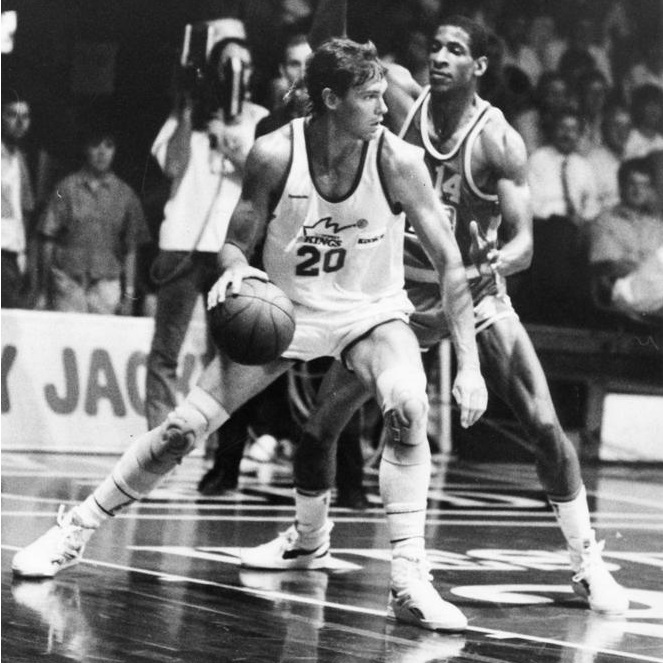
Marc Ridlen
March 19, 2021


BIO: The 7-foot Polk, a Cleveland Central Catholic graduate, played at Ohio State and 18 years professionally, including with the Harlem Globetrotters (1989-94).
Polk, who had a tryout with the Los Angeles Clippers, played overseas in Australia, Belgium and Brazil.
Derick Polk made his NBL debut with the Sydney Supersonics at 25 years of age. He scored 25 points in his first game.
Coming off a disappointing 1985 season, the Sydney Supersonics entered 1986 in full rebuild mode. Imports Wayne Kreklow, Jerry Steurer, along with local players like Brett Flanigan, Graham Davis, Tony Wilkerson all departed. To fill the void, Sydney recruited powerful American big man Derrick Polk, versatile forward Audie Matthews (via Brisbane), and young Australian Andrew Svaldenis (via Bankstown).
Last season’s leading scorer for the Supersonics, Kendal “Tiny” Pinder returned for a second NBL season after leading the league in scoring and earning All-NBL First Team honours the previous year. Veterans Wayne Burden, Curt Forrester, Scott Fenton, Darren Shaw, Zoran Zunic, Gavin Kelly, and Nick Stenstrom also returned to provide stability.
Coaching responsibilities shifted as well, with Owen Wells returning for a second stint as Supersonics coach, taking over the helm from Paul Coughter. Wells, a former NBL MVP with the Supersonics, was tasked with guiding a revamped squad back to contention.
Derrick Polk wasted no time making his presence felt, debuting with 25 points, 13 rebounds and 2 blocks in Sydney’s opening night win over Perth. He followed up with 26 points against Adelaide and 25 more against St Kilda, asserting himself as one of the NBL’s most complete interior forces. Despite Polk’s strong start, Sydney dropped eight of their next nine games, often falling just short.
Even in defeat, Polk’s productivity was elite. He poured in 28 points and 9 boards against Canberra on May 10, posted 27 and 29 rebounds in a monster effort against Geelong on May 30, and later delivered 26 points and 19 rebounds in a win over Melbourne. A 35-point outburst against Nunawading in late July was his season high.
At 2–8 entering June, the Supersonics appeared out of playoff contention. But Wells overhauled the team’s approach, focusing the offense through Polk and Pinder, while giving more control to point guard Scott Fenton. The transformation sparked a major turnaround — Sydney closed the regular season on a 12–4 run, finishing 14–12 and clinching a return to the playoffs for the first time since 1983.
Pinder (21.4 points, 16.0 rebounds, and 3.6 assists) and Polk (21.9 points, 13.7 rebounds, and 2.7 blocks) emerged as one of the league’s most dominant frontcourt tandems. Wayne Burden (14.6 points, 3.3 rebounds), Audie Matthews (10.0 points, 6.5 rebounds), and Zoran Zunic (9.0 points, 2.2 rebounds) were the other primary scorers.
Polk’s consistency and rim protection became a defining element of Sydney’s identity. He logged 12 games with 20 or more points and 10+ rebounds, including four performances with at least 18 rebounds. His defensive presence was unmatched — he averaged 2.7 blocks per game, second-best in the league.
In the Elimination Final, Polk posted 18 points and 12 rebounds against the Brisbane Bullets, but the Supersonics fell 100–82. Brisbane star Leroy Loggins (28 points) proved too much to contain as Sydney exited in the first round.
While their playoff run was brief, Sydney’s late-season surge established the team as a rising threat. Polk’s inside dominance, combined with Pinder’s all-around brilliance, gave the Supersonics one of the most feared frontlines in the NBL. Coach Wells earned praise for navigating early struggles and maximizing the team’s potential, and fans had reason to believe 1986 was just the beginning for Sydney’s rebuilt core.
1987
In 1986, the Adelaide 36ers, led by coach Ken Cole, produced the most dominant season in NBL history (24–2), claiming the championship amid off-court controversy. Cole had admitted publicly to marijuana use and was suspended before the Grand Final, only to be reinstated after strong backlash from players and fans. Though he led Adelaide to the title, the club’s board—citing image concerns—terminated his contract immediately afterward, despite being the reigning Coach of the Year.
That decision opened the door for the Sydney Supersonics to appoint Cole as their new head coach for 1987, replacing Owen Wells. Known for his flair and motivational energy, “King” Cole set about building a roster that mirrored his championship-winning Adelaide squad. He retained 7-foot import Derick Polk as the cornerstone of the frontcourt, positioning him alongside new American recruit Marc Ridlen in a “twin towers” system reminiscent of Adelaide’s Mark Davis and Bill Jones pairing. With Scott Fenton returning at point guard, Bruce Hope added on the perimeter, and young big Andrew Svaldenis developing off the bench, Cole’s blueprint was set.
Polk entered his second NBL season with high expectations his monster year in 1986. He wasted no time re-establishing his dominance in 1987, opening the season with 21 points, 14 rebounds, 2 blocks, and 3 steals in a losing effort against Eastside Melbourne (98–76). He followed it up with 24 points, 13 rebounds, and 3 blocks against West Sydney in Round 2, despite the Supersonics falling 124–104. That same game saw Marc Ridlen announce himself with 35 points and 17 rebounds, solidifying their interior tandem.
Sydney’s first win came in Round 3 over Hobart (116–105), with Polk posting 24 points and 13 boards. His best early stretch came in late May: he dropped 25 points on Wollongong, added 18 points and 14 rebounds against Canberra, and followed with a season-best 29 points, 17 rebounds, and 3 blocks in an upset win over playoff-bound North Melbourne (105–98).
Sydney’s only winning streak came shortly after, with a hard-fought 86–81 victory in the “Battle of Sydney” over West Sydney. Polk had 18 points and 7 rebounds, combining with Ridlen and Hope to control the tempo. On June 6, he tallied 27 points and 8 boards against Geelong, and a week later delivered 18 points, 7 rebounds, and 5 blocks in a 104–90 upset over third-placed Wollongong.
Polk remained consistent through midseason. He delivered 27 points and 16 rebounds against Geelong on July 11, followed by 29 points and 12 boards against Newcastle. Even in losses, his presence was immense—20 points and 16 rebounds against Brisbane, 23 points against Newcastle again, and 21 points, 12 rebounds versus Adelaide kept Sydney competitive.
His most dominant game on the glass came on August 22 in a 129–76 thrashing of Melbourne, where Polk pulled down a season-high 25 rebounds to go with 17 points. He added 14 points and 13 rebounds against Perth (Aug 28), 11 points and 12 boards against Hobart (Sept 4), and 27 points, 16 rebounds in a win over Westside the next night. Against top-tier teams, he was still elite—posting 23 points and 14 rebounds against Perth on September 11 and 12 points, 7 rebounds against Adelaide the following evening.
Sydney closed the season on September 18 with a commanding 118–98 win over the Westside Saints, their final game under the Supersonics name. Polk delivered a fitting farewell: 18 points, 21 rebounds, and 5 blocks. Ridlen added 40 points and 26 rebounds, while Forrester and Matthews chipped in 17 apiece.
Across 26 games, Polk averaged 20.2 points, 12.8 rebounds, and 3.0 blocks, with 1.0 assist and 1.0 steal per game. He ranked second in the league in total blocks (78) and was among the top five rebounders, including 5.3 offensive boards per game. His defensive impact anchored the Supersonics’ interior and created second-chance opportunities for a high-scoring Sydney offense.
He formed one half of the NBL’s most formidable frontcourt alongside Marc Ridlen, who averaged 30.5 points, 16.1 rebounds, 1.3 steals, and 1.2 blocks per game. Bruce Hope (13.0 points, 2.6 rebounds, 2.9 assists, 2.9 steals), Audie Matthews (12.8 points, 7.0 rebounds, 2.6 assists), Curt Forrester (12.1 points, 4.5 rebounds, 1.7 steals), and Scott Fenton (10.5 points, 4.1 rebounds, 4.3 assists) gave Cole a balanced supporting cast, with Fenton also leading the NBL in free-throw percentage.
Although Sydney finished 9–17 and missed the playoffs, Polk’s individual excellence never wavered. Whether dominating the paint, hitting the offensive glass, or altering shots at the rim, he was one of the NBL’s most complete big men in 1987. He anchored Ken Cole’s Adelaide-inspired system with discipline, athleticism, and a relentless motor.
In the offseason that followed, the Supersonics franchise merged with the West Sydney Westars to form the new Sydney Kings.
Derick Polk played three seasons in the NBL, playing for both the Sydney Supersonics and the Newcastle Falcons. He averaged 18.4 points, 12.6 rebounds, and 0.8 assists in 77 NBL games.
CAREER RANKINGS:
– 11th in rebounds per game.
– 8th in blocks per game.
| SEASON | AGE | TEAM | TEAM RECORD | GP | MINS | PTS | REB | AST | OR | DR | STL | BLK | TO | PF | FGM | FGA | FG% | 3PM | 3PA | 3P% | FTM | FTA | FT% | TS% | EFG% | HS |
|---|---|---|---|---|---|---|---|---|---|---|---|---|---|---|---|---|---|---|---|---|---|---|---|---|---|---|
| 1988 | 27 | Newcastle | 13-11 (5) | 25 | 905 | 325 | 283 | 10 | 113 | 170 | 14 | 63 | 53 | 85 | 136 | 255 | 53% | 0 | 0 | 0% | 53 | 75 | 71% | 56% | 53% | 35 |
| 1987 | 26 | Sydney | 8-18 (10) | 26 | 1,023 | 525 | 332 | 25 | 138 | 194 | 25 | 78 | 74 | 88 | 224 | 499 | 45% | 0 | 2 | 0% | 77 | 110 | 70% | 48% | 45% | |
| 1986 | 25 | Sydney | 14-11 (6) | 26 | 0 | 570 | 356 | 34 | 132 | 224 | 34 | 70 | 109 | 65 | 241 | 501 | 48% | 0 | 1 | 0% | 88 | 129 | 68% | 51% | 48% | Totals | 77 | 1928 | 1420 | 971 | 69 | 383 | 588 | 73 | 211 | 236 | 238 | 601 | 1255 | 47.9% | 0 | 3 | 0.0% | 218 | 314 | 69.4% | 51% | 48% | 35 |
| SEASON | AGE | TEAM | TEAM RECORD | GP | MINS | PTS | REB | AST | OR | DR | STL | BLK | TO | PF | FGM | FGA | FG% | 3PM | 3PA | 3P% | FTM | FTA | FT% | TS% | EFG% | HS |
|---|---|---|---|---|---|---|---|---|---|---|---|---|---|---|---|---|---|---|---|---|---|---|---|---|---|---|
| 1988 | 27 | Newcastle | 13-11 (5) | 25 | 36.2 | 13.0 | 11.3 | 0.4 | 4.5 | 6.8 | 0.6 | 2.5 | 2.1 | 3.4 | 5.4 | 10.2 | 53% | 0.0 | 0.0 | 0% | 2.1 | 3.0 | 71% | 56% | 53% | 35 |
| 1987 | 26 | Sydney | 8-18 (10) | 26 | 39.3 | 20.2 | 12.8 | 1.0 | 5.3 | 7.5 | 1.0 | 3.0 | 2.8 | 3.4 | 8.6 | 19.2 | 45% | 0.0 | 0.1 | 0% | 3.0 | 4.2 | 70% | 48% | 45% | |
| 1986 | 25 | Sydney | 14-11 (6) | 26 | 0.0 | 21.9 | 13.7 | 1.3 | 5.1 | 8.6 | 1.3 | 2.7 | 4.2 | 2.5 | 9.3 | 19.3 | 48% | 0.0 | 0.0 | 0% | 3.4 | 5.0 | 68% | 51% | 48% | Total | 77 | 25.0 | 18.4 | 12.6 | 0.9 | 5.0 | 7.6 | 0.9 | 2.7 | 3.1 | 3.1 | 7.8 | 16.3 | 47.9% | 0.0 | 0.0 | 0.0% | 0.0 | 69.4% | 51% | 48% | 35 |
| POINTS | REBOUNDS | ASSISTS | STEALS | BLOCKS | TURNOVERS | TRIPLE DOUBLES | 35 | 29 | 4 | 4 | 10 | 9 | 0 |
|---|
Polk played for Angra in Brazil in 1995.
Polk played college basketball at Ohio State, As a freshman he was part of an Ohio State program coached by Eldon Miller and listed as No. 55 at center, joining Buckeye teams that featured players such as Clark Kellogg, Granville Waiters, Tony Campbell, Larry Huggins, Troy Taylor and Ron Stokes.
In the 1981-82 season, Ohio State finished 21-10 overall and 12-6 in the Big Ten, tying for second in the conference and advancing to the NCAA tournament before a 48-55 first-round loss to James Madison.
Polk appeared in 8 games and made 0 starts in 1981-82, playing 14 total minutes for 1.8 minutes per game and averaging 1.3 points, 0.4 rebounds and 0.1 assists per game.
His 1981-82 season totals were 10 points, 3 rebounds and 1 assist, and he shot 5-for-6 from the field for .833 from the floor.
One confirmed early appearance came against Kentucky on December 5, 1981, when he logged 1 minute in a 62-50 Ohio State loss.
In 1982-83, Ohio State again played under Eldon Miller and went 20-10 overall with an 11-7 Big Ten record, finishing in a tie for second behind Indiana and reaching the Sweet Sixteen of the NCAA tournament.
That team opened league play by beating No. 1 Indiana 70-67 on January 8, 1983, later defeated Kansas 64-61 in non-conference play, beat Syracuse 79-74 in the NCAA tournament, and then ended its season with a 51-64 Sweet Sixteen loss to North Carolina.
Polk appeared in 14 games and made 0 starts in 1982-83, playing 37 total minutes for 2.6 minutes per game while averaging 1.7 points, 0.7 rebounds and 0.0 assists per game.
His 1982-83 totals were 24 points, 10 rebounds, 2 blocks and 5 turnovers, and he shot 10-for-19 from the field for .526 from the floor.
Across his Ohio State career from 1981-82 through 1982-83, Polk played 22 games with 0 starts and totaled 51 minutes, 34 points, 13 rebounds, 1 assist, 2 blocks and 6 turnovers.
His career averages were 1.5 points, 0.6 rebounds and 0.0 assists per game, and his career shooting line was 15-for-25 from the field for .600 overall and 4-for-6 at the foul line for .667.
Polk’s Ohio State seasons both ended in the NCAA tournament, first with a 21-win team in 1981-82 and then with a Sweet Sixteen run in 1982-83, giving him college experience on two winning Buckeye teams that remained near the top of the Big Ten standings.
Whilst we try to source as much information as we can for every player who has ever played in the NBL some information on a player profile may be missing. If you have additional information on a player you'd like us to add to a profile, please send it to us using the enquiry form below.
Submissions are then sent to info@aussiehoopla.com

