

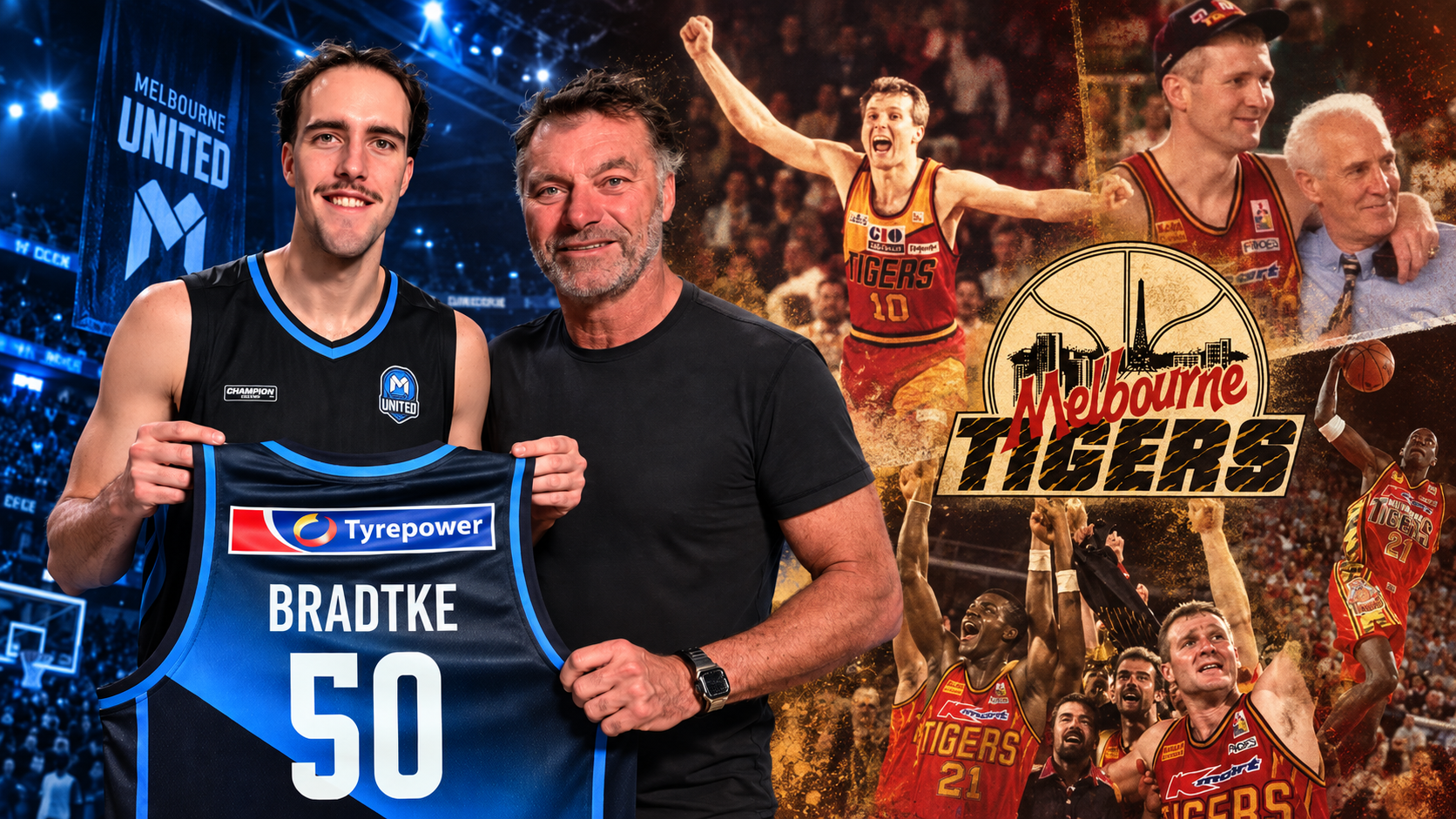
Jensen Bradtke wearing his father Mark’s famous No. 50 should be one of the great stories of NBL27. Instead, it has again exposed a question Melbourne United has never properly answered: when does Melbourne Tigers history belong to United, and when doesn’t it?
Seeing BRADTKE and No. 50 together on a Melbourne basketball jersey again should be nothing other than a celebration.
Jensen Bradtke is beginning his first season with Melbourne United, wearing the same number his father Mark wore through one of the great careers in Melbourne Tigers history. Mark’s No. 50 hangs in the rafters at John Cain Arena and United itself highlighted that fact when announcing Jensen’s signing. Melbourne United’s announcement of Jensen Bradtke’s signing.
Listen: Mark Bradtke on the Aussie Hoopla Podcast
There is another layer to the story. New United import Cole Anthony has worn No. 50 throughout his professional career because his father Greg Anthony wore it during his NBA career. But Anthony was told early that he wouldn’t be wearing it in Melbourne. Jensen would.
Anthony had no issue with that once he understood the Bradtke connection, telling Michael Randall that sharing the same father-son connection through No. 50 made the situation “pretty cool”. Mark was then brought into the club for the jersey presentation and watched his son receive the number that has hung above Melbourne games in his honour.
It is a fantastic story.
It also brings Melbourne United back to a contradiction that has existed almost from the moment the club changed its name.
Is Mark Bradtke’s No. 50 actually retired by Melbourne United?
For years, United’s official answer has essentially been no.
Yet everything about the way No. 50 has been handled in 2026 suggests the answer might now be something much closer to yes.
And if something has changed, it would be good for Melbourne United to tell its supporters exactly what it is.
There have always been two versions of Melbourne’s history
There are two perfectly defensible ways Melbourne United could treat the Melbourne Tigers.
The first is that this is one continuous NBL franchise which played as the Melbourne Tigers from 1984 until 2014 and has played as Melbourne United ever since.
Under that version, the organisation has six NBL championships. Andrew Gaze, Lanard Copeland, Mark Bradtke, Warrick Giddey, Ray Gordon and Dave Simmons are part of the club’s history. The Tigers’ retired numbers remain retired by the franchise. The colours and name changed, but the history did not.
The other position is that Melbourne United was born in 2014 as something deliberately new. The Tigers history can be acknowledged and celebrated as the history of the predecessor club, but United has its own championships, records and retired numbers beginning from the rebrand.
Either approach can work.
What shouldn’t continue is switching between the two depending on the occasion.
And there is plenty of evidence that Melbourne has done exactly that.
The original promise was not to forget the Tigers
When the Tigers were renamed on May 20, 2014, owner Larry Kestelman made it clear why the change was happening.
Kestelman said the club had found it difficult to bring the broader Victorian basketball community behind the Tigers name and believed a new identity was required.
“When we took over we had a grand total of 400 members,” Kestelman said at the time.
“We found it very difficult to unite the basketball community behind the Melbourne Tigers.”
Read Russell Gould’s 2014 report on Kestelman’s reasoning for the rebrand.
Kestelman offered the same reasoning elsewhere.
“It was never an easy decision to move away from the Melbourne Tigers name,” he said.
The aim was to provide a basketball club for supporters throughout the state and “unite as one side, with one voice”.
Read ABC’s report from the day the Melbourne Tigers became Melbourne United.
The club’s original announcement went further. Melbourne United said it was dedicated to honouring its “rich Tigers history”, while also attempting to recognise the other Victorian NBL clubs whose supporters no longer had teams.
That distinction was important. United wanted supporters of the Magic, Giants, Spectres, Saints, Dragons and Titans to feel welcome, but the Tigers history was different. Melbourne United wasn’t replacing some unrelated defunct franchise.
Read Boti Nagy’s contemporary analysis of the 2014 announcement.
Melbourne United was the Melbourne Tigers under a new name.
The club even posted at the time that becoming Melbourne United was “not turning our back on history”.
That didn’t satisfy everyone.
Andrew Gaze described losing the Tigers name as “gut-wrenching”. Copeland said he was “gutted”. The backlash wasn’t simply resistance to a new logo. For a section of Tigers supporters, there was a legitimate concern over what would happen to the history of the club they had followed.
Twelve years later, that question still hasn’t completely gone away.
Was Melbourne’s first championship in 1993 or 2018?
Perhaps the clearest example is the championship count.
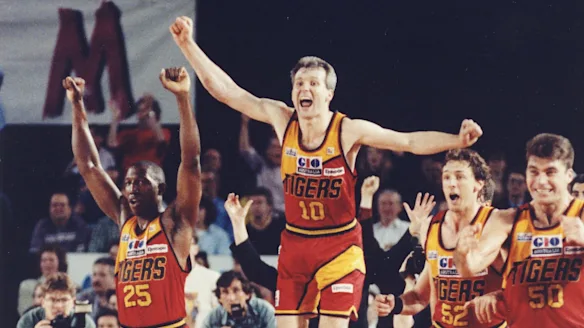
Melbourne United itself celebrated the 30th anniversary of the 1993 Melbourne Tigers championship in 2023 and described that Tigers side as the team that delivered “the organisation its first NBL championship.”
United’s CEO Nick Truelson spoke about honouring the club’s past champions, while the Tigers’ championship banners and retired jerseys were specifically referenced as part of United’s game-day environment.
Read Melbourne United’s celebration of the 1993 Tigers championship team.
That places the Tigers and United on one continuous line.
1993 was the organisation’s first championship.
Then came 1997, 2006 and 2008.
Then 2018.
Then 2021.
Six championships.
That is effectively how the NBL presents Melbourne today. Its current official team page lists the year established as “1984 (Melbourne Tigers), 2014 (Melbourne United)” and lists all six championships, separating the four won as the Tigers from the two won as United.
That is a logical way to do it.
But United has also repeatedly called 2018 its first championship.
In a retrospective specifically titled United’s first NBL Championship, the club described the 2018 Grand Final victory over Adelaide as “securing Melbourne United its first Championship”.
As recently as September 2026, United again referred to 2018 as “our first Championship” and NBL21 as “our second title”. See Melbourne United’s September 2026 reference to its first and second titles.
Both descriptions can technically be made accurate.
1993 was the franchise’s first championship.
2018 was the first championship won under the Melbourne United name.
Only a few months ago, Dean Vickerman demonstrated how easily the distinction can be made when he described 2018 as “the club’s first Championship under the United banner.”
Read Dean Vickerman’s farewell letter.
That’s clear.
The problem is that Melbourne has not always included those five important words: under the United banner.
Without them, two histories exist at once.
Nowhere is the contradiction clearer than in the rafters
In December 2021, Melbourne United tried to explain the situation itself.
The article was titled Our Banners: Why Melbourne only flies United and Tigers.
The first key statement was unequivocal:
“Melbourne United’s history is that of Melbourne Tigers after the franchise rebranded in 2014.”
The article went on to explain that Melbourne does not claim to own the history of other former Victorian franchises, which is why only Tigers and United championship banners and retired jerseys are flown.
Again, perfectly logical.
Then came the qualification.
According to United, the Tigers’ retired jerseys were only retired for the Melbourne Tigers brand, not Melbourne United.
That, the club explained, was why someone such as Matthew Dellavedova could wear Ray Gordon’s No. 8 even while Gordon’s No. 8 jersey hung overhead.
Read Melbourne United’s full explanation of its Tigers banners and retired numbers.
Think about those two statements together.
Melbourne United’s history is that of the Melbourne Tigers.
But:
Melbourne Tigers retired numbers aren’t retired by Melbourne United.
That is the contradiction.
If the history transfers, why doesn’t the retirement?
If the retirement doesn’t transfer, why are the jerseys hanging in the Melbourne United rafters?
What does a retired jersey actually mean?
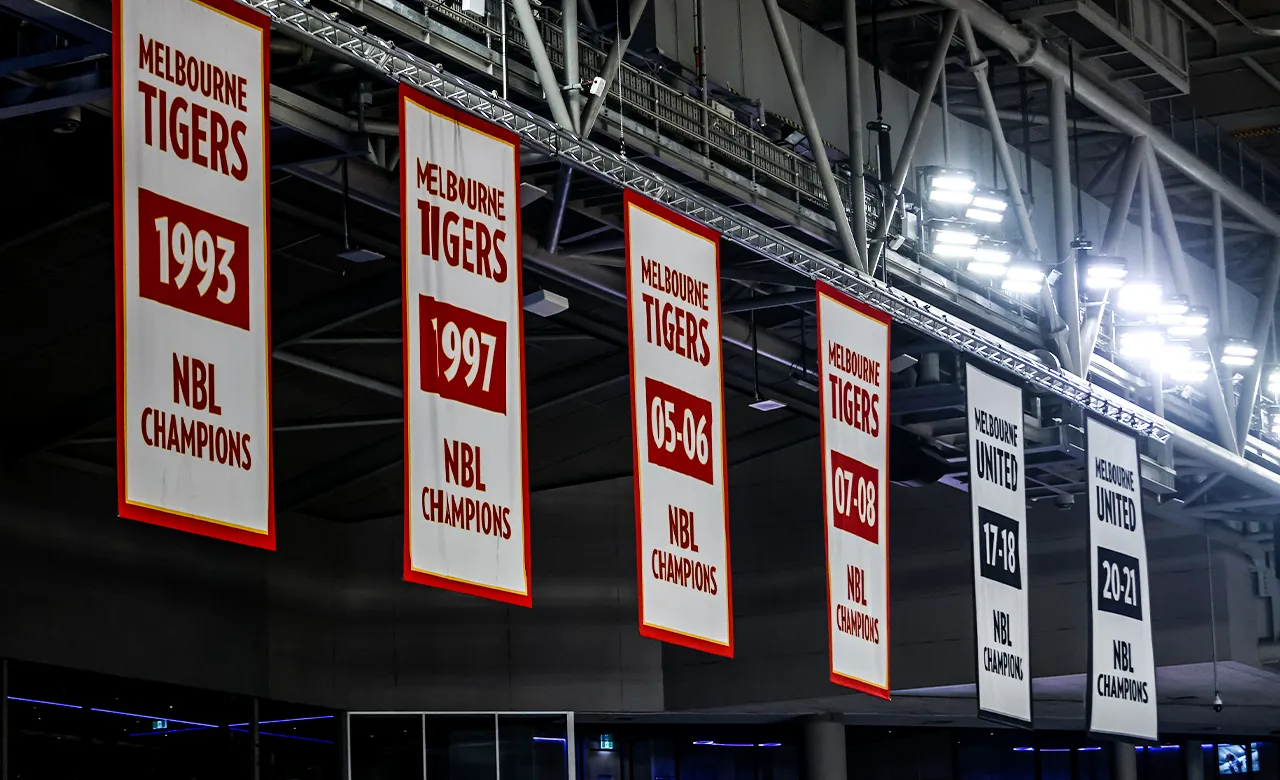
The six Tigers numbers hanging above Melbourne games belong to Warrick Giddey, Ray Gordon, Andrew Gaze, Lanard Copeland, Dave Simmons and Mark Bradtke.
The NBL itself has described those red-and-yellow banners as evidence of a Melbourne history that “can’t be bought or manufactured”.
Read the NBL’s feature on Melbourne’s history and the Tigers banners in the rafters.
Yet numbers attached to those banners have repeatedly appeared on United players.
Kyle Adnam wore Gordon’s No. 8.
Nate Tomlinson wore Giddey’s No. 6.
Ramone Moore wore Gaze’s No. 10.
Casper Ware wore Copeland’s No. 21.
No. 25, retired for Simmons, has also returned.
A petition from Tigers supporters complaining about this very issue dates all the way back to 2015. It specifically identified those examples, showing this disagreement is almost as old as Melbourne United itself.
United’s 2021 explanation later made clear that this wasn’t an oversight.
It was policy.
The numbers were retired by the Tigers, but not United.
So what has changed in NBL27?
This is what makes the events of the past week so interesting.
Sam Waardenburg is wearing No. 21 this season.
Jensen Bradtke is wearing No. 50.
United’s current roster officially lists both numbers. See Melbourne United’s current NBL27 roster.
On the surface, nothing has changed. Two more retired Tigers numbers are being used.
But the way they have been handled appears noticeably different.
According to Michael Randall’s report on the Bradtke jersey presentation, Waardenburg contacted Lanard Copeland before taking No. 21 and sought his permission.
That matters.
Copeland’s No. 21 isn’t being treated simply as an unrestricted number available because Tigers retirements don’t apply to United.
Waardenburg recognised whose number it was and spoke with him before wearing it.
The same report reveals an even more interesting situation with No. 50.
Cole Anthony wanted the number.
United told him early that he wouldn’t be able to wear it because of Jensen and Mark Bradtke.
Anthony understood and moved to No. 3.
Mark then attended the jersey presentation as his son was given No. 50.
Read the full story behind Bradtke, Anthony, Waardenburg and the retired numbers.
So what changed?
There has been no public announcement from Melbourne United that I could find overturning its 2021 position or introducing a new retired-number policy.
But the actions surrounding No. 21 and No. 50 feel different.
They suggest that, at minimum, these numbers are now being treated as something more than ordinary available uniform numbers.
Potentially, this is a long overdue step in the right direction.
Maybe this is actually the solution
There is nothing wrong with Lanard Copeland allowing Sam Waardenburg to wear No. 21.
There is certainly nothing wrong with Mark Bradtke watching his son carry No. 50 back onto the floor.
In fact, those circumstances can make a retired number even more meaningful.
The issue is the language around them.
Imagine if Melbourne simply said:
Mark Bradtke’s No. 50 is a retired number of this franchise. With Mark’s support, Jensen Bradtke has been granted the honour of wearing it.
Lanard Copeland’s No. 21 remains one of the club’s retired numbers. Sam Waardenburg approached Copeland and received his blessing to wear it.
Problem solved.
The banner still means something.
The original player is respected.
The history remains intact.
And an exceptional circumstance creates another connection between generations rather than undermining the original honour.
Maybe what we are seeing with Waardenburg and Bradtke is Melbourne beginning to move towards exactly that approach.
If so, it is a step in the right direction.
But it would be better if the club said so.
United has increasingly embraced the Tigers anyway
The strange part is that Melbourne United has moved significantly closer to embracing its Tigers history over time.
It celebrated the 1993 championship team as delivering “the organisation its first NBL championship.” Read Melbourne United’s 1993 championship tribute.
Its own website says the Melbourne Tigers ownership made the decision to “rename and refocus the club” in 2014. Read Melbourne United’s official Victorian basketball history.
The NBL currently lists Melbourne’s history beginning in 1984 and displays Tigers and United championships together. See the NBL’s Melbourne United team page.
And when Jensen Bradtke signed, United itself promoted his family history and specifically noted that Mark’s No. 50 hangs from the rafters inside John Cain Arena for all Melbourne United games.
Pick one history and own it
This doesn’t require Melbourne United to bring back the Tigers name.
It doesn’t require the club to pretend 2014 didn’t represent a major change.
And it doesn’t diminish what Melbourne United has built since then.
The rebrand achieved much of what Kestelman wanted.
United has grown into one of the NBL’s most successful organisations. It has attracted supporters who would never have followed the Melbourne Tigers. The league itself has grown enormously around it.
That success doesn’t make the old Tigers supporters irrelevant.
Nor does it resolve what belongs in the history books.
There are two coherent choices available.
Melbourne United can say it is one franchise stretching from 1984 to today. In that case, it has six championships, Tigers records form part of United’s franchise records, and Tigers retired numbers remain retired unless the honoured player approves an exception.
Or Melbourne United can say 2014 was the beginning of a separate club identity. In that case, 2018 really was its first championship, 2021 was its second and the Tigers banners are the honoured history of the predecessor franchise rather than United’s own retired numbers.
What it shouldn’t do is use both versions simultaneously.
You shouldn’t be able to call 1993 “the organisation’s first championship” in one article and 2018 “our first Championship” in another without explaining the distinction.
You shouldn’t say Melbourne United’s history “is that of Melbourne Tigers” and then say the honours bestowed during that history don’t apply to Melbourne United.
You shouldn’t hang No. 21 and No. 50 in the rafters as symbols of the club’s history while treating them as ordinary available numbers when someone wants to wear them.
And perhaps NBL27 provides the perfect opportunity to finally clear that up.
A Bradtke wearing 50 should bring people together
There is a nice symmetry to Jensen Bradtke being at the centre of this. His father joined the Melbourne Tigers in 1993, and 33 years later Jensen will run onto the floor for Melbourne wearing No. 50.
That’s what sporting history should do: connect one generation to another. Supporters who remember Mark get another connection to the current team, while younger fans learn why that red-and-yellow No. 50 hangs above them.
Perhaps the most interesting part of this week’s story isn’t that Jensen is wearing a retired number, but that Melbourne appears to be treating those numbers differently.
Waardenburg called Copeland, Anthony was told why No. 50 mattered, and Mark Bradtke was brought into the presentation.
If this represents a change in thinking from Melbourne United, potentially this is a long overdue step in the right direction. Now take the final step.
Decide whether Tigers history is Melbourne United history.
Apply that decision consistently to the championships, records, banners and retired numbers.
And after 12 years of two different timelines existing side-by-side, finally commit to one.