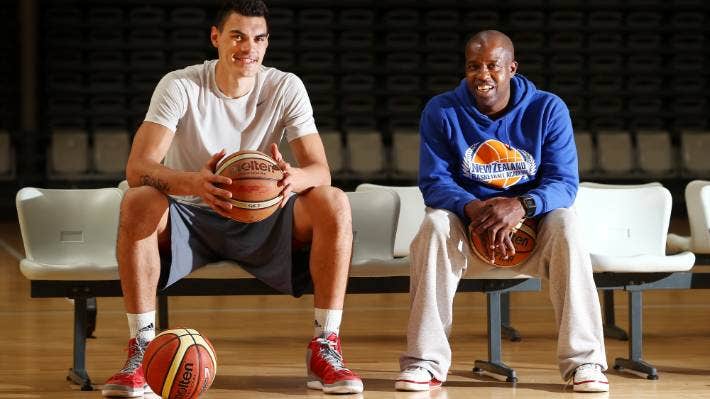
Paul Henare on the NZ Breakers’ Early Years, the Tall Blacks’ 2002 World Champs Run, and Japan’s Basketball Boom
December 13, 2024


BIO: Paul Donald Henare was born in Napier (NZ) and attended Napier Boys’ High School. He played one season of college basketball for Utah Valley State College.
Paul Henare made his NBL debut with the New Zealand Breakers at 24 years of age. He scored five points in his first game.
In March 2003, Three Waikato businessmen, Michael Redman, Dallas Fisher and Keith Ward, acquired a NBL licence for a team based in New Zealand. The inaugural Breakers roster was built from the core playing group of New Zealand’s national team, which had finished in fourth place at the FIBA World Championships six months prior.
Phill Jones, who had been the Tall Blacks leading scorer (18.2 ppg) at the World Champs, Paul Henare, Dillon Boucher, Paora Winitana and Pero Cameron (who was named team captain) formed the Breakers’ local core. The roster was then filled out with up and coming New Zealand talent like Aaron Olsen and Lindsey Tait and some Australian NBL veterans like Ben Melmeth and Brad Williams to add leadership. Lastly, Casey Frank, a long-time import in the New Zealand national league, was signed as the team’s second import.
Jeff Green was implemented as the team’s first coach and, despite the Breakers being picked by many to finish dead last, they pulled out a win in their very first NBL game against Adelaide (111-110).
After initial success, the Breakers went on to lose ten of their next eleven games (proving the pundits right) to languish near the bottom of the NBL ladder for the remainder of the season.
Twelve games into the season (2-10), Green was fired and succeeded by the team’s assistant coach Frank Arsego, who had also headed up the basketball program at the Australian Institute of Sport for the past five years. Arsego would then bring in Mike Chappell (22.7 points, 5.2 rebounds, and 1.7 assists), who finished top five in the league in both points and three-point shooting while playing in Canberra the season before. Both Casey Frank and Brad Williams would be released to make way for Chappell, who went on to lead the team in scoring and named Breakers club MVP.
Chappell’s presence delivered a mid-season resurgence where a five game winning streak towards the end of the season gave the Breakers a realistic shot of qualifying for the playoffs. Needing to win both of their final games in the final round to claim a playoff berth, the Breakers instead went winless and finished in tenth place (12–21).
Henare averaged 6.4 points, 2.6 rebounds, and 4 assists alongside teammates Jones (13.8 points, 3.9 rebounds, 1.8 assists, and 1.1 steals) and Ben Melmeth (13.4 points, 7.9 rebounds, and 2.2 assists) who were the best among the team’s local talent.
2004/05
The Breakers entered their second NBL season looking to improve on their tenth-place finish in their first year during their debut season. The Breakers moved Frank Arsego, who had replaced Jeff Green mid-season, into a permanent position as the team’s head coach. The next move was locking in the Breakers’ leading scorer and MVP from the previous season, Mike Chappell, and replacing import Casey Frank with Shawn Redhage, who had been dominating the state league (SEABL).
Ben Melmeth would return to his hometown of Newcastle to play for the Hunter Pirates. He was replaced with fellow Aussie big man Ben Pepper, whose former team, the Victoria Giants, had vacated the league due to financial issues.
To begin the season, Henare was made co-captain, alongside last year’s ‘skipper’ Pero Cameron, and despite falling short in their opening game (a re-match of the team’s first ever game against Adelaide, which they lost 94-106) they started the season by splitting the first games six games and sit within the middle of the were pack with a 3-3 record.
Although Redhage (12.2 points, 4.6 rebounds, and 1.4 assists) made a impressive start to the season, a form slump in November, which saw the team lose six of its seven games, led to Redhage’s court time being reduced and eventually his release after 13 games.
While Redhage would go on to sign with Perth and become one of the NBL’s all-time greats, his replacement came in the form of Marcus Timmons (9.3 points, 7.2 rebounds, 1.9 assists, and 1.5 steals). A clear mistake had been made there, however, as shortly after taking the court, it was clear Timmons was no longer the player he was back when he joined the Melbourne Tigers mid-season in 1997 and led them to a championship.
Chappell (18 points, 4.3 rebounds, and 2.0 assists) would lead the team in scoring for a second consecutive season, while Aaron Olson would boost his scoring from 10.8 points per game to 15.5 points per game and win the club’s MVP award at the end of the season.
Henare appeared in 32 games and averaged 7.4 points, 3.4 rebounds, and 4 assists, while the Breakers finished in eleventh place (9-23), failing to improve on their debut season.
2005/06
With the Breakers still searching for their first winning season, they chose not to re-sign Mike Chappell, the Breakers’ leading scorer from the past two seasons and appointed a new head coach Andrej Lemanis. Lemanis had played in the NBL during the 1980s and 1990s and spent the previous five seasons as a assistant coach with the Townsville Crocodiles.
Lemanis inherited a Breakers squad who had seen both its national team players, Pero Cameron (Gold Coast) and Dillon Boucher (Perth), leave for better opportunities on other NBL team’s.
Lemanis looked to build around its young turning core group, which included Aaron Olsen, Ben Pepper, Lindsay Tait and Paul Henare, who was named team captain with the departure of co-captain Pero Cameron.
Rugged defender Ben Thompson and New Zealand born Adrian Majstrovich (both via Perth) were added to the roster, as was the import duo of Rich Melzer and Brant Bailey.
The Breakers started the season poorly (1-5) and quickly made the decision to replace Bailey (18.3 points, 6.1 rebounds, and 1.9 assists) with Brian Green (18.9 points, 4.3 rebounds, 3 assists, and 1.5 steals).
Melzer (18.6 points, 7.4 rebounds, and 1.7 assists) would lead New Zealand in scoring while the Breakers continued to see strong development from young gun Aaron Olson (17.2 points, 3.2 rebounds, and 3.1 assists) and Ben Pepper (14.6 points, 10.2 rebounds, and 1.3 blocks) was a force inside the paint. Henare averaged 6.2 points, 3.1 rebounds, and 4.3 assists, appearing in all 32 of the Breakers’ games.
Lemanis’ first season in charge was not particularly memorable. During the season, the Breakers endured a team-worst eleven straight losses, but after making the personnel changes, the team split their final twelve games of the season and finished the regular season tenth out of eleven team’s (9-23).
2006/07
In his second season as head coach, Andrej Lemanis retained much of New Zealand’s 2005/06 core, with captain Paul Henare, Aaron Olson, Ben Pepper, Mika Vukona, and Tim Behrendorff all returning.
The offseason saw Dillon Boucher join Brisbane, while Rich Melzer was released after signing with the NBA’s San Antonio Spurs. The Breakers added Oscar Forman (via Adelaide) and Adam Darragh (via West Sydney) to the roster, along with two imports: former NBL MVP Brian Wethers (via Hunter) and high-scoring Carlos Powell (via NBA D-League).
New Zealand opened their campaign with a 118–97 home win over defending champions Melbourne on 2 November. Wethers led with 31 points, Powell added 28 points and 8 rebounds, Pepper had 18 points and 7 rebounds, and Henare contributed 7 points, 3 rebounds, and 6 assists in directing the offence. On 13 December, in the NBL’s first ever clash between two non-Australian teams, the Breakers went down 111–94 to Singapore despite Powell’s 43 points; Henare added 6 points, 2 rebounds, and 5 assists alongside Pepper’s 17 and 9. Later in the season, Powell scored 50 points in a close loss to Melbourne, with Henare posting 8 points, 4 rebounds, and 7 assists.
On 1 January against Sydney, Wethers suffered a fractured tibial plateau early in a 100–89 defeat. At that point, he was averaging (19.4 points, 4.2 rebounds, 2.3 assists, and 1.2 steals) over 22 games. His loss triggered a ten-game losing streak. Import guard Pierre Wooten (8.8 points, 2.3 rebounds, and 1.8 assists across 9 games) was signed as a replacement, but the Breakers struggled to fill Wethers’ scoring role.
Paul Henare (8.8 points, 3.4 rebounds, and 4.7 assists across 33 games) provided steady playmaking and defensive effort while captaining the side. Carlos Powell (28.2 points, 8.2 rebounds, and 4.0 assists) led the league in scoring, winning two NBL Player of the Month awards and the All-Star Slam Dunk Contest. Ben Pepper (15.9 points, 7.8 rebounds, and 1.2 assists) anchored the interior, Aaron Olson (12.1 points, 3.0 rebounds, and 2.5 assists) delivered in his final NBL season, Oscar Forman (10.6 points and 5.2 rebounds) added outside shooting, and Mika Vukona (5.2 points and 6.2 rebounds) brought rebounding strength.
The Breakers finished 10th with an 11–22 record, a slight improvement on their 9–23 result from the year before. Henare’s contributions in the team’s best performances and his ability to steady the offence in key moments were important factors in keeping New Zealand competitive despite injuries and mid-season struggles.
2007/08
During the 2007/08 season, Henare averaged 4 points, 2.1 rebounds, and 3.6 assists and was a part of the Breakers squad which finished in a seventh place with a record of 16-14.
2008/09
After the Brisbane Bullets fell into financial hardship and withdrew from the league, head coach Andrej Lemanis recruited free agent pair CJ Bruton (two-year deal) and former Breaker Dillon Boucher (three-year deal) to play for the Breakers with the explicit intentions to win a championship that season.
“The Breakers have proved they’re a playoff team and I’d like to help take them up to that next level,” Bruton said upon signing with New Zealand.
“I’ve seen the Breakers change their team and their culture to become more competitive. They’re serious about becoming number one and I want to be a part of New Zealand’s first championship. You don’t play this sport just to be in it.”
The duo joined the existing roster of Paul Henare, Kirk Penney, Phill Jones, Oscar Forman, Tony Ronaldson and Tim Behrendorff. The Breakers later signed import Rick Rickert and elevated development player Thomas Abercrombie into the full squad to finalise their roster.
Bruton’s signing gave the Breakers’ stability and direction at the point guard position, something that had previously been missing. Behind Bruton (16.2 points, 3.4 rebounds, 5.4 assists, and 1.7 steals) and sharp-shooting Kirk Penney (24.1 points, 4.3 rebounds, and 2.8 assists), the Breakers started the season off firing with 15 wins and 4 losses. But, the loss of Bruton to a high-ankle sprain in late December saw the Breakers stumbled through January to lose eight of their next nine games.
Heading into the playoffs with a win in their last game regular season game, the Breakers finished with a 18–12 record, setting the team up with their first ever home playoff game. New Zealand went on to win their elimination playoff, routing Adelaide (131–101) to set up a best-of-three semi final series with the defending champions Melbourne. In their first-ever semi finals appearance, the Breakers were beaten 2–0.
Henare would average 3.1 points, 1.9 rebounds, and 3 assists over the course of the Breakers’ season.
2009/10
Having achieved their first-ever playoff appearance the season prior, coach Andrej Lemanis returned with the majority of Breakers roster intact, losing only Phill Jones (to Cairns) and Tim Behrendorff (to Wollongong). Having played with one import last season, Rick Rickert, the Breakers added Dave Thomas (via Cairns) to add veteran leadership to the club but prior to the season starting, he was forced to retire from playing in the NBL due to injury. Former NBA talent Awvee Storey was then signed as his replacement and development player Thomas Abercrombie was elevated to the full squad.
New Zealand struggled through the first half of the season, mainly due to missing their leading scorer Kirk Penney (23.2 points, 5.2 rebounds, and 2.7 assists) due to a back injury that saw him sidelined for nine games. In addition to this, Storey (7.8 points, 5.1 rebounds, and 0.8 assists) fell well short of expectations and was released after nine games with the club stating ‘things weren’t working out’. John Rillie (4.3 points and 1.6 rebounds), who had been released by Townsville the season prior, signed with the club as a interim replacement and appeared in 12 games.
New Zealand was then boosted by the midseason addition of import Kevin Braswell (9.7 points, 2.1 rebounds, 5.4 assists, and 2.3 steals), who played in the Breakers final seven games, winning the last six in a row.
New Zealand’s late-season surge proved to be in vain, as the Breakers missed the playoffs during one of the closest NBL seasons of all-time. Despite New Zealand being only two games behind league leaders Perth, they would miss the playoffs and finish in fifth place (15-13).
Henare would appear in all 28 games and average 3.3 points, 1.8 rebounds, and 2.6 assists.
2010/11
In 2010, Mika Vukona returned to the Breakers after winning a championship with the South Dragons in 2009 and spending the season prior with Gold Coast. He was named team captain, taking over from Paul Henare who had assumed the role for the past six seasons. The Breakers also replaced import Rick Rickert with former Utah State standout Gary Wilkinson and re-signed point guard Kevin Braswell, who had impressed coach Lemanis after being added to the roster in the middle of the season prior. This season saw Kevin Braswell (10.2 points, 2.6 rebounds, 4.2 assists, and 1.2 steals) and 22-year-old Corey Webster, who was elevated into the Breakers’ full-time roster, eat into point guard CJ Bruton’s playing time. Bruton (11 points, 1.7 rebounds, and 1.8 assists) saw his role reduced, his minutes dropping from 32 to 25 per game, while the team became a much deeper squad.
The season began with Kirk Penney missing the start of the season while he attempted to earn a NBA contract. Failing to do that, he re-joined the Breakers after the season’s first month. Despite missing Penney, the Breakers won their first five games of the season before losing 114–74 to the Wildcat’s in Perth.
Kirk Penney (20 points, 4 rebounds, and 2.3 assists per game) would finish as the team’s leading scorer, with the Breakers finishing the regular season with a 22–6 record and Henare averaging 2.6 points, 1.5 rebounds, and 2.7 assists.
The Breakers finishing on top of the ladder saw them meet fourth-placed Perth in the semifinals. The Breakers lost game one to the Perth Wildcats at home before recovering to win the series 2–1, qualifying for their first-ever NBL Grand Final.
There, the Breakers met the Cairns Taipans in the championship series and coasted to a 85–67 win in game one after leading by as much as 31 in the third quarter. The team’s then fought out a gripping game two in Cairns. Tied 60–60 at the end of regulation and 73–73 at the end of the first overtime, it was Cairns who prevailed 85–81 to send the series to a third and deciding game. Back at home for game three on 29 April 2011, the Breakers recorded a comfortable 71–53 win to claim their maiden NBL title, becoming the first New Zealand side to win a major Australian championship. Bruton etched his name into Breakers folklore when he nailed two three-pointers in the fourth quarter of the championship-deciding game to seal the game against the Cairns Taipans, while Thomas Abercrombie collected Grand Final MVP honours.
Henare would retire after leading the Breakers to their first championship.
Paul Henare played eight seasons the New Zealand Breakers. He averaged 5.2 points, 2.5 rebounds, and 3.6 assists in 250 NBL games.
| SEASON | AGE | TEAM | TEAM RECORD | GP | MINS | PTS | REB | AST | OR | DR | STL | BLK | TO | PF | FGM | FGA | FG% | 3PM | 3PA | 3P% | FTM | FTA | FT% | TS% | EFG% | HS |
|---|---|---|---|---|---|---|---|---|---|---|---|---|---|---|---|---|---|---|---|---|---|---|---|---|---|---|
| 2010-11 | 32 | New Zealand | 22-6 (1) | 34 | 591.0 | 87 | 51 | 91 | 19 | 32 | 21 | 2 | 37 | 73 | 31 | 71 | 44% | 2 | 9 | 22% | 23 | 37 | 62% | 49% | 45% | 8 |
| 2009-10 | 31 | New Zealand | 15-13 (5) | 28 | 493.0 | 92 | 51 | 73 | 13 | 38 | 17 | 1 | 37 | 67 | 38 | 68 | 56% | 3 | 15 | 20% | 13 | 28 | 46% | 57% | 58% | 13 |
| 2008-09 | 30 | New Zealand | 18-12 (3) | 31 | 691.0 | 97 | 58 | 92 | 13 | 45 | 28 | 4 | 43 | 74 | 35 | 104 | 34% | 5 | 30 | 17% | 22 | 35 | 63% | 40% | 36% | 8 |
| 2007-08 | 29 | New Zealand | 16-14 (7) | 27 | 642.0 | 107 | 57 | 97 | 15 | 42 | 16 | 7 | 38 | 81 | 40 | 91 | 44% | 5 | 21 | 24% | 22 | 39 | 56% | 49% | 47% | 13 |
| 2006-07 | 28 | New Zealand | 11-22 (10) | 33 | 1,220.0 | 290 | 112 | 154 | 22 | 90 | 45 | 7 | 83 | 116 | 103 | 246 | 42% | 12 | 60 | 20% | 72 | 104 | 69% | 49% | 44% | 24 |
| 2005-06 | 27 | New Zealand | 9-23 (10) | 32 | 997.0 | 199 | 99 | 136 | 19 | 80 | 34 | 10 | 54 | 103 | 71 | 173 | 41% | 11 | 56 | 20% | 46 | 63 | 73% | 49% | 44% | 12 |
| 2004-05 | 26 | New Zealand | 9-23 (11) | 32 | 1,064.0 | 238 | 110 | 129 | 20 | 90 | 19 | 10 | 78 | 79 | 75 | 221 | 34% | 31 | 108 | 29% | 57 | 79 | 72% | 46% | 41% | 18 |
| 2003-04 | 25 | New Zealand | 12-21 (10) | 33 | 982.0 | 210 | 87 | 132 | 13 | 74 | 29 | 7 | 77 | 75 | 72 | 186 | 39% | 23 | 72 | 32% | 43 | 65 | 66% | 48% | 45% | 17 | Totals | 250 | 6680 | 1320 | 625 | 904 | 134 | 491 | 209 | 48 | 447 | 668 | 465 | 1160 | 40.1% | 92 | 371 | 24.8% | 298 | 450 | 66.2% | 49% | 44% | 24 |
| SEASON | AGE | TEAM | TEAM RECORD | GP | MINS | PTS | REB | AST | OR | DR | STL | BLK | TO | PF | FGM | FGA | FG% | 3PM | 3PA | 3P% | FTM | FTA | FT% | TS% | EFG% | HS |
|---|---|---|---|---|---|---|---|---|---|---|---|---|---|---|---|---|---|---|---|---|---|---|---|---|---|---|
| 2010-11 | 32 | New Zealand | 22-6 (1) | 34 | 17.4 | 2.6 | 1.5 | 2.7 | 0.6 | 0.9 | 0.6 | 0.1 | 1.1 | 2.1 | 0.9 | 2.1 | 44% | 0.1 | 0.3 | 22% | 0.7 | 1.1 | 62% | 49% | 45% | 8 |
| 2009-10 | 31 | New Zealand | 15-13 (5) | 28 | 17.6 | 3.3 | 1.8 | 2.6 | 0.5 | 1.4 | 0.6 | 0.0 | 1.3 | 2.4 | 1.4 | 2.4 | 56% | 0.1 | 0.5 | 20% | 0.5 | 1.0 | 46% | 57% | 58% | 13 |
| 2008-09 | 30 | New Zealand | 18-12 (3) | 31 | 22.3 | 3.1 | 1.9 | 3.0 | 0.4 | 1.5 | 0.9 | 0.1 | 1.4 | 2.4 | 1.1 | 3.4 | 34% | 0.2 | 1.0 | 17% | 0.7 | 1.1 | 63% | 40% | 36% | 8 |
| 2007-08 | 29 | New Zealand | 16-14 (7) | 27 | 23.8 | 4.0 | 2.1 | 3.6 | 0.6 | 1.6 | 0.6 | 0.3 | 1.4 | 3.0 | 1.5 | 3.4 | 44% | 0.2 | 0.8 | 24% | 0.8 | 1.4 | 56% | 49% | 47% | 13 |
| 2006-07 | 28 | New Zealand | 11-22 (10) | 33 | 37.0 | 8.8 | 3.4 | 4.7 | 0.7 | 2.7 | 1.4 | 0.2 | 2.5 | 3.5 | 3.1 | 7.5 | 42% | 0.4 | 1.8 | 20% | 2.2 | 3.2 | 69% | 49% | 44% | 24 |
| 2005-06 | 27 | New Zealand | 9-23 (10) | 32 | 31.2 | 6.2 | 3.1 | 4.3 | 0.6 | 2.5 | 1.1 | 0.3 | 1.7 | 3.2 | 2.2 | 5.4 | 41% | 0.3 | 1.8 | 20% | 1.4 | 2.0 | 73% | 49% | 44% | 12 |
| 2004-05 | 26 | New Zealand | 9-23 (11) | 32 | 33.3 | 7.4 | 3.4 | 4.0 | 0.6 | 2.8 | 0.6 | 0.3 | 2.4 | 2.5 | 2.3 | 6.9 | 34% | 1.0 | 3.4 | 29% | 1.8 | 2.5 | 72% | 46% | 41% | 18 |
| 2003-04 | 25 | New Zealand | 12-21 (10) | 33 | 29.8 | 6.4 | 2.6 | 4.0 | 0.4 | 2.2 | 0.9 | 0.2 | 2.3 | 2.3 | 2.2 | 5.6 | 39% | 0.7 | 2.2 | 32% | 1.3 | 2.0 | 66% | 48% | 45% | 17 | Total | 250 | 26.7 | 5.3 | 2.5 | 3.6 | 0.5 | 2.0 | 0.8 | 0.2 | 1.8 | 2.7 | 1.9 | 4.6 | 40.1% | 0.0 | 0.0 | 24.8% | 0.4 | 1.5 | 66.2% | 49% | 44% | 24 |
| POINTS | REBOUNDS | ASSISTS | STEALS | BLOCKS | TURNOVERS | TRIPLE DOUBLES | 24 | 12 | 12 | 6 | 2 | 7 | 0 |
|---|
Later, he was a part of the history making Tall Black squad, whom competed in the countries in their first Olympics tournament in 2000. Their campaign ended in a game between New Zealand and Angola to determined who finish last. Playing off for eleventh spot and neither having won a single game, New Zealand came away victorious with a 70-60 win and finished in eleventh spot.
Henare again made history, playing on the Tall Black team that not only defeated Australia to earn a spot at the 2002 FIBA World Championships, but went on to reach the bronze medal game. There, New Zealand would fall to Dirk Nowitzki led German team (94-117) to finish fourth, the countries highest finish ever at a major FIBA tournament.
He remained a part of the national program for the 2004 Olympic games. There, Tall Blacks failed to win a game in their opening pool, resulting in them facing Australia in a crossover game to determine FIBA rankings. New Zealand then lost to Australia, 98-80, in the classification matches to finish in tenth place.
Henare was a part of the Tall Blacks squad that competed at the 2006 FIBA World Championships (Japan). There, New Zealand (2–4) made it to the second round before being eliminated by Argentina (62-79). They finished the tournament tied for ninth place.
| YEAR | AGE | GP | MINS | PTS | REB | AST | OR | DR | STL | BLK | TO | PF | FGM | FGA | FG% | 3PM | 3PA | 3P% | FTM | FTA | FT% |
|---|---|---|---|---|---|---|---|---|---|---|---|---|---|---|---|---|---|---|---|---|---|
| 2006 | 27 | 6 | 157 | 40 | 11 | 16 | 1 | 10 | 9 | 0 | 11 | 13 | 15 | 25 | 60.0% | 4 | 7 | 57.1% | 6 | 12 | 50.0% |
| 2004 | 25 | 6 | 53 | 8 | 5 | 1 | 2 | 3 | 1 | 0 | 3 | 7 | 3 | 10 | 30.0% | 2 | 5 | 40.0% | 0 | 1 | 0.0% |
| 2002 | 23 | 9 | 112 | 23 | 4 | 16 | 0 | 4 | 2 | 1 | 9 | 16 | 8 | 24 | 33.3% | 3 | 9 | 33.3% | 4 | 6 | 66.7% |
| 2000 | 21 | 6 | 86 | 3 | 6 | 10 | 2 | 4 | 5 | 0 | 6 | 6 | 1 | 7 | 14.3% | 0 | 4 | 0.0% | 1 | 2 | 50.0% | Total | 27 | 408 | 74 | 26 | 43 | 5 | 21 | 17 | 1 | 29 | 42 | 27 | 66 | 41% | 9 | 25 | 36% | 11 | 21 | 52% |
| YEAR | AGE | GP | MINS | PTS | REB | AST | OR | DR | STL | BLK | TO | PF | FGM | FGA | FG% | 3PM | 3PA | 3P% | FTM | FTA | FT% |
|---|---|---|---|---|---|---|---|---|---|---|---|---|---|---|---|---|---|---|---|---|---|
| 2006 | 27 | 6 | 26.2 | 6.7 | 1.8 | 2.7 | 0.2 | 1.7 | 1.5 | 0.0 | 1.8 | 2.2 | 2.5 | 4.2 | 60.0% | 0.7 | 1.2 | 57.1% | 1.0 | 2.0 | 50.0% |
| 2004 | 25 | 6 | 8.8 | 1.3 | 0.8 | 0.2 | 0.3 | 0.5 | 0.2 | 0.0 | 0.5 | 1.2 | 0.5 | 1.7 | 30.0% | 0.3 | 0.8 | 40.0% | 0.0 | 0.2 | 0.0% |
| 2002 | 23 | 9 | 12.4 | 2.6 | 0.4 | 1.8 | 0.0 | 0.4 | 0.2 | 0.1 | 1.0 | 1.8 | 0.9 | 2.7 | 33.3% | 0.3 | 1.0 | 33.3% | 0.4 | 0.7 | 66.7% |
| 2000 | 21 | 6 | 14.3 | 0.5 | 1.0 | 1.7 | 0.3 | 0.7 | 0.8 | 0.0 | 1.0 | 1.0 | 0.2 | 1.2 | 14.3% | 0.0 | 0.7 | 0.0% | 0.2 | 0.3 | 50.0% | Total | 27 | 15.1 | 2.7 | 1.0 | 1.6 | 0.2 | 0.8 | 0.6 | 0.0 | 1.1 | 1.6 | 1.0 | 2.4 | 41% | 0.3 | 0.9 | 36% | 0.4 | 0.8 | 52% |
Paul Henare began his senior career in New Zealand with the Hawke’s Bay Hawks (1995–1997) before spending four seasons with the Auckland Stars (1998–2001), then returning to the Hawks for a second extended stint (2002–2008) and later appearing again for Hawke’s Bay in 2010.
In the 2002–03 season, Henare had a stint in Yugoslavia/Serbia with OKK Beograd, where he played five games and scored 23 total points while working under OKK Beograd head coach Nenad Vučinić, who was also involved with the New Zealand national-team program, and he was pictured during that period alongside fellow New Zealander Pero Cameron.
Henare returned to Europe in the 2005–06 Turkish league season with Banvit (Bandırma), appearing in 12 games and averaging 3.7 points, 2.3 assists, and 1.6 rebounds per game, and he shot 72.7% from the free-throw line during that stint, which also included time connected with Tall Blacks teammate Pero Cameron and coach Tab Baldwin in Bandırma.
In 2014, Henare came out of retirement in New Zealand with the Southland Sharks and was appointed temporary player-coach on 30 May 2014 during a period when the roster was affected by multiple suspensions, and he finished that season with averages of 2.9 points, 2.3 rebounds, 1.9 assists, 0.5 steals, and 0.3 blocks per game.
Paul Henare played one season of college basketball at Utah Valley State College during the 1999-00 campaign, joining the Wolverines in the Scenic West Athletic Conference and appearing in 31 games as part of an 18-13 overall season that included a 9-9 conference record.
In that 1999-00 season, Henare finished with 153 total assists (4.94 assists per game), ranking fifth among Scenic West players, while his 2.43 assist-to-turnover ratio (153 assists to 63 turnovers) ranked second among qualifying conference players.
Utah Valley State College averaged 80.4 points per game and allowed 71.4 points per game across its 31 games, and the Wolverines’ 71.4 points allowed per game led the Scenic West in scoring defense that season.
Paul Henare began his NBL coaching career as an assistant with the New Zealand Breakers from 2013 to 2015, helping the team win the 2014/15 NBL Championship under Dean Vickerman.
He was promoted to head coach of the Breakers in 2016 and led the team to the 2017/18 NBL semi-finals before stepping down in 2018 to pursue international opportunities.
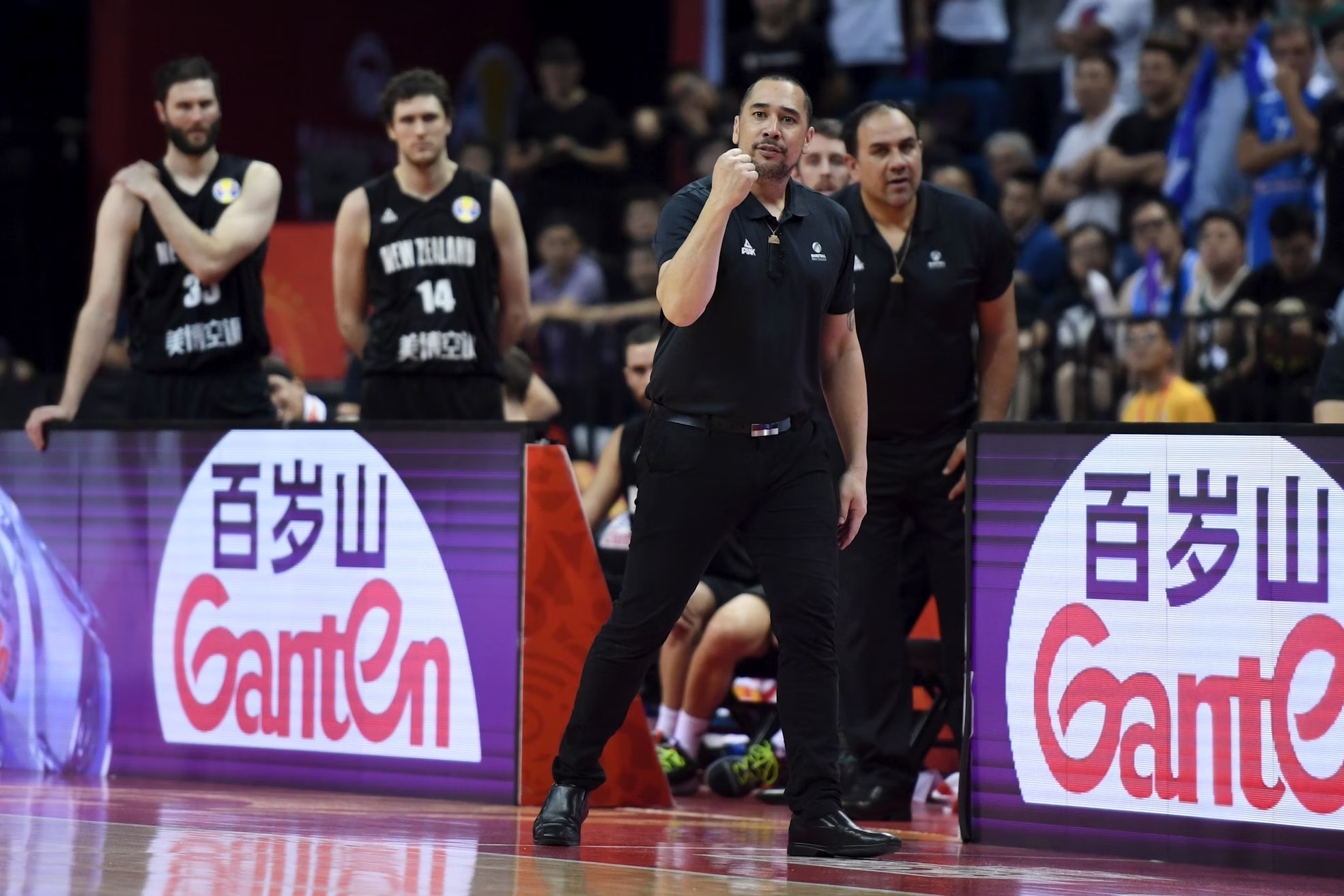
Henare also served as head coach of the New Zealand Tall Blacks from 2015 to 2019, guiding them through the 2017 FIBA Asia Cup (4th place) and qualification for the 2019 FIBA World Cup.
In the Australian NBL, Henare joined Melbourne United as an assistant coach from 2018 to 2021, again working under Dean Vickerman and playing a key role in United’s 2021 NBL Championship win.
In 2021, Henare was appointed head coach of Shimane Susanoo Magic in Japan’s B.League. He coached NBL star Nick Kay during his time there and led Shimane to one of its most successful seasons in club history in 2022/23.
Whilst we try to source as much information as we can for every player who has ever played in the NBL some information on a player profile may be missing. If you have additional information on a player you'd like us to add to a profile, please send it to us using the enquiry form below.
Submissions are then sent to info@aussiehoopla.com