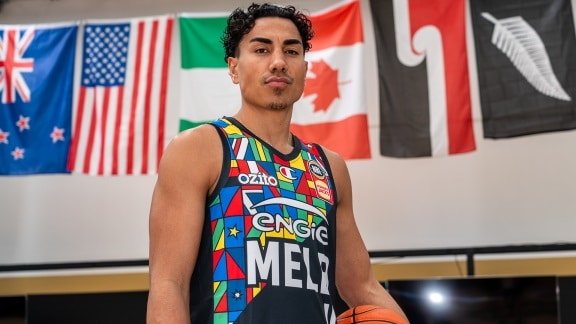
Flynn Cameron on the Tall Blacks falling short of the Olympics, what his dad means to NZ hoops and improving his game for NBL year two
July 21, 2024



BIO: Pero Cameron was born in Tokoroa (NZ).
A FIBA Hall of Fame player, Pero captained the New Zealand Tall Blacks from 2000 to 2010, helping lead New Zealand to the semi final of the 2002 FIBA World Championship, earning a All-Tournament Team selection in the process.
Pero Cameron made his NBL debut with the New Zealand Breakers at 29 years of age. He scored four points in his first game.
In March 2003, Three Waikato businessmen, Michael Redman, Dallas Fisher and Keith Ward, acquired a NBL licence for a team based in New Zealand. The inaugural Breakers roster was built from the core playing group of New Zealand’s national team, which had finished in fourth place at the FIBA World Championships six months prior.
Phill Jones, who had been the Tall Blacks leading scorer (18.2 ppg) at the World Champs, Paul Henare, Dillon Boucher, Paora Winitana and Pero Cameron (who was named team captain) formed the Breakers’ local core. The roster was then filled out with up and coming New Zealand talent like Aaron Olsen and Lindsey Tait and some Australian NBL veterans like Ben Melmeth and Brad Williams to add leadership. Lastly, Casey Frank, a long-time import in the New Zealand national league, was signed as the team’s second import.
Jeff Green was implemented as the team’s first coach and, despite the Breakers being picked by many to finish dead last, they pulled out a win in their very first NBL game against Adelaide (111-110).
After initial success, the Breakers went on to lose ten of their next eleven games (proving the pundits right) to languish near the bottom of the NBL ladder for the remainder of the season.
Twelve games into the season (2-10), Green was fired and succeeded by the team’s assistant coach Frank Arsego, who had also headed up the basketball program at the Australian Institute of Sport for the past five years. Arsego would then bring in Mike Chappell (22.7 points, 5.2 rebounds, and 1.7 assists), who finished top five in the league in both points and three-point shooting while playing in Canberra the season before. Both Casey Frank and Brad Williams would be released to make way for Chappell, who went on to lead the team in scoring and named Breakers club MVP.
Chappell’s presence delivered a mid-season resurgence where a five game winning streak towards the end of the season gave the Breakers a realistic shot of qualifying for the playoffs. Needing to win both of their final games in the final round to claim a playoff berth, the Breakers instead went winless and finished in tenth place (12–21).
Cameron averaged 9.8 points, 6.6 rebounds, and 2.4 assists alongside teammates Jones (13.8 points, 3.9 rebounds, 1.8 assists, and 1.1 steals) and Ben Melmeth (13.4 points, 7.9 rebounds, and 2.2 assists) who were the best among the team’s local talent.
2004/05
The Breakers entered their second NBL season looking to improve on their tenth-place finish in their first year during their debut season. The Breakers moved Frank Arsego, who had replaced Jeff Green mid-season, into a permanent position as the team’s head coach. The next move was locking in the Breakers’ leading scorer and MVP from the previous season, Mike Chappell, and replacing import Casey Frank with Shawn Redhage, who had been dominating the state league (SEABL).
Ben Melmeth would return to his hometown of Newcastle to play for the Hunter Pirates. He was replaced with fellow Aussie big man Ben Pepper, whose former team, the Victoria Giants, had vacated the league due to financial issues.
To begin the season, Paul Henare was made co-captain, alongside last year’s ‘skipper’ Pero Cameron, and despite falling short in their opening game (a re-match of the team’s first ever game against Adelaide, which they lost 94-106) they started the season by splitting the first games six games and sit within the middle of the were pack with a 3-3 record.
Although Redhage (12.2 points, 4.6 rebounds, and 1.4 assists) made a impressive start to the season, a form slump in November, which saw the team lose six of its seven games, led to Redhage’s court time being reduced and eventually his release after 13 games.
While Redhage would go on to sign with Perth and become one of the NBL’s all-time greats, his replacement came in the form of Marcus Timmons (9.3 points, 7.2 rebounds, 1.9 assists, and 1.5 steals). A clear mistake had been made there, however, as shortly after taking the court, it was clear Timmons was no longer the player he was back when he joined the Melbourne Tigers mid-season in 1997 and led them to a championship.
Chappell (18 points, 4.3 rebounds, and 2.0 assists) would lead the team in scoring for a second consecutive season, while Aaron Olson would boost his scoring from 10.8 points per game to 15.5 points per game and win the club’s MVP award at the end of the season.
Cameron appeared in 30 games and averaged 11.2 points, 4.8 rebounds, and 2.5 assists, while the Breakers finished in eleventh place (9-23), failing to improve on their debut season.
GOLD COAST BLAZE
2007/08
In 2007/08, Cameron averaged 10.5 points, 4.1 rebounds, and 2.2 assists as the Blaze finished with a record of 15-15 during the regular season.
2008/09
In 2008/09, Cameron averaged 6.2 points, 2.8 rebounds, and 1.7 assists as the Blaze finished with a record of 8-22 and in tenth place during the regular season.
2009/10
In 2009/10, Cameron averaged 1.8 points, 1.5 rebounds, and 0.7 assists, playing a limited role in the Blaze rotation, but was a part of the team finishing the season in third place with a 16-12 record.
Pero Cameron played five seasons in the NBL, playing for both the New Zealand Breakers and the Gold Coast Blaze. He averaged 8.6 points, 4.1 rebounds, and 2 assists in 130 NBL games.
| SEASON | AGE | TEAM | TEAM RECORD | GP | MINS | PTS | REB | AST | OR | DR | STL | BLK | TO | PF | FGM | FGA | FG% | 3PM | 3PA | 3P% | FTM | FTA | FT% | TS% | EFG% | HS |
|---|---|---|---|---|---|---|---|---|---|---|---|---|---|---|---|---|---|---|---|---|---|---|---|---|---|---|
| 2009-10 | 35 | Gold Coast | 16-12 (3) | 13 | 119.0 | 23 | 19 | 9 | 6 | 13 | 3 | 0 | 6 | 20 | 8 | 21 | 38% | 3 | 13 | 23% | 4 | 7 | 57% | 47% | 45% | 8 |
| 2008-09 | 34 | Gold Coast | 8-22 (10) | 30 | 582.0 | 187 | 84 | 51 | 21 | 63 | 12 | 4 | 32 | 77 | 62 | 148 | 42% | 30 | 87 | 34% | 33 | 45 | 73% | 55% | 52% | 20 |
| 2007-08 | 33 | Gold Coast | 15-15 (8) | 31 | 840.0 | 326 | 128 | 68 | 36 | 92 | 11 | 4 | 46 | 109 | 114 | 226 | 50% | 50 | 120 | 42% | 48 | 69 | 70% | 63% | 62% | 20 |
| 2004-05 | 30 | New Zealand | 9-23 (11) | 30 | 753.0 | 335 | 143 | 76 | 52 | 91 | 21 | 8 | 42 | 94 | 120 | 270 | 44% | 52 | 135 | 39% | 43 | 56 | 77% | 56% | 54% | 23 |
| 2003-04 | 29 | New Zealand | 12-21 (10) | 26 | 708.0 | 255 | 171 | 62 | 62 | 109 | 17 | 1 | 46 | 62 | 90 | 204 | 44% | 29 | 78 | 37% | 46 | 58 | 79% | 55% | 51% | 21 | Totals | 130 | 3002 | 1126 | 545 | 266 | 177 | 368 | 64 | 17 | 172 | 362 | 394 | 869 | 45.3% | 164 | 433 | 37.9% | 174 | 235 | 74.0% | 58% | 55% | 23 |
| SEASON | AGE | TEAM | TEAM RECORD | GP | MINS | PTS | REB | AST | OR | DR | STL | BLK | TO | PF | FGM | FGA | FG% | 3PM | 3PA | 3P% | FTM | FTA | FT% | TS% | EFG% | HS |
|---|---|---|---|---|---|---|---|---|---|---|---|---|---|---|---|---|---|---|---|---|---|---|---|---|---|---|
| 2009-10 | 35 | Gold Coast | 16-12 (3) | 13 | 9.2 | 1.8 | 1.5 | 0.7 | 0.5 | 1.0 | 0.2 | 0.0 | 0.5 | 1.5 | 0.6 | 1.6 | 38% | 0.2 | 1.0 | 23% | 0.3 | 0.5 | 57% | 47% | 45% | 8 |
| 2008-09 | 34 | Gold Coast | 8-22 (10) | 30 | 19.4 | 6.2 | 2.8 | 1.7 | 0.7 | 2.1 | 0.4 | 0.1 | 1.1 | 2.6 | 2.1 | 4.9 | 42% | 1.0 | 2.9 | 34% | 1.1 | 1.5 | 73% | 55% | 52% | 20 |
| 2007-08 | 33 | Gold Coast | 15-15 (8) | 31 | 27.1 | 10.5 | 4.1 | 2.2 | 1.2 | 3.0 | 0.4 | 0.1 | 1.5 | 3.5 | 3.7 | 7.3 | 50% | 1.6 | 3.9 | 42% | 1.5 | 2.2 | 70% | 63% | 62% | 20 |
| 2004-05 | 30 | New Zealand | 9-23 (11) | 30 | 25.1 | 11.2 | 4.8 | 2.5 | 1.7 | 3.0 | 0.7 | 0.3 | 1.4 | 3.1 | 4.0 | 9.0 | 44% | 1.7 | 4.5 | 39% | 1.4 | 1.9 | 77% | 56% | 54% | 23 |
| 2003-04 | 29 | New Zealand | 12-21 (10) | 26 | 27.2 | 9.8 | 6.6 | 2.4 | 2.4 | 4.2 | 0.7 | 0.0 | 1.8 | 2.4 | 3.5 | 7.8 | 44% | 1.1 | 3.0 | 37% | 1.8 | 2.2 | 79% | 55% | 51% | 21 | Total | 130 | 23.1 | 8.7 | 4.2 | 2.0 | 1.4 | 2.8 | 0.5 | 0.1 | 1.3 | 2.8 | 3.0 | 6.7 | 45.3% | 0.0 | 0.0 | 37.9% | 1.3 | 3.3 | 74.0% | 58% | 55% | 23 |
| POINTS | REBOUNDS | ASSISTS | STEALS | BLOCKS | TURNOVERS | TRIPLE DOUBLES | 23 | 14 | 9 | 3 | 1 | 7 | 0 |
|---|
Cameron again made history, playing on the Tall Black team that not only defeated Australia to earn a spot at the 2002 FIBA World Championships, but went on to reach the bronze medal game. There, New Zealand would fall to Dirk Nowitzki led German team (94-117) to finish fourth, the countries highest finish ever at a major FIBA tournament.
He remained a part of the national program for the 2004 Olympic games. There, Tall Blacks failed to win a game in their opening pool, resulting in them facing Australia in a crossover game to determine FIBA rankings. New Zealand then lost to Australia, 98-80, in the classification matches to finish in tenth place.
Cameron was a part of the Tall Blacks squad that competed at the 2006 FIBA World Championships (Japan). There, New Zealand (2–4) made it to the second round before being eliminated by Argentina (62-79). They finished the tournament tied for ninth place.
In 2010, Cameron led the Tall Blacks squad which competed at the FIBA World Championships. With Kirk Penney leading the team in scoring (24.7 ppg), New Zealand finished in 12th place.
Cameron captained the team at two Summer Olympic Games (Sydney 2000 and Athens 2004) and three FIBA World Cups (2002, 2006 and 2010). As a player, Pero is the only New Zealand National to be inducted into the FIBA Hall of Fame.
| YEAR | AGE | GP | MINS | PTS | REB | AST | OR | DR | STL | BLK | TO | PF | FGM | FGA | FG% | 3PM | 3PA | 3P% | FTM | FTA | FT% |
|---|---|---|---|---|---|---|---|---|---|---|---|---|---|---|---|---|---|---|---|---|---|
| 2010 | 36 | 6 | 102 | 23 | 6 | 20 | 0 | 6 | 1 | 0 | 4 | 13 | 8 | 25 | 32.0% | 5 | 16 | 31.3% | 2 | 4 | 50.0% |
| 2006 | 32 | 6 | 173 | 75 | 24 | 17 | 9 | 15 | 8 | 0 | 14 | 16 | 22 | 56 | 39.3% | 16 | 45 | 35.6% | 15 | 21 | 71.4% |
| 2004 | 30 | 6 | 181 | 65 | 26 | 13 | 5 | 21 | 6 | 1 | 11 | 23 | 22 | 51 | 43.1% | 15 | 37 | 40.5% | 6 | 8 | 75.0% |
| 2002 | 28 | 9 | 287 | 132 | 45 | 32 | 15 | 30 | 8 | 1 | 19 | 26 | 41 | 103 | 39.8% | 24 | 67 | 35.8% | 26 | 34 | 76.5% |
| 2000 | 26 | 6 | 156 | 48 | 22 | 17 | 6 | 16 | 10 | 3 | 12 | 18 | 16 | 43 | 37.2% | 10 | 27 | 37.0% | 6 | 8 | 75.0% | Total | 33 | 899 | 343 | 123 | 99 | 35 | 88 | 33 | 5 | 60 | 96 | 109 | 278 | 39% | 70 | 192 | 36% | 55 | 75 | 73% |
| YEAR | AGE | GP | MINS | PTS | REB | AST | OR | DR | STL | BLK | TO | PF | FGM | FGA | FG% | 3PM | 3PA | 3P% | FTM | FTA | FT% |
|---|---|---|---|---|---|---|---|---|---|---|---|---|---|---|---|---|---|---|---|---|---|
| 2010 | 36 | 6 | 17.0 | 3.8 | 1.0 | 3.3 | 0.0 | 1.0 | 0.2 | 0.0 | 0.7 | 2.2 | 1.3 | 4.2 | 32.0% | 0.8 | 2.7 | 31.3% | 0.3 | 0.7 | 50.0% |
| 2006 | 32 | 6 | 28.8 | 12.5 | 4.0 | 2.8 | 1.5 | 2.5 | 1.3 | 0.0 | 2.3 | 2.7 | 3.7 | 9.3 | 39.3% | 2.7 | 7.5 | 35.6% | 2.5 | 3.5 | 71.4% |
| 2004 | 30 | 6 | 30.2 | 10.8 | 4.3 | 2.2 | 0.8 | 3.5 | 1.0 | 0.2 | 1.8 | 3.8 | 3.7 | 8.5 | 43.1% | 2.5 | 6.2 | 40.5% | 1.0 | 1.3 | 75.0% |
| 2002 | 28 | 9 | 31.9 | 14.7 | 5.0 | 3.6 | 1.7 | 3.3 | 0.9 | 0.1 | 2.1 | 2.9 | 4.6 | 11.4 | 39.8% | 2.7 | 7.4 | 35.8% | 2.9 | 3.8 | 76.5% |
| 2000 | 26 | 6 | 26.0 | 8.0 | 3.7 | 2.8 | 1.0 | 2.7 | 1.7 | 0.5 | 2.0 | 3.0 | 2.7 | 7.2 | 37.2% | 1.7 | 4.5 | 37.0% | 1.0 | 1.3 | 75.0% | Total | 33 | 27.2 | 10.4 | 3.7 | 3.0 | 1.1 | 2.7 | 1.0 | 0.2 | 1.8 | 2.9 | 3.3 | 8.4 | 39% | 2.1 | 5.8 | 36% | 1.7 | 2.3 | 73% |
Cameron played for Mobil Marters Northland for the 1991 Conference Basketball League season in New Zealand, winning the CBL championship.
Cameron joined Waikato Warriors for the 1992 New Zealand National Basketball League season, playing his first season in the league and earning Rookie of the Year.
Cameron remained with Waikato Warriors for the 1993 New Zealand National Basketball League season, winning NZ Most Valuable Player and the league rebounding title.
Cameron joined Auckland Stars for the 1994 New Zealand National Basketball League season, winning NZ Most Valuable Player, Most Outstanding NZ Forward/Centre and All-Star Five selection.
Cameron remained with Auckland Stars for the 1995 New Zealand National Basketball League season, winning the championship after Auckland defeated Hawke’s Bay 80–74 and 70–57, while also earning NZ Most Valuable Player, Most Outstanding NZ Forward/Centre and All-Star Five selection.
Cameron played for Ipoh Red Eagles for the 1995–1996 season in Malaysia.
Cameron stayed with Auckland Stars for the 1996 New Zealand National Basketball League season, winning another championship and adding Most Outstanding NZ Forward/Centre and All-Star Five selection.
Cameron continued with Auckland Rebels for the 1997 New Zealand National Basketball League season, winning the championship after Auckland defeated Nelson 115–94 and 100–82, while also earning NZ Most Valuable Player and All-Star Five selection.
Cameron remained with Auckland Rebels for the 1998 New Zealand National Basketball League season, earning Most Outstanding Forward, Most Outstanding NZ Forward/Centre and All-Star Five selection.
Cameron stayed with Auckland Rebels for the 1999 New Zealand National Basketball League season, winning the championship after Auckland defeated Canterbury 79–72, while also earning NZ Most Valuable Player, Most Outstanding NZ Forward/Centre and All-Star Five selection.
Cameron joined Chester Jets for the 1999–2000 British Basketball League season in England.
Cameron continued with Auckland Rebels for the 2000 New Zealand National Basketball League season, winning the championship after Auckland defeated Nelson 95–78.
Cameron remained with Chester Jets for the 2000–2001 British Basketball League season, earning BBL Trophy final MVP as Chester defeated Newcastle 92–81.
Cameron joined Waikato Titans for the 2001 New Zealand National Basketball League season, winning the championship after Waikato defeated Wellington 112–97 and earning All-Star Five selection.
Cameron stayed with Chester Jets for the 2001–2002 British Basketball League season, winning the BBL Championship, BBL Play-offs, BBL Trophy and National Cup, with 20 points in Chester’s 93–82 Play-off final win over Sheffield and 19 points in the 112–105 National Cup final win over Birmingham.
Cameron remained with Waikato Titans for the 2002 New Zealand National Basketball League season, winning the championship after Waikato defeated Nelson 85–83.
Cameron stayed with Chester Jets for the 2002–2003 British Basketball League season, winning the BBL Trophy after Chester defeated London Towers 84–82.
Cameron continued with Waikato Titans for the 2003 New Zealand National Basketball League season, reaching the final after a 98–77 semi-final win over Auckland before an overtime loss to Wellington, 97–88.
Cameron remained with Waikato Titans through the 2004 and 2005 New Zealand National Basketball League seasons.
Cameron joined Banvitspor for the 2005–2006 Turkish Basketball League season in Turkey, averaging 8.6 points, 4.9 rebounds and 2.1 assists across 34 league games and 8.0 points, 6.6 rebounds and 1.6 assists across five FIBA EuroCup Challenge games.
Cameron stayed with Banvitspor for the 2006–2007 Turkish Basketball League season, averaging 4.9 points, 1.2 rebounds and 1.1 assists across 11 league games and making five three-pointers in an 84–58 win over Tekelspor on 24 November 2006.
Cameron joined Mahram Tehran for the 2007 Iranian Super League season in Iran, with Mahram finishing third in the 2006–2007 Iranian Super League.
Cameron returned to Waikato Pistons for the 2007 New Zealand National Basketball League season, with Waikato finishing fourth in the final standings.
Cameron remained with Waikato Pistons for the 2008 New Zealand National Basketball League season, winning the championship after Waikato defeated Wellington 95–78 and 84–79 in the best-of-three finals series.
Cameron stayed with Waikato Pistons for the 2009 New Zealand National Basketball League season, winning the championship after Waikato defeated Nelson 81–69 and 94–84 in the best-of-three finals series.
Cameron joined Gold Coast’s Queensland Basketball League program on 9 December 2015, taking over the men’s team ahead of the 2016 season. In his first QBL season, the Rollers played out of The Southport School, used Thalo Green and Lonnie Funderburke as imports, and finished 12th on the ladder with a 5–12 record.
Cameron continued with Gold Coast for the 2017 QBL season. The Rollers again played out of The Southport School, with Torrey Craig, Thalo Green and Devon Sullivan on the roster, and finished 10th with a 6–11 record.
Cameron coached New Zealand to a bronze medal result at the 2022 FIBA Asia Cup.
In 2023, Cameron joined the Brisbane Bullets as an assistant coach under Greg Vanderjagt mid-season, with both coaches stepping up after James Duncan’s departure.
Cameron was also part of Gold Coast’s NBL1 North women’s coaching staff during the 2023 season. The Rollers reached the NBL1 North women’s quarter-finals, and the regular-season bench included Cameron alongside Billy Yu and Brodie Ledgerwood across multiple games.
Cameron returned to Gold Coast as head coach of the NBL1 North women’s team for the 2026 season. His early-season staff included Billy Yu and Siarn Woods, with the Rollers continuing in the NBL1 North women’s competition.
Whilst we try to source as much information as we can for every player who has ever played in the NBL some information on a player profile may be missing. If you have additional information on a player you'd like us to add to a profile, please send it to us using the enquiry form below.
Submissions are then sent to info@aussiehoopla.com

