

Over the past few weeks we once again reached the point of the season in which trade talks and rumours dominated the narratives of the NBA. The name on everyone’s lips, twitter feed and podcast was the potentially generational talent – Anthony Davis.
With indications that Anthony Davis will almost certainly leave the Pelicans an enter free agency, teams throughout the league we clamouring to put together offers to acquire Davis, notably the biggest franchise in the league, the Lakers.
Whether the Pelicans were ever going to deal Davis to the Lakers aside, Magic Johnson and Rob Pelinka were willing to throw in the whole kitchen sink for a shot at AD. The entire young core alongside two future draft picks was all included in a staggering offer made by the Lakers. Ultimately, the Pelicans made a counteroffer the Lakers considered to be ridiculous and Davis remained with his team.
Since entering the league as the overwhelming consensus number one draft pick in 2012 Anthony Davis has been anointed as a candidate for one of the league’s best players. While this is certainly with good reason (Davis has a career average of 24 points, 10.5 rebounds and 2.5 blocks per game), the question must be posed: Can you actually win a title in the modern NBA if the number one option on your team is a big man?
Prior to the beginning of the 2017-18 season the NBA’s general managers took part in the annual league survey, encompassing a wide range of questions. When asked which player they would start their franchise with (given to the chance to start over) the player who received the highest vote total was Karl Anthony-Towns, receiving 29% of the total vote.
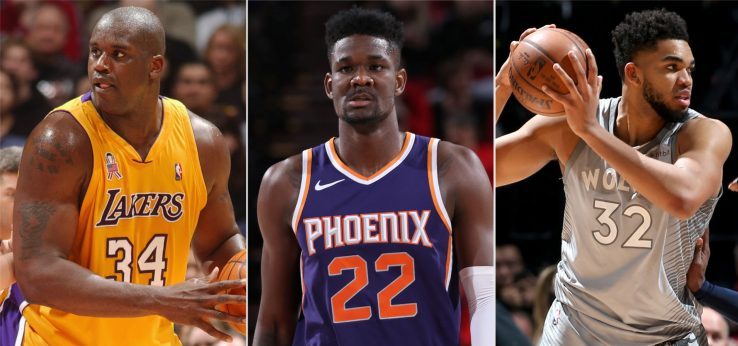
This wave of thinking was nothing new. Throughout the history of the league (and the sport overall), acquiring the ‘big man’, who plays at the Power Forward or Center spot has perpetually been the primary goal for NBA franchises. The NBA draft is littered with examples in which teams elected to select a center or a power forward over other prospects, here are a few examples;
1984 – Hakeem Olajuwon and Sam Bowie, both selected ahead of Michael Jordan
2003 – Darko Milicic – selected 2, ahead of Carmelo Anthony and Dwayne Wade
2005 – Andrew Bogut – selected 1, ahead of both Deron Williams and Chris Paul
2006 – Andrea Bargnarni W selected 1 overall
2007 – Greg Oden – selected 1, ahead of Kevin Durant
2012 – Blake Griffin – selected 1, ahead of James Harden, Steph Curry
In the 1960s and the 1970s Centers combined for a total of 18 MVP awards. In fact, in the history of the award, centers account for 26 overall. During this era, centers and power forwards dominated the MVP voting, winning every MVP but one from 1958 to 1980. The only year in which they did not win was in 1964 when it was awarded to Oscar Robertson, a guard.
The next best position in the rankings is the point guard with a total of 10 MVP awards.
In 2019 many NBA GM’s, analysts and fans alike continue to follow this same mantra. In the most recent draft the consensus number 1 selection was once again a center – the 7’1 Deandre Ayton, taken ahead of the now must watch sensation and possible all-star Luka Doncic. In a head scratching move by the Phoenix Suns, the national coach of Doncic’s home nation of Slovenia (a man who had previously coached Luka) was even hired prior to the draft. This move was still overruled it seems when Ayton was selected. The Suns, however, weren’t the only team searching for the next great big man, with 5 or the top 7 selections including Power Forwards and Centers.
Recent MVP awards indicate a shift in the dynamic of the NBA. The last time either a Power Forward or a Center won the award was Dirk Nowitzki in 2006-07. The last time a bonafide center took home the finals MVP was Shaquille O’Neal in 2002. The last big
man to feature as the focal point in a championship roster was Dirk Nowitzki in 2011.
Specifically, the recent champions and perpetual NBA finalists Cavaliers and Warriors have featured players at the Center position who are the least utilised components of their teams’ offense. Another barrier restricting the long term prospects of these players is the question of durability. As evident up to this point in this season and seasons past, centers and power forwards are perpetually prone to injury. Unfortunate long term injuries to Anthony Davis, Porzingis and Cousins, as well as constant issues surrounding the health of Joel Embid have typically been the only roadblock in the success of these otherwise phenomenal players.
When analysing the most successful teams last season, however, only 3 or 4 of the current 16 playoff teams feature a center or power forward as their primary option on offense.
Three players, however, hold the proverbial key to this question: Joel Embid, Anthony Davis and Nikola Jokic. These all NBA performers have the opportunity to buck the trend. The reason in which they can lies in their versatility, while all three can dominate down low, they possess dynamic and varied skillsets allowing them to affect the game in numerous ways. Nikola Jokic, currently leading an undermanned Denver Nuggets to the number one seed in a tough Western Conference, is a truly unique player. Perhaps one of the best passers in the game (he averages 7.5 per game) combined with the ability to score from inside and out (19 points and 10 rebounds per game), the Joker represents a changing face of the role in which a center can play in the modern NBA.
Anthony Davis and Joel Embid also possess freakish talent for 7 footers, able to score from anywhere on the court, provide an intimidating presence in the paint on defence and run the court. Along with Karl Anthony-Towns, Embid and Davis are unique blends between the traditional center and the stretch 5.
One issue that does plague each of these players is that of their ability to be used as the number option late in games. The inability to create shots off the dribble in late game situations has negatively affected each player’s respective teams – evident as a case in point in many 76ers games including the 76ers Celtics playoffs series last season.
Simply put, these players do not have the skill-set and athleticism displayed by the likes of a Steph Curry, Kyrie Irving, James Harden, Lebron James and Kevin Durant. This (disappointingly) disallows them from being effective in the clutch moments.
Past players, coaches and fans alike regularly express a desire for the NBA to return to the days of back to the basket post up dominance seen in decades past. Many yearn for the return of a reborn Shaq, Wilt, Kareem or Patrick Ewing.
If the modern style big man can overcome the current trend and win a championship as the best player on their team then this argument can be questioned. Until then, however, it will definitely still be up for debate.