

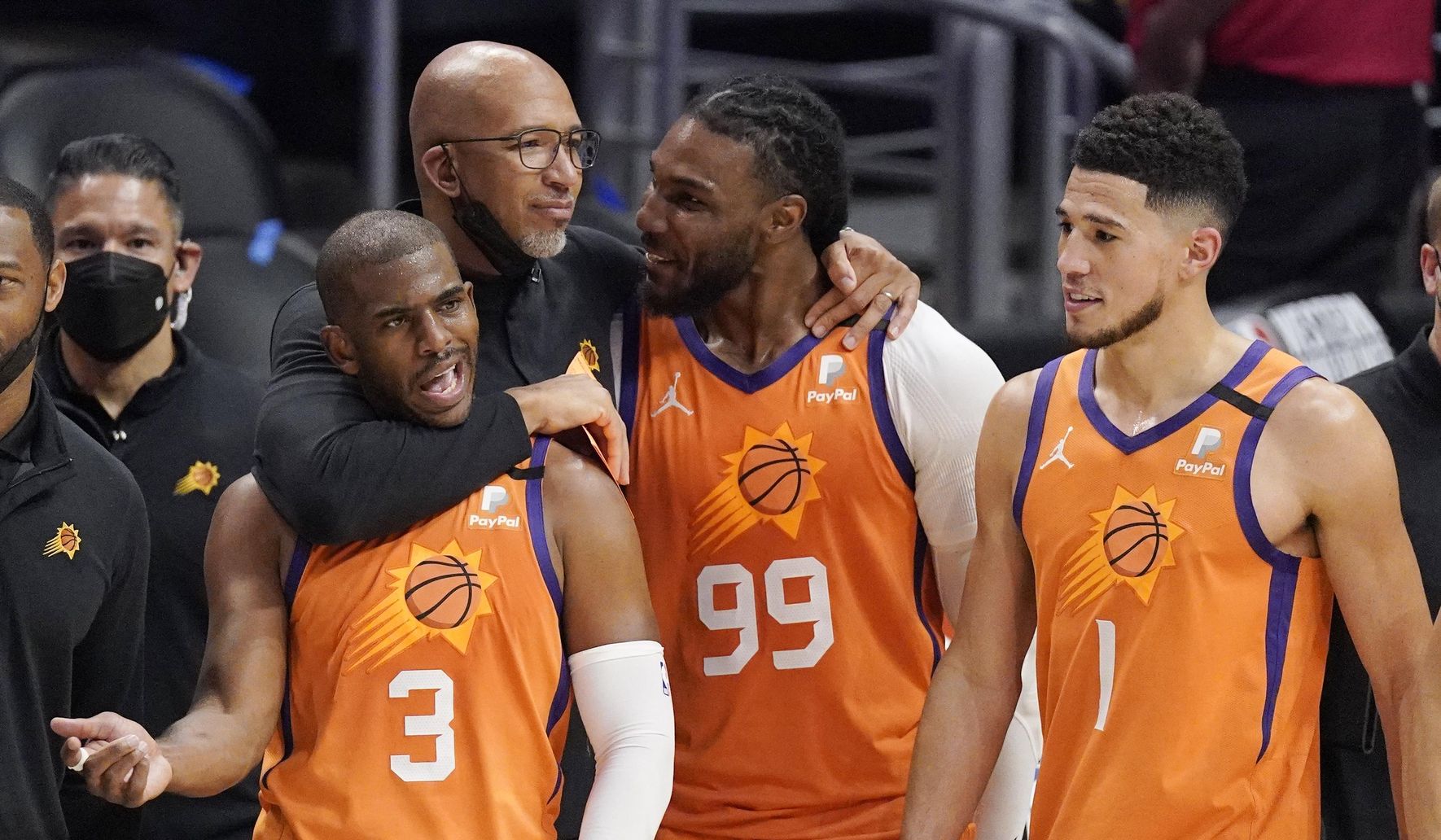
The Phoenix Suns have reached the NBA Finals for the first time in 28 years. This year, unlike any other before it, the Suns has what they believe is their competitive advantage – emotional intelligence.
Jeff Bower, the team’s Senior VP of Basketball Operations has credited a program developed by Sydney based company Genos International as an integral part of the team’s recent success.
Dr Ben Palmer, CEO of Genos International, who developed the program Bower implemented, originally developed this framework from working with the Hawthorn Football Club and Adelaide Thunderbirds here in Australia. Palmer acknowledges that Emotional Intelligence is something many elite sporting teams are now looking at in order to achieve the 1% advantage against the competition.
“The thing about relationships and enhancing them helps you lead a happier, healthier and longer life and it’s becoming increasing proven to increase elite performance,” says Palmer.
Sports is perhaps unlike any other occupation. It’s filled with emotions for all involved, from players, their families and the fans. You could even argue that creating emotions for fans is one of the fundamental jobs of professional sports.
As the world realises the importance of mental health, sporting teams have begun to increase their focus on mental health, and Palmer says he’s never been busier as more and more elite sports teams realise how big a role it plays within success.
What bigger example can you get than Australia’s best female player Liz Cambage deciding she had to remove herself from the Olympic team as a result of mental health issues which needed addressing.
View this post on Instagram
Australian Boomers head coach Brian Goorjian for many years has also told his teams “we can only control the controllable”. This is something Bower agrees with but notes that players and people have more control than they realise.
“We’re only going to worry about what we control, but we can control an incredible amount of things when you consider how you think, the strategies you use to process situations, how you feel, how you talk, your self talk, your language, how that makes you feel, how that makes you act and does all that drives you to the outcome that you want.” said Bower.
Bower noted people really do have control over a lot more things than what they think they do, and ignoring those areas of one’s life is easy to slip into because it’s safer or easier. As a result, the Suns began to study a number of underperforming NBA teams, failed businesses and case studies on failure to uncover common trends and how to avoid them.
Through the Genos Certified Practitioner program, Bower and the Suns found, that many failed NBA teams and businesses encountered situations, where people involved, didn’t have a clear outlook or understanding of success. Failures often included players or coaches misreading or misinterpreting what was said to them, things that went on to create the exact opposite reaction than what was actually intended.
“Everything we do in sports is all about the human touch and the relationships that get built and the relationships that get stressed over time that add up to peak performance or failed performance in many cases. This is something I thought could be of extreme benefit to us and all the people we work with and around the game,” Bower said.
“We deal with the elite and driven, and many times how a problem or conflict is presented determines how people respond to it. Skills that help athletes find the answer and nudge them along the way whether through realising the reasons behind the emotions or having a little more empathy in the situation towards how it might make the individual feel. “
The more the Suns looked at these failures, the more it becomes obvious that the team’s success lies in the direction of improved communication and having a clear outlook. Something Palmer refers to as Emotional Reasoning. For over 15 years Palmer has helped overcome these issues for professional sports teams in Australia like the Hawthorn Football Club and the Adelaide Thunderbirds Netball team as well as and countless businesses in Australia and overseas.
“This is the skill of stepping back and thinking about emotions and the information in emotions and using that information strategically with facts and figures,” said Palmer.
“When you look back at it, it’s often the fact that those players are playing for something more than just winning, and those players had a bond between them where their effort, the amount of work invested into the foundation is generally something they don’t want to fail on be it their teammate, their family or fans and that comes into play a lot from an emotional standpoint. What ends up driving them is I don’t want to let me teammates, or coach or these people who care about us so much from an emotional standpoint.”
The Phoenix Suns have put an incredible amount of focus on lifting the emotional intelligence of all operational staff and those that work with the players to help improve both the organisation and player performance. The results are now on display for the world to see.
In the corporate world, Palmer says generally they will see a 5%-15% improvement, but within sport, even if it delivers a 1% improvement, it can be the difference between winning and losing, especially in the NBA. Jeff Bower notes that the improvement has been a huge part of the team’s journey to the NBA Finals this season.
“It’s been a great process, we have a coaching staff whose actions and behaviours they’ve built with our team have really been the driving force behind our improvement. The trust that exists between our players and coaches, they exist in our locker room from player to player, has really been our strategic weapon. It’s been a competitive advantage for us as a group and something we’ve benefited from greatly… and it’s happened quickly for us over the past couple of years, but there has been a lot of investment and a lot of hard learning and growing in the years leading up the now.” said Bower.
With NBA players moving from team to team quite frequently, Bower notes this is one of the toughest hurdles to maintaining a high emotional intelligence within a team. He cites the important thing is to know as a team who you want to be and what your teams make-up is going to be all about.
It makes sense that if you want a team that spreads the floor well, you recruit good three-point shooters, if you want a defensively tough team you recruit tough nose defenders.
“What we’ve found over the years is changing the behaviours of a player so that he will be different for you rarely ever happens. So finding players that fit the DNA of your team, the culture and your values as an organisation is such a crucial part of this. Whenever you bring a new player into the group basically what you’re saying as an organisation is this is who we want to be and this new guy he fits, and that’s something we spend a lot of time on.” said Bower.
Emotion is a part of every decision in outcome in humans and sport. Emotion is part of every action and reaction and learning how to use that emotion towards a player benefit is incredibly valuable. Ben and his team at Genos International develop ways that can help players identify and understand the extent of how they are being impacted by their feelings and emotions, before looking at ways to alter their thinking and decision making to improved performance.
“Self-management is really something that can predict players performance. Players who were better able to manage and regulate emotions were coping better with the sledging on the football and netball field.” Said Palmer.
“Those who work with players use their emotional intelligence to get the best out of players. It’s something I think we all understand and resonate with. I think anyone who has seen the film Remember the Titans will agree with the importance of coach-player relationships. The work we’re doing at Genos International is really about helping people within the organisation improve their self-awareness, so they had a better impact on those around them”.
The Genos Certification Program helped Bower facilitate and improve empathy among Suns players enabling them to relate to each other better and understand the different circumstances of others better.
The Suns incorporated what’s known as an emotional expression into team meetings so that people could open up more and speak more about trials and tribulations they are facing in and outside of basketball. A problem shared is a problem halved after all. This involved improving self-management capabilities so that people learn to manage their own emotions more effectively.
These capabilities (self-awareness, empathy, authentic expression and self-management), whether on or off the field, on or off the court, help improve the way all people involved in professional sports think and the decisions they make; connect, communicate and collaborate with each other, and ultimately the way coaches, players and all those who work with them perform.
“I really feel that this is where the analytics movement was 15 years ago. How that has become a way of life in sports I believe human performance and EI and mind setting and the ability to take a proactive approach on mind setting strategies to allow yourself to be more successful is where the NBA is going to go and where the next advantage really lies” said Bower.
Listen to Jeff Bower’s comments on the EI at Work podcast.