

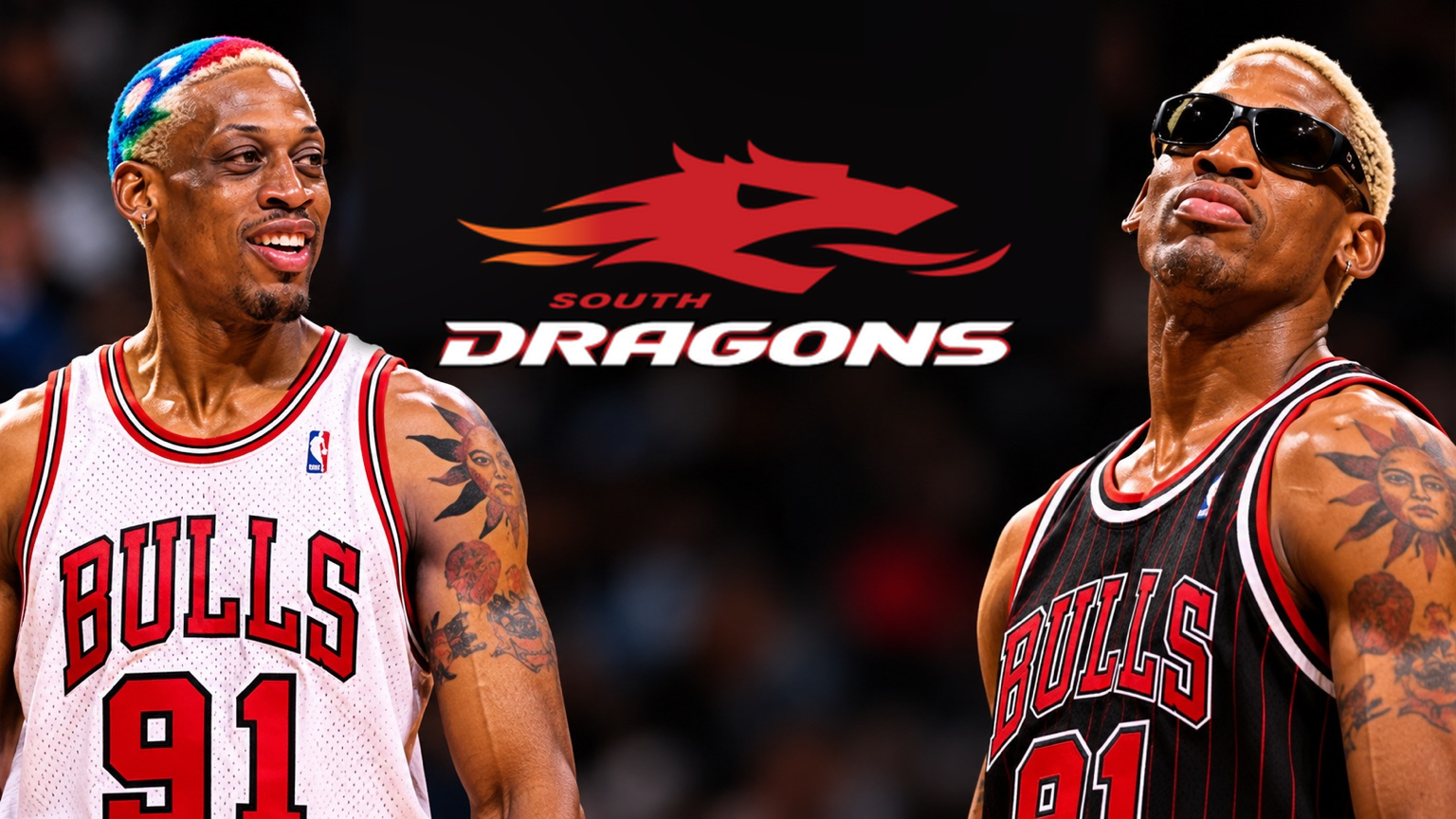
On a previous episode of the Aussie Hoopla podcast, former South Dragons CEO and majority owner Mark Cowan revealed how close the franchise came to bringing five-time NBA champion Dennis Rodman to Australia, and why the deal ultimately fell through.
“He was coming over for a poker tournament and I heard about it and I just thought, ‘Let’s get in touch with him,’” Cowan recalled.
“And we actually got his signature.”
While the media reported on the possibility of the seven-time NBA rebounding champion playing in Australia, Cowan revealed that negotiations had progressed well beyond that. Even the finer details of his appearance had been agreed upon.
“We agreed how long he’d do signing of autographs after and how many minutes he had to play and all that stuff. It was all done.”
Why the Dennis Rodman deal fell through
Media reports in 2007 suggested the Dragons were prepared to pay Rodman $80,000 for a one-off preseason appearance against the Sydney Kings.
Despite reaching an agreement with Rodman, Cowan said he faced opposition from the NBL. The league felt Rodman would not be good for the game and pressured the Dragons to withdraw from the arrangement.
It’s thought the NBL was wary of Rodman due to his long history of off-court controversy, which included a controversial appearance on Britain’s Celebrity Big Brother some 12 months prior.
Rodman had attracted headlines during his time on the show for his lewd behaviour and clashes with other housemates.
Cowan resisted the pressure for several days before eventually relenting.
“It went on for several days ’cause I resisted and then I folded and said, ‘Okay, we’ll withdraw it.’”
Although Cowan did not believe the league had the power to veto the signing, the Dragons were a young franchise. He felt he had to pick his battles with the NBL.
“I think everyone would’ve loved to see him, and I disagree that he would’ve been bad for the game.”
A missed opportunity to reshape Australian basketball
Signing Rodman was part of a much bigger vision for the Dragons. Cowan wanted to restore basketball’s popularity in Melbourne by making the game as much an entertainment event as a sporting contest.
The Dragons had already made their intentions clear, recruiting former NBA All-Star Mark Price as their inaugural coach, bringing Shane Heal out of retirement and signing future NBA veteran Joe Ingles as the franchise’s first player. Rodman’s arrival would have taken that ambition a step further, but Cowan saw the opportunity as something that could benefit the entire league.
“It wasn’t even about, you know, the Dragons,” Cowan explained.
Looking at the NBL today, the irony is that Cowan was pursuing many of the same ideas that Larry Kestelman would later use to revitalise the competition.
His ambition was not simply to build a winning basketball team, but to show how Australian basketball could become a commercially successful entertainment product.
“Our original intention was really to help save basketball,” Cowan explained.
“I think we set the blueprint in a lot of ways for what the league is now.”
The proposed signing of Rodman was an early example of that approach. Under Kestelman, bringing internationally recognised basketball personalities to Australia has become a regular part of promoting the NBL’s biggest events.
In 2023, Rodman’s former Chicago Bulls teammate Scottie Pippen attended the NBL season opener alongside Luc Longley.
In 2024, Carmelo Anthony and Kenny Smith headlined the inaugural HoopsFest, followed by Allen Iverson in 2026.
Four-time NBA All-Star DeMarcus Cousins has been announced for HoopsFest 2027.
While these stars have been brought to Australia to promote the league rather than play in it, the principle is much the same as the one the NBL’s front office resisted in 2007: using NBA star power to attract new audiences and generate publicity for Australian basketball.
The parallels extend beyond celebrity appearances. Long before the NBL’s revival under Kestelman, Cowan was advocating for greater investment in marketing, marquee players, three imports, improved television coverage and a more fan-friendly schedule.
Perhaps most telling was Cowan’s belief that, had the league been under Kestelman’s leadership during the Dragons’ existence, the franchise might never have disappeared.
“If Larry had been around and it was like it was now, we would still be there. There’s no doubt.”
The Rodman deal illustrated exactly what Cowan had in mind. He imagined the appearance making the front page of the Herald Sun and fans buying South Dragons jerseys bearing his name. Whatever his reputation off the court, Rodman’s accomplishments on it were undeniable.
“Whatever you think of him or of his, of him as a person, like, as a player, you know, you’ve only got to admire him.”
That same notoriety had already proved attractive to another basketball club. Following Rodman’s eviction from Celebrity Big Brother in 2006, Britain’s Brighton Bears signed him in the hope that his celebrity would boost ticket sales. It was the kind of opportunity Cowan had recognised for Australian basketball.
The Dragons would go on to win the NBL championship two years later before departing the competition. Rodman, however, never pulled on a Dragons jersey.
Almost two decades later, Rodman’s proposed appearance remains one of the great what-ifs of NBL history.
While Cowan takes pride in what the Dragons contributed to Australian basketball, he still regrets his decision to abandon the Rodman deal. Having already secured the NBA star’s signature, he wishes he had stood his ground when the league pressured him to withdraw.
“Shouldn’t have backed down,” Cowan admitted.
The Dragons never got their night with Rodman, but the kind of spectacle Cowan had envisioned has since become a feature of the modern NBL.
Listen to the full interview with Mark Cowan on the Aussie Hoopla podcast, where he discusses the formation of the South Dragons, recruiting Joe Ingles, winning the 2009 NBL championship and the franchise’s eventual departure from the league.