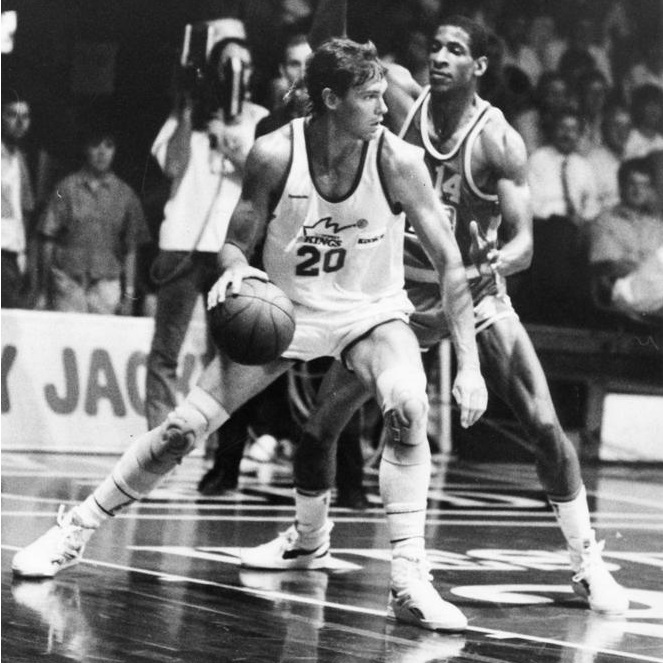
Larry Davidson (Born 1958)
March 31, 2025


BIO: Jim Bateman was born in Los Angeles, California (USA).
Jim Bateman made his NBL debut with the Newcastle Falcons at 24 years of age. He scored 20 points in his first game.
The 1984 season marked the beginning of a new era for the Newcastle Falcons, with club legend and all-time leading scorer Dave Ankeney stepping into the head coaching role following the departure of Denis Kibble. Looking to build around rising local star Michael Johnson—who had broken out in 1983—Ankeney reshaped the roster, bringing in imports Jim Bateman and Jerry Dennard to replace George Morrow and Donnie Cruse. The move added athleticism and frontcourt depth, with Bateman anchoring the paint as a scoring and rebounding force.
Newcastle stormed out of the gates, stringing together five consecutive victories to start the season, including a statement 91–80 home win over the undefeated Brisbane Bullets (6–0). The Falcons quickly emerged as a contender, locking horns with Brisbane and Coburg in a tight race for Eastern Division supremacy.
Jim Bateman was a revelation in his debut NBL campaign. The 6’8” American big man averaged 24.6 points, 9.0 rebounds, 1.8 assists, 1.4 steals, and 0.7 blocks over 26 games—providing consistent interior scoring and rebounding, while holding his own defensively against the league’s best. He formed a dynamic core alongside Michael Johnson (21.8 points, 4.7 rebounds, 2.8 assists) and veteran shooter Ian Davies (19.1 points, 4.7 rebounds, 2.9 assists), giving Newcastle a formidable inside-outside attack.
Supporting that trio were Jerry Dennard (15.7 points, 8.8 rebounds, 2.7 steals) and Ian Robilliard (12.5 points, 5.0 rebounds, 4.4 assists, 2.7 steals), with both players finishing among the league leaders in steals. The team’s commitment to defence and transition scoring kept opponents under pressure for four quarters.
Heading into the final three rounds, the Falcons were neck and neck with Brisbane and Coburg atop the standings. However, a costly 129–117 road loss to Adelaide proved decisive. Brisbane surged to finish 19–5, while Coburg and Newcastle both ended 18–6. With their season series split 1–1, Coburg secured second spot via a +4 point differential, relegating Newcastle to the third seed and a sudden-death route through the finals.
In the elimination final, Bateman powered Newcastle to a 108–101 win over Illawarra, contributing 21 points, 12 rebounds, and 1 block. He was well supported by Davies (26 points, 6 rebounds, 2 steals), Johnson (23 points, 8 rebounds), and Robilliard (21 points, 10 rebounds) as the Falcons shot 44% from the field and won the rebound battle 48–42.
The following night, however, Newcastle’s season came to a crushing end in the semi-finals. Despite 15 points from Bateman, 29 points and 11 rebounds from Johnson, and 24 points and 10 boards from Davies, the Falcons were outgunned by Coburg 132–109. Led by Wayne Carroll (29 points, 7 assists), the Giants shot 46% and converted 25-of-29 free throws to seal the win.
Even with the abrupt finish, 1984 was a historic year for both the Falcons and Jim Bateman. The team notched a franchise-best 18–6 regular season record and won their first playoff game, while Bateman’s dominant debut campaign solidified his status as one of the top big men in the NBL.
1985
Coming off a breakout 1984 campaign that saw the Newcastle Falcons make their first-ever playoff appearance, head coach Dave Ankeney returned in 1985 with the majority of the core group intact. The only significant roster change was import forward Scott Horrell replacing Jerry Dennard, who had moved on to Illawarra.
Newcastle opened their season in style, defeating the Sydney Supersonics 121–102. Jim Bateman was unstoppable, dropping 47 points and grabbing 16 rebounds in a dominant display. Sydney’s Kendal Pinder (37 points, 16 rebounds) provided fierce opposition in the high-scoring affair. Supporting Bateman were Ian Robilliard (23 points, 5 assists, 5 steals) and Michael Johnson (20 points, 4 rebounds, 3 assists).
The Falcons started strong, going 4–1 over their first five games. Their only early blemish came in a 104–74 loss to the eventual champions Brisbane, who were led by Calvin Bruton (30 points). Bateman was again a standout in the loss, finishing with 23 points and 8 rebounds.
Newcastle’s mid-season form peaked with a six-game win streak, pushing their record to 10–2. However, a dramatic collapse followed—dropping nine of their last eleven games. Despite the slump, their strong start was enough to secure sixth place on the ladder with a 16–10 record and a return to the playoffs.
Bateman was the cornerstone of the Falcons’ offense all season. Over 28 games, he averaged 22.7 points, 10.5 rebounds, 2.3 assists, 1.2 steals, and 1.0 block—making him one of the most complete big men in the competition.
In the elimination final against Nunawading, Bateman contributed 16 points, 12 rebounds, and 1 steal, helping Newcastle claim a 103–97 win. Ian Davies (26 points, 5 rebounds) and Michael Johnson (23 points, 10 rebounds, 3 assists) also starred, while Ron Lemons led the Spectres with 38 points and 12 boards.
Their semi-final appearance—the deepest playoff run in franchise history—came to an abrupt end against Adelaide. Despite a strong performance from Bateman (19 points, 13 rebounds, 1 steal), the Falcons were overrun 151–103. Adelaide were powered by Al Green (45 points, 8 rebounds, 5 assists) and Darryl Pearce (41 points, 6 assists, 5 steals).
ILLAWARRA HAWKS
1986
The 1986 season saw Bateman average 20.9 points, 8.1 rebounds, and 2.5 assists and play a key role in helping the Hawks to a fifth place finish in the regular season with a 15-11 record.
1987
In 1987, the Hawks had their best season to date, finishing in third place (20–6). In the postseason, Illawarra lost a three-game series, again to the eventual league champions, the Brisbane Bullets. Bateman added 19.8 points, 10 rebounds, and 2.6 assists.
1988
During the 1988 season, Bateman averaged 17 points, 7.2 rebounds, and 2 assists and was a part of the Hawks squad which finished in a seventh place with a record of 11-13.
GEELONG SUPERCATS
1989
At the end of the 1988 a group of local business men fought together to save the club, injected the team with some much needed financial assistance. The team was rebranded from Cats to Supercats Barry Barnes, who had been replaced by Brian Goorjian at Eastside Melbourne, was named head coach. Barnes had been a mentor to up and coming guard Shane Heal, who after winning Rookie of the Year with Brisbane, joined Barnes in Geelong for the 1989 season. Naturalised big man Jim Bateman (via Illawarra) was also signed to provide some addition scoring punch. The team was led by new import duo Daren Rowe (14.2 points, 2.5 rebounds and 5.5 assists) and Aubrey Sherrod (14.2 points, 2.5 rebounds and 5.5 assists). New recruits Bateman (17.2 points, 8.2 rebounds, and 2.0 assists) and Heal (14.2 points, 2.5 rebounds and 5.5 assists) also impressed in their first seasons with the Supercats. Geelong improved from going winless the season prior to a 5-19 record in 1989 despite all of the off-court distractions.
1990
For the second year in a row, coach Barry Barnes was forced to build a new-look roster at the Supercats. John Dorge (via Brisbane) and Vince Hinchen (via Westside Melbourne) were added to the roster. Import forward Brian Vaughans was also brought in to replace Aubrey Sherrod.
The season didn’t start well for the Supercats. Although Vaughns (17.0 points, 12.0 rebounds, 2.5 assists, 2.0 steals, and 1.3 blocks) put up good numbers across four games, Geelong started the year 0-4 and Vaughns was released. This opened the door for explosive point guard Bobby Locke to join the team, who dropped 50 points, 3 rebounds, 2 assists and 5 steals in his first NBL game. While the addition of Locke brought a new level of excitement for Supercats fans, the team wasn’t able to turn things around, losing the next three games before finally notching up a win against the Adelaide 36ers.
With Locke (31.6 points, 3.0 rebounds, 4.6 assists and 2.4 steals) leading the team in scoring, 19-year-old Shane Heal (22.4 points, 3.2 rebounds, 8.3 assists) delivering career highs in points, rebounds and assists and Daren Rowe (18.3 points, 10.0 rebounds, 5.0 assists, 2.4 steals and 3.2 blocks) leading the league in blocks, Geelong were able to win more games this season (11) than they had totaled in the previous two seasons combined (5).
Heal would receive the league’s Most Improved Player award and Bateman would end the year averaging 16.4 points, 7.8 rebounds, and 2.5 assists per game.
1991
After three difficult seasons that yielded just 16 total wins, the 1991 Geelong Supercats entered the new NBL campaign with low expectations. But a retooled starting lineup, improved team culture, and financial backing from four local stakeholders and around 30 shareholders helped turn Geelong into one of the league’s surprise packages. Under head coach Barry Barnes, the Supercats finished the regular season 17–9—equal second in the standings and good enough to return to the postseason for the first time since 1984.
Key changes to the roster helped spark the turnaround. Former import Daren Rowe moved on and was replaced by athletic forward Terry Dozier, who would go on to win NBL Best Defensive Player. Wing Andrew Parkinson also departed (joining Southern Melbourne), with rookie Leigh Cleary stepping in as a developmental piece off the bench.
Geelong started the season with three straight losses—falling to North Melbourne (109–112), Eastside Spectres (100–119), and Perth (105–110)—but a statement 126–106 win over Brisbane on the road flipped the switch. From there, the Supercats won 16 of their next 22 games, driven by heavy minutes and big-time production from their starting five.
While the starting unit dominated headlines, it was sixth man Jim Bateman who quietly held the rotation together. Bateman averaged 7.5 points, 5.1 rebounds, and 1.2 assists per game across 29 appearances, regularly rotating in across forward spots and providing vital rebounding, physicality, and composure. He led the second unit in minutes and was trusted by Barnes to steady the group when starters needed rest.
All five Supercats starters averaged over 33 minutes per night, making Bateman’s role off the bench even more important in maintaining energy and defensive effort. He was also one of the few non-starters to log regular playoff minutes, highlighting his reliability in big moments.
Geelong’s 17–9 finish tied them with Eastside, but a narrow head-to-head tiebreaker saw the Supercats dropped to the third seed. They would face the North Melbourne Giants in the Elimination Finals, and Game 1 was a rout in front of the home fans. Shane Heal exploded for 36 points, 11 assists, and nine three-pointers, with Hinchen adding 31 and Dozier delivering 17 points and 13 rebounds. John Dorge contributed 23 points, 12 boards, and six blocks, while Bateman added 6 points and 3 rebounds in 20 minutes off the bench as Geelong dominated 139–119 while shooting 57% from the field.
The Giants responded in Game 2 with a 136–116 home victory, setting up a decider back in Geelong. In the winner-takes-all Game 3, the Supercats fought hard but were overrun 125–113. Despite 31 points from Bobby Locke, 27 from Heal, and 23 from Hinchen, Geelong struggled to contain Paul Maley (24 points, 12 rebounds) and Scott Fisher (30 points on 14-of-20 shooting). Bateman played 23 minutes in the loss, grabbing 1 rebound and battling defensively, though he went scoreless on 0-of-3 shooting.
GOLD COAST ROLLERS
1992
A stroke of luck saw the Rollers able to retain team captain Larry Sengstock who signed a three-year deal (worth $300,000) to play with Westside Melbourne only to see that disintegrate after they merged with Eastside Melbourne (forming South East Melbourne) and had no room on the roster. Sengstock then returned to the Gold Coast who re-signed star imports Mike Mitchell and Andre LaFleur and looked to take things one step further after narrowly missing out on the playoffs in their first season playing together. Nine games into the season, however, the Rollers suffered a huge blow when they lost Mitchell on May 31, 1992, after he suffered a horrific injury after a loss in Illawarra. Mitchell had punched a wire-reinforced glass panel of a locker-room door after Gold Coast narrowly lost to the Illawarra Hawks, which saw his arm almost severed, and his muscle cut from the bone. Mitchell was found slumped on the floor in a pool of blood by Rollers teammate Ron Radliff. Doubt was initially cast over whether Mitchell would ever play again, miraculously he recovered, making his return to the court the following season.
Mitchell (26.8 points, 7.8 rebounds, 3.0 assists, and 1.9 steals) left a huge hole at both ends of the court. Willie Jennette, who had averaged 37.3 points over three seasons in the state league (SEABL) was then signed as his replacement, and the team looked to LaFleur (22.8 points, 2.8 rebounds, 9.6 assists, and 2.2 steals) and Sengstock (13.3 points, 8.8 rebounds, and 3.3 assists) to step things up in Mitchell’s absence.
Bateman also added 6.7 points, 3.9 rebounds, and 1.2 assists, but the Rollers were unable to cover Mitchell’s loss and struggled to generate wins against any of the top team’s. Gold Coast ended the year with a record of 11-13 and a tenth-place finish in a disappointing season for Gold Coast fans.
Bateman (6.7 points, 3.9 rebounds, and 1.2 assists) would struggle in his one and only season with the Rollers, appearing in 23 games and recorded career lows in points, reobunds and assists.
Jim Bateman played nine seasons across four NBL teams. This included the Newcastle Falcons, Geelong Supercats, Illawarra Hawks and Gold Coast Rollers. He averaged 17 points, 7.8 rebounds, and 2 assists in 236 NBL games.
| SEASON | AGE | TEAM | TEAM RECORD | GP | MINS | PTS | REB | AST | OR | DR | STL | BLK | TO | PF | FGM | FGA | FG% | 3PM | 3PA | 3P% | FTM | FTA | FT% | TS% | EFG% | HS |
|---|---|---|---|---|---|---|---|---|---|---|---|---|---|---|---|---|---|---|---|---|---|---|---|---|---|---|
| 1992 | 33 | Gold Coast | 11-13 (10) | 23 | 447.0 | 154 | 90 | 27 | 41 | 49 | 8 | 10 | 24 | 62 | 60 | 145 | 41% | 3 | 12 | 25% | 31 | 41 | 76% | 47% | 42% | 14 |
| 1991 | 32 | Geelong | 17-9 (3) | 29 | 650.0 | 217 | 149 | 36 | 60 | 89 | 15 | 6 | 35 | 94 | 90 | 160 | 56% | 4 | 10 | 40% | 33 | 38 | 87% | 61% | 58% | 17 |
| 1990 | 31 | Geelong | 11-15 (10) | 26 | 991.0 | 427 | 202 | 66 | 80 | 122 | 31 | 14 | 67 | 82 | 182 | 334 | 54% | 10 | 30 | 33% | 53 | 78 | 68% | 58% | 56% | 39 |
| 1989 | 30 | Geelong | 5-19 (13) | 24 | 922.0 | 413 | 197 | 49 | 90 | 107 | 24 | 18 | 63 | 75 | 171 | 335 | 51% | 9 | 37 | 24% | 62 | 83 | 75% | 55% | 52% | 39 |
| 1988 | 29 | Illawarra | 11-13 (7) | 24 | 818.0 | 409 | 172 | 49 | 52 | 120 | 21 | 9 | 61 | 60 | 158 | 352 | 45% | 36 | 98 | 37% | 57 | 83 | 69% | 52% | 50% | 38 |
| 1987 | 28 | Illawarra | 20-6 (3) | 28 | 1,111.0 | 553 | 281 | 74 | 101 | 180 | 33 | 10 | 77 | 66 | 223 | 488 | 46% | 22 | 49 | 45% | 85 | 109 | 78% | 51% | 48% | 37 |
| 1986 | 27 | Illawarra | 15-11 (5) | 28 | 0.0 | 584 | 227 | 69 | 80 | 147 | 36 | 15 | 86 | 68 | 232 | 506 | 46% | 23 | 68 | 34% | 97 | 135 | 72% | 51% | 48% | 32 |
| 1985 | 26 | Newcastle | 16-10 (6) | 28 | 0.0 | 635 | 295 | 64 | 121 | 174 | 33 | 27 | 112 | 83 | 243 | 500 | 49% | 14 | 33 | 42% | 135 | 175 | 77% | 54% | 50% | 47 |
| 1984 | 25 | Newcastle | 18-6 (4) | 26 | 0.0 | 639 | 233 | 47 | 110 | 123 | 37 | 18 | 98 | 86 | 248 | 485 | 51% | 3 | 12 | 25% | 140 | 203 | 69% | 55% | 51% | 41 | Totals | 236 | 4939 | 4031 | 1846 | 481 | 735 | 1111 | 238 | 127 | 623 | 676 | 1607 | 3305 | 48.6% | 124 | 349 | 35.5% | 693 | 945 | 73.3% | 54% | 50% | 47 |
| SEASON | AGE | TEAM | TEAM RECORD | GP | MINS | PTS | REB | AST | OR | DR | STL | BLK | TO | PF | FGM | FGA | FG% | 3PM | 3PA | 3P% | FTM | FTA | FT% | TS% | EFG% | HS |
|---|---|---|---|---|---|---|---|---|---|---|---|---|---|---|---|---|---|---|---|---|---|---|---|---|---|---|
| 1992 | 33 | Gold Coast | 11-13 (10) | 23 | 19.4 | 6.7 | 3.9 | 1.2 | 1.8 | 2.1 | 0.3 | 0.4 | 1.0 | 2.7 | 2.6 | 6.3 | 41% | 0.1 | 0.5 | 25% | 1.3 | 1.8 | 76% | 47% | 42% | 14 |
| 1991 | 32 | Geelong | 17-9 (3) | 29 | 22.4 | 7.5 | 5.1 | 1.2 | 2.1 | 3.1 | 0.5 | 0.2 | 1.2 | 3.2 | 3.1 | 5.5 | 56% | 0.1 | 0.3 | 40% | 1.1 | 1.3 | 87% | 61% | 58% | 17 |
| 1990 | 31 | Geelong | 11-15 (10) | 26 | 38.1 | 16.4 | 7.8 | 2.5 | 3.1 | 4.7 | 1.2 | 0.5 | 2.6 | 3.2 | 7.0 | 12.8 | 54% | 0.4 | 1.2 | 33% | 2.0 | 3.0 | 68% | 58% | 56% | 39 |
| 1989 | 30 | Geelong | 5-19 (13) | 24 | 38.4 | 17.2 | 8.2 | 2.0 | 3.8 | 4.5 | 1.0 | 0.8 | 2.6 | 3.1 | 7.1 | 14.0 | 51% | 0.4 | 1.5 | 24% | 2.6 | 3.5 | 75% | 55% | 52% | 39 |
| 1988 | 29 | Illawarra | 11-13 (7) | 24 | 34.1 | 17.0 | 7.2 | 2.0 | 2.2 | 5.0 | 0.9 | 0.4 | 2.5 | 2.5 | 6.6 | 14.7 | 45% | 1.5 | 4.1 | 37% | 2.4 | 3.5 | 69% | 52% | 50% | 38 |
| 1987 | 28 | Illawarra | 20-6 (3) | 28 | 39.7 | 19.8 | 10.0 | 2.6 | 3.6 | 6.4 | 1.2 | 0.4 | 2.8 | 2.4 | 8.0 | 17.4 | 46% | 0.8 | 1.8 | 45% | 3.0 | 3.9 | 78% | 51% | 48% | 37 |
| 1986 | 27 | Illawarra | 15-11 (5) | 28 | 0.0 | 20.9 | 8.1 | 2.5 | 2.9 | 5.3 | 1.3 | 0.5 | 3.1 | 2.4 | 8.3 | 18.1 | 46% | 0.8 | 2.4 | 34% | 3.5 | 4.8 | 72% | 51% | 48% | 32 |
| 1985 | 26 | Newcastle | 16-10 (6) | 28 | 0.0 | 22.7 | 10.5 | 2.3 | 4.3 | 6.2 | 1.2 | 1.0 | 4.0 | 3.0 | 8.7 | 17.9 | 49% | 0.5 | 1.2 | 42% | 4.8 | 6.3 | 77% | 54% | 50% | 47 |
| 1984 | 25 | Newcastle | 18-6 (4) | 26 | 0.0 | 24.6 | 9.0 | 1.8 | 4.2 | 4.7 | 1.4 | 0.7 | 3.8 | 3.3 | 9.5 | 18.7 | 51% | 0.1 | 0.5 | 25% | 5.4 | 7.8 | 69% | 55% | 51% | 41 | Total | 236 | 20.9 | 17.1 | 7.8 | 2.0 | 3.1 | 4.7 | 1.0 | 0.5 | 2.6 | 2.9 | 6.8 | 14.0 | 48.6% | 0.0 | 0.0 | 35.5% | 0.5 | 1.5 | 73.3% | 54% | 50% | 47 |
| POINTS | REBOUNDS | ASSISTS | STEALS | BLOCKS | TURNOVERS | TRIPLE DOUBLES | 47 | 21 | 8 | 5 | 4 | 9 | 0 |
|---|
Bateman played college basketball at San Diego during the 1980-81 season before continuing at San Diego, where he competed from 1980 to 1982.
In the 1980-81 season, San Diego finished 10-16 overall and 3-11 in the West Coast Athletic Conference, placing seventh, with Jim Brovelli as head coach.
As a junior in 1980-81, Bateman appeared in 20 games, averaged 8.5 minutes per game, and produced 2.1 points, 2.2 rebounds, 1.2 assists, 0.2 steals, and 0.1 blocks per game while averaging 0.7 turnovers.
Bateman shot 16-for-34 from the field (47.1%) in 1980-81 and made 10-of-16 free throws (62.5%).
Across those 20 games in 1980-81, he totaled 42 points, 43 rebounds, 23 assists, 3 steals, 2 blocks, and 169 minutes.
San Diego scored 64.8 points per game in 1980-81 and allowed 65.3 points per game, with a 693-651 edge in made field goals over the season and 1,685 total points as a team.
In 1981-82, Bateman was a senior for San Diego as the program continued under head coach Jim Brovelli and played as a Division I member of the West Coast Athletic Conference.
San Diego went 11-15 overall in 1981-82 and finished sixth in the West Coast Athletic Conference standings.
During the 1981-82 season, Bateman averaged 8.5 points, 4.4 rebounds, and 1.3 assists per game.
Whilst we try to source as much information as we can for every player who has ever played in the NBL some information on a player profile may be missing. If you have additional information on a player you'd like us to add to a profile, please send it to us using the enquiry form below.
Submissions are then sent to info@aussiehoopla.com