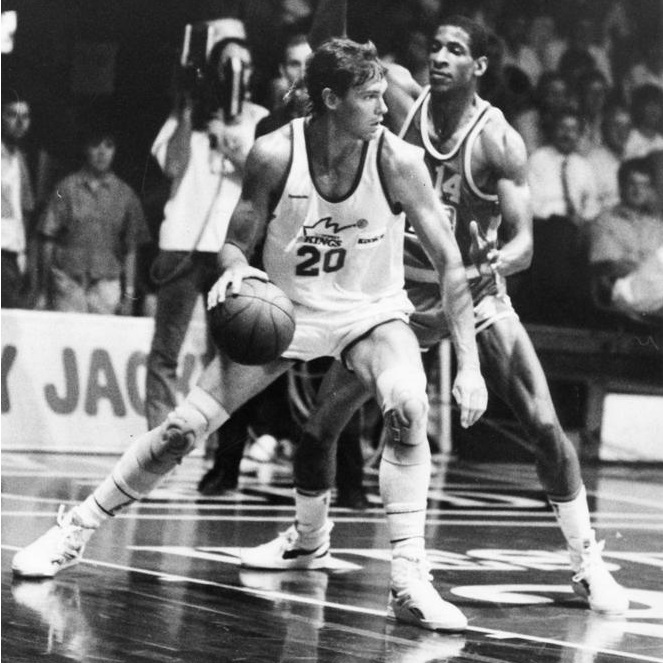
Marc Ridlen
March 19, 2021


NICKNAME/S: The Leaper
BIO: Tim Morrissey was born in Wollongong (NSW) and began playing basketball as a junior with the Illawarra basketball program. Morrisey played for NSW U20’s and went undefeated in 1982 National Championships. Morrissey received a scholarship to attend the Australian Institute of Sport (Canberra) in 1982. He spent three years year there and played for the program’s state league team (1982, 1983, 1984).
FAMILY: Tim’s brother, Ben Morrissey also played 51 games in the NBL.
Tim Morrissey made his NBL debut with the Illawarra Hawks at 17 years of age. He went scoreless in his first NBL game.
Illawarra’s third NBL campaign saw the return of foundation coach Joe Farrugia and a revamped roster built around high-scoring American duo Michael Jones and Benny Lewis, with 17-year-old local guard Tim Morrissey joining the senior ranks for the first time. Captain Gordie McLeod continued to control the offence, while Ray Hannett, Jim Slacke and Jim Williams rounded out a familiar Wollongong-based core. The club’s biggest move, however, was off the floor—the permanent relocation to Beaton Park Stadium, soon to be nicknamed “The Snakepit.”
A strong preseason highlighted by a shock exhibition win over European powerhouse Partizan set early optimism, before the Hawks’ campaign began with a 73–93 road loss to Newcastle. Jones (25 points) and Lewis (24 points) made immediate impacts, with McLeod (6 points) steady in his captaincy role, but Carl Whitfield (26 points) and the Falcons proved too strong at home. The next day Illawarra rebounded at Alexandria Stadium, defeating City of Sydney (92–80) behind Jones (30 points), Lewis (15 points), and McLeod (15 points). Morrissey, making his debut off the bench, added 2 points and showed early poise, while Astronauts star Curt Forrester (30 points) top-scored for the opposition.
Illawarra’s first home game at Beaton Park proved a milestone as the Hawks dismantled Canberra (91–71). Jones (36 points) dominated, Lewis (31 points) set a season-high, while young Morrissey (10 points) took his game to another level. Cannons import Dave Nelson (34 points) led the visitors in a game where Illawarra went a perfect 11-of-11 from the line.
Momentum halted during a challenging Melbourne double as Illawarra fell to St Kilda (100–114) despite Jones (37 points) and McLeod (20 points) producing their best games of the season, then backed up the next day in Kilsyth for a 74–95 defeat to Nunawading. The Hawks sat 2–2 after four rounds. Mid-March brought further setbacks: a 91–104 home loss to Launceston, followed by the club’s heaviest defeat at West Adelaide (66–104) and another loss the next night at Forestville (88–94). With McLeod sidelined against the Eagles, Jones (43 points) set a new season-high on 17-of-34 shooting (9-of-9 FT).
The Hawks stabilised when the schedule turned homeward. Illawarra snapped its losing streak with a 97–76 revenge win over Forestville, then went 3–1 in May, beating City of Sydney (98–81), upsetting West Adelaide (108–91) and grinding out a 76–74 thriller over Nunawading.
A late-season road swing produced more heartbreak with losses to Launceston (78–95) and Coburg (81–84), before the Hawks closed strongly at home—taking three of their last five. Illawarra beat Brisbane (90–80), pushed first-placed St Kilda to the wire (100–102), and defeated Coburg (87–85) and Bankstown (98–86) before finishing with a road defeat to Brisbane (69–82). In the finale, Jones (21 points) and Lewis (16 points) led scoring while McLeod (8 points) and Morrissey (2 points, 2-of-2 FT) rounded out the contributions in what capped a respectable end to the year.
The Hawks proved formidable in Wollongong (8–3) but managed just one victory away (1–10), finishing ninth of twelve with a 9–13 record. Despite the inconsistency, the season produced several milestones: the club’s move into The Snakepit, Jones winning league MVP after averaging 30.5 points (and leading the league in free-throw percentage at 87.6%), and
Morrissey (2.3 points across 15 games) becoming the youngest Hawk to debut to that point. Lewis (20.5 points), Slacke (12.7 points), Hannett (8.4 points), McLeod (7.5 points), and Williams (5.4 points) rounding out a solid supporting cast.
1983
The Hawks’ season began on a challenging note, with the departure of team captain Gordie McLeod to the Sydney Supersonics and import Alonzo Weatherly returning to the USA. McLeod’s exit marked the loss of a long-serving and pivotal figure whose leadership had anchored the club since inception.
Charlie Ammit replaced Tom Pottinger as head coach—Illawarra’s fourth different coach in four seasons after Adrian Hurley (1980), Joe Farrugia (1981) and Pottinger (1982)—with Mike Jones installed as captain and Tom Penrose assisting.
To fill key gaps, the Hawks signed import guard Jerry Steurer to replace Weatherly, added local rookie centre Simon Cottrell (via Launceston), and Morrissey returning to the roster after being left out in 1982.
Illawarra’s opener foreshadowed the climb ahead—95–113 at Newcastle—despite Jones (35 points), Cottrell (24) and Steurer (20) lighting up the scoreboard. Morrissey (2 points), feeling his way back into the team under Ammit’s system.
An eight-game skid followed before the drought finally broke in Round 8 at Beaton Park: Illawarra edged Devonport 102–100 behind big games again from Steurer (24 points), Slacke (29 points on 10-of-12 FG and 9-of-9 FT) and Jones (33 points, 6 rebounds, 3 blocks). Morrissey (10 points on 5-of-8 shooting, plus 3 assists, 2 steals and 3 boards) was also a key part of the Hawks first win.
A slew of losses then followed, while there were some impressive individual performances, Steurer (31 points) producing a season-best in a loss to Bankstown (71–82), a game where Morrissey (4 points and 5 rebounds) played a key role at the defensive end, and a season high for Jones (46 points) in a 92–109 loss at Coburg.
The Hawks entered the closing weeks with only a single victory, but a rare road win at Hobart (89–79) kickstarted Illawarra’s best patch of the season. Back to back wins at the Snakepit followed, a 89–88 over Coburg where Steurer (31 points), Jones (30 and 11 rebounds) led the way offensively and Morrissey (6 points) logged key minutes, and 92–90 over Frankston a week later as Steurer (30) and Jones (25) sealed back-to-back victories—Morrissey adding 8 points (2-of-3 FG, 4-of-6 FT) and 2 assists in crunch time rotations.
The Hawks would lose to Brisbane in their last game of the season (90–98). Morrissey (8 points and 4 rebounds) played aggressive inside, scoring all of his points from the free throw line (8-of-9 FT), while Jones (34 points) and Steurer (22 points) again finished as the team’s leading scorers..
Jones (32.7 points, 8.5 rebounds, and 1.1 steals) led the entire NBL in scoring this season, topped 30 points 16 times in 22 outings. Jerry Steurer (23.7 points, 5.4 rebounds, and 1.7 steals), was impressive in his first year with the Hawks and Jim Slacke (11 points, 3.5 rebounds) provided veteran leadership. Other key contributors included Morrissey (7.9 points, 2.9 rebounds, and 1.1 assists across 16 games) and Simon Cottrell (7.6 points, 3.9 rebounds).
Despite the late fight and the star power of Jones and Steurer, Illawarra finished 4–18 (seventh in the Eastern Division). With McLeod’s leadership absent, retirements to Ray Hannett and Ted Holcomb, a new coach bedding in, and a youthful backcourt rotation (including Morrissey and Bret Flanigan) gaining experience under fire, 1983 wrapped up as one of the Hawks toughest seasons.
1984
After a one-season stint with the Sydney Supersonics, Gordie McLeod returned to Illawarra and reclaimed the captaincy under Charlie Ammit, the first Hawks coach to be retained for consecutive seasons.
With former MVP Michael Jones heading overseas and not returning for a third year, the club reshaped its frontline by bringing in American seven-footer David McGuire to join returning import Jerry Steurer. Wing and depth roles were also retooled, with Rick Fowle and Michael Roodenrys arriving to cover the departures of Simon Cottrell (to Hobart) and Brett Flanigan (to Sydney), while Wollongong-born forward Tim Morrissey stepped into a larger role as part of a strengthened local core.
Illawarra launched the season in style by routing McLeod’s former club Sydney 119–93 at the Snakepit. McLeod set the tone (24 points, 8 assists, 4 rebounds, 3 steals on 11-of-21 shooting), Steurer controlled the interior (22 points, 15 rebounds, 8 assists), and Morrissey (18 points, 8 rebounds, 1 steal and 1 assist) was active at both ends. Morrissey’s tenacity would see him foul out in this one as Illawarra shot 49-of-97 from the field and finished with an impressive 21 team assists.
A three-game losing streak followed, but the Hawks reset at home with a 97–84 victory over St Kilda that again highlighted Morrissey’s growing importance. McLeod (21 points, 11 assists, 6 rebounds, 5 steals) steered the result again, Steurer (19 points, 12 rebounds) delivered another double-double and Morrissey produced one of his standout performances of the season, scoring 22 points on 9-of-15 shooting and 4-of-10 from the line, while also grabbing 8 rebounds, 2 steals and 1 block, and adding 2 turnovers and 5 personal fouls as the Hawks limited St Kilda to 36-of-83 from the floor.
Ten games into the season, with Illawarra sitting at 5–5 and determined to finally reach the playoffs, management decided that McGuire (16.0 points, 9.0 rebounds, 0.7 assists, 0.2 steals and 3.1 blocks across 10 games) was not the right long-term fit. The Hawks replacing him with former NBA forward Marlon Redmond for the last 15 games of the season. Redmond announced himself with a stunning debut in a 107–103 win over Perth, scoring 45 points on 17-of-33 shooting, including 4-of-7 from three and 7-of-10 from the foul line, while adding 17 rebounds, 2 assists, 1 steal and 1 block. Steurer backed him with 23 points, 9 rebounds, 5 assists and 3 steals on 9-of-15 shooting, McLeod (10 points, 12 assists, 1 steal) orchestrated the offense and Morrissey (10 points, 2 rebounds, and 5 turnovers) again filled his role on the wing, as Illawarra shot 44-of-84 from the field and 4-of-9 from long range.
From that point, Illawarra surged behind the scoring of Redmond (29.1 points, 12.5 rebounds, and 1.6 steals), the playmaking of McLeod (15.9 points, 3.8 rebounds, 8.7 assists, 2.4 steals) and Morrissey (18.7 points, 6.6 rebounds, 1.3 assists, 1.1 steals) delivering the best season of his career.
Illawarra converted that production into the first winning record and maiden playoff berth in club history, setting up an Elimination Final on the road against Newcastle. Although the Hawks ultimately fell 101–108, the core group again delivered big numbers. Redmond led the way with 31 points on 12-of-19 shooting, along with 11 rebounds, 2 steals and 1 block. Steurer added 21 points on 8-of-16 shooting and 5-of-8 from the stripe, plus 9 rebounds, 3 assists and 2 steals, while McLeod produced an elite playmaking performance with 14 points on 7-of-14 shooting, 14 assists, 7 rebounds, 2 steals and 2 blocks. Morrissey again rose to the occasion, finishing with 20 points on 7-of-12 shooting and 6-of-7 from the free throw line, together with 5 rebounds, 3 assists, 2 steals and 1 block, while also recording 4 turnovers and 4 personal fouls. Newcastle advanced behind a balanced attack led by Ian Davies (26 points, 6 rebounds), Michael Johnson (23 points, 8 rebounds), Jim Bateman (21 points, 12 rebounds, 1 block) and Jerry Dennard (15 points, 11 rebounds).
Tim Morrissey played thirteen seasons across three NBL teams. This included the Illawarra Hawks, Canberra Cannons and Sydney Kings. He averaged 9.7 points, 3.7 rebounds, and 1.2 assists in 322 NBL games.
| SEASON | AGE | TEAM | TEAM RECORD | GP | MINS | PTS | REB | AST | OR | DR | STL | BLK | TO | PF | FGM | FGA | FG% | 3PM | 3PA | 3P% | FTM | FTA | FT% | TS% | EFG% | HS |
|---|---|---|---|---|---|---|---|---|---|---|---|---|---|---|---|---|---|---|---|---|---|---|---|---|---|---|
| 1994 | 30 | Sydney | 16-10 (7) | 29 | 344.0 | 93 | 57 | 18 | 29 | 28 | 7 | 0 | 29 | 56 | 35 | 68 | 51% | 0 | 0 | 0% | 23 | 38 | 61% | 54% | 51% | 8 |
| 1993 | 29 | Sydney | 11-15 (11) | 26 | 658.0 | 158 | 85 | 28 | 42 | 43 | 23 | 4 | 43 | 81 | 66 | 132 | 50% | 0 | 1 | 0% | 26 | 47 | 55% | 51% | 50% | 16 |
| 1992 | 28 | Sydney | 17-7 (2) | 29 | 661.0 | 215 | 90 | 38 | 41 | 49 | 20 | 9 | 53 | 71 | 85 | 183 | 46% | 0 | 2 | 0% | 45 | 79 | 57% | 49% | 46% | 16 |
| 1991 | 27 | Sydney | 14-12 (7) | 26 | 756.0 | 298 | 85 | 36 | 55 | 30 | 24 | 7 | 55 | 80 | 126 | 252 | 50% | 2 | 5 | 40% | 44 | 74 | 59% | 52% | 50% | 27 |
| 1990 | 26 | Sydney | 16-10 (6) | 28 | 980.0 | 394 | 114 | 52 | 47 | 67 | 24 | 9 | 66 | 87 | 157 | 306 | 51% | 0 | 8 | 0% | 80 | 114 | 70% | 55% | 51% | 25 |
| 1989 | 25 | Sydney | 15-9 (5) | 30 | 1,110.0 | 398 | 176 | 46 | 74 | 102 | 27 | 9 | 83 | 85 | 166 | 348 | 48% | 1 | 4 | 25% | 65 | 109 | 60% | 50% | 48% | 26 |
| 1988 | 24 | Sydney | 10-14 (9) | 23 | 514.0 | 174 | 74 | 22 | 37 | 37 | 13 | 6 | 34 | 59 | 79 | 168 | 47% | 1 | 4 | 25% | 15 | 33 | 45% | 47% | 47% | 15 |
| 1987 | 23 | Canberra | 17-9 (5) | 23 | 742.0 | 290 | 121 | 47 | 51 | 70 | 26 | 8 | 66 | 65 | 112 | 238 | 47% | 0 | 2 | 0% | 66 | 104 | 63% | 50% | 47% | 23 |
| 1986 | 22 | Canberra | 19-7 (2) | 27 | 0.0 | 310 | 110 | 34 | 52 | 58 | 18 | 6 | 47 | 78 | 124 | 257 | 48% | 2 | 9 | 22% | 60 | 84 | 71% | 52% | 49% | 28 |
| 1985 | 21 | Canberra | 19-7 (4) | 28 | 0.0 | 241 | 99 | 30 | 38 | 61 | 16 | 11 | 54 | 71 | 102 | 197 | 52% | 0 | 0 | 0% | 37 | 77 | 48% | 52% | 52% | 19 |
| 1984 | 20 | Illawarra | 13-11 (8) | 22 | 0.0 | 412 | 145 | 28 | 53 | 92 | 24 | 9 | 84 | 77 | 173 | 329 | 53% | 0 | 2 | 0% | 66 | 117 | 56% | 54% | 53% | 35 |
| 1983 | 19 | Illawarra | 4-18 (14) | 16 | 0.0 | 126 | 46 | 18 | 18 | 28 | 8 | 1 | 41 | 41 | 44 | 110 | 40% | 0 | 0 | 0% | 38 | 53 | 72% | 47% | 40% | 17 |
| 1981 | 17 | Illawarra | 9-13 (8) | 15 | 0.0 | 34 | 0 | 0 | 0 | 0 | 0 | 0 | 0 | 22 | 14 | 30 | 47% | 0 | 0 | 0% | 6 | 15 | 40% | 46% | 47% | 10 | Totals | 322 | 5765 | 3143 | 1202 | 397 | 537 | 665 | 230 | 79 | 655 | 873 | 1283 | 2618 | 49.0% | 6 | 37 | 16.2% | 571 | 944 | 60.5% | 52% | 49% | 35 |
| SEASON | AGE | TEAM | TEAM RECORD | GP | MINS | PTS | REB | AST | OR | DR | STL | BLK | TO | PF | FGM | FGA | FG% | 3PM | 3PA | 3P% | FTM | FTA | FT% | TS% | EFG% | HS |
|---|---|---|---|---|---|---|---|---|---|---|---|---|---|---|---|---|---|---|---|---|---|---|---|---|---|---|
| 1994 | 30 | Sydney | 16-10 (7) | 29 | 11.9 | 3.2 | 2.0 | 0.6 | 1.0 | 1.0 | 0.2 | 0.0 | 1.0 | 1.9 | 1.2 | 2.3 | 51% | 0.0 | 0.0 | 0% | 0.8 | 1.3 | 61% | 54% | 51% | 8 |
| 1993 | 29 | Sydney | 11-15 (11) | 26 | 25.3 | 6.1 | 3.3 | 1.1 | 1.6 | 1.7 | 0.9 | 0.2 | 1.7 | 3.1 | 2.5 | 5.1 | 50% | 0.0 | 0.0 | 0% | 1.0 | 1.8 | 55% | 51% | 50% | 16 |
| 1992 | 28 | Sydney | 17-7 (2) | 29 | 22.8 | 7.4 | 3.1 | 1.3 | 1.4 | 1.7 | 0.7 | 0.3 | 1.8 | 2.4 | 2.9 | 6.3 | 46% | 0.0 | 0.1 | 0% | 1.6 | 2.7 | 57% | 49% | 46% | 16 |
| 1991 | 27 | Sydney | 14-12 (7) | 26 | 29.1 | 11.5 | 3.3 | 1.4 | 2.1 | 1.2 | 0.9 | 0.3 | 2.1 | 3.1 | 4.8 | 9.7 | 50% | 0.1 | 0.2 | 40% | 1.7 | 2.8 | 59% | 52% | 50% | 27 |
| 1990 | 26 | Sydney | 16-10 (6) | 28 | 35.0 | 14.1 | 4.1 | 1.9 | 1.7 | 2.4 | 0.9 | 0.3 | 2.4 | 3.1 | 5.6 | 10.9 | 51% | 0.0 | 0.3 | 0% | 2.9 | 4.1 | 70% | 55% | 51% | 25 |
| 1989 | 25 | Sydney | 15-9 (5) | 30 | 37.0 | 13.3 | 5.9 | 1.5 | 2.5 | 3.4 | 0.9 | 0.3 | 2.8 | 2.8 | 5.5 | 11.6 | 48% | 0.0 | 0.1 | 25% | 2.2 | 3.6 | 60% | 50% | 48% | 26 |
| 1988 | 24 | Sydney | 10-14 (9) | 23 | 22.3 | 7.6 | 3.2 | 1.0 | 1.6 | 1.6 | 0.6 | 0.3 | 1.5 | 2.6 | 3.4 | 7.3 | 47% | 0.0 | 0.2 | 25% | 0.7 | 1.4 | 45% | 47% | 47% | 15 |
| 1987 | 23 | Canberra | 17-9 (5) | 23 | 32.3 | 12.6 | 5.3 | 2.0 | 2.2 | 3.0 | 1.1 | 0.3 | 2.9 | 2.8 | 4.9 | 10.3 | 47% | 0.0 | 0.1 | 0% | 2.9 | 4.5 | 63% | 50% | 47% | 23 |
| 1986 | 22 | Canberra | 19-7 (2) | 27 | 0.0 | 11.5 | 4.1 | 1.3 | 1.9 | 2.1 | 0.7 | 0.2 | 1.7 | 2.9 | 4.6 | 9.5 | 48% | 0.1 | 0.3 | 22% | 2.2 | 3.1 | 71% | 52% | 49% | 28 |
| 1985 | 21 | Canberra | 19-7 (4) | 28 | 0.0 | 8.6 | 3.5 | 1.1 | 1.4 | 2.2 | 0.6 | 0.4 | 1.9 | 2.5 | 3.6 | 7.0 | 52% | 0.0 | 0.0 | 0% | 1.3 | 2.8 | 48% | 52% | 52% | 19 |
| 1984 | 20 | Illawarra | 13-11 (8) | 22 | 0.0 | 18.7 | 6.6 | 1.3 | 2.4 | 4.2 | 1.1 | 0.4 | 3.8 | 3.5 | 7.9 | 15.0 | 53% | 0.0 | 0.1 | 0% | 3.0 | 5.3 | 56% | 54% | 53% | 35 |
| 1983 | 19 | Illawarra | 4-18 (14) | 16 | 0.0 | 7.9 | 2.9 | 1.1 | 1.1 | 1.8 | 0.5 | 0.1 | 2.6 | 2.6 | 2.8 | 6.9 | 40% | 0.0 | 0.0 | 0% | 2.4 | 3.3 | 72% | 46.6% | 40% | 17 |
| 1981 | 17 | Illawarra | 9-13 (8) | 15 | 0.0 | 2.3 | 0.0 | 0.0 | 0.0 | 0.0 | 0.0 | 0.0 | 0.0 | 1.5 | 0.9 | 2.0 | 47% | 0.0 | 0.0 | 0% | 0.4 | 1.0 | 40% | 45.8% | 47% | 10 | Total | 322 | 17.9 | 9.8 | 3.7 | 1.2 | 1.7 | 2.1 | 0.7 | 0.2 | 2.0 | 2.7 | 4.0 | 8.1 | 49.0% | 0.0 | 0.0 | 16.2% | 0.0 | 0.1 | 60.5% | 52% | 49% | 35 |
| POINTS | REBOUNDS | ASSISTS | STEALS | BLOCKS | TURNOVERS | TRIPLE DOUBLES | 35 | 15 | 6 | 4 | 2 | 8 | 0 |
|---|
| YEAR | AGE | GP | MINS | PTS | REB | AST | OR | DR | STL | BLK | TO | PF | FGM | FGA | FG% | 3PM | 3PA | 3P% | FTM | FTA | FT% |
|---|---|---|---|---|---|---|---|---|---|---|---|---|---|---|---|---|---|---|---|---|---|
| 1990 | 26 | 2 | 0 | 4 | 0 | 0 | 0 | 0 | 0 | 0 | 0 | 7 | 0 | 0 | 0.0% | 0 | 0 | 0.0% | 4 | 4 | 100.0% | Total | 2 | 0 | 4 | 0 | 0 | 0 | 0 | 0 | 0 | 0 | 7 | 0 | 0 | 0% | 0 | 0 | 0% | 4 | 4 | 100% |
| YEAR | AGE | GP | MINS | PTS | REB | AST | OR | DR | STL | BLK | TO | PF | FGM | FGA | FG% | 3PM | 3PA | 3P% | FTM | FTA | FT% |
|---|---|---|---|---|---|---|---|---|---|---|---|---|---|---|---|---|---|---|---|---|---|
| 1990 | 26 | 2 | 0.0 | 2.0 | 0.0 | 0.0 | 0.0 | 0.0 | 0.0 | 0.0 | 0.0 | 3.5 | 0.0 | 0.0 | 0.0% | 0.0 | 0.0 | 0.0% | 2.0 | 2.0 | 100.0% | Total | 2 | 0.0 | 2.0 | 0.0 | 0.0 | 0.0 | 0.0 | 0.0 | 0.0 | 0.0 | 3.5 | 0.0 | 0.0 | 0% | 0.0 | 0.0 | 0% | 2.0 | 2.0 | 100% |
Whilst we try to source as much information as we can for every player who has ever played in the NBL some information on a player profile may be missing. If you have additional information on a player you'd like us to add to a profile, please send it to us using the enquiry form below.
Submissions are then sent to info@aussiehoopla.com

