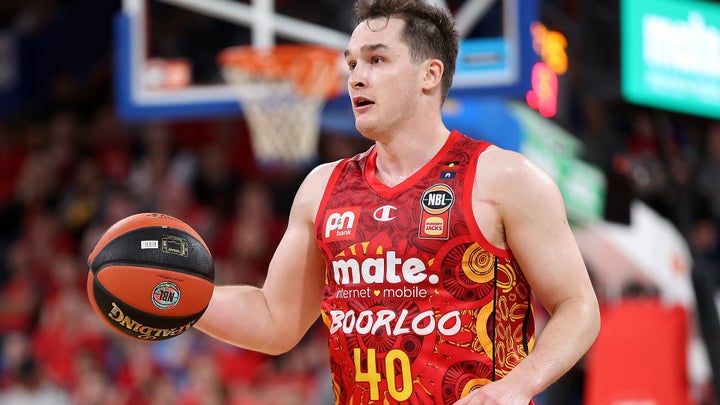
Cole Anthony
October 6, 2026


 Melbourne Tigers3 seasons

BIO: Dean Vickerman was born in Warragul (VIC) and began playing basketball as a junior with the Warragul basketball program. Vickerman grew up on his family’s dairy farm outside Warragul, where his parents were farmers and school teachers and the family milked around 120 cows twice a day. His father introduced him to basketball and built a court at the family farm. Warragul was his first representative team, before he joined the Dandenong Rangers at under-14 level and moved to the Melbourne Tigers by under-16, where he played his junior and senior careers.
FAMILY: Vickerman is the son of John and Pam Vickerman.
John was a co-founder of the Warragul and District Amateur Basketball Association, where Dean began playing junior basketball.
Vickerman’s wife is Christy and they have three daughters, Georgia, Jade and Bailey.
Dean Vickerman made his NBL debut with the Melbourne Tigers at 19 years of age. He scored one point in his first NBL game.
Melbourne looked to build on their first-ever playoff appearance in 1990, re-signing their core while upgrading from departing swingman Eric Bailey (Gold Coast) to Cecil Exum (via North Melbourne). Imports Dave Colbert and Dave Simmons also returned, while Andrew Gaze, fresh off a stint with Seton Hall and a near-miss with the Seattle Supersonics, was primed for a huge season.
Gaze (37.6 points, 4.8 rebounds, 6.9 assists, and 2.6 steals), Colbert (31.1 points, 10.7 rebounds, and 2.9 assists), and Simmons (27.4 points, 8.7 rebounds, and 3.2 assists) combined for an explosive 96 points per game. However, Melbourne’s momentum was derailed when Gaze was diagnosed with a blood clot in his shoulder, forcing him to miss the final two regular-season games and the playoffs.
Despite finishing fourth (17-9), the Tigers fell to fifth-seed Perth in the elimination finals. Colbert exploded for 52 points, but Perth’s Ricky Grace (30 points, 8 rebounds, and 7 assists) orchestrated a dominant 122-100 win. In Game 2, Colbert (42 points) and Simmons (29 points, 9 rebounds, and 6 assists) delivered big performances, but Perth shut down the rest of the Tigers, sealing Melbourne’s fate with a 123-113 victory.
Serving as the reserve point guard behind Andrew Gaze, who Vickerman recalled would play around 44 minutes of a 48-minute game, Vickerman saw limited action and appeared in just one game for the season.
1991
Melbourne had become a formidable team by 1991, and had it not been for a blood clot that derailed Andrew Gaze’s season, could have seen a deep playoff run from the Tigers. This year would see the trio of Gaze (38.8 points, 4.4 rebounds, 6.0 assists, and 2.7 steals), David Cobert (24.6 points, 9.8 rebounds, 3.1 assists, 1.7 steals, and 1.5 blocks) and Dave Simmons (24.1 points, 8.4 rebounds, 2.4 assists, 1.7 steals, and 1.1 blocks) get the chance to see how far they could go with a full season together. Melbourne was also boosted by the emergence of Stephen Whitehead (9.9 points, 3.6 rebounds, 2.0 assists, and 1.4 steals), who would double his production with a shift to the team’s starting lineup.
The Tigers made history this season when they faced off against Illawarra and recorded the highest scoring game in NBL history (Jul 27). The game saw 344 points scored, and the Tigers come out as victors (186-158). Gaze (59 points, 11 assists, and 4 steals), Colbert (42 points, 20 rebounds and 5 assists) and Simmons (36 points, 7 rebounds and 3 assists) doing the bulk of the scoring for Melbourne and Patric Fairs (41 points and 10 rebounds) and Greg Hubbard (36 points, 4 rebounds and 6 assists) top scoring for Illawarra, who shot 76% from the field, which remains the highest shooting percentage ever recorded by a team in a losing effort.
Once into the playoffs, Melbourne would lose game one (115-129) and game two (96-132) to Adelaide in the elimination finals. The scoring brilliance of Gaze, combined with the Tigers’ regular season success, was enough to earn him the NBL Most Valuable Player award for the first time. Gaze would then take home the NBL MVP award in seven of his next eight seasons. Vickerman would continue to see limited opportunities to play, appearing in 11 games and averaging 0.7 points, 0.2 rebounds, and 0.3 assists for the season.
1992
In 1992, the Tigers made a pivotal roster change by replacing forward David Colbert with former NBA guard Lanard Copeland. This move paired Copeland with Andrew Gaze in the backcourt, forming one of the most electrifying duos in NBL history. Gaze led the league in scoring, averaging 33.8 points, 4.6 rebounds, and 6.3 assists per game, while Copeland showcased his NBA pedigree with impressive averages of 28.1 points, 4.5 rebounds, and 3.0 assists per game.
To bolster their interior presence, the Tigers acquired Robert Sibley from Brisbane, leading to a talent swap as Brisbane signed free agent Colbert. Sibley integrated well into the frontcourt, contributing 11.1 points, 7.8 rebounds, and 2.7 assists per game. Additionally, the talented young swingman Stephen Whitehead saw a boost in his numbers for the third consecutive season, averaging 13.8 points, 4.5 rebounds, 2.0 assists, 1.2 steals, and 1.1 blocks per game.
With this revamped roster, the Tigers adopted a faster playing style, culminating in their highest regular-season finish to date with a 15-9 record, securing the third spot. In the postseason, Melbourne eliminated Perth (2-1) in the quarterfinals and the Sydney Kings (2-1) in the semifinals, advancing to their first Grand Final series in franchise history. Facing crosstown rivals, the South East Melbourne Magic, Gaze delivered 26 points, 5 rebounds, and 3 assists in Game 1, leading the Tigers to a commanding 116-98 victory. However, the Magic rebounded to win the next two games, clinching the 1992 NBL championship (2-1).
During this season, Dean Vickerman appeared in only four games for the Tigers, contributing a total of 10 points. Perhaps his most notable game this season came in a practice game, Copeland’s first after his arrival in Australia. In that game Vickerman dropped 32 points against a jet-lagged Copeland who had arrived at training exhausted after a 30 hour flight from Atlanta to Melbourne. Copeland later reflected on this experience, acknowledging Vickerman’s tenacity and hinting at his future coaching prowess. He described Vickerman as “one of those guards that was always up and in, one of those little nagging guards that bothered you.”
Vickerman’s playing style and work ethic during his time with the Tigers laid the foundation for his future coaching career, characterized by a no-nonsense approach and the ability to extract the best from his players. His journey from a determined player to a respected coach underscores his deep understanding of the game and his commitment to excellence.
Dean Vickerman played three seasons with the Melbourne Tigers. He averaged 1.2 points, 0.2 rebounds, and 0.3 assists in 16 NBL games.
| SEASON | AGE | TEAM | TEAM RECORD | GP | MINS | PTS | REB | AST | OR | DR | STL | BLK | TO | PF | FGM | FGA | FG% | 3PM | 3PA | 3P% | FTM | FTA | FT% | TS% | EFG% | HS |
|---|---|---|---|---|---|---|---|---|---|---|---|---|---|---|---|---|---|---|---|---|---|---|---|---|---|---|
| 1992 | 21 | Melbourne | 15-9 (3) | 4 | 12 | 10 | 1 | 1 | 0 | 1 | 0 | 0 | 0 | 2 | 3 | 5 | 60% | 2 | 2 | 100% | 2 | 3 | 67% | 79% | 80% | 5 |
| 1991 | 20 | Melbourne | 16-10 (5) | 11 | 29 | 8 | 2 | 3 | 1 | 1 | 4 | 0 | 7 | 5 | 2 | 12 | 17% | 0 | 4 | 0% | 4 | 6 | 67% | 27% | 17% | 6 |
| 1990 | 19 | Melbourne | 17-9 (4) | 1 | 3 | 1 | 0 | 0 | 0 | 0 | 1 | 0 | 0 | 0 | 1 | 0% | 0 | 0 | 0% | 1 | 2 | 50% | 27% | 0% | 1 | Totals | 16 | 44 | 19 | 3 | 4 | 1 | 2 | 5 | 0 | 7 | 7 | 5 | 18 | 27.8% | 2 | 6 | 33.3% | 7 | 11 | 63.6% | 42% | 33% | 6 |
| SEASON | AGE | TEAM | TEAM RECORD | GP | MINS | PTS | REB | AST | OR | DR | STL | BLK | TO | PF | FGM | FGA | FG% | 3PM | 3PA | 3P% | FTM | FTA | FT% | TS% | EFG% | HS |
|---|---|---|---|---|---|---|---|---|---|---|---|---|---|---|---|---|---|---|---|---|---|---|---|---|---|---|
| 1992 | 21 | Melbourne | 15-9 (3) | 4 | 3.0 | 2.5 | 0.3 | 0.3 | 0.0 | 0.3 | 0.0 | 0.0 | 0.0 | 0.5 | 0.8 | 1.3 | 60% | 0.5 | 0.5 | 100% | 0.5 | 0.8 | 67% | 79% | 80% | 5 |
| 1991 | 20 | Melbourne | 16-10 (5) | 11 | 2.6 | 0.7 | 0.2 | 0.3 | 0.1 | 0.1 | 0.4 | 0.0 | 0.6 | 0.5 | 0.2 | 1.1 | 17% | 0.0 | 0.4 | 0% | 0.4 | 0.5 | 67% | 27% | 17% | 6 |
| 1990 | 19 | Melbourne | 17-9 (4) | 1 | 3.0 | 1.0 | 0.0 | 0.0 | 0.0 | 0.0 | 1.0 | 0.0 | 0.0 | 0.0 | 0.0 | 1.0 | 0% | 0.0 | 0.0 | 0% | 1.0 | 2.0 | 50% | 27% | 0% | 1 | Total | 16 | 2.8 | 1.2 | 0.2 | 0.3 | 0.1 | 0.1 | 0.3 | 0.0 | 0.4 | 0.4 | 0.3 | 1.1 | 27.8% | 0.1 | 0.4 | 33.3% | 0.4 | 0.7 | 63.6% | 42% | 33% | 6 |
| POINTS | REBOUNDS | ASSISTS | STEALS | BLOCKS | TURNOVERS | TRIPLE DOUBLES | 6 | 2 | 2 | 2 | 0 | 2 | 0 |
|---|
Vickerman had the opportunity to go to the United States and play college basketball (NCAA), but chose to remain with the Melbourne Tigers to pursue the semi-professional opportunity there.
While playing with Melbourne, he studied business (management) at university and worked part-time, primarily as a basketball coach.
- As coach: 3× NBL Coach of the Year (2018, 2019, 2024)
Before entering the NBL coaching ranks, Vickerman worked in basketball development as a Basketball Victoria Development Officer and later as Coaching Director with Geelong.
Vickerman said his coaching career began with the Geelong Supercats, but when Geelong withdrew from the NBL he moved to the North Melbourne Giants as an assistant coach in 1997. He then moved into head coaching with the Rockhampton Rockets in 1998 and 1999 before joining the Sydney Panthers as an assistant coach for the 2000 and 2001 WNBL seasons. Vickerman was part of the Panthers' coaching staff when Sydney won the 2001 WNBL championship.
Vickerman moved to New Zealand in 2002 to become head coach of the Wellington Saints in the NZNBL. He remained in the role into the beginning of the 2003 season before leaving four games into the campaign amid financial uncertainty at the club.
Returning to Victoria, Vickerman coached Melbourne University to the 2004 Big V Division One men's championship and was recognised by the club as the division's 2004 Coach of the Year before joining the Melbourne Tigers as an assistant coach. He spent the 2004/05 and 2005/06 NBL seasons on the Tigers' staff and was part of the 2006 championship team that defeated the Sydney Kings 3–0 in the Grand Final series.
Vickerman joined the Singapore Slingers as an assistant coach for the club's inaugural NBL season in 2006/07 and also took on coaching responsibilities with the Singapore national program. At the beginning of 2007, he also coached the Latrobe City Pacers in the Big V before leaving during the season to join the New Zealand Breakers as an assistant coach under Andrej Lemanis. Vickerman remained with the Breakers through 2012/13 and was part of the coaching staff for three consecutive NBL championships in 2010/11, 2011/12 and 2012/13.
During his time as a Breakers assistant, Vickerman also worked in the New Zealand national-team pathway. He served as an assistant coach with the Tall Blacks in 2008, including New Zealand's Olympic Qualifying Tournament campaign.
Vickerman became head coach of the Waikato Pistons for the 2009 NZNBL season. Waikato won the regular-season title before defeating Christchurch 96–89 in the semi-final and sweeping Nelson in the Grand Final series, 81–69 and 94–84, to win the championship. Vickerman was named the 2009 NZNBL Coach of the Year.
Waikato again reached the NZNBL Grand Final in 2010. The Pistons won Game 1 against Wellington 80–74 before the Saints won the next two games 98–69 and 82–79 to take the championship series 2–1. In 2011, Waikato finished second in the regular season before losing its semi-final 95–86 to Hawke's Bay. Vickerman was named NZNBL Coach of the Year for the second time. He also coached the New Zealand men's team at the 2011 World University Games in China, where the team finished 21st.
After six seasons as a Breakers assistant, Vickerman was promoted to head coach for the 2013/14 NBL season. New Zealand finished his first season 11–17 in seventh place and missed the playoffs. In 2014/15, the Breakers improved to 19–9 and second place, swept Adelaide 2–0 in the semi-finals and then swept Cairns 2–0 in the Grand Final series, winning 86–71 in Game 1 and 83–81 in Game 2 to claim the championship.
Vickerman led New Zealand back to the Grand Final in 2015/16. The Breakers finished 16–12 in fourth place, swept Melbourne United 2–0 in the semi-finals and then lost the championship series 2–1 to the Perth Wildcats. His three-season tenure as Breakers head coach ended following the season and Paul Henare took over the role.
Vickerman returned to Australia as an assistant coach with the Sydney Kings for the 2016/17 NBL season, working with head coach Andrew Gaze and assistant Lanard Copeland. In March 2017, Melbourne United appointed Vickerman as head coach.
In his first season with Melbourne United, Vickerman led the club to a 20–8 record and first place in 2017/18. United defeated the New Zealand Breakers 2–0 in the semi-finals and Adelaide 3–2 in the Grand Final series to win the championship, with Melbourne taking Game 5 100–82. Vickerman was named the 2018 NBL Coach of the Year.
Melbourne finished 18–10 and second in 2018/19, swept Sydney 2–0 in the semi-finals and returned to the Grand Final before losing the series 3–1 to Perth. Vickerman won NBL Coach of the Year for a second consecutive season. In 2019/20, United went 15–13 and finished fourth before losing its semi-final series 2–1 to Sydney.
Vickerman guided Melbourne to another championship in 2020/21. United finished first with a 28–8 record, defeated South East Melbourne 2–1 in the semi-finals and swept Perth 3–0 in the Grand Final series to win the title. Melbourne again finished first in 2021/22 with a 20–8 record but lost its semi-final series 2–1 to the Tasmania JackJumpers.
United finished 15–13 in 2022/23 but missed the postseason in seventh place. Vickerman signed a four-year contract extension in April 2023 that was due to keep him with Melbourne through the end of the 2027/28 season.
Melbourne returned to the top of the ladder in 2023/24 with a 20–8 record. United defeated Illawarra 2–1 in the semi-finals and reached the Championship Series, where Tasmania won the deciding Game 5 83–81 to take the series 3–2. Vickerman was named NBL Coach of the Year for the third time, adding the 2024 award to those he won in 2018 and 2019.
In 2024/25, Melbourne finished 19–10 and second, defeated Perth 2–1 in the semi-finals and again reached a deciding Game 5 of the Championship Series. Illawarra won the decider 114–104 to take the series 3–2. United finished the 2025/26 regular season 20–13 in fifth place and was eliminated from the postseason after a 95–77 Play-In loss to Perth.
Vickerman's Melbourne United tenure ended on 5 May 2026 after nine seasons when he exercised an option in his contract to pursue an overseas opportunity. He finished with 199 wins as United head coach and two championships, in 2018 and 2021. Across his NBL head-coaching career with New Zealand and Melbourne, Vickerman recorded 249 wins and 149 losses in 398 games when he departed the league on May 5, 2026, a 62.6 per cent winning record. He was ranked seventh all-time in NBL head-coaching victories (249) and third in Finals wins (31), according to the NBL's May 2026 coaching record. This remains his latest NBL coaching total following his move to Japan.
Vickerman also continued to work with the Australian national program during his Melbourne tenure. In February 2023, he served as Boomers head coach for the final window of 2023 FIBA World Cup qualification, with Australia defeating Bahrain 83–51 and Kazakhstan 98–53. In 2024, he coached the Australian Select team in the Nippon Life Cup against Japan, winning the first game 90–89 before the second finished in a 95–95 draw.
On 12 March 2025, Vickerman was appointed Associate Head Coach of the Australian Boomers under Adam Caporn, with responsibility for assuming the head-coaching role during international windows that conflicted with Caporn's NBA commitments. Vickerman led Australia in the May 2025 Trans-Tasman Throwdown against New Zealand, winning the three-game series 2–1 with victories of 80–68 and 92–67 before a 106–97 loss in Game 3.
Vickerman remained part of Australia's coaching group as the Boomers went undefeated and won the 2025 FIBA Asia Cup. He then handled the opening 2027 FIBA World Cup qualifying window in November and December 2025 while Caporn was with the Washington Wizards. Australia defeated New Zealand 84–79 in Hobart and 79–77 in Wellington to open qualification 2–0. Vickerman returned to his Associate Head Coach role when Caporn was available for the July 2026 qualifying window in Perth.
On 19 June 2026, Nagasaki Velca announced it had reached a new head-coach contract agreement with Vickerman for the 2026/27 B.PREMIER season, replacing Mody Maor after Nagasaki's 2025/26 championship. His move to Japan also made him unavailable for Australia's August 2026 World Cup qualifying window, with Jacob Chance taking charge of the Boomers for that period.
Nagasaki opened Vickerman's 2026/27 season 0–4, losing its first two games to Shimane 89–64 and 85–78 before road losses to Kyoto 84–76 and 90–65.
Velca recorded Vickerman's first regular-season win in Japan on October 8, defeating Shinshu 74–71 to improve to 1–4, before beating previously unbeaten Gunma 70–59 on October 10 to improve to 2–4.
Whilst we try to source as much information as we can for every player who has ever played in the NBL some information on a player profile may be missing. If you have additional information on a player you'd like us to add to a profile, please send it to us using the enquiry form below.
Submissions are then sent to info@aussiehoopla.com
HAVE A TAKE ON THE GAME?
Love Australian basketball? Have a story to tell or an opinion worth sharing? We're keen to hear from passionate basketball fans, writers and aspiring journalists. Pitch your idea and be part of the Aussie Hoopla writing team.