

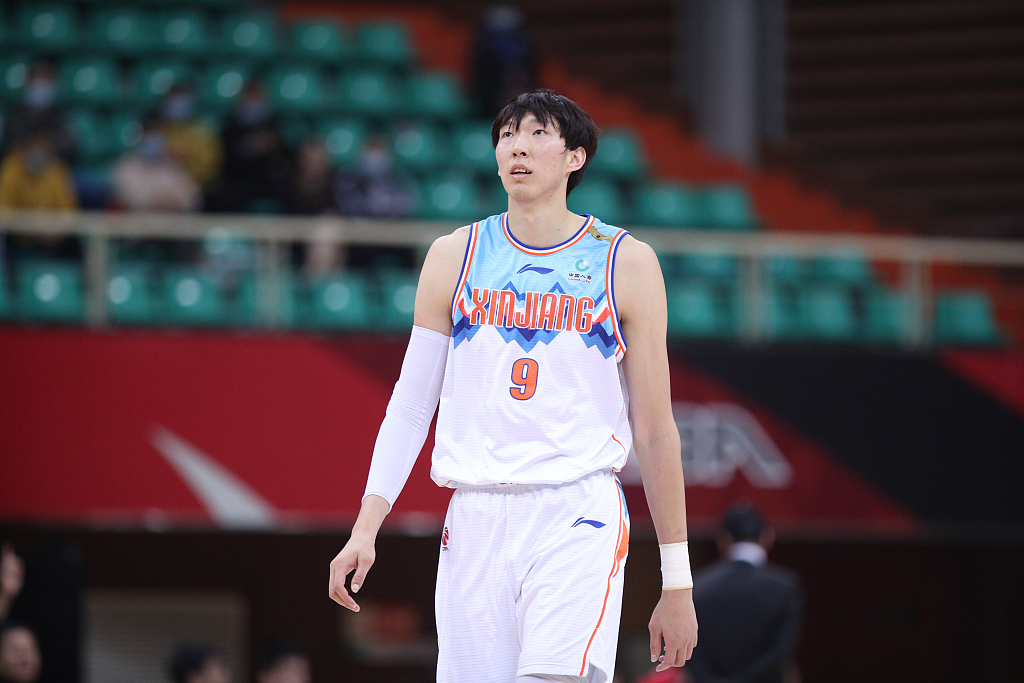
With uncertainty around the Chinese Basketball Association (CBA) many stars have chosen to play elsewhere this season, and a number of them have decided to spend this season in the NBL while the CBA gets its act together.
Under the influence of the epidemic and major changes to the CBA contract, this year, the league saw an unprecedented situation in which two national team players chose to play in Australia rather than the Chinese league due to unfair policies in player contracts.
Up and coming talent Liu Chuanxing has signed this year to play with the Brisbane Bullets, and Zhou Qi, a former player for the Houston Rockets in the NBA, has signed on to play with the South East Melbourne Phoenix after contract disputes with their Chinese teams. Qi’s issues with his former club, the Xinjiang Flying Tigers, were heavily publicised in China and stem from a clause that severely limits CBA players from switching teams and earning additional money.
If a player’s previous contract with the team expires and the team offers this player a maximum salary contract, even if other teams offer the same salary (not exceeding the maximum salary), this player can only Renew the contract with the old club, but can not choose other teams.
In hopes to overturn this Zhou followed up his dispute and presented it to the league’s governing body which ruled that the contract was still valid and the club still owns the relevant rights. The 25-year-old center then applied for arbitration over the contract dispute, contacted a number of overseas clubs and then swiftly signed with the NBL’s South East Melbourne Phoenix.
“I announced I am quitting the whole season. I will persist in safeguarding the legitimate rights of players because that’s my responsibility as a player,” said Zhou.
“I hope what happened to me will spur the CBA league to set more reasonable standards and do a better job of protecting the legitimate rights of players. Meanwhile, I will submit supplementary materials to the Chinese Basketball Association as soon as possible. I expect the association to conduct a fair and just arbitration over the matter.”
By foregoing this season in CBA both Chuanxing and Zhou’s rights then revert to free-agent status and he is free to sign with any other club in the next CBA season.
Qi is believed to have left an $840,000 contract on the table to sign with the Phoenix operating under the league’s salary cap of $1,637,000 for the entire roster will be paying him a substantial amount less. The move also caused Zhou Qi to lose a lot of commercial endorsement opportunities.
The contact changes are due to financial issues the CBA is currently facing, some of these due to COVID-19 and the others due to the flippancy of Chinese basketball fans.
In China, fans aren’t as loyal to their sporting teams as we are in Australia. While fans are quick to attend CBA games to see their national players in action will equally not attend games if they miss a game. This then creates a situation where as long as a CBA team has a big name star they will pack stadiums, no matter how they place around them. In addition to this most CBA teams are not making a profit.
The CBA chairman Yao Ming announced a new concept of CBA reform which included the changes to player contracts. The so-called “CBA2.0 brand upgrade plan” was launched in response to the current commercial deficiencies of the league, including increasing the number of league games to meet the needs of fans to watch the game, thereby increasing ticket revenue, increasing the length and scope of sponsor exposure and a re-brand to attract young fans.
The issues with Chinese basketball are also linked to the countries inability to qualify for the FIBA 2019 World Cup and the recent Olympics which has also seen the sport wane in fan support and team finances.
Zhou made public comments last season regarding his issues with Xinjiang and their player recruitment. The big man seemingly had been forced to carry the Flying Tigers with little teammate support in recent seasons, the team relying on his name alone to generate profits and save money on other roster spots. This reached a point where he refused to play for the club. Chuanxing, whose experience with his CBA in Qingdao never escalated to the point of Zhou, but were enough so that he too refused to stay with his former club, yet had no other options to play in China.
The situation provides only one other option and that’s to ply their trade overseas. Enter the NBL.
It’s a difficult situation where neither party has really done anything wrong. The CBA modified its contract rules in order to protect the interests of its teams and allow them exclusive rights to keep their best players with maximum deals, the league wants to make sure that every team, especially the weak ones, can remain competitive, for the sake of both games and finances.
On the other side, Zhou’s contract with Xinjiang expired and being unhappy with his former team it seems fair that he does not want to sign a new contract, regardless of the number on it.
The only winner, it seems, in these situations is, surprisingly, the NBL.