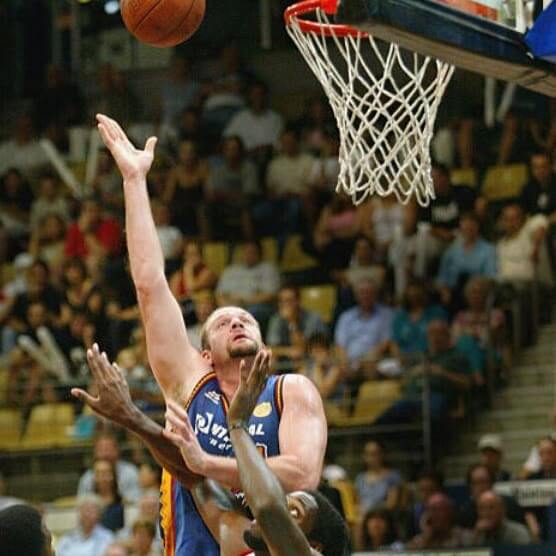
Clarence Tyson
July 23, 2020


BIO: Chris Sneed was born in Tallahassee, Florida (USA).
Chris Sneed made his NBL debut with the Townsville Suns at 25 years of age. He scored five points in his first game.
Townsville improved sharply from its 9-17 finish in 1996, with head coach Mark Bragg retaining captain Derek Rucker, Clarence Tyson, Jason Cameron and Grant Kruger while Cameron Dickinson (to Sydney) and David Blades (retired) moved on. Simon Kerle (via Geelong) and Tony De Ambrosis (via Gold Coast) strengthened the rotation, and by the end of August the Suns were fifth at 14-10, one victory from the franchise’s first playoff appearance. That push was disrupted in early September when Tyson suffered a season-ending knee injury in Canberra. After playing for Dandenong at state league level during 1997, Chris Sneed joined Townsville on a short-term deal for the closing weeks.
Sneed made his NBL debut against Brisbane at the Brisbane Convention Centre on September 13, finishing with 5 points, 7 rebounds, 1 assist, and 3 steals. Keiron Mitchelhill (18 points) and Rucker (15 points, 7 rebounds, 3 assists, and 6 steals) led Townsville’s scoring and defensive pressure, while Leroy Loggins (33 points, 6 rebounds, 4 assists, 4 steals, and 1 block) carried Brisbane to an 82-76 victory.
Sneed (15.7 points, 7.3 rebounds, and 2 steals across 3 games) immediately gave Townsville additional rebounding and defensive activity during his brief stint. He made 18-of-26 field goals across his three appearances, shooting 69 percent while collecting 10 offensive rebounds in only 90 minutes of NBL action.
His highest-scoring game came against Newcastle at the Townsville Entertainment Centre on September 20. Sneed made 10-of-13 field goals and finished with 26 points, 5 rebounds, 2 assists, and 1 steal, with Kerle (21 points, 6 rebounds, 8 assists, and 1 steal) and Rucker (16 points, 2 rebounds, 5 assists, and 2 steals) providing the main support. Scott McGregor (29 points, 5 rebounds, 8 assists, and 2 steals) led Newcastle to a 106-103 victory, extending Townsville’s late-season losing streak.
Across the season, Rucker (25.9 points, 3.9 rebounds, 7.6 assists, and 2.6 steals across 30 games) finished second in the NBL in scoring and assists and third in steals, earning All-NBL First Team honours and Townsville’s club MVP award. Tyson (22 points and 13.7 rebounds across 25 games) led the NBL in rebounding and also earned All-NBL First Team selection despite his season ending early, while Kerle (16.7 points and 4.1 assists across 30 games) became Townsville’s third major offensive option.
Townsville’s last chance to reach the postseason came against Perth at the Townsville Entertainment Centre on September 26. Sneed (16 points, 10 rebounds, 2 steals, and 1 block) made 6-of-7 field goals and all four free throws for the only double-double of his NBL career, while Rucker (36 points, 7 rebounds, 9 assists, and 2 steals) and Kerle (20 points, 2 rebounds, 3 assists, and 1 steal) led the Suns’ attack. Todd Lichti (25 points, 5 rebounds, 1 assist, and 2 steals) led Perth to a 102-100 victory, Townsville’s sixth consecutive loss, leaving the Suns eighth with a 14-16 record after Adelaide won the head-to-head tiebreak and ending their bid for a maiden playoff appearance.
Chris Sneed played one season in the NBL. He averaged 15.6 points, 7.3 rebounds, and 1 assists in 3 NBL games.
| SEASON | AGE | TEAM | TEAM RECORD | GP | MINS | PTS | REB | AST | OR | DR | STL | BLK | TO | PF | FGM | FGA | FG% | 3PM | 3PA | 3P% | FTM | FTA | FT% | TS% | EFG% | HS |
|---|---|---|---|---|---|---|---|---|---|---|---|---|---|---|---|---|---|---|---|---|---|---|---|---|---|---|
| 1997 | 25 | Townsville | 14-16 (8) | 3 | 90 | 47 | 22 | 3 | 10 | 12 | 6 | 1 | 7 | 12 | 18 | 26 | 69% | 0 | 0 | 0% | 11 | 18 | 61% | 68% | 69% | 26 | Totals | 3 | 90 | 47 | 22 | 3 | 10 | 12 | 6 | 1 | 7 | 12 | 18 | 26 | 69.2% | 0 | 0 | 0.0% | 11 | 18 | 61.1% | 69% | 69% | 26 |
| SEASON | AGE | TEAM | TEAM RECORD | GP | MINS | PTS | REB | AST | OR | DR | STL | BLK | TO | PF | FGM | FGA | FG% | 3PM | 3PA | 3P% | FTM | FTA | FT% | TS% | EFG% | HS |
|---|---|---|---|---|---|---|---|---|---|---|---|---|---|---|---|---|---|---|---|---|---|---|---|---|---|---|
| 1997 | 25 | Townsville | 14-16 (8) | 3 | 30.0 | 15.7 | 7.3 | 1.0 | 3.3 | 4.0 | 2.0 | 0.3 | 2.3 | 4.0 | 6.0 | 8.7 | 69% | 0.0 | 0.0 | 0% | 3.7 | 6.0 | 61% | 68% | 69% | 26 | Total | 3 | 30.0 | 15.7 | 7.3 | 1.0 | 3.3 | 4.0 | 2.0 | 0.3 | 2.3 | 4.0 | 6.0 | 8.7 | 69.2% | 0.2 | 0.0% | 61.1% | 69% | 69% | 26 |
| POINTS | REBOUNDS | ASSISTS | STEALS | BLOCKS | TURNOVERS | TRIPLE DOUBLES | 26 | 10 | 2 | 3 | 1 | 3 | 0 |
|---|
Sneed joined Bascharage Hedgehogs for the 1996–97 Luxembourg season, playing his first season in Luxembourg.
Sneed moved to Poland in 1998, joining Komfort Forbo Stargard in the Polish top division, and he later played for Stal Ostrów Wielkopolski in 1998–1999, appearing in 24 games and leading the league in rebounds that season at 12.8 per game across his Stargard and Ostrów stops.
In 1999–2000 he joined Kouvot in Finland, making 10 appearances and also taking part in the 1999–2000 FIBA Korać Cup during that spell.
Sneed played in Sweden in 2000, first with Södertälje Kings and later with Norrköping Dolphins, then returned to Södertälje in 2001, and during the Swedish league season he was recognised as the league’s Center of the Year, including a January 24, 2000 result where Södertälje’s scoring list included Sneed alongside teammates Olle Håkanson, Sherron Wilkerson, Per Stümer and Mats Appell.
He moved to the United Kingdom in 2000–2001 to play for Haribo London Towers before returning to continental Europe in 2001–2002 with ART Düsseldorf, and he later joined EnBW Ludwigsburg in Germany’s Basketball Bundesliga, appearing on the club’s official BBL rosters for the 2002 and 2003 seasons.
Sneed returned to Poland in 2002–2003 with Noteć Inowrocław, playing 19 games and being named the league’s rebounding leader again for the 2002–2003 season, before another brief stint with Stal Ostrów Wielkopolski in 2003–2004 where he appeared in five games.
He finished his documented European club run in Spain with Mallorca Basquet in 2004–2005, including a March 19, 2005 game report for Drac Inca that listed him in the rotation alongside teammates Stevie Johnson, Adrián Boccia, Joseph Lang, Berto Alzamora and Sergio Rodríguez.
Sneed played college basketball at North Florida during the 1992-93 season and remained with the Ospreys through 1995-96, spanning the program’s early years as it moved into NCAA Division II Sunshine State Conference play under head coach Rich Zvosec.
In 1992-93, he appeared in 27 games and started 25 as North Florida finished 7-20 overall, producing 255 points (9.4 per game) and 224 rebounds (8.3 per game) while shooting 87-for-137 from the field (63.5%) and 81-for-143 at the foul line (56.6%).
That freshman season included the first 20-rebound game in UNF history when he pulled down 20 boards against Edward Waters on January 18, 1993, a mark that still stands as the program’s single-game rebounding record.
As a sophomore in 1993-94, Sneed played 28 games and started all 28 during a 15-13 campaign, increasing his production to 321 points (11.5 per game) and 264 rebounds (9.4 per game) while converting 116-of-168 shots from the field (69.0%) and 89-of-152 free throws (58.6%).
In 1994-95, he started all 27 games for a 10-17 team, totaling 309 points (11.4 per game) and 208 rebounds (7.7 per game) while shooting 129-for-185 from the field (69.7%) and 51-for-99 at the stripe (51.5%), and that season ended with him receiving honorable mention All-Sunshine State Conference recognition.
Sneed closed his college career as a senior in 1995-96 by starting 24 of 26 games for a 14-15 North Florida squad and posting 237 points (9.1 per game) with 232 rebounds (8.9 per game), shooting 90-for-130 from the field (69.2%) and 57-for-108 on free throws (52.8%).
During that 1995-96 season he had at least one game with 14 made field goals, and he also earned second-team All-Sunshine State Conference honours.
In postseason play that year, North Florida reached the Sunshine State Conference tournament final, and despite a 53-49 loss to Florida Southern, Sneed was named the tournament’s most valuable player.
Across four seasons at North Florida, he finished with 1,122 points and 889 rebounds in 108 games, becoming the first 1,000-point scorer in program history and establishing a long-standing standard as the Ospreys’ career rebounding leader from that era, with his career also highlighted by elite efficiency around the basket (66.9% shooting for his college career).
His impact on the program’s foundation was later recognised with induction into the University of North Florida Athletics Hall of Fame in 2016.
Whilst we try to source as much information as we can for every player who has ever played in the NBL some information on a player profile may be missing. If you have additional information on a player you'd like us to add to a profile, please send it to us using the enquiry form below.
Submissions are then sent to info@aussiehoopla.com