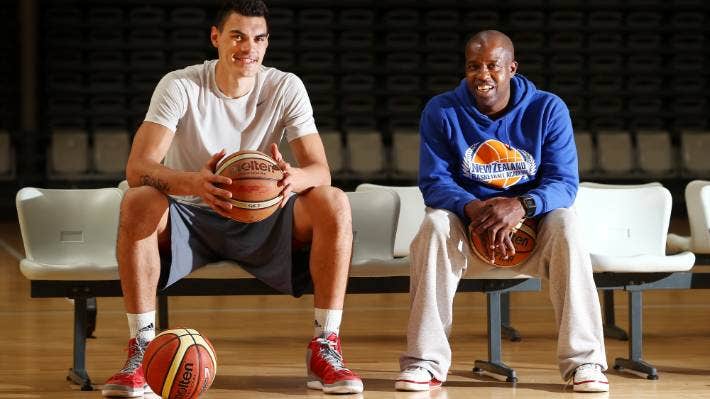
Kenny McFadden
March 25, 2022



NICKNAME/S: Jumpin’ Joe
BIO: Born in East Saint Louis, Illinois (USA) and attended Assumption High School in Louisville, Kentucky.
FAMILY: His daughter Ahlise played college basketball for Oregon University
Joe Hurst made his NBL debut with the Hobart Devils at 24 years of age. He scored 28 points in his first game.
The Devils season started off on a negative, with many fans disappointed to see star players Steven Carfino (to Sydney) and Paul Stanley allowed to leave the team, and replaced by the import duo of Joe Hurst and Greg Giddings.
While Hurst (31.8 points, 9.5 rebounds, 1.7 steals and 1.2 blocks) gave fans a reason to be excited, they don’t give you the name ‘Jumpin’ Joe Hurst for no reason, earning the reputation as one of the greatest dunkers in the NBL during the 1980’s. If you were in the gym when Hurst was playing, it was a sure thing you would witness some thunderous dunks being thrown down. Even one of his opponents, former NBL player Rodger Smith, said they would have dunk competitions during games when they played against each other to see who could get the biggest dunk.
The high scoring forward would go on to earn the league MVP award at seasons end, but Giddings (22.5 points, 5.0 rebounds, 5.3 assists, and 2.0 steals) managed only six games as an import point guard, before being replaced by Kelvin Scarborough (21.7 points, 4.9 rebounds, 5.8 assists, and 2.5 steals).
Jerry Dennard (11.4 points, 8.1 rebounds, and 2.8 steals), Wayne Burden (7.8 points, 3.5 rebounds, and 2.1 assists 1.1 steals) and Murray Shiels (6.8 points, 5.5 rebounds, and 0.9 blocks) were the other key players for the squad as Hobart finished in tenth place (10-14).
In a strange result, although Hurst was named NBL MVP he was left off the All-NBL First team, becoming the only MVP in history to not make the All NBL First team in the same season. Jones is one of only three players (alongside Al Green and Michael Jones) who somehow achieved the feat being named the league’s best player but not worthy of being considered the best player at his position.
1989
Amidst financial woes, Hobart attempted a 180 degree turn in 1989. The team had recorded their first winning season in 1987, but backed that up with a tenth place finish and this, combined with the loss of fan favorite players Steve Carfino and Stanley, saw the Devils facing backlash from fans and sponsors alike.
Hobart added Wayne McDaniel (33.6 points, 9.8 rebounds, and 1.3 steals) to go alongside the reigning NBL MVP Joe Hurst.
The off-court drama resulted in a coaching merry-go-round affair, with the team being coached by three different men in the first five weeks. The Devils ending the year with Tom Maher in the role.
Mid-season injuries saw Hurst (23.0 points, 9.2 rebounds, and 1.6 assists) unable to put up the same numbers as he previously had and a decision was made to bring back high scoring import Stanley (28.5 points, 6.4 rebounds, and 2.5 assists) for the final 11 games of the season. Turmoil eventually made it’s way to the playing group, with Gordie McLeod retiring at season’s end, amid threats of suing the club.
Hobart finished a disappointing tenth for the second season in a row, only this time with an even worse record (8-16).
Hurst wasn’t offered a contract in 1990 and instead played overseas, making way for the club to sign hard-working Devonport SEABL import Dan Krebs.
1992
Player coach Cal Bruton reached out to Hurst in 1992, bringing back the former NBL MVP for a third season in Australia. Hurst averaged 10.4 points, 6.7 rebounds, and 1.4 assists as the Devils finished with a 9-15 record.
At the end of the year wasn’t offered a contract to return.
CANBERRA CANNONS
2000/01
Without an NBL job, Hurst continued to play overseas and after retiring from basketball returned to Australia to live.
At 37 years of age, he made a one game cameo, filling in as an injury replacement for the Canberra Cannons in 2001.
Joe Hurst played four seasons in the NBL, playing for both the Hobart Devils and the Canberra Cannons. He averaged 21.6 points, 8.3 rebounds, and 1.2 assists in 71 NBL games.
HIGHLIGHTS:
| SEASON | AGE | TEAM | TEAM RECORD | GP | MINS | PTS | REB | AST | OR | DR | STL | BLK | TO | PF | FGM | FGA | FG% | 3PM | 3PA | 3P% | FTM | FTA | FT% | TS% | EFG% | HS |
|---|---|---|---|---|---|---|---|---|---|---|---|---|---|---|---|---|---|---|---|---|---|---|---|---|---|---|
| 2000-01 | 37 | Canberra | 3-25 (11) | 2 | 19 | 6 | 1 | 1 | 0 | 1 | 1 | 0 | 1 | 4 | 3 | 9 | 33% | 0 | 3 | 0% | 0 | 0 | 0% | 33% | 0% | 4 |
| 1992 | 28 | Hobart | 9-15 (11) | 21 | 559 | 219 | 141 | 30 | 54 | 87 | 35 | 14 | 47 | 68 | 84 | 171 | 49% | 8 | 34 | 24% | 43 | 50 | 86% | 56% | 51% | 28 |
| 1989 | 25 | Hobart | 8-16 (10) | 24 | 1,040 | 551 | 221 | 39 | 90 | 131 | 42 | 16 | 82 | 68 | 193 | 419 | 46% | 48 | 124 | 39% | 117 | 143 | 82% | 57% | 52% | 41 |
| 1988 | 24 | Hobart | 10-14 (10) | 24 | 1,083 | 764 | 228 | 22 | 94 | 134 | 40 | 28 | 70 | 69 | 294 | 624 | 47% | 36 | 97 | 37% | 140 | 182 | 77% | 54% | 50% | 51 | Totals | 71 | 2701 | 1540 | 591 | 92 | 238 | 353 | 118 | 58 | 200 | 209 | 574 | 1223 | 46.9% | 92 | 258 | 35.7% | 300 | 375 | 80.0% | 55% | 51% | 51 |
| SEASON | AGE | TEAM | TEAM RECORD | GP | MINS | PTS | REB | AST | OR | DR | STL | BLK | TO | PF | FGM | FGA | FG% | 3PM | 3PA | 3P% | FTM | FTA | FT% | TS% | EFG% | HS |
|---|---|---|---|---|---|---|---|---|---|---|---|---|---|---|---|---|---|---|---|---|---|---|---|---|---|---|
| 2000-01 | 37 | Canberra | 3-25 (11) | 2 | 9.5 | 3.0 | 0.5 | 0.5 | 0.0 | 0.5 | 0.5 | 0.0 | 0.5 | 2.0 | 1.5 | 4.5 | 33% | 0.0 | 1.5 | 0% | 0.0 | 0.0 | 0% | 33% | 0% | 4 |
| 1992 | 28 | Hobart | 9-15 (11) | 21 | 26.6 | 10.4 | 6.7 | 1.4 | 2.6 | 4.1 | 1.7 | 0.7 | 2.2 | 3.2 | 4.0 | 8.1 | 49% | 0.4 | 1.6 | 24% | 2.0 | 2.4 | 86% | 56% | 51% | 28 |
| 1989 | 25 | Hobart | 8-16 (10) | 24 | 43.3 | 23.0 | 9.2 | 1.6 | 3.8 | 5.5 | 1.8 | 0.7 | 3.4 | 2.8 | 8.0 | 17.5 | 46% | 2.0 | 5.2 | 39% | 4.9 | 6.0 | 82% | 57% | 52% | 41 |
| 1988 | 24 | Hobart | 10-14 (10) | 24 | 45.1 | 31.8 | 9.5 | 0.9 | 3.9 | 5.6 | 1.7 | 1.2 | 2.9 | 2.9 | 12.3 | 26.0 | 47% | 1.5 | 4.0 | 37% | 5.8 | 7.6 | 77% | 54% | 50% | 51 | Total | 71 | 38.0 | 21.7 | 8.3 | 1.3 | 3.4 | 5.0 | 1.7 | 0.8 | 2.8 | 2.9 | 8.1 | 17.2 | 46.9% | 0.0 | 0.0 | 35.7% | 1.3 | 3.6 | 80.0% | 55% | 51% | 51 |
| POINTS | REBOUNDS | ASSISTS | STEALS | BLOCKS | TURNOVERS | TRIPLE DOUBLES | 51 | 15 | 7 | 4 | 4 | 8 | 0 |
|---|
Guided the Southern Districts Spartans to the 1999 championship and etching his name in the minds of fans all around the state.
Hurst had been told the Kansas City Kings had intended to draft him in the NBA draft but he suffered an ankle injury in his senior year in college and instead went undrafted and went on to play for Quad Cities in the Continental Basketball Association (CBA) in 1987.
Another NBA shot came after his MVP season in Australia, he was contacted by multiple NBA teams and offered a chance to attend their training camps but he chose to play a second season with the Devils.
In the 1991–92 season, Joe Hurst played for UMF Grindavík in Iceland’s top division, appearing in 16 games and logging 362 total minutes while shooting 56.2% from the field, 27.7% on three-pointers and 76.9% at the free-throw line, with production that included 30.4 points, 12.2 rebounds, 2.2 assists and 3.3 steals per game.
In 1995, he appeared for Hageby BK in the FIBA European Cup for Men’s Clubs, averaging 22.5 points, 7.8 rebounds and 1.5 assists across four games.
Hurst also played professionally for teams in Croatia, Indonesia and Portugal, and he spent part of the 1990s playing in France.
Joe Hurst earned a sporting scholarship with Northwest Missouri State University in 1982 and went on to complete a five-year collegiate career with the Bearcats from the 1982–83 season through 1986–87, competing in NCAA Division II as a member of the Mid-America Intercollegiate Athletics Association (MIAA).
Across his five seasons at Northwest Missouri State, Hurst appeared in more than 200 games, reflecting both his durability and consistent role within the program, and he was selected as an all-conference representative in three separate seasons.
As a sophomore, Hurst led the MIAA in blocked shots with 53, a total that set a Northwest Missouri State single-season record at the time, and he played a key role on a Bearcats team that finished with a 24–7 record and advanced to the South Central Regional Tournament under head coach Lionel Sinn.
During his junior season, Hurst finished first on the team in scoring, rebounding, blocked shots, and steals, highlighting his all-around statistical impact and versatility within the Northwest Missouri State lineup.
Hurst’s final two collegiate seasons were his most decorated, as he was named team MVP in both years and earned All-MIAA First Team honours in each of those seasons, cementing his status as one of the conference’s premier players during the mid-1980s.
He concluded his Northwest Missouri State career ranked in the program’s top five all-time in both career scoring with 1,580 points and career rebounding with 777, while also setting the school’s all-time blocked shots record with 153 rejections.
Hurst was in his final year at Northwest Missouri State when an ankle injury curtailed his season and ultimately derailed his NBA draft prospects, bringing an end to a highly productive collegiate career with the Bearcats.
- 1x time NBL Most Valuable Player (1988)
- 1x All-NBL Second Team
Whilst we try to source as much information as we can for every player who has ever played in the NBL some information on a player profile may be missing. If you have additional information on a player you'd like us to add to a profile, please send it to us using the enquiry form below.
Submissions are then sent to info@aussiehoopla.com