


“I wanna be like Mike”
to quote the 1992 Gatorade commercial.
This advertising campaign was merely a promotional ploy focused on selling sugary beverages, but it is also an example of how endemic the belief is that Michael Jordan has no equal on a basketball court, and how this myth has been spread throughout society.
Michael Jordan’s greatness is also inextricably linked to his being the best player born at the best possible time, and without these unique, once-in-a-lifetime opportunities that coincided with his career, he almost certainly would not be considered by many to be the single greatest player of all time.
Different eras provide unique opportunities that create clear advantages over players from other time periods. Jordan should not be considered the greatest ever (although he is certainly one of the greats), due to the many benefits he received simply by being born in 1963 and drafted in 1984.
How marketing and consumerism created the Jordan Myth?
The Jordan myth is perpetuated by his being in the right place at the right time. Jordan’s drafting in 1984 coincided with the reality that, up until that year, few NBA games were shown on television, with local stations broadcasting only regional games.
If you lived in Boston, you saw only Celtics games; if you lived in New York, you could see only Knicks games. (ESPN began distributing sports programming outside the United States in 1983).
This rare situation no doubt allowed Jordan’s agent, David Falk, to offer Nike a deal in which, for a lower-than-usual fee, the company could use Jordan’s image—provided he was positioned as the face of their brand. As Porter (2007, p. 69) notes, “In 1988, Jordan became the first basketball player ever to appear on a Wheaties box.”
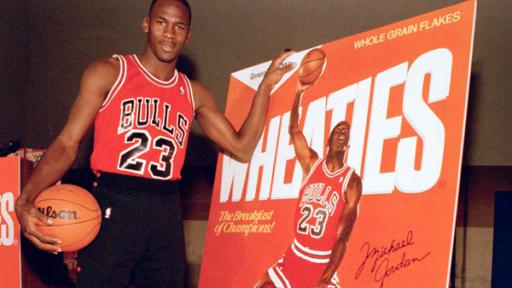
This innovative move, combined with Falk’s savvy decision to split the Jordan brand among advertisers such as Coca-Cola, Chevrolet, Gatorade, and McDonald’s, allowed for maximum simultaneous exposure. Michael Jordan was the fortunate recipient of being the first athlete to be nationally promoted by multiple consumer brands in the mid to late 1980s.
Due to the lack of NBA exposure at the time, Jordan was likely one of the first Chicago Bulls players seen by many people across the United States and around the world. Combined with ESPN’s efforts to increase brand recognition for the NBA, partnering with its latest product—an exciting rookie, Michael Jordan—became the perfect strategy to boost NBA viewership.
This strategy was executed during a period of rampant capitalism, when America echoed Gordon Gekko’s famous line in Wall Street (1987), “Greed is good.” Jordan appeared on consumer products in nearly every American household, and at a time when media and commercial saturation of a single individual was unprecedented, he performed better than any other basketball player.

People have an innate desire to belong. Those who saw Jordan during their youth want him to be the best because it enriches their lives to believe they witnessed the greatest player of all time. Jordan’s legacy is further enhanced by the fact that his career coincided with the boom in consumerism, the expansion of television, and the rise of product placement.
The Luck of the Draw in 1984
The launch of ESPN’s broadcasts allowed players from all NBA teams to become marketable both nationally and internationally for the first time. That year, the NBA Draft was decided by a coin flip. Houston won the toss, earned the number one pick, and selected big man Hakeem Olajuwon, allowing Jordan to fall to Chicago—a rebuilding team eager to build around a new star in the nation’s third-largest media market.
Had the coin flip landed tails, Portland would have received the number one pick and selected Olajuwon, causing Jordan to end up in Houston—a market half the size—on a team built around big man Ralph Sampson, who likely would have used Jordan as a complementary piece rather than the team’s primary option, at least at the start of Jordan’s career.
If Jordan had ended up in Houston instead of Chicago—the third-largest city in America—it likely would have resulted in Nike, amid a surge in consumerism, selecting a different player from the 1984 draft for its first national marketing campaign. The “Air Jordan” shoe likely would never have been created, and Michael Jordan’s likeness would not have been promoted nationwide.
David Stern became NBA commissioner in 1984, following a period during which the league struggled to market itself under Larry O’Brien’s leadership. One of his first initiatives was to revive the Slam Dunk Contest as a means of improving the NBA’s marketability, recognizing that children preferred posters of dynamic dunks over jump shots.
Had Stern not revived the contest and had ESPN not broadcast the event, Jordan’s poster likely would not have appeared in millions of children’s bedrooms during the 1980s. If the coin flip, a new commissioner, the rise of consumerism, and the first marketing campaign of its kind had not all converged in 1984, Michael Jordan likely would not have become the global icon he is today.
“The sense of possibility so necessary for success comes not just from inside ourselves or from our parents. It comes from our time: from the particular opportunities that our place in history presents us with” Malcolm Gladwell states in Outliers (2008).
Michael Jordan can’t be the greatest of all-time.
Although marketing and consumerism no doubt influenced the opinions of many who call Jordan the greatest, he remains one of the best players ever seen and was clearly the most successful of the 1990s.
However, another once-in-a-lifetime factor that benefited Jordan was the rapid dilution of the NBA—an event that had never occurred before or since—which advantaged him by weakening the league during the height of his career.
Bulls Championships came during the most diluted era in the modern NBA
While Jordan was being marketed in ways no other athlete had been during the late 1980s and early 1990s, the NBA expanded internationally. This expansion diluted the league with an influx of players—approximately 20% of the total—who likely would not have played in the NBA prior to 1988.
This dilution allowed players who peaked between 1988 and 1992 to enjoy extended periods as their teams’ top players, as the increase in teams spread elite talent more thinly across the league.
In 1987, while Jordan was struggling to advance past the first round of the playoffs, the league consisted of 23 teams. Between 1988 and 1995, when the Chicago Bulls achieved their greatest success, the NBA’s rising popularity led the league to add six expansion teams—Miami, Charlotte, Minnesota, Orlando, Vancouver, and Toronto.
Twenty-seven percent of the league’s players were redistributed among the new teams, resulting in a highly diluted league that gave the Chicago Bulls an extended window of dominance, as other franchises were unable to rebuild as quickly as teams had in the 1980s.
A review of the average age of the league’s top ten players each year, based on NBA win shares, reveals significant shifts in the NBA landscape during that period. Historically, the best NBA players tend to reach their peak performance between the ages of 26 and 28, with an average peak age of 26.9 based on data from 1985 to 2019.
From 1985 to 1993, the average age of the league’s top ten players remained within this typical range; however, between 1993 and 2000, it abruptly increased to between 28 and 31 years old.
1993’s Top 10 Players By Win Share
| Rk | Player | Pos | Age | Tm | WS▼ |
| 1 | Michael Jordan* | SG | 29 | CHI | 17.2 |
| 2 | Hakeem Olajuwon* | C | 30 | HOU | 15.8 |
| 3 | Karl Malone* | PF | 29 | UTA | 15.4 |
| 4 | Charles Barkley* | PF | 29 | PHO | 14.4 |
| 5 | David Robinson* | C | 27 | SAS | 13.2 |
| 6 | Brad Daugherty | C | 27 | CLE | 12.7 |
| 7 | Reggie Miller* | SG | 27 | IND | 11.3 |
| 8 | Larry Nance | PF | 33 | CLE | 10.7 |
| 9 | Patrick Ewing* | C | 30 | NYK | 10.6 |
| 10 | John Stockton* | PG | 30 | UTA | 10.6 |
1998’s Top 10 Players By Win Share
| Rk | Player | Pos | Age | Tm | WS▼ |
| 1 | Karl Malone* | PF | 34 | UTA | 16.4 |
| 2 | Michael Jordan* | SG | 34 | CHI | 15.8 |
| 3 | David Robinson* | C | 32 | SAS | 13.8 |
| 4 | Tim Duncan* | PF | 21 | SAS | 12.8 |
| 5 | Gary Payton* | PG | 29 | SEA | 12.5 |
| 6 | Reggie Miller* | SG | 32 | IND | 12 |
| 7 | Tim Hardaway | PG | 31 | MIA | 11.7 |
| 8 | Dikembe Mutombo* | C | 31 | ATL | 10.8 |
| 9 | Vin Baker | C | 26 | SEA | 10.4 |
| 10 | Detlef Schrempf | SF | 35 | SEA | 10.4 |
Four players remained among the league’s top ten for a five-year stretch—an occurrence that is virtually unprecedented in NBA history.
When examining the period from 1985 to 1990, only Michael Jordan and Magic Johnson consistently maintained their status among the league’s elite. Similarly, from 2014 to 2019, only LeBron James and James Harden retained their positions among the top ten. While it is not unusual for one or two generational talents to maintain such consistency, four players doing so over five consecutive seasons is extremely rare.
During the NBA’s expansion period, teams that drafted most of their rosters before the league became diluted—between 1983 and 1988—and successfully retained that talent, were among the most dominant teams of the 1990s. Franchises such as Chicago, Houston, Utah, San Antonio, and New York exemplify this model.
These teams benefited significantly from expansion. As each new franchise entered the league, existing teams—particularly mid- and lower-tier ones—were forced to give up players in expansion drafts and lost favorable positions in the NBA Draft, which they typically relied on to transition from good to great. Consequently, mid-tier teams were unable to rebuild at the pace seen in previous decades.
Modern Team Turnover vs. 1990s Stagnation
Recent NBA seasons demonstrate that newly rising teams can now more easily break into the league’s top four. For instance, franchises such as Toronto, the LA Clippers, and Denver have recently displaced long-dominant teams like Miami, Golden State, Dallas, and San Antonio. This level of turnover was not common during the NBA’s expansion era.
Between 1993 and 1998, the top teams remained relatively unchanged as the league adapted to its 30-team structure. In 1993, the Bulls, Jazz, Suns, and Spurs all had records that placed them in the top eight. By 1998, those same four franchises were still ranked in the top eight. The persistence of half the top eight teams over five years is highly unusual in a competitive sports league.
This consistency is further contextualized by the state of the league in 1998, the year Jordan secured his sixth championship. That season, six teams failed to win more than 20 games. In other words, 20% of the NBA lost over 60 games. Under such conditions, it is unsurprising that the Chicago Bulls were able to compile a record-breaking 72-win season.
Draft Dilution and the Rise of High School Prospects
This pattern was not a one-time anomaly. A similar trend emerged when the NBA began allowing players to enter the draft directly from high school. Mid-tier teams, already challenged by expansion, now faced a diluted talent pool spread across 30 franchises. As a result, the league’s top incoming talent was often either drafted before they were NBA-ready or sent to brand-new franchises such as Toronto, Vancouver, and Minnesota, which lacked the infrastructure and developmental systems to support early player growth.
Consider how Kevin Garnett (5th overall), Kobe Bryant (13th), Jermaine O’Neal (17th), and Tracy McGrady (9th) were all selected between 1995 and 1997 by mid-tier teams attempting to acquire high-upside players within a weakened draft system. These cases exemplify how mid-tier franchises adapted to a draft process that had become approximately 20% more competitive due to the addition of six new teams.
At the same time, elite college prospects increasingly began declaring for the NBA Draft after only one or two collegiate seasons, bypassing their junior and senior years. As a result, the NBA was forced to take on a greater role in talent development. Consequently, the average age of the league’s best players declined to between 25 and 27, especially after the league expanded to 30 teams and implemented a younger draft process.
Reassessing Jordan’s Legacy in Context
No matter which statistical metrics one uses to compare Jordan to his peers, his accomplishments are often matched—or even surpassed—by other great players. Many of these athletes have been forgotten or overlooked, particularly by those who rely heavily on outlets like ESPN as their primary source of basketball analysis.
While there is little doubt that Jordan was the most dominant player of the 1990s, and the Chicago Bulls the decade’s most successful team, it is reasonable to suggest that they might not have won six championships if the league had not slowed down the rebuilding process for competing franchises through expansion.
Had the league not expanded to 30 teams, removed key players from mid-tier rosters through expansion drafts, and pushed back their draft positions to accommodate incoming franchises, those mid-tier teams from 1988 to 1993 would likely have developed more rapidly—and potentially prevented the Bulls from capturing their fifth and sixth titles.
So how were these contextual factors overlooked?
The consumerism of the 1980s and 1990s was so effective in promoting Michael Jordan that it succeeded in obscuring many of the more relevant statistical and structural dynamics that shaped his era. The result is a narrative in which essential context is often omitted in favor of marketing-driven myth.
0 titles without All-Stars: Michael Jordan needed a very talented cast to help him win his titles.
The success of the Chicago Bulls was always reliant on Jordan’s exceptional scoring ability rather than on ball distribution to teammates, which would have created difficult defensive switches.
This approach proved limited until Scottie Pippen became an All-Star in 1990 and the team added Horace Grant or Dennis Rodman—both NBA All-Stars—to support deep playoff runs.
This strategy had not been effective during the 1980s, prior to the Bulls drafting Pippen, and any suggestion that Jordan lacked a strong supporting cast is greatly mistaken. Jordan was never without at least one All-Star teammate during his championship seasons, which is more than many other teams could claim.
Isiah Thomas, for instance, won a championship in 1989 as the sole All-Star on his team—a feat that has been accomplished several times in NBA history and is by no means impossible. Recent examples include:
- 2011’s Dallas Mavericks only All-Star was Dirk Nowitzki
- 2004’s Detroit Pistons only All-Star was Ben Wallace
- 2003’s San Antonio Spurs only All-Star was Tim Duncan
- 1994-95 Hakeem Olajuwon, whose Rockets won back to back titles in Jordan’s absence won his titles as the team’s only all-star. But this is something that Jordan could not do.
The Chicago Bulls won 57 games in 1993.
When Jordan retired to pursue a career in baseball, they won 55 the following season—only two less losses.
The Chicago Bulls won 57 games in 1993. When Jordan retired to pursue a career in baseball, they won 55 games the following season—only two fewer.
Supporters of Jordan often claim that he had a weak supporting cast, yet they frequently ignore the Bulls’ continued success in his absence, which directly challenges that narrative.
Typically, when a great player leaves a team, its performance declines significantly. This trend can be observed in several notable cases. When LeBron James left the Cleveland Cavaliers in 2010, the team’s record dropped by more than 40 wins the following season. Similarly, when Shaquille O’Neal departed the Los Angeles Lakers, the franchise struggled to make the playoffs in the immediate years that followed.
Therefore, when the so-called “Greatest Player of All Time” retired from the Bulls after the 1993 season, one might reasonably expect a drastic decline—perhaps a drop of 20 or more wins. In reality, led by the outstanding play of Scottie Pippen, the Bulls lost only two additional games.
If a league MVP—and arguably the greatest player of all time—leaves his team, shouldn’t that team collapse without him?
6 expansion teams: Michael Jordan won his championships when the league was at its weakest.
We’ve already addressed this point, but to further emphasize it, consider the playoff opposition that Jordan and the Bulls faced most frequently during their championship runs: New York, Indiana, Seattle, and Utah.
Jordan’s success often came against defenders who were physically smaller than he was, such as John Starks and Hersey Hawkins, or against three-point specialists who were not known for their defense, like John Stockton, Jeff Hornacek, and Reggie Miller.
The only great player Jordan faced who was both a Hall of Famer and an elite defender was Gary Payton. Despite being two inches shorter, 35 pounds lighter, and dealing with a calf injury, Payton still gave Jordan considerable difficulty.
Consider Jordan’s production in the 1996 NBA Finals. In the first three games—before Payton began guarding him—Jordan averaged 31 points per game on 46% shooting from the field, 50% from three-point range, and 12.3 free throw attempts per game.
In the final three games, with Payton as his primary defender, those numbers dropped to 23.7 points, 36.7% shooting from the field, 11.1% from three, and 10 free throw attempts.
First three games : 31 points, 46 fg%, 50 3fg%, 12.3 FTA.
Last three games: 23.7 points, 36.7 fg%, 11.1 3fg% 10 FTA.
You have to wonder if Jordan has “Six Rings” if Payton doesn’t have a calf injury.
By contrast, earlier legends faced far more imposing individual matchups. Bill Russell had to defeat Hall of Famers Wilt Chamberlain, Dolph Schayes, and Bob Pettit to win his titles. Kareem Abdul-Jabbar battled Chamberlain, Hakeem Olajuwon, and the legendary Boston Celtics frontcourt of Larry Bird, Kevin McHale, and Robert Parish.
Even Jordan’s closest “heir apparent,” LeBron James, has had to defeat multiple players considered among the top twenty of all time—such as Tim Duncan, Kevin Garnett, and Kevin Durant—to secure his championships.
While Jordan may have six titles, and Kareem and LeBron sit behind him with five and four respectively, it is a fact that Jordan won his championships against noticeably weaker opposition. And surely, the quality of competition must be a serious consideration in any discussion of who truly deserves the title of the greatest player of all time.
3 year drop off?
Only three years after being named All-Star MVP, League MVP, Finals MVP, and NBA champion, Michael Jordan was a shadow of his former self in Washington.
Granted, he was no longer in his prime during his time with the Wizards. But we are still talking about the man many regard as the “Greatest Player of All Time,” aren’t we? Only three years removed from winning a championship and virtually every MVP award possible, one might expect that the greatest player ever could at least carry his team to the playoffs. Yet the Wizards failed to make the postseason in either of the two years Jordan played for them.
Wilt Chamberlain was never featured on children’s cereal boxes, and Bill Russell was rarely seen on national television outside of Boston. A multitude of great players have accomplished remarkable feats, only to be largely overlooked due to the global market saturation of the Jordan brand—an image perpetuated by companies eager to sell the latest cereal, sugary beverage, or athletic shoe.
What else is there?
All of the other Jordan is the greatest arguments are subjective and futile.
‘Jordan won six Championships’
True, but Bill Russell won eleven championships. If we are using championship success as the primary metric, then Jordan ranks only as the tenth greatest player of all time—behind Robert Horry and Jim Loscutoff, who each won seven titles, mind you.
When this inconsistency is pointed out, it is typically dismissed by invoking the idea that Jordan won more playoff games as a franchise centerpiece. This argument is used to discount Russell’s claim (as a relic of a bygone era) and Horry’s (because he was not a franchise player).
Yet LeBron James—another legitimate contender for the title of greatest player of all time—has already won a comparable number of playoff games. However, whenever this is raised, the conversation often circles back to the now-familiar refrain: Jordan won “six rings.”
‘They had to change the rules for Michael Jordan’
Very few players ever forced the NBA to changes it’s rules. The game hadn’t seen a player use their athleticism to score like Jordan before and implemented a number of officiating changes as a result.
Illegal offense was introduced to clear out isolation on one side of the court and the NBA’s rule on hand checking was amended to say;
“A defender will not be permitted to use his forearm to impede the progress of an offensive player who is facing the basket in the frontcourt”.
These rules were changed to make it easier for athletic wing players to score against the league’s big men, who had dominated the league up until that time. This ultimately led to the death of the traditional NBA centre.
Wilt Chamberlain on the other hand, forced the NBA to make changes that made it more difficult to score, not easier, changes like;
- Widening the lane from 12 feet to 16 feet to move Wilt away from the basket.
- Offensive interference/goal tending rules introduced to stop him blocking shots. Blocked shots were not a statistic during Wilt’s career but RealGM found that in the 112 full games which exist of Wilt’s career, he averaged 8.8 blocks per game.
- Shooters cannot cross the free throw line during free throws. Wilt would throw it against the backboard for dunks.
- The ball cannot be in-bounded over the backboard. In-bounders would routinely stand underneath the basket and lob the ball over the backboard for Wilt.
If you are the greatest player of all-time shouldn’t the league be changing the rules to make it harder for you instead of easier?
‘But he was also a five time league MVP’
So too were Bill Russell (five times) and Kareem Abdul-Jabbar (six times). Heck, it’s likely will LeBron James will too before he retires (LeBron currently has four NBA MVP’s).
‘He was the NBA’s greatest scorer’
Jordan averaged 30 points per game, but so did Wilt Chamberlain, who once scored 100 points in a game, something Jordan came nowhere close to.
Many other players had greater scoring performances than Jordan;
- Kobe Bryant – 81 point career high
- David Thompson – 73 point career high
- Elgin Baylor – 71 point career high
- David Robinson – 71 point career high
If you needed a player to score as many points as possible in one game wouldn’t one of these players be more qualified?
But other players say he was the best?
Take Charles Barkley, whose outspoken commentary frequently attracts attention. He often refers to Michael Jordan as the greatest basketball player of all time. Barkley—and many others in the media—regularly rank Jordan at the top. But do they have an ulterior motive? Could declaring Jordan’s greatness also serve to enhance their own legacies?
Barkley was denied an NBA championship by Jordan multiple times, both during his time in Phoenix and in Philadelphia. Therefore, it benefits Barkley to frame Jordan as the “Greatest Ever,” as this implies he was denied a title not because of personal shortcomings, but because he played in the same era as the most dominant player in history.
Many NBA media personalities are former players from the 1990s who were similarly denied championships by Jordan. Their own legacies are strengthened when Jordan is elevated in this way, as it casts their failures in a more forgiving light.
But what about the perspectives of players, coaches, and analysts whose opinions are not entangled with personal history or self-interest? What do those individuals—who have no incentive to benefit from naming Jordan the greatest—have to say?
Phil Jackson, who coached Michael to all six of his championships said he would take Bill Russell over not Michael Jordan.
Julius Erving, the man Jordan spent his entire career trying to emulate points to Lakers legend Kareem Abdul-Jabbar as the greatest of all time.
” For him to that (being the best ever). for me, he (Lebron) has to surpass Kareem Abdul-Jabbar. He is the best to ever play the game” said Erving
In 1985, Larry Bird called Jordan as a rookie the best ever. But when MJ retired in 1998, he said: “Is he the greatest? He’s in the top two.”
Kareem Abdul-Jabbar and Oscar Robertson, two men who belong in the conversation of greatest players also, have made it known that they do not rate Jordan as the greatest NBA player ever. Both men have stated that there are several players are in the conversation, Abdul- Jabbar adding that he thinks Oscar Robertson was superior to both Jordan and Lebron
If Bill Russell had 120 million social media followers like LeBron James, had billions of marketing dollars from megabrands like Nike and Wheaties promoting his on-court exploits as Jordan did, and had each of his eleven championships broadcast live and viewed by billions around the world—would he be viewed differently today?
This article is not arguing that Jordan was not a great player, nor is it denying that he deserves to be in the conversation for the greatest of all time. The point is that we cannot objectively compare players across different eras—there are simply too many variables at play.
Attempting to evaluate players who never competed against one another and played in vastly different contexts is not only impossible, but fundamentally unfair.
League expansion, advancements in technology, evolving training regimens, and changing economic landscapes have drastically transformed the NBA from decade to decade. These shifts make it impossible to definitively answer the question, “Who is the greatest basketball player of all time?”
While Jordan’s off-court impact through branding and marketing may never be equaled, the title of “greatest ever” certainly has been challenged.
Had the league not expanded—and if lottery teams had not been forced to undergo longer rebuilding periods—does Jordan still win six titles? Perhaps he wins only five. Or maybe just four.
Then how would he compare to players like Shaquille O’Neal, who won four championships across two different teams? Or Tim Duncan, who secured five titles? What about Kobe Bryant, who not only matched Jordan’s five championships but also surpassed him in nearly every major all-time statistical category?
We cannot compare eras. Jordan is undoubtedly one of the greatest—but it is unfair to definitively claim that he is the greatest.
REFERENCES
- Porter, David 2007. Michael Jordan: A Biography, Greenwood Publishing Group 2007.
- Wall Street 1987, Feature film, Twentieth Century Fox, Los Angeles.
- National Basketball Association (NBA) 2004, Official Rules of the National Basketball Association: 2004–2005 Season, NBA, New York.
- Jordan Michael, MJ unauthorized: a collection of quotes in four quarters, Bonus Books, 1998.
- Gladwell, M. 2008, Outliers: The Story of Success, Little, Brown and Company, New York.

2 Responses to the post:
Great article.