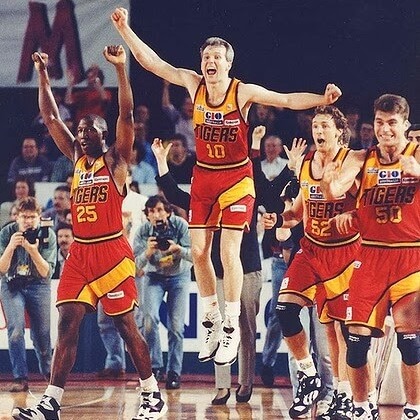
Andrew Gaze
July 23, 2020


BIO: Rowan Gomes was born in St. John’s (Antigua & Barbuda).
Rowan Gomes made his NBL debut with the Melbourne Tigers at 25 years of age. He scored nine points in his first game.
Rowan Gomes played one season in the NBL. He averaged 12 points, 6.5 rebounds, and 2 assists in 2 NBL games.
| SEASON | AGE | TEAM | TEAM RECORD | GP | MINS | PTS | REB | AST | OR | DR | STL | BLK | TO | PF | FGM | FGA | FG% | 3PM | 3PA | 3P% | FTM | FTA | FT% | TS% | EFG% | HS |
|---|---|---|---|---|---|---|---|---|---|---|---|---|---|---|---|---|---|---|---|---|---|---|---|---|---|---|
| 1988 | 25 | Melbourne | 8-16 (12) | 2 | 88 | 24 | 13 | 4 | 7 | 6 | 3 | 0 | 8 | 7 | 9 | 23 | 39% | 0 | 1 | 0% | 6 | 8 | 75% | 45% | 39% | 15 | Totals | 2 | 88 | 24 | 13 | 4 | 7 | 6 | 3 | 0 | 8 | 7 | 9 | 23 | 39.1% | 0 | 1 | 0.0% | 6 | 8 | 75.0% | 45% | 39% | 15 |
| SEASON | AGE | TEAM | TEAM RECORD | GP | MINS | PTS | REB | AST | OR | DR | STL | BLK | TO | PF | FGM | FGA | FG% | 3PM | 3PA | 3P% | FTM | FTA | FT% | TS% | EFG% | HS |
|---|---|---|---|---|---|---|---|---|---|---|---|---|---|---|---|---|---|---|---|---|---|---|---|---|---|---|
| 1988 | 25 | Melbourne | 8-16 (12) | 2 | 44.0 | 12.0 | 6.5 | 2.0 | 3.5 | 3.0 | 1.5 | 0.0 | 4.0 | 3.5 | 4.5 | 11.5 | 39% | 0.0 | 0.5 | 0% | 3.0 | 4.0 | 75% | 45% | 39% | 15 | Total | 2 | 44.0 | 12.0 | 6.5 | 2.0 | 3.5 | 3.0 | 1.5 | 0.0 | 4.0 | 3.5 | 4.5 | 11.5 | 39.1% | 0.2 | 0.0% | 0.5 | 75.0% | 45% | 39% | 15 |
| POINTS | REBOUNDS | ASSISTS | STEALS | BLOCKS | TURNOVERS | TRIPLE DOUBLES | 15 | 7 | 3 | 3 | 0 | 7 | 0 |
|---|
Rowan Gomes was drafted by the Denver Nuggets with pick #146 in the 1987 NBA Draft.
Gomes played professionally in Spain after his 1987 draft year. He also played for Deputy Quakers in Antigua and Barbuda where Gomes was part of the Bulldogs teams that dominated in the late 1980s and early 1990s alongside Noel “Nia” Roberts, Wayne “Doc” Harris, Carl “Bowlie” Knight, Richie Francis, and Eustace “Spud” Davis. In 2016, the Division One leading block shot award in Antigua and Barbuda was renamed in his honour.
Gomes played college basketball at Hampton University, As a freshman in 1983-84 he appeared in 10 games for Hank Ford’s Pirates in the CIAA and averaged 2.5 points and 2.8 rebounds while shooting 33.3 percent from the field and 72.2 percent at the foul line.
He remained with Hampton for the 1984-85 season, again playing under Ford, and his production climbed to 25 games, 6.1 points per game and 4.7 rebounds per game while converting 54.0 percent from the field and 57.7 percent from the free-throw line.
Gomes made a major jump as a junior in 1985-86, playing 22 games and averaging 10.9 points and 8.6 rebounds per outing.
That 1985-86 campaign also saw him collect 190 rebounds, which made him Hampton’s team leader on the glass that season, and he added 13 assists and 13 blocked shots.
By his senior year in 1986-87, Gomes had become one of Hampton’s most efficient interior scorers, playing 26 games and averaging 11.8 points and 7.8 rebounds per game while making 120 of 192 field-goal attempts.
His 62.5 field-goal percentage in 1986-87 ranked among the best single-season marks in Hampton program history, and that season he also averaged 0.7 steals and 1.0 blocked shots per game.
Across his four-year college career from 1983-84 through 1986-87, Gomes played 83 games and averaged 8.7 points and 6.5 rebounds per game with a 61.0 field-goal percentage and a 60.4 free-throw percentage.
He wore No. 45 at Hampton, finished his career with 58 blocked shots to sit among the program’s career leaders in that category, and graduated with a degree in physical education.
Gomes moved to Virginia in 1982 before beginning his Hampton career, adapted from the freer style of play he had known in Antigua to the American college system, and developed from a limited-use freshman into a productive senior frontcourt player in Ford’s program.
His college run ended with NBA draft recognition in 1987 when Denver selected him in the seventh round with the 146th overall pick, making him one of Hampton’s HBCU draft products from that era.
Whilst we try to source as much information as we can for every player who has ever played in the NBL some information on a player profile may be missing. If you have additional information on a player you'd like us to add to a profile, please send it to us using the enquiry form below.
Submissions are then sent to info@aussiehoopla.com