

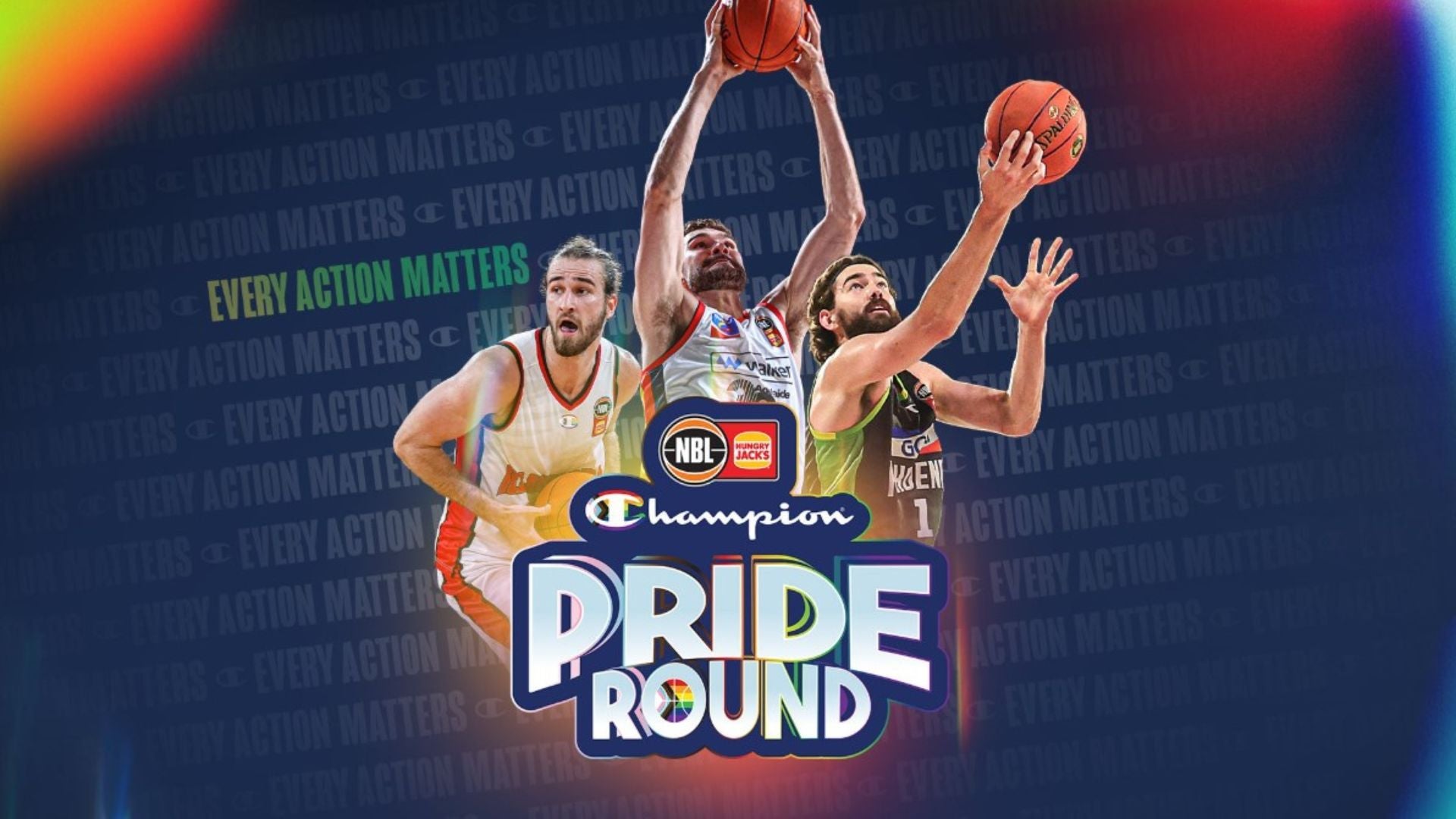
In recent weeks, NBL Pride Round has been accompanied by a wave of opinion pieces — including Michael Randall’s “Pride Round: Why the NBL should be proud it won’t ever ‘shut up and dribble’” — praising the initiative while dismissing its critics.
This has been something I’ve been thinking about and discussing with people since Indigenous Round.
I think we all need a little perspective sometimes. https://t.co/2D65bvtS5K— Michael Randall (@MickRandallHS) February 3, 2026
But the argument that any criticism of the National Basketball League’s social-issue messaging is “narrow-minded” rests on a false binary: that you must either support league-mandated advocacy or oppose inclusion itself.
That framing doesn’t hold up under even modest scrutiny. It ignores the possibility that someone can support equality, respect, and fair treatment for all people while still questioning whether symbolic, top-down campaigns are the best or most effective way to achieve those goals.
What follows is not an argument against gay people, Indigenous Australians, or multiculturalism. It is an argument for evidence-based inclusion, voluntary expression, and institutional restraint — principles that historically produce more cohesion, not less.
1. Branding, not dialogue
When the NBL first introduced Pride Round, players and staff were required to attend workshops focused on LGBTQ+ inclusion. For some, those sessions touched on issues that conflicted with their personal, cultural, or religious beliefs, including debates around gender identity and participation in women’s sport.
This season, the messaging appears to have softened to the slogan: “We see you, let’s talk.” But that raises a simple question — where is the conversation?
The phrase is rhetorically appealing, yet functionally hollow. Symbolism without space for dissent is not dialogue; it is branding.
From a policy perspective, that distinction matters.
- In Australia, same-sex marriage was legalised through a national postal survey in 2017, with 61.6% public support.
- Long-running datasets such as HILDA and ABS social inclusion indicators show that gay and lesbian Australians now report comparable outcomes to the broader population across employment, income stability, and civic participation.
- Acceptance rates for homosexuality in Australia consistently exceed 80% in longitudinal attitudinal studies.
When a group is no longer structurally marginalised in law, labour access, or civil rights, the burden of proof shifts. The question is no longer simply, “Why shouldn’t we talk?” but rather, “What specific problem is this solving — and for whom?”
Real conversation requires a plurality of views. Symbolism without space for dissent is not dialogue; it is branding.
2. “LGBTQ+” is not a single constituency — and the data proves it
Multiple population studies show that “LGBTQ+” is not a single, unified constituency with identical needs or priorities.
In Australia, the Private Lives 3 national survey — one of the largest studies of LGBTQ health ever conducted — found that transgender and gender-diverse participants reported significantly higher levels of psychological distress and poorer overall health than gay and lesbian participants (Private Lives 3 National Report, Rainbow Health Victoria, 2020). That reflects very different healthcare needs and policy priorities between the groups.
International data shows similar divides. A 2025 study by the Pew Research Center found that 61% of LGBTQ adults believed gay and lesbian people were widely accepted in society, compared with just 13% for transgender people and 14% for non-binary people (Pew Research Center, The Experiences of LGBTQ Americans Today, 2025). That gap points to very different lived experiences within the same umbrella.
Research has identified a measurable subgroup of gay, lesbian, and bisexual people who support same-sex rights but disagree with certain transgender-related policies, particularly those involving women’s sport and single-sex spaces (Burke, Kazyak & Oliver, LG but Not T: Opposition to Transgender Rights Amidst Gay and Lesbian Acceptance, The Sociological Quarterly, 2023). This indicates that the LGBTQ population does not hold a single, unified set of political views.
Generational data reinforces this divide. Figures from the Australian Bureau of Statistics, the UK Office for National Statistics, and Gallup all show younger people are far more likely to identify as LGBTQ than older cohorts, and more likely to use newer identity labels, while older generations predominantly identify as gay or lesbian (ABS, First LGBTI+ Population Estimates, 2023; ONS Sexual Orientation Data, 2024; Gallup LGBTQ Identification Poll, 2023–2024).
Taken together, the data shows major differences in health outcomes, policy priorities, and identity across the LGBTQ spectrum. Treating all of these groups as a single, unified constituency oversimplifies a far more complex reality.
3. Pride Round as performative inclusion — the problem of “rainbow washing”
Annual Pride Rounds function like ESG checkboxes: high visibility, low accountability.
Key issues:
- There is no published evidence that Pride Rounds measurably improve player wellbeing, grassroots participation, or discrimination outcomes.
- No longitudinal tracking of fan sentiment or inclusion metrics is released.
- Jerseys are sold, sponsors activated, and the league moves on.
In corporate governance literature, this is referred to as symbolic compliance — action designed to signal virtue rather than produce outcomes.
Many gay commentators, athletes, and sport researchers have criticised initiatives like this as “rainbow-washing” — symbolic gestures that look inclusive but lack meaningful, lasting impact.
- Celebration without structural change: Sport policy bodies such as the Australian Sports Commission have warned that Pride-themed campaigns can be perceived as tokenistic when they aren’t backed by year-round policies, enforcement, and measurable inclusion strategies.
- Branding without measurable benefit: Research into sport marketing and inclusion consistently notes that one-off Pride activations risk functioning as reputation-building exercises for leagues and sponsors if they aren’t tied to clear outcomes for participants on the ground.
If inclusion is the goal, why is it time-boxed, marketable, and sponsor-friendly, rather than embedded year-round in welfare policy, junior pathways, or anti-harassment enforcement?
🏳️🌈 Why do we have a Pride Round?
Brisbane Spectres President Barb Kirby explains the purpose of the round and the importance fostering a welcoming and inclusive atmosophere in our sport. pic.twitter.com/2lFGzyF87c
— Brisbane Bullets (@BrisbaneBullets) February 6, 2026
4. “Shut up and dribble” no longer exists — and invoking it is misleading
The phrase originated in U.S. culture-war commentary, but using it in the context of Australian sport in 2025 misrepresents reality.
Across professional sport, leagues and teams already:
- Actively promote political and social messaging
- Amplify social justice campaigns
- Encourage athlete activism and public advocacy
The National Basketball League itself:
- Regularly platforms political and social positions
- Faces minimal institutional pushback for doing so
- Operates in a media environment broadly sympathetic to advocacy
So the criticism is not that “athletes shouldn’t speak.”
It is that institutions should not compel speech or enforce values alignment.
That distinction matters.
Voluntary expression is a core principle of a liberal society.
Mandated symbolism is not.
5. Pride Round is fundamentally different from Indigenous or Multicultural rounds
Lumping Pride Round together with Indigenous or Multicultural Rounds obscures critical differences.
Indigenous Round:
- Recognises a constitutionally and historically distinct group
- Addresses unresolved sovereignty, health, incarceration, and economic gaps
- Is supported by clear, ongoing disadvantage metrics
Multicultural Round:
- Celebrates demographic reality
- Aligns with immigration history and civic pluralism
- Does not require ideological agreement, only coexistence
Pride Round, by contrast:
- Is tied to contested beliefs about sex, gender, and identity
- Encompasses unresolved policy debates
- Requires symbolic endorsement rather than recognition
Recognition of people ≠ endorsement of ideology.
That distinction is routinely ignored.
6. Forced inclusion is not inclusion — and it creates internal conflict
True inclusion is opt-in, not enforced.
Organisational psychology research consistently finds:
- Mandated value statements increase resentment, not cohesion
- Forced compliance reduces trust among team members
- Silence is mistaken for agreement, masking internal fractures
We’ve already seen signs of this tension in the NBL itself.
- The Cairns Taipans have previously chosen not to take part in Pride Round activations.
- The New Zealand Breakers have also stepped away from elements of the round.
- Multiple players across the league have opted out of Pride-related activities or expressed discomfort with certain messaging.
Pressure is being ramped up on the @NZBreakers to reverse their decision not to wear the Pride flag in next year’s @NBL Pride Round.
The pride cult are now in full heresy-hunt mode.
– because nothing says “inclusion” like demanding compulsory obedience.https://t.co/zJV8tPvDRO— Ro Edge (@rosey_nz) November 19, 2025
These examples suggest that the issue is not universally embraced inside locker rooms, even if the public messaging implies otherwise.
In practical terms:
- Players and staff with religious, cultural, or philosophical objections are given no neutral option
- Teams are pressured into uniformity
- Disagreement is moralised, not discussed
That creates division — precisely what inclusion claims to avoid.
A locker room with unspoken tension is not healthier than one with respectful pluralism.
Conclusion: Inclusion needs outcomes, not slogans
The National Basketball League deserves credit for wanting basketball to be welcoming.
But it also deserves scrutiny for how it goes about it.
Symbolic activism without:
- Clear objectives
- Measurable outcomes
- Voluntary participation
- Space for disagreement
…is not progress. It is performance.
Sport is at its best when it creates room for difference, not when it demands alignment. If the league truly wants to “see” everyone, it must first accept that not everyone sees the world the same way. Inclusion, like democracy, works best when it is earned, practical, and measurable — not enforced through symbolism.
And if the goal is genuine impact, there are themed rounds that would deliver far more for the sport, its players, and its communities.
A better option: Access & Participation Round
The premise: Basketball should be playable for every kid, everywhere.
This approach would have broader impact than Pride Round because:
- It affects every community — metro, regional, Indigenous, migrant, and low-income families.
- It is not ideologically contested.
- It produces hard outcomes: more kids playing, more coaches, better retention, more referees, and stronger local clubs.
The Australian Sports Commission has repeatedly noted that cost remains one of the biggest barriers to youth sport, and that participation levels have not fully recovered in some demographics since the COVID-19 disruption. That means the largest inclusion gap in Australian sport today is not identity-based — it is access-based.
What the NBL could actually do (not just jerseys):
- A league-wide registration relief fund, that every home game, the team and a sponsor would each add some money to a shared fund that helps kids who can’t afford to play basketball.
- “Shoes and uniforms” banks in each club region.
- Referee and coach fast-track scholarships to address major participation bottlenecks.
- Basketball courts and programs funded in disadvantaged areas.
How you measure success:
- Number of fee waivers funded
- New junior registrations in target postcodes
- Year-on-year retention rates
- New referees and coaches accredited
This is the cleanest “big impact” round because it is practical, apolitical, and directly grows the sport. Rather than signalling that certain groups are welcome, it removes the biggest barrier stopping people from playing in the first place.
Another high-impact option: Mental Fitness Round
Pride Round is most often marketed as the league “taking a stand” for people in that community who face exclusion or stigma. And there is no doubt that for some athletes, that experience is real. Isaac Humphries has spoken openly about the mental health toll of being a closeted gay basketballer, describing how the fear and pressure contributed to severe distress, including suicidality.
But that is precisely the point: the strongest, most compelling argument Pride Round makes is not really about branding or symbolism — it’s about mental health harm. If the league’s core justification is that “people are struggling and need support,” then why focus on a narrower identity campaign when you could address the larger, measurable crisis that affects the NBL’s core demographic and the broader community?
Mental health is one of the most urgent issues facing the league’s audience — young men and families. Suicide was the leading cause of death among Australians aged 15–44 in 2023 (AIHW summarising ABS data), and male suicide rates are consistently higher than female rates across age groups. The ABS also reports suicide as the leading cause of death for ages 15–44 and highlights the scale of premature mortality linked to it.
That means the problem touches not only players and fans, but fathers, brothers, sons, teammates — the people who make up the backbone of basketball participation and NBL support. A Mental Fitness Round would still cover the same human reality Pride Round points to (distress, isolation, belonging), while reaching a far larger share of Australians and doing so with clearer outcomes.
The premise: Strength is getting help early.
Partners: Beyond Blue, Lifeline, headspace, Black Dog Institute.
What it includes: Players speaking about habits and help-seeking (not politics), free community sessions at every club (parents + teens; stress, performance pressure, alcohol and gambling harms), and a simple 3-step help pathway promoted in every broadcast and arena.
How you measure it: hotline referrals driven by the campaign, attendance at sessions, uptake of club wellbeing resources, and completion of screening tools (where partners provide them).
In short: Pride Round’s most persuasive case is that some people, including elite athletes, have suffered mentally under stigma. Humphries is proof of that. But the solution that creates the greatest good — and the least division — is to tackle the bigger, evidence-backed mental health crisis directly.
The real choice
If the league wants to prove it is serious about inclusion, the test is simple:
- Is the round measurable?
- Does it help more people play or live better?
- Does it unite rather than divide?
Because inclusion that produces outcomes will always matter more than inclusion that produces headlines.