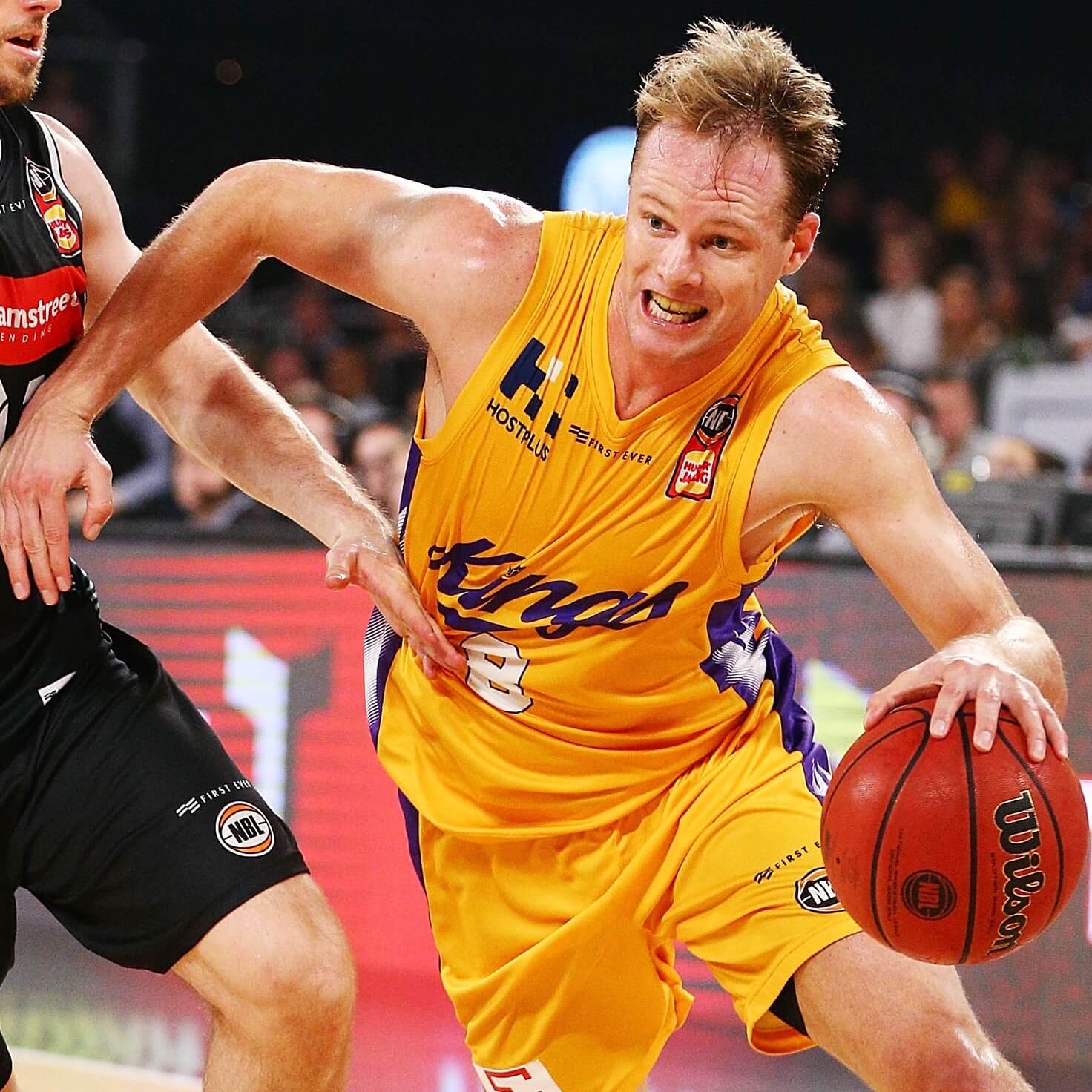
Robert Rose
July 23, 2020


BIO: Adam Quick was born in Melbourne (VIC) and began playing basketball as a junior with the Nunawading basketball program. Quick received a scholarship to attend the Australian Institute of Sport (Canberra) in 1999. He spent one year there and played for the program’s state league team.
Adam Quick made his NBL debut with the Townsville Crocodiles at 23 years of age. He scored three points in his first game.
Following a season plagued by roster instability, the Townsville Crocodiles entered 2004/05 with a rejuvenated lineup under coach Ian Stacker. The team parted ways with Andrew Goodwin (retired), Peter Crawford (to Perth), and Mike Kelly (to Wollongong), and brought in new talent including imports Robert Brown and Casey Calvary, veteran sharpshooter John Rillie (via West Sydney), big man Derek Moore (via Adelaide), and rising stars Adam Quick and Brad Newley from the AIS.
While stars like Rillie, Calvary, and Brown headlined the Crocs’ resurgence, it was the steady contributions of Adam Quick (5.6 points, 1.9 rebounds, and 3.4 assists) across all 35 games that often helped tie the rotation together. Quick provided reliability off the bench, operating as a secondary ball-handler who could manage tempo and contribute defensively. He posted multiple efficient shooting performances and maintained one of the team’s best assist-to-turnover ratios.
Townsville’s rebuilt core quickly clicked, finishing third on the NBL ladder with a 19–13 record. Rillie (18.2 points, 7.5 rebounds, and 5.2 assists) led from the front and earned All-NBL Second Team honours. He was joined by Calvary (17.8 points, 7.9 rebounds, and 1.8 blocks), Brown (16.9 points, and 6.5 rebounds), Newley (16.0 points, and 3.3 rebounds), and veteran Robert Rose (12.8 points, 4.8 rebounds, and 3.6 assists) to form one of the league’s most balanced lineups. Quick’s consistent second-unit minutes allowed the starters critical rest and helped maintain game control.
Quick’s highlight came in the semi-final series against the Hawks, where he delivered 9 points on 4-of-5 shooting with a triple in Game 2, energizing the second unit and keeping Townsville within reach. He also scored 5 points in 20 minutes during the Elimination Final win over Melbourne, helping control the second quarter pace and feeding key contributors like Brown and Rillie.
The Crocodiles hosted the 2004/05 NBL All-Star Game on January 19, with a crowd of 5,078 witnessing a breakout 35-point MVP performance by Brad Newley. Rillie added 23 points for the Aussies, while Brown top-scored with 31 points for the World All-Stars and won the Dunk Contest. Though not an All-Star, Quick’s off-court reliability and role clarity were essential to the Crocs’ bench cohesion.
In the playoffs, Townsville overcame Melbourne 112–100 in the Elimination Final, led by Brown (22 points), Robertson (17 points), and Rillie (17 points, 10 rebounds, 6 assists). Quick chipped in 5 points and 2 assists, steadying the team through crucial stretches. Game 1 of the semi-final against Illawarra proved challenging; the Crocs were held to 2-of-15 from long range and committed 19 turnovers, falling 100–84. Game 2 was a high-intensity battle in Townsville. Quick contributed an efficient 9 points in 16 minutes, but despite big efforts from Newley (22 points) and Calvary (20 points, 12 rebounds), the Crocs fell short 109–105, ending their postseason.
Adam Quick played two seasons in the NBL, playing for both the South Dragons and the Townsville Crocodiles. He averaged 4 points, 1.4 rebounds, and 2.4 assists in 56 NBL games.
| SEASON | AGE | TEAM | TEAM RECORD | GP | MINS | PTS | REB | AST | OR | DR | STL | BLK | TO | PF | FGM | FGA | FG% | 3PM | 3PA | 3P% | FTM | FTA | FT% | TS% | EFG% | HS |
|---|---|---|---|---|---|---|---|---|---|---|---|---|---|---|---|---|---|---|---|---|---|---|---|---|---|---|
| 2006-07 | 25 | South | 15-18 (7) | 21 | 173 | 31 | 9 | 15 | 3 | 6 | 3 | 1 | 8 | 12 | 10 | 41 | 24% | 7 | 25 | 28% | 4 | 6 | 67% | 35% | 33% | 6 |
| 2004-05 | 23 | Townsville | 19-13 (3) | 35 | 778 | 195 | 68 | 119 | 14 | 54 | 22 | 1 | 50 | 48 | 67 | 155 | 43% | 37 | 94 | 39% | 24 | 31 | 77% | 57% | 55% | 17 | Totals | 56 | 951 | 226 | 77 | 134 | 17 | 60 | 25 | 2 | 58 | 60 | 77 | 196 | 39.3% | 44 | 119 | 37.0% | 28 | 37 | 75.7% | 53% | 51% | 17 |
| SEASON | AGE | TEAM | TEAM RECORD | GP | MINS | PTS | REB | AST | OR | DR | STL | BLK | TO | PF | FGM | FGA | FG% | 3PM | 3PA | 3P% | FTM | FTA | FT% | TS% | EFG% | HS |
|---|---|---|---|---|---|---|---|---|---|---|---|---|---|---|---|---|---|---|---|---|---|---|---|---|---|---|
| 2006-07 | 25 | South | 15-18 (7) | 21 | 8.2 | 1.5 | 0.4 | 0.7 | 0.1 | 0.3 | 0.1 | 0.0 | 0.4 | 0.6 | 0.5 | 2.0 | 24% | 0.3 | 1.2 | 28% | 0.2 | 0.3 | 67% | 35% | 33% | 6 |
| 2004-05 | 23 | Townsville | 19-13 (3) | 35 | 22.2 | 5.6 | 1.9 | 3.4 | 0.4 | 1.5 | 0.6 | 0.0 | 1.4 | 1.4 | 1.9 | 4.4 | 43% | 1.1 | 2.7 | 39% | 0.7 | 0.9 | 77% | 57% | 55% | 17 | Total | 56 | 17.0 | 4.0 | 1.4 | 2.4 | 0.3 | 1.1 | 0.4 | 0.0 | 1.0 | 1.1 | 1.4 | 3.5 | 39.3% | 0.0 | 0.0 | 37.0% | 0.8 | 2.1 | 75.7% | 53% | 51% | 17 |
| POINTS | REBOUNDS | ASSISTS | STEALS | BLOCKS | TURNOVERS | TRIPLE DOUBLES | 17 | 5 | 7 | 3 | 1 | 4 | 0 |
|---|
Quick joined AIS for the 1999 season, with the men’s program including Adam Quick among a group that also featured Stephen Black, Ian Crosswhite, Wade Helliwell, Andrew Murdock, Andrew Rice, Luke Schenscher, Luke Spencer-Gardner, Benjamin Tatulli, Daniel Thompson and Marcus Wright.
Quick played for Dandenong in the 2000 season before his later senior Victorian stops.
Quick joined Sandringham for the 2007 season and remained with the Sabres in 2008, when Sandringham played Dandenong in a Big V Championship Men qualifying final at Dandenong Stadium on 18 July 2008, losing 90–81 while still holding a home preliminary final place.
Quick played college basketball at Portland during the 2000–01 season and competed with the Pilots from 2000 to 2004 in the West Coast Conference under head coach Michael Holton.
In the 2000–01 season, Portland finished 11–16 overall (5–9 WCC), and Quick appeared in 26 games as a freshman, averaging 3.5 points and 1.7 rebounds per game while shooting 44.7% from the field and 71.4% from the free-throw line across 8.8 minutes per game.
Across those 26 freshman appearances, he totaled 90 points, 45 rebounds, 9 assists, 8 steals, and 6 blocked shots while posting multiple double-figure scoring games including a 14-point outing against Loyola Marymount.
In 2001–02, Portland went 13–15 overall (5–9 WCC), and Quick played 27 games, increasing his role to 6.4 points and 3.2 rebounds per game in 16.0 minutes per contest while shooting 49.0% from the floor and 73.1% at the line.
During that sophomore season, he recorded 172 total points and 87 total rebounds, with a season-high 19 points against Santa Clara and a 9-rebound performance against Gonzaga.
In 2002–03, Portland finished 14–14 overall (8–6 WCC), and Quick appeared in 28 games with 23 starts, averaging 9.8 points and 4.7 rebounds per game while shooting 51.2% from the field and 74.5% from the free-throw line in 25.4 minutes per game.
Across that 2002–03 campaign, he scored 275 total points, grabbed 131 rebounds, and added 20 assists, 17 steals, and 18 blocks, including a 24-point performance against San Diego and a double-double of 18 points and 11 rebounds against Saint Mary’s.
In 2003–04, Portland finished 13–15 overall (7–7 WCC), and Quick played 28 games with 27 starts, averaging 11.6 points and 5.8 rebounds per game while shooting 53.4% from the field and 76.8% from the free-throw line across 27.8 minutes per contest.
During his senior season, he totaled 324 points and 162 rebounds, added 28 assists, 21 steals, and 22 blocks, and produced multiple 20-point games including a season-high 26 points against Pepperdine and a 12-rebound outing against Loyola Marymount.
Across his four-year Portland career, Quick appeared in 109 games, scored 861 total points, recorded 425 total rebounds, 57 assists, 46 steals, and 66 blocked shots while finishing with a career field-goal percentage above 50%.
He graduated from the University of Portland in 2004, concluding his NCAA Division I college basketball career with the Pilots prior to embarking on his professional career.
Adam Quick moved into basketball coaching and coach development following his playing career.
Quick returned to the Nunawading Basketball program and became Head of Coach Development for the boys program, overseeing and supporting junior representative coaches.
Whilst we try to source as much information as we can for every player who has ever played in the NBL some information on a player profile may be missing. If you have additional information on a player you'd like us to add to a profile, please send it to us using the enquiry form below.
Submissions are then sent to info@aussiehoopla.com