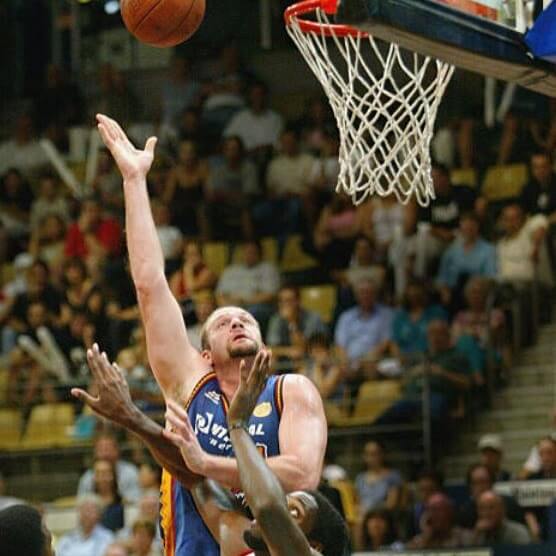
Robert Rose
July 23, 2020


NICKNAME/S: Mick
BIO: Michael “Mick” Pennisi was born in Innisfail (QLD) and was raised in nearby suburb Silkwood. An Australian-Filipino, Pennisi was a talented left-handed 3-point shooter.
He played three seasons with the Townsville Crocodiles before moving to the Philippines. where he played the majority of his career.
FAMILY: Michael’s brother, David Pennisi also played 150 games in the NBL. Pennisi holds Australian, Italian, and Filipino passports due to his heritage, with an Italian father and an Ilocano mother.
Michael Pennisi made his NBL debut with the Townsville Suns at 20 years of age. He scored four points in his first game.
Michael Pennisi joined Townsville as a development player at a time where the club was going through a roster restructure. With long-time captain Graham Kubank (retired), Jeff Warren (released), and import duo Ricky Jones and Darryl Johnson all exiting the club, Derek Rucker (via Newcastle) and Clarence Tyson (via USA) were brought in as the team’s new import duo and veteran forward Shane Froling (via Brisbane) was added to the roster.
The reset was obvious from tip-off, even in a 106–116 opening loss to Brisbane, as Clarence Tyson (38 points, 10 rebounds, 4 steals, 3 blocks), Derek Rucker (28 points, 9 assists, 4 steals), and Cameron Dickinson (23 points) showcased the Suns’ fast, high-usage attack. Pennisi remained a depth option early, continuing to learn the speed of the league behind the veteran bigs.
Townsville finally snapped its five-game skid by edging Sydney 105–104, driven by Derek Rucker (42 points, 6 rebounds, 6 assists) and reinforced by Clarence Tyson (19 points, 11 rebounds, 2 blocks) and Cameron Dickinson (26 points). In that thriller, Michael Pennisi (2 points, 1 rebound, 1 block) saw 5 minutes of court time after Shane Froling fouled out of the game.
Momentum turned again with a 108–97 win over Gold Coast—Derek Rucker (32 points, 7 assists), Cameron Dickinson (20 points), and Clarence Tyson (17 points, 13 rebounds) combining for 69—before the Suns claimed a signature 116–115 upset of Melbourne behind Rucker (43 points, 10 assists), Dickinson (27 points), and Tyson (20 points, 13 rebounds). Pennisi’s assignments in this stretch were simple but important: set early ball screens, wall up in drop coverage, and keep possessions alive on the offensive glass when called upon.
Townsville split the run home (7–7) to finish 9–17 in 11th—an uptick on 1994—while clarifying roles around the stars. Michael Pennisi (1.6 points, 1.1 rebounds, and 0.1 assists, 0.3 steals, 0.2 blocks across 9 games) closed the year as a useful depth big, earning trust in short stints and positioning himself for a bigger bite of minutes with continued development. The headliners remained team captain Derek Rucker (30.3 points, 3.8 rebounds, and 8.3 assists, 2.5 steals), Clarence Tyson (24.6 points, 14.7 rebounds, 3.5 assists, 1.5 steals, and 1.7 blocks), as well as Cameron Dickinson (20.0 points, 3.2 rebounds, 2.7 assists, and 1.3 steals), who became one of the highest scoring local players in the league. Other key contibutors included Shane Froling (7.5 points, 4.5 rebounds, and 2.4 assists across 23 games), Jason Cameron (7.4 points, 4.2 rebounds, and 2.4 assists, 1.2 steals), and Keiron Mitchelhill (7.0 points, 1.8 rebounds, and 1.6 assists). Rucker collected club MVP and All-NBL Second Team honors, while Tyson was named to the All-NBL Third Team. Mick Pennisi (1.6 points, 1.1 rebounds, and 0.1 assists) played a limited role in his rookie season, appearing in nine games.
1996
Townsville largely rolled back their 1995 roster, with the only significant adjustment being Grant Kruger (via Newcastle) stepping in for Lucas Agrums (released). The team’s nucleus of Derek Rucker, Clarence Tyson, and Cameron Dickinson remained intact, and expectations were again set around Rucker orchestrating the tempo, Tyson anchoring the paint, and Dickinson providing perimeter balance.
The season opened shakily with lopsided defeats to Perth (89–103) and Adelaide (77–117), but the Suns rebounded in emphatic style against Hobart (123–94). Rucker controlled every phase of the contest (28 points, 8 rebounds, and 13 assists), setting the tone for a blowout. A rough patch followed with close calls against Gold Coast (99–102) and back-to-back losses to Melbourne, before Townsville reset with crucial wins over North Melbourne (97–95) and Brisbane (104–89), the latter fueled by a Rucker masterclass (35 points and 16 assists). The team closed with momentum, securing three straight victories over Illawarra (130–122), Newcastle (114–100), and playoff-bound Canberra (103–100) to lock in a (9–17) record.
On the individual front, Rucker (26.8 points, 5.0 rebounds, 8.2 assists, and 2.6 steals) was again among the NBL’s elite, ranking third in scoring and second in assists. Tyson (22.8 points, 14.1 rebounds, 2.5 assists, 1.3 steals, and 1.0 blocks) dominated inside and collected club MVP honors, while Dickinson (20.1 points, 3.4 rebounds, 1.9 assists, and 1.4 steals) reinforced his standing as the top-scoring local. Supporting roles came from Keiron Mitchelhill (7.2 ppg), Shane Froling (7.2 ppg), and Kruger (5.8 ppg). Developmental forward Michael Pennisi also gained valuable minutes across six appearances (3.2 points, 2.2 rebounds, 1.0 assists, and 0.7 steals), showing flashes of floor spacing and activity on the glass that hinted at the long career ahead of him.
TOWNSVILLE CROCODILES
1998/99The summer shift brought a wholesale reboot in Townsville. After six seasons, inaugural coach Mark Bragg made way for Ian Stacker, who arrived from South East Melbourne as the club retired “Suns” and adopted the region-first “Crocodiles” following a trademark stoush with the NBA’s Phoenix Suns—a name that also echoed Stacker’s under-22 “Crocodiles” who won FIBA gold in 1997. Stacker’s appointment helped lure Sam Mackinnon north, a headline move that strained ties with mentor Brian Goorjian. Only four holdovers returned (Simon Kerle, Brad Davidson, David Pennisi, Jason Cameron) as Stacker rebuilt around Robert Rose (via Canberra), Andrew Goodwin (via North Melbourne) and James Harper (via South Florida), with Michael Pennisi rejoining from overseas to deepen the frontcourt in the league’s first true summer season.
Townsville’s debut under the Crocodiles banner was a 91–84 win over Brisbane. Mackinnon (18 points, 6 rebounds, 6 assists) and David Pennisi (18 points, 5 rebounds) led a balanced night, supported by Rose (16 points, 9 rebounds, 4 assists), Harper (15 points, 12 rebounds), and Kerle (14 points). Michael (0 points, 0 rebounds) making a brief cameo, as the Crocs outlasted Steve Woodberry’s 31 for the Bullets.
A six-game skid followed—Wollongong (86–99), Adelaide (89–94), Newcastle (96–102), Canberra (94–99), Melbourne (87–102)—before Townsville reset at home by beating Wollongong 93–80. Mackinnon delivered his regular-season peak (26 points, 14 rebounds, 7 assists on 12-of-22, 2-of-2 from three). Kerle (21 points, 7-of-8 FT) and Rose (20 points), while Pennisi (0 points, 2 rebounds and 1 assist) provided solid defence in minimal game time against the Hawks’ Clayton Ritter (22).
The following outing produced the Crocs’ most explosive offensive display, a 120-point December win over Canberra where Simon Kerle caught fire (33 points, 5 assists).
Home-court muscle became a theme for Townsville, showcased during their demolition of Sydney (116–68) and upset of reigning champion Melbourne (90–89)—though late stumbles to Sydney (101–119) and Adelaide (92–107) kept Townsville at 12–14 and seventh, just outside the playoff cut.
Rose remained the heartbeat across the year (21.8 points, 6.8 rebounds, 5.8 assists, 1.8 steals) and earned All-NBL Second Team honours while leading the league in minutes. Mackinnon blossomed into an all-court force (16.5 points, 9.3 rebounds, 4.3 assists, 2.0 steals, 1.0 blocks) and made the All-NBL Third Team. Other key contributors this season included Goodwin (14.7 points, 7.3 rebounds), Kerle (13.4 points, 2.0 rebounds, 2.3 assists) and Harper (10.2 points, 8.5 rebounds, 1.3 blocks).
Michael Pennisi (2.3 points and 2.1 rebounds) shared the centre spot with his brother David (7.0 points, 3.6 rebounds) to give Stacker usable size and fouls throughout the season. Pennisi would go on to use this season as a springboard to a long playing career in the Philippines.
| SEASON | AGE | TEAM | TEAM RECORD | GP | MINS | PTS | REB | AST | OR | DR | STL | BLK | TO | PF | FGM | FGA | FG% | 3PM | 3PA | 3P% | FTM | FTA | FT% | TS% | EFG% | HS |
|---|---|---|---|---|---|---|---|---|---|---|---|---|---|---|---|---|---|---|---|---|---|---|---|---|---|---|
| 1998-99 | 24 | Townsville | 12-14 (7) | 16 | 145.0 | 37 | 34 | 3 | 14 | 20 | 3 | 4 | 16 | 22 | 10 | 30 | 33% | 3 | 10 | 30% | 14 | 20 | 70% | 47% | 38% | 15 |
| 1996 | 21 | Townsville | 9-17 (11) | 6 | 73.0 | 19 | 13 | 6 | 5 | 8 | 4 | 0 | 9 | 13 | 6 | 17 | 35% | 2 | 3 | 67% | 5 | 8 | 63% | 46% | 41% | 6 |
| 1995 | 20 | Townsville | 9-17 (10) | 9 | 63.0 | 14 | 10 | 1 | 7 | 3 | 3 | 2 | 6 | 6 | 6 | 13 | 46% | 0 | 0 | 0% | 2 | 4 | 50% | 47% | 46% | 4 | Totals | 31 | 281 | 70 | 57 | 10 | 26 | 31 | 10 | 6 | 31 | 41 | 22 | 60 | 36.7% | 5 | 13 | 38.5% | 21 | 32 | 65.6% | 47% | 41% | 15 |
| SEASON | AGE | TEAM | TEAM RECORD | GP | MINS | PTS | REB | AST | OR | DR | STL | BLK | TO | PF | FGM | FGA | FG% | 3PM | 3PA | 3P% | FTM | FTA | FT% | TS% | EFG% | HS |
|---|---|---|---|---|---|---|---|---|---|---|---|---|---|---|---|---|---|---|---|---|---|---|---|---|---|---|
| 1998-99 | 24 | Townsville | 12-14 (7) | 16 | 9.1 | 2.3 | 2.1 | 0.2 | 0.9 | 1.3 | 0.2 | 0.3 | 1.0 | 1.4 | 0.6 | 1.9 | 33% | 0.2 | 0.6 | 30% | 0.9 | 1.3 | 70% | 47% | 38% | 15 |
| 1996 | 21 | Townsville | 9-17 (11) | 6 | 12.2 | 3.2 | 2.2 | 1.0 | 0.8 | 1.3 | 0.7 | 0.0 | 1.5 | 2.2 | 1.0 | 2.8 | 35% | 0.3 | 0.5 | 67% | 0.8 | 1.3 | 63% | 46% | 41% | 6 |
| 1995 | 20 | Townsville | 9-17 (10) | 9 | 7.0 | 1.6 | 1.1 | 0.1 | 0.8 | 0.3 | 0.3 | 0.2 | 0.7 | 0.7 | 0.7 | 1.4 | 46% | 0.0 | 0.0 | 0% | 0.2 | 0.4 | 50% | 47% | 46% | 4 | Total | 31 | 9.1 | 2.3 | 1.8 | 0.3 | 0.8 | 1.0 | 0.3 | 0.2 | 1.0 | 1.3 | 0.7 | 1.9 | 36.7% | 0.0 | 38.5% | 0.2 | 0.4 | 65.6% | 47% | 41% | 15 |
| POINTS | REBOUNDS | ASSISTS | STEALS | BLOCKS | TURNOVERS | TRIPLE DOUBLES | 15 | 8 | 3 | 2 | 1 | 3 | 0 |
|---|
In 1994, Pennisi averaged 18 points and 10 rebounds for the Burdekin Wildcats in the WA state league. After college he returned to the club and played state league again in 1998
Name: Pennisi, Michael | college: Eastern Michigan (1994–1997)| Additional Info: Pennisi played three seasons of college basketball at Eastern Michigan University (1994-1997).
As a freshman (1994-95), Pennisi played limited minutes but was efficient, averaging 2.4 points and 1.5 rebounds while shooting an impressive 64% from the field.
By his sophomore year (1995-96), he developed a reputation as a hard-nosed defender, averaging a foul every 4.3 minutes. Despite playing just 8 minutes per game, he played a key defensive role in the 1996 NCAA Tournament, where Eastern Michigan pulled off a stunning 75-60 first-round upset over Duke. He logged 18 minutes in that game, frustrating Duke’s Greg Newton with his physical play.
In his junior season (1996-97), Pennisi became a regular contributor, starting 23 of 32 games and averaging 4.0 points, 2.0 rebounds, and 15.9 minutes per game. He showcased his versatility by shooting 49.5% from the field and hitting 6-of-13 three-pointers (46.2%), proving he could step outside and score from beyond the arc. He also added 23 assists, 12 steals, and 10 blocks, demonstrating his all-around game.
During his time at Eastern Michigan, Pennisi played alongside future NBA guard Earl Boykins and NBL talent Theron Wilson and Brian Tolbert, helping the Eagles maintain a competitive presence in the MAC.
Whilst we try to source as much information as we can for every player who has ever played in the NBL some information on a player profile may be missing. If you have additional information on a player you'd like us to add to a profile, please send it to us using the enquiry form below.
Submissions are then sent to info@aussiehoopla.com