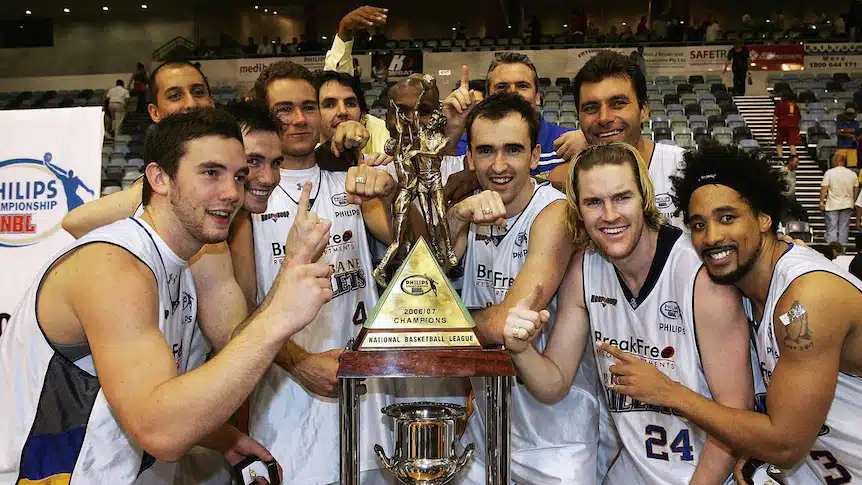
Michael Hill (Brisbane Bullets) explains how the NBL Point System set Aussie Hoops backwards for a decade
January 26, 2024


BIO: Michael Hill was born in Melbourne (VIC) and began playing basketball as a junior with the Dandenong basketball program.
Michael Hill made his NBL debut with the Canberra Cannons at 23 years of age. He scored two points in his first game.
Hill joined the Canberra Cannnons at the same time Australia Boomers guard CJ Bruton returned from Europe, and signed with the team. There, Bruton joined his father and head coach Calvin and together looked to build a competitive squad after a season where the Cannons managed only three wins.
In addition to Bruton import George Banks (via Perth), Brendan Mann (via Brisbane) and rookies Cameron Rigby and Michael Hill were added to the roster.
Banks (23.1 points, 8.4 rebounds, and 1.0 assists) would lead the team in scoring while Bruton (19.2 points, 4.5 rebounds, and 3.9 assists) led the team in assists. Canberra finished the season with 12 wins and 18 losses and failed to reach the playoffs.
During his first season in the league, Hill averaged 3.9 points, 1.5 rebounds, and 1.3 assists.
2002/03
Although Canberra entered 2002 struggling to stay afloat financially, the team added imports Mike Chappell (via Wollongong) and Reginald Poole (via Europe) to the roster and hoped a competitive team would draw enough fans to cover their costs.
With Chappell (21.3 points, 6.0 rebounds, and 1.8 assists) leading the team in scoring, alongside Dave Thomas (18.2 points, 12.3 rebounds, 1.8 assists, and 1.4 steals), CJ Bruton (15.9 points, 3.9 rebounds, 4.2 assists, and 2.1 steals) and Poole (14.1 points, 9.4 rebounds, 1.1 assists, 1.7 steals, and 2.2 blocks) the Cannons started the season on fire. The part of the plan that involved building a successful team worked with Canberra winning seven of their first nine games, but by December, Cannon’s ownership couldn’t afford to keep paying the bills, and the team was forced into voluntary administration just three months into the season. Back-up big man Pero Vasiljevic (5.1 points, 2.7 rebounds, and 1.2 assists) and Thomas, who had both just signed two-year deals with the Cannons, exited the club to find alternative employment. A few games later, Bruton and Chappell both requested their release and signed elsewhere also.
Veterans Matthew Shanahan (14.5 points, 4.6 rebounds, and 3.9 assists) and Willie Simmons (6.9 points, 5.1 rebounds, and 0.8 blocks) were added mid-season to help cover the loss of their starting line-up but it wasn’t nearly enough.
In a combined attempt to raise enough money to keep the team in the league and add a few bodies to the roster, a number of NBL legends made cameo appearances with Cannons throughout the last half of the season. 41-year-old Butch Hays suited up for four games for the Cannons, and Perth Wildcats’ legend James Crawford also came out of retirement for one game. The Cannons season ended with the club going 4-17 across their remaining games, and at the end of 2003, Canberra’s licence was moved to Newcastle, where it operated as the Hunter Pirates. Hill became a key part of the Cannons rotation this season, appearing in all 30 of the team’s games and averaging 11.1 points, 4. rebounds, and 2.3 assists.
BRISBANE BULLETS
2003/04
The 2003/04 season saw Hill average 10.7 points, 4.1 rebounds, and 2.1 assists and play a key role in helping the Bullets to a fourth place finish in the regular season with a 22-11 record.
2004/05
During the 2004/05 season Hill averaged 8.4 points, 3.5 rebounds, and 1.9 assists and helped the Bullets finish the regular season in fifth place (17-15).
2005/06
In 2005/06, Hill averaged 12.7 points, 3.3 rebounds, and 3.4 assists and helped the Bullets finish the season with a 17-15 record. Finishing the season in sixth place, Brisbane would host the seventh placed Perth Wildcats in the elimination finals. In front of 3,996 Bullets fans the team fell short, losing the sudden death match-up 86-91. Bradtke led the way for the Bullets with 22 points, 11 rebounds, 2 steals and 2 blocks while Matt Shanahan (22 points) and Tony Ronaldson (20 points, 8 rebounds) were best for the Wildcats.
2006/07 – THE GREATEST NBL TEAM OF ALL-TIME?
Brisbane continued to develop its roster in 2007, adding the country’s best backcourt player in CJ Bruton (via Sydney) to the existing combo of two of Australia’s greatest frontcourt talents, Sam MacKinnon and Mark Bradtke. Signing Bruton also led to the Bullets moving on from long-term import duo Derek Rucker and Bobby Brannen. Ebi Ere, Bruton’s backcourt partner for the Kings championship in 2004, and do-it-all forward Dusty Rychart (via Adelaide) were signed as import replacements and, with the roster having a number of scoring options, chose not to re-sign Lanard Copeland (to Adelaide) and Daniel Egan (to Townsville) and brought in defensive stopper Dillon Boucher (via Perth) who Bullets front office felt was responsible for the Wildcats eliminating the team from the playoffs the previous season, after shutting down leading scorer Stephen Black.
The Bullets began the season by winning the NBL Preseason Blitz (Coffs Harbour), with Bruton being named MVP of the tournament. In contrast, Brisbane began the regular season with a largely indifferent record (3-3), which by the season’s mid-way point was a respectable, but not at all earth-shattering 10 wins and 5 losses. Reigning champions Melbourne (11-4) sat on top of the ladder, although Brisbane had managed to defeat them in their first match-up of the season (98-85). From here, the Bullets reached a level that has many considering this team to be the greatest of all time. Brisbane wouldn’t lose for the remainder of the regular season, heading into the playoffs on a 18 game winning streak. During this time, seven of the team’s victories come in wins by 30 points or more, including a run of three games against Adelaide, New Zealand and Singapore, where they won by 32, 34, and 32, respectively.
Mackinnon (18.9 points, 9.1 rebounds, 4.2 assists, 1.8 steals, and 1.4 blocks) would deliver perhaps the greatest season of all time, becoming the first player in NBL history to win both the Best Defensive Player and Most Valuable Player award in the same season. Making Brisbane even tougher to stop is the fact that besides MacKinnon, they had five guys who could take over a game at any time in Ere (17.3 points, 4.9 rebounds, and 2.3 assists), Rychart (15.1 points, 8.1 rebounds, 1.0 steals), Bruton (14 points, 2.6 rebounds, and 4.5 assists), Black (13.9 points, 2.6 rebounds, and 3.8 assists) and Bradtke (10.2 points, 6.5 rebounds, and 1.2 assists).
Coach Joey Wright would be selected as the coach of the year before leading Brisbane to a seven-point win over Sydney (91-84) in the first game of the semi finals. Ere (22 points) leading the Bullets in scoring. Game two moved to Sydney, where Ere (23 points) would again finish as game-high scorer, but it was Bruton (21 points) that sealed the series, scoring 16 points in the fourth quarter to eliminate his former club from the playoffs (93-86).
Melbourne (25-8) had finished second on the ladder and defeated Cairns (2-0) to meet Brisbane in the Grand Final. Playing at home, Brisbane extended their winning streak to 21, narrowly defeating Melbourne by three points (98-95). Stephen Black (24 points, 5 rebounds, and 5 assists) top scoring, alongside Sam Mackinnon (18 points, 12 rebounds, 8 assists, and 2 blocks), who came close to racking up a triple-double. Chris Anstey (21 points and 9 rebounds) would lead the Tigers in the loss.
Melbourne would end the streak in game two, defeating Brisbane (105-91) thanks to a huge game from Anstey (31 points, 8 rebounds, and 3 blocks) and the Tigers dominating the Bullets on the glass (59 to 44 rebounds).
Brisbane returned home for game three where they had only lost one game for the entire season and made sure Anstey (9 points and 13 rebounds) wouldn’t have a repeat performance. MacKinnon, Bradtke and Rychart were instrumental in keeping him off the scoreboard, limiting him to 4 of 15 shooting. Black (22 points) again finished as the game’s high scorer, with MacKinnon (19 points, 7 rebounds, 9 assists, and 3 steals) filling every other column of the stat sheet to give the Bullets a 20 point victory (113-93).
In game four, Brisbane defied the odds and defeated Melbourne by nine points (103-94), despite the Tigers shooting a better percentage from the field, beyond the arc and winning the rebound battle. However, Melbourne finishing with 26 turnovers, compared to Brisbane’s 14 was the true indicator of the championship. Rashad Tucker (17 points and 12 rebounds) would lead the Tigers in scoring, while the Bullets held Anstey (16 points, 11 rebounds, 5 assists, and 3 blocks) well below his usual scoring averages again, making him shoot 6 from 15 from the field. Bruton (22 points, 7 assists, and 2 steals) and Dusty Rychart (21 points, 2 rebounds, and 2 steals) were instrumental at both ends of the floor, while MacKinnon (13 points, 8 rebounds, and 3 steals), who may have had his quietest game of the series, was awarded the Finals MVP.
MacKinnon would become the first player to ever be selected to the All-NBL First team, win the regular season and finals MVP awards, be the defensive player of the year and win a championship in the same season (Until Chris Anstey would repeat the effort in the following season). Hill would appear in all 39 games and average 9.6 points, 2.6 rebounds, and 2.3 assists for the season.
2007/08
In 2007/08 Hill averaged 7.5 points and 3.7 rebounds, and 2.3 assists, as the Bullets finished in third place with a 20-10record.
Michael Hill played seven seasons in the NBL, playing for both the Canberra Cannons and the Brisbane Bullets. He averaged 9.2 points, 3.2 rebounds, and 2.2 assists in 235 NBL games.
| SEASON | AGE | TEAM | TEAM RECORD | GP | MINS | PTS | REB | AST | OR | DR | STL | BLK | TO | PF | FGM | FGA | FG% | 3PM | 3PA | 3P% | FTM | FTA | FT% | TS% | EFG% | HS |
|---|---|---|---|---|---|---|---|---|---|---|---|---|---|---|---|---|---|---|---|---|---|---|---|---|---|---|
| 2007-08 | 29 | Brisbane | 20-10 (3) | 33 | 762 | 247 | 121 | 75 | 36 | 85 | 15 | 6 | 61 | 88 | 85 | 244 | 35% | 29 | 93 | 31% | 48 | 71 | 68% | 44% | 41% | 22 |
| 2006-07 | 28 | Brisbane | 28-5 (1) | 39 | 787 | 375 | 103 | 90 | 34 | 69 | 21 | 8 | 64 | 100 | 115 | 264 | 44% | 35 | 94 | 37% | 110 | 151 | 73% | 56% | 50% | 20 |
| 2005-06 | 27 | Brisbane | 17-15 (6) | 33 | 874 | 420 | 108 | 111 | 23 | 85 | 21 | 3 | 81 | 82 | 129 | 296 | 44% | 50 | 136 | 37% | 112 | 151 | 74% | 57% | 52% | 27 |
| 2004-05 | 26 | Brisbane | 17-15 (5) | 36 | 863 | 301 | 127 | 67 | 36 | 91 | 28 | 2 | 64 | 88 | 94 | 245 | 38% | 38 | 109 | 35% | 75 | 100 | 75% | 51% | 46% | 20 |
| 2003-04 | 25 | Brisbane | 22-11 (4) | 36 | 1,023 | 384 | 147 | 75 | 42 | 105 | 35 | 3 | 69 | 116 | 136 | 331 | 41% | 34 | 109 | 31% | 78 | 115 | 68% | 50% | 46% | 25 |
| 2002-03 | 24 | Canberra | 11-19 (9) | 30 | 787 | 333 | 119 | 69 | 46 | 73 | 21 | 4 | 79 | 65 | 116 | 302 | 38% | 24 | 85 | 28% | 77 | 117 | 66% | 47% | 42% | 31 |
| 2001-02 | 23 | Canberra | 12-18 (10) | 28 | 410 | 110 | 42 | 36 | 13 | 29 | 13 | 0 | 38 | 39 | 42 | 115 | 37% | 7 | 33 | 21% | 19 | 28 | 68% | 43% | 40% | 13 | Totals | 235 | 5506 | 2170 | 767 | 523 | 230 | 537 | 154 | 26 | 456 | 578 | 717 | 1797 | 39.9% | 217 | 659 | 32.9% | 519 | 733 | 70.8% | 51% | 46% | 31 |
| SEASON | AGE | TEAM | TEAM RECORD | GP | MINS | PTS | REB | AST | OR | DR | STL | BLK | TO | PF | FGM | FGA | FG% | 3PM | 3PA | 3P% | FTM | FTA | FT% | TS% | EFG% | HS |
|---|---|---|---|---|---|---|---|---|---|---|---|---|---|---|---|---|---|---|---|---|---|---|---|---|---|---|
| 2007-08 | 29 | Brisbane | 20-10 (3) | 33 | 23.1 | 7.5 | 3.7 | 2.3 | 1.1 | 2.6 | 0.5 | 0.2 | 1.8 | 2.7 | 2.6 | 7.4 | 35% | 0.9 | 2.8 | 31% | 1.5 | 2.2 | 68% | 44% | 41% | 22 |
| 2006-07 | 28 | Brisbane | 28-5 (1) | 39 | 20.2 | 9.6 | 2.6 | 2.3 | 0.9 | 1.8 | 0.5 | 0.2 | 1.6 | 2.6 | 2.9 | 6.8 | 44% | 0.9 | 2.4 | 37% | 2.8 | 3.9 | 73% | 56% | 50% | 20 |
| 2005-06 | 27 | Brisbane | 17-15 (6) | 33 | 26.5 | 12.7 | 3.3 | 3.4 | 0.7 | 2.6 | 0.6 | 0.1 | 2.5 | 2.5 | 3.9 | 9.0 | 44% | 1.5 | 4.1 | 37% | 3.4 | 4.6 | 74% | 57% | 52% | 27 |
| 2004-05 | 26 | Brisbane | 17-15 (5) | 36 | 24.0 | 8.4 | 3.5 | 1.9 | 1.0 | 2.5 | 0.8 | 0.1 | 1.8 | 2.4 | 2.6 | 6.8 | 38% | 1.1 | 3.0 | 35% | 2.1 | 2.8 | 75% | 51% | 46% | 20 |
| 2003-04 | 25 | Brisbane | 22-11 (4) | 36 | 28.4 | 10.7 | 4.1 | 2.1 | 1.2 | 2.9 | 1.0 | 0.1 | 1.9 | 3.2 | 3.8 | 9.2 | 41% | 0.9 | 3.0 | 31% | 2.2 | 3.2 | 68% | 50% | 46% | 25 |
| 2002-03 | 24 | Canberra | 11-19 (9) | 30 | 26.2 | 11.1 | 4.0 | 2.3 | 1.5 | 2.4 | 0.7 | 0.1 | 2.6 | 2.2 | 3.9 | 10.1 | 38% | 0.8 | 2.8 | 28% | 2.6 | 3.9 | 66% | 47% | 42% | 31 |
| 2001-02 | 23 | Canberra | 12-18 (10) | 28 | 14.6 | 3.9 | 1.5 | 1.3 | 0.5 | 1.0 | 0.5 | 0.0 | 1.4 | 1.4 | 1.5 | 4.1 | 37% | 0.3 | 1.2 | 21% | 0.7 | 1.0 | 68% | 43% | 40% | 13 | Total | 235 | 23.4 | 9.2 | 3.3 | 2.2 | 1.0 | 2.3 | 0.7 | 0.1 | 1.9 | 2.5 | 3.1 | 7.6 | 39.9% | 0.0 | 0.0 | 32.9% | 0.9 | 2.8 | 70.8% | 51% | 46% | 31 |
| POINTS | REBOUNDS | ASSISTS | STEALS | BLOCKS | TURNOVERS | TRIPLE DOUBLES | 31 | 14 | 7 | 4 | 1 | 7 | 0 |
|---|
Hill started playing in the state leagues with Dandenong for the 1998 season.
Hill joined Knox for the 2001 ABA season where, teaming with Cam Rigby, he was part of the Knox Raiders team that finished runners-up in the ABA South Conference.
He remained part of Knox’s state-league program through the 2000s, and by 2009 had returned to the Raiders group that won the SEABL Championship with a 125–98 grand final win over Frankston at the Melbourne Sports and Aquatic Centre.
In that 2009 championship season, Knox finished second in the East Conference at 15–12 before beating Kilsyth in the Conference preliminary final, then defeating South Conference champion Frankston by 27 points in the SEABL decider.
Hill continued with Knox in 2010 where the Raiders’ mid-season home game against Brisbane included a 6–0 first-quarter run helped by four Mick Hill free throws.
Knox re-signed Hill for the 2011 SEABL season, which marked his sixth season with the club, and at that point he had played 123 games in a Raiders uniform with Knox career averages of 17.7 points, 5.4 rebounds and 3.4 assists per game.
He remained with Knox for the 2012 state-league season on a Raiders roster that also included Lester Strong, Sean Carroll, CJ Massingale and Ben Waterhouse.
Hill’s Knox stint extended into the 2013 state-league season, giving him a long second run with the Raiders after his original 2001 ABA South Conference campaign and the club’s 2009 SEABL championship season.
Whilst we try to source as much information as we can for every player who has ever played in the NBL some information on a player profile may be missing. If you have additional information on a player you'd like us to add to a profile, please send it to us using the enquiry form below.
Submissions are then sent to info@aussiehoopla.com

