NBL Next Star Malique Lewis on the Phoenix’s Playoff Run and plans for the NBA draft
February 21, 2025


NICKNAME/S: Slammin Sam
BIO: Sam Mackinnon was born in Melbourne (VIC) and began playing basketball as a junior with the Diamond Valley basketball program. At 17-years-old, MacKinnon was offered his first shot at the NBL by head coach of the Westside Melbourne Saints, Gary Fox. Although the was officially offered a contract, the Saints became defunct before he ever played a game for the team.
MacKinnon’s athleticism above the rim saw him become known as `Slammin’ Sam Mackinnon.
FAMILY: Sam’s son Max MacKinnon also played 5 games in the NBL.
Sam Mackinnon made his NBL debut with the South East Melbourne Magic at 17 years of age. He went scoreless in his first NBL game.
After a tough loss to their cross-town rivals, the Melbourne Tigers, head coach Brian Goorjian decided it was time to inject youth into the South East Melbourne Magic’s roster. Veterans Darren Perry and Robert Rose were not re-signed, and the team opted to go younger, bringing in exciting prospects. 18-year-old Sam MacKinnon joined the squad straight out of the Australian junior ranks, while Rupert Sapwell returned home after a college stint in the United States. To fill the import slot, the Magic secured the services of Adonis Jordan, who had just led the Kansas Jayhawks to the 1993 NCAA Final Four.
Jordan wasted no time establishing himself, averaging 19.9 points, 8.2 assists, 3.0 rebounds, and 2.6 steals to lead the team in both scoring and playmaking. He was well-supported by frontcourt mainstays Tony Ronaldson (19.4 points, 7.4 rebounds, 2.7 assists, and 1.1 steals) and Bruce Bolden (16.5 points, 8.9 rebounds, 2.2 assists, and 1.5 steals), who provided the team’s interior strength. MacKinnon (5.7 points, 3.3 rebounds, and 2.8 assists in 19.2 minutes per game) delivered one of the greatest seasons ever by a 18-year-old, earning NBL Rookie of the Year in the process.
Interestingly, when Jordan missed a stretch due to injury, the Magic brought in state league standout Mike Kelly as a temporary replacement. Although his time was brief, Kelly would go on to become a key player for the Magic a few years later in 1997.
South East Melbourne was dominant at home throughout the regular season, finishing with an 11–2 record at the Glass House. However, their road form was inconsistent—they dropped half of their away games, ultimately finishing third on the ladder with an 18–18 record.
In the playoffs, the Magic hit form early, sweeping the Perth Wildcats in straight sets to advance to the semifinals where they faced familiar foes in the North Melbourne Giants. Game one saw the Giants stun South East with a commanding 108–87 victory. Game two was far tighter, going down to the final seconds. The Magic trailed by three (76–79), and Adonis Jordan launched a deep three at the buzzer to force overtime. The shot missed, and some speculated he may have had time to pass to a wide-open David Graham. Regardless, the attempt fell short, and with it, the Magic’s season came to an end.
1995
Brian Goorjian continued to reshape the South East Melbourne Magic in 1995 with a focus on youth. After letting go of former import star Robert Rose the year before, the team parted ways with veteran big man Bruce Bolden, who would go on to sign with the Sydney Kings. In his place, the Magic made a high-profile move for 7-foot prospect Chris Anstey, prying him away from the Melbourne Tigers.
Anstey’s attempted switch sparked controversy. Melbourne head coach Lindsey Gaze appealed to the NBL tribunal, arguing the Tigers had the right to retain Anstey if they could match any rival offer. The league ruled in Gaze’s favour, but in a bold counter, Magic CEO Graham McNaney and coach Goorjian worked around the cap—convincing every Magic player to temporarily take reduced salaries to create enough room to offer Anstey an unmatched deal. Once Anstey officially joined, the players’ original contracts were reinstated.
With Anstey secured, the Magic completed their roster by bringing in Nunawading product Jason Smith, re-signing import Adonis Jordan, and adding Richard “Scooter” Barry—the son of NBA legend Rick Barry—as a second import. Barry (14.3 points, 2.8 rebounds, 5.3 assists, and 2.3 steals) lasted only four games before being released. Instead of signing another import, Goorjian promoted development player Shane Bright (0.3 points, 0.4 rebounds, and 0.6 assists), choosing to invest playing time in his emerging young core of Anstey, MacKinnon, and Smith.
The youthful Magic clicked, finishing second on the ladder with an 18–8 record. Tony Ronaldson led the team in scoring with 21.5 points, 6.7 rebounds, and 3.9 assists per game, while Adonis Jordan (20.0 points, 5.9 assists, 2.9 rebounds, and 1.8 steals) continued his strong play in the backcourt.
Veteran big man John Dorge (16.1 points, 12.3 rebounds, 1.1 steals, and 3.0 blocks) turned back the clock with his best season yet, topping the NBL in blocks and earning All-NBL First Team honours. Defensive specialist Darren Lucas (9.4 points, 4.6 rebounds, 3.7 assists, and 1.8 steals) also stood out, winning the NBL Best Defensive Player award.
In the playoffs, the Magic dropped game one of their quarterfinal series to Illawarra (108–113), but responded with narrow and convincing wins at home in games two (92–89) and three (93–75) to advance. Their postseason run ended in the semifinals against North Melbourne, falling in both game one (77–98) and game three (92–107) to bow out of the championship race.
1996
Heading into 1996, head coach Brian Goorjian had fully retooled the South East Melbourne Magic roster with rising Australian talent. Young guns Sam MacKinnon, Chris Anstey, and Jason Smith—each under 21—were now key parts of the rotation. In a bid to create more opportunities for his emerging core, Goorjian moved on from scoring import Adonis Jordan and brought in pass-first guard Billy McCaffrey from Vanderbilt. Defensive stalwart Mike Kelly, who had previously made a brief appearance for the Magic in 1994, was signed from the state league, while Rupert Sapwell was replaced by teenage prospect Frank Drmic. The veteran spine of Tony Ronaldson, John Dorge, Darren Lucas, and Andrew Parkinson all returned, confident that 1996 could be their breakthrough year.
The Magic executed a highly balanced offensive attack, with six players averaging double digits. Ronaldson (18.6 points, 5.2 rebounds, and 4.7 assists) and new import McCaffrey (17.6 points, 2.8 rebounds, and 4.7 assists) shouldered most of the scoring and playmaking load. Chris Anstey (11.8 points, 7.8 rebounds, and 1.5 blocks) had a breakout season, more than doubling his minutes and winning the NBL’s Most Improved Player award. Veteran John Dorge (12.4 points, 8.8 rebounds, and 1.2 blocks) continued to deliver at a high level, providing strength inside.
At home, South East Melbourne was a fortress—winning 11 of 13 games. On the road, however, their youth occasionally showed, managing just two wins against other playoff-bound teams across the season.
MacKinnon (11.7 points, 6.8 rebounds, and 3.7 assists) was a key contributor throughout the year as the Magic secured a second-place finish on the ladder with a 19–7 record.
In the quarterfinals, South East Melbourne got revenge on their crosstown rivals, North Melbourne, who had ended their 1995 campaign. The Magic claimed game one (96–82), stifling Giants guard Darryl McDonald (11 points, 6 rebounds, 5 assists, 6 turnovers). Veteran Andrew Parkinson came off the bench to top-score with 19 points, while McCaffrey (18 points, 6 rebounds, 5 assists) and Mike Kelly (15 points, 8 rebounds, 2 steals) added all-around performances. Anstey (12 points, 7 rebounds) dominated the interior.
In game two, Dorge (14 points, 14 rebounds) neutralised Paul Rees, who had scored 28 in game one. Ronaldson (25 points, 4 rebounds, 5 assists, 2 steals, 2 blocks) led all scorers, and Kelly again delivered (17 points, 8 rebounds, 5 assists) as South East won 87–77 to end the Giants’ season.
The semi-final clash with Adelaide began with a narrow loss (86–87), as Leon Trimmingham’s 23 points and 9 rebounds proved too much despite Ronaldson’s 20-point, 7-assist effort. Game two was a different story—Ronaldson (11 points, 8 rebounds, 8 assists) delivered all-around impact, but it was the young guns who led the blowout. MacKinnon (20 points, 5 rebounds, 7 assists) and Anstey (14 points, 6 rebounds) shone on both ends, holding Trimmingham to just 10 points on 3-of-12 shooting. The 112–81 win booked South East Melbourne a spot in the Grand Final against city rivals, the Melbourne Tigers.
Game one saw the Tigers dominate behind Andrew Gaze (35 points, 8 rebounds, 7 assists), with support from Mark Bradtke (24 points, 15 rebounds) and Lanard Copeland (23 points). The Tigers’ “Big Three” combined for 82 points in a 100–89 win.
The Magic hit back in game two with an 88–84 win in front of 15,064 fans at Flinders Park—still the largest NBL crowd in Melbourne history. Ronaldson led the way with 28 points, while Kelly (19 points, 9 rebounds, 4 assists, 2 steals) was everywhere. Gaze top-scored for the Tigers with 21 points.
With just 48 hours between games, the younger Magic squad thrived in the decider. They overwhelmed the Tigers 107–70 in a blowout. McCaffrey (24 points, 5 assists), MacKinnon (18 points, 9 rebounds on 9-of-10 shooting), and Dorge (16 points, 8 rebounds on 8-of-11 shooting) were outstanding. The Magic shot 54% from the field, compared to the Tigers’ 38%.
The 1996 NBL Grand Final series drew a record aggregate crowd of 43,605 (average 14,535), the largest ever for a three-game series. Mike Kelly earned Finals MVP honours after averaging 16 points, 6 rebounds, 4 assists, and 2.3 steals over the three games.
1997
Coming off their championship triumph in 1996, the South East Melbourne Magic retained most of their core heading into the 1997 season. The only major changes were the addition of import guard Brian Tolbert, who took over for departing Billy McCaffrey, and 18-year-old Frank Drmic, who replaced the retiring Darren Lucas. Despite the minor reshuffle, the Magic didn’t skip a beat—finishing first on the NBL ladder with a franchise-best 22–8 record.
True to coach Brian Goorjian’s philosophy, the team thrived on balance, with five players averaging double-digit scoring and just four points separating the top five scorers. Tony Ronaldson led the way with 16.0 points, 4.9 rebounds, and 3.2 assists per game. Rising stars Sam MacKinnon (15.2 points, 6.3 rebounds, 3.3 assists) and Chris Anstey (13.8 points, 9.8 rebounds, 1.6 steals, and 1.8 blocks) continued their rapid development. Defensive ace Mike Kelly (12.6 points) was rewarded with the NBL’s Best Defensive Player award, while Goorjian claimed Coach of the Year honors.
Earning top spot gave the Magic a bye in the first round of the playoffs, setting up a semi-final showdown with the Perth Wildcats, who had just dispatched Brisbane. In game one on the road, Anstey dominated with 19 points, 16 rebounds, and 5 steals, while Ronaldson added 18 points to power a 92–82 victory. Back in Melbourne, the Magic turned up the heat defensively and blew out the Wildcats 96–69, with MacKinnon leading the way with 21 points, 7 rebounds, and 4 assists.
With the win, South East Melbourne returned to the NBL Grand Final for a highly anticipated rematch with cross-town rivals, the Melbourne Tigers. But this version of the Tigers was on a historic run. After a shaky start, they replaced import Jarvis Lang with Marcus Timmons and surged to 13 straight regular-season wins—a streak they extended to 15 heading into the Finals. In game one, the Tigers delivered a statement win, thrashing the Magic 111–74 behind big performances from Copeland (29 points), Timmons (24 points, 9 rebounds), and Gaze (23 points, 9 assists). They also held Anstey to just 6 points, nullifying the Magic’s interior threat.
Facing elimination, Goorjian changed tactics for game two, inserting veteran big man John Dorge into the starting five and bringing Anstey off the bench. The move paid off—Anstey responded with 21 points, 8 rebounds, and 3 blocks in 33 minutes, helping the Magic grind out an 84–78 win. The result snapped Melbourne’s 17-game win streak and forced a deciding third game.
The championship came down to a winner-takes-all showdown. Early in game three, the teams were evenly matched, but a second-quarter surge from the Tigers, who again limited Anstey to just 8 points, proved decisive. By halftime, Melbourne had seized control and never looked back, closing out the game 93–83 to secure their second NBL title.
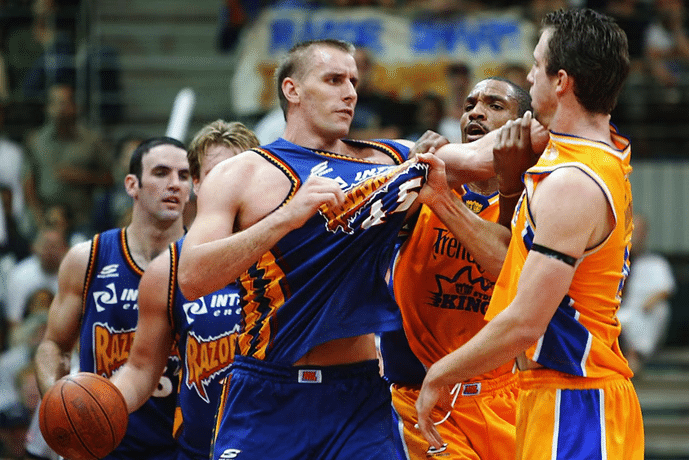
Tony Ronaldson led the Magic with 26 points, but it was Lanard Copeland’s 26-point performance that sealed the win for the Tigers. Copeland earned Finals MVP honors, averaging 27.6 points and 3.3 rebounds on 56% shooting across the series. However, it was forward Warrick Giddey’s gritty play in game three that many felt turned the tide. Though he finished with just four rebounds, three assists, and a block, Giddey made three crucial late-game plays: a hard foul that broke Sam MacKinnon’s nose, a key block on Frank Drmic, and a brutal mid-court screen that floored Mike Kelly. Those hustle plays helped swing the momentum and delivered Melbourne the title.
A great Australian sporting rivalry!! pic.twitter.com/qVrlKwROkN— RANDOM HOOPS (@HoopsRandom) March 21, 2023
1998
Following their heartbreaking loss in the 1997 Grand Final, South East Melbourne Magic coach Brian Goorjian made targeted moves in hopes of reclaiming championship glory. The club brought back Billy McCaffrey, the guard who helped steer them to a title in 1996, to replace outgoing import Brian Tolbert. Additionally, emerging big man Brett Wheeler was recruited from Adelaide to fill the void left by Chris Anstey, who had departed for the NBA.
The Magic started the season on fire, winning their first six games before a loss to Brisbane halted their momentum. That same week, the team parted ways with McCaffrey (10.3 points, 2.9 assists), who hadn’t quite recaptured his previous form. In his place, Perth-native and former NBA guard Clinton McDaniel was signed. McDaniel (17.4 points, 4.3 assists, 2.7 steals) made an immediate impact and would go on to lead the league in steals.
Tony Ronaldson (18.1 points, 5.2 rebounds, 3.1 assists) once again led the team in scoring—his fifth consecutive season doing so—while rising star Frank Drmic (14.4 points, 6.6 rebounds) had a breakout year that drew attention from NBA scouts. Alongside Ronaldson and Drmic, Sam MacKinnon added 13.2 points, 7.8 rebounds, and 5.2 assists per game, forming one of the league’s most well-rounded cores.
The Magic dominated the regular season, finishing with a stellar 26–4 record—good enough for the third-best regular-season mark in NBL history behind only Adelaide in 1986 (24–2) and Geelong in 1984 (21–2). Brian Goorjian was awarded his third NBL Coach of the Year title, and Mike Kelly took home his second consecutive Defensive Player of the Year award.
Finishing atop the ladder granted South East Melbourne a first-round playoff bye. They then advanced to the Grand Final after sweeping Brisbane in the semifinals, overpowering Steve Woodberry and the Bullets in two straight games.
In the Grand Final series, however, the Magic ran into a red-hot Adelaide 36ers team, who had hit their stride at just the right time. In Game 1, Adelaide struck first with a 100–93 victory led by import Kevin Brooks (24 points, 8 rebounds). Remarkably, it was only the second time Adelaide had beaten the Magic since the club’s formation in 1992 through the merger of Eastside Melbourne and Southern Melbourne.
Game 2 was a shocker. At Melbourne Park—where the Magic had lost just once all season—the 36ers dismantled them 90–62. Adelaide’s suffocating defense held the Magic to under 15 points in three separate quarters. Brooks (21 points, 6 rebounds) and Martin Cattalini (20 points, 6 rebounds) led the way as turnovers and free throws defined the contest. South East Melbourne committed 26 turnovers and shot just 6-of-8 from the foul line, while Adelaide capitalized with 25-of-33 free throws and only 14 turnovers.
With the win, the 36ers claimed their first championship since 1986, and Kevin Brooks was named Grand Final MVP. The loss marked the end of an era for the Magic—not just on the court, but as a franchise. The 1998 season would be their last as a standalone team, with the Magic merging with cross-town rivals North Melbourne the following year to form the Victoria Titans.
TOWNSVILLE CROCODILES
1998/99
The 1998/99 season saw the NBL shift to summer, and with it, Townsville underwent a brand change after a dispute with the NBA’s Phoenix Suns, who held the “Suns” trademark in Australia. Faced with the prospect of paying Phoenix royalties on merchandise sales, the team changed its name to the Townsville Crocodiles.
The change to the Crocodiles was apt for many a reason. Besides being synonymous with the Queensland region, it was also the team name of Australia’s gold medal–winning 22-and-under junior team in 1997, which featured coach Ian Stacker and Sam Mackinnon. At the time, it was viewed that the outgoing Stacker, an assistant to Brian Goorjian of the South East Melbourne Magic, had “stolen” Mackinnon to headline his new squad, which created a rift between former coach and mentor Goorjian.
Only four holdovers remained (Simon Kerle, Brad Davidson, David Pennisi, Jason Cameron) while the club added Robert Rose (via Canberra), Andrew Goodwin (via North Melbourne), James Harper (via South Florida), and welcomed back big man Michael Pennisi from overseas.
Townsville’s first outing as the Crocodiles was a 91–84 win over Brisbane. Mackinnon (18 points, 6 rebounds, 6 assists) set the two-way tone, flanked by David Pennisi (18 points, 5 rebounds), Rose (16 points, 9 rebounds, 4 assists), Harper (15 points, 12 rebounds), enough to withstand Steve Woodberry (31 points, 8 rebounds) and Leroy Loggins (17 points) for the Bullets.
The early win was quickly followed by six straight losses to Wollongong (86–99), Adelaide (89–94), Newcastle (96–102), Canberra (94–99), and Melbourne (87–102)—before the Crocs reset at home by beating Wollongong (93–80). There, Mackinnon (26 points, 14 rebounds, 7 assists) delivered his signature regular-season line, with Kerle (21 points) and Rose (20 points) also delivering solid games, out performing the Hawks and star import Clayton Ritter (22 points).
Momentum spilled into the team’s best offensive night of the year. The Crocs putting up 120 points against Canberra. Kerle (33 points, 5 assists) delivering a season high with Goodwin (19 points, 5 rebounds) and Harper (19 points, 13 rebounds) both scoring at will. Mackinnon (14 points, 5 rebounds, 3 assists) was a swiss army knife and made an impact wherever needed, as Rose (17 points, 8 assists, 5 rebounds) steered the pace; Melvin Thomas (21 points, 13 rebounds) paced the Cannons.
At 33, Robert Rose steered almost every column for Townsville—(21.8 points, 6.8 rebounds, 5.8 assists, and 1.3 steals)—topping the team in points and assists, sitting second in both rebounds and steals, and logging a league-high 47.2 minutes per game. Still only 22, Sam Mackinnon blossomed into a top-tier two-way force (16.5 points, 9.3 rebounds, 4.3 assists, 2.0 steals, 1.0 blocks), leading the Crocs in rebounds and steals and making the All-NBL Third Team. His game log featured multiple double-doubles, 20-plus outings against Adelaide (21) and Brisbane (26), and a 12-assist showcase versus West Sydney—all while his workload climbed to 44 minutes per game, up from 39 the previous year with the Magic.
Around them, Andrew Goodwin (14.7 points, 7.3 rebounds, 1.3 steals) supplied dependable size, Simon Kerle (13.4 points, 2.0 rebounds, 2.3 assists) delivered perimeter punch, and James Harper (10.2 points, 8.5 rebounds, 1.3 blocks) provided interior edge.
Home dominance defined the campaign: a 9–4 record in North Queensland, headlined by a 116–68 demolition of Sydney and a 90–89 upset of reigning champion Melbourne. But a thin eight-man rotation and road stumbles—capped by late losses to Sydney (101–119) and Adelaide (92–107)—left Townsville 12–14 and seventh, just outside the playoff line.
1999/00
Townsville’s second season under Ian Stacker began with a clear changing of the guard: veterans Simon Kerle and Jason Cameron (both to Brisbane), big man Michael Pennisi (to Philippines) and import James Harper exited, leaving Brad Davidson and David Pennisi as the only holdovers from the old “Suns” era. The core trio of Robert Rose, Sam Mackinnon and Andrew Goodwin returned, and Stacker rounded out a deeper, longer rotation with Mike Kelly (via Victoria), Pat Reidy (via Newcastle) and Ben Knight (via Sydney).
Mackinnon (9 points, 2 rebounds, 2 assists, 3 steals) struggled offensively in the Croc’s opening game against the Titans, which saw them lose 106–95, despite Rose (29 points, 14 rebounds, 4 assists) and Goodwin (19 points, 6 rebounds) having big games. Victoria were led by Jason Smith (29 points, 7 rebounds) and Darryl McDonald (19 points, 2 rebounds, 8 assists), with support from Frank Drmic (17 points, 3 rebounds).
A week later the Crocs reset at home, beating Wollongong 99–88 behind a balanced offensive attack from Reidy (21 points, 3 rebounds), Kelly (19 points, 4 rebounds) and Goodwin (18 points, 4 rebounds), with Mackinnon (9 points, 7 rebounds, 7 assists, 3 steals) filling out the rest of the stat sheet. The Hawks were led by Melvin Thomas (21 points, 10 rebounds).
Momentum rolled through Sydney (98–88) and Cairns (103–75) and peaked in a 131–127 shootout over Adelaide as Goodwin (40 points, 15 rebounds) delivered a season high and Kelly (24 points, 7 rebounds) produced his best game to date. Mackinnon (11 points, 6 rebounds, 4 assists, 2 steals, 1 block) again filling in the stat sheet everywhere else, while trying to stop Adelaide’s Maher (40 points, 3 rebounds) and Martin Cattalini (27 points, 10 rebounds).
By early December Townsville had slipped to 4–6, then snapped back with a 108–90 statement over Wollongong. Mackinnon (22 points, 11 rebounds, 13 assists, 5 steals) delivered a triple-double masterclass in this game, while Brad Davidson (19 points) made a huge impact off the bench and CJ Bruton (24 points, 3 rebounds) and Melvin Thomas (23 points, 11 rebounds) led the Hawks.
The Crocs kept stacking wins through the holidays—Cairns (116–82), Wollongong (108–90) and Canberra twice (117–88, 128–101)—and closed the year by crushing Brisbane 103–78 as Rose authored a triple-double (14 points, 10 rebounds, 11 assists). Mackinnon continued to toggle between scorer, stopper and secondary playmaker throughout the run.
January and February showcased Mackinnon’s versatility in tight spots. Townsville edged Melbourne 102–97, then split their series with West Sydney before winning in Liverpool 102–95 as Mackinnon (15 points, 9 rebounds, 4 assists, 2 blocks, 1 steal) made an impact at both ends and Pat Reidy (28 points, 7 rebounds) delivered his game game as a Croc so far. The Crocs kept rolling at Canberra (121–98) and dismantled Brisbane 122–73 before banking late-road wins at the Giants (81–74) and in Wollongong (114–98). The Crocs ending the season with a club-record 22–6 (11–3 home, 11–3 away), a second place finish and a first-round playoff bye.
Townsville’ primary scorers were Andrew Goodwin (18.0 points, 6.6 rebounds, 1.4 steals) and Sam Mackinnon (17.3 points, 8.6 rebounds, 4.9 assists, 2.0 steals, 1.1 blocks), with Goodwin claiming NBL Most Improved Player and All-NBL Second Team honours, and Mackinnon earning All-NBL First Team while sharing the club MVP with Rose. Rose (17.2 points, 7.2 rebounds, 6.6 assists, 1.8 steals) saw his numbers decline from last season but remained highly effective during big games.
New faces Mike Kelly (16.1 points, 4.6 rebounds, 3.6 assists) while leading the league in three-point accuracy, Reidy (14.7 points, 5.7 rebounds, 3.3 assists), and Knight (8.5 points, 4.4 rebounds), who was recognised with Sixth Man of the Year, all delivered quality numbers. Stacker was named NBL Coach of the Year as the identity—pace, length, shooting and unselfish playmaking—clicked into place.
Perth would meet Townsville in the semifinals, where they won the opening game on their home court (104–101). Sam Mackinnon (16 points, 13 rebounds, 10 assists, 3 steals, 1 block) produced a playoff triple-double in this game, while Mike Kelly (29 points, 4 rebounds, 2 assists) led the team in scoring. Ricky Grace (24 points, 2 rebounds, 6 assists) and Marcus Timmons (20 points, 5 rebounds) were the Wildcats best.
There series moved to Townsville for Game 2, where the Croc’s levelled the series in a statement win (101–78). Mackinnon (23 points, 9 rebounds, 5 assists, 4 steals, 1 block) and Reidy (22 points, 8 rebounds, 5 assists) led the team in scoring and Rose (21 points, 11 rebounds, 9 assists) narrowly missed out on recording a triple-double.
The decider in Townsville went Perth’s way 104–84. Rose (33 points, 8 assists, 4 steals) equalled his season high in the loss but Mackinnon (8 points, 6 rebounds, 1 steal) was shut down by Perth’s frontline. With Ricky Grace (21 points, 11 assists) and Anthony Stewart (21 points, 2 rebounds) stretching the floor, Paul Rogers commanding the paint (20 points, 12 rebounds) and Andrew Vlahov (15 points, 17 rebounds) imposing his will on the glass, Townsville’s most successful year to date came to an abrupt end.
2000/01
Ian Stacker returned with the core group that had delivered Townsville’s first playoff appearance, retaining Robert Rose, Sam Mackinnon, Pat Reidy, Mike Kelly, Andrew Goodwin, Brad Davidson, Peter Crawford and David Pennisi, with the only notable departure Ben Knight (to Cairns – Cairns), who was replaced with import Dujuan Wiley.
Townsville opened the season with a statement win over Queensland rivals Cairns at home (120–85). Sam Mackinnon (35 points, 10 rebounds, and 10 assists) led the team in scoring alongside Andrew Goodwin (24 points, 8 rebounds, and 2 steals), while Robert Rose (13 points, 8 rebounds, and 9 assists) flirted with a triple-double.
The wins continued with the team pulling out a 4–1 start to the season, before a string of losses at Adelaide (105–121) and Perth (108–121) and a double defeat from the hands of Victoria left Townsville 5–4
Shortly after, severe bone bruising saw Sam Mackinnon (17.4 points, 9.8 rebounds, 5.1 assists, 1.5 steals, 1.1 blocks across 16 games) shut down for the rest of the season, the injury to Mackinnon prompting the release of underperforming Wiley (7.9 points, 6.1 rebounds, 1.9 blocks) who was replaced with David Hinton (9.8 points, 6.0 rebounds) in February.
Mackinnon’s best games prior to going down included his 33 points, 12 rebounds, and 5 assists vs Melbourne on 26 Nov and his 30 points, 13 rebounds, and 8 assists vs Sydney on 16 Dec.
Hinton’s arrival sparked an eleven game win streak, headlined by the 126–63 Round 22 demolition of Brisbane—one of the largest margins in NBL history—with Andrew Goodwin (22 points, 8 rebounds, and 3 steals) leading the scoring, Robert Rose (18 points, 14 rebounds, and 10 assists) recording a triple-double, Mike Kelly (8 points, 9 assists, and 8 rebounds) nearly matching it, and Pat Reidy (18 points) and Brad Davidson (18 points and 7 assists) adding punch.
Other key second-half results included a 122–88 rout of Canberra, a 126–123 thriller over Sydney, and a 138–107 home win against the Kings to close the regular season, sending the Crocodiles to 22–6—best in club history to that point and equal-best in the league—finishing second to the Victoria Titans on percentage and riding that streak into the finals.
Without Mackinnon, Robert Rose (22.0 points, 8.3 rebounds, 6.2 assists, and 1.2 steals) won league Most Valuable Player and made the All-NBL First Team, while Pat Reidy (17.5 points, 6.8 rebounds, and 3.3 assists) and Mike Kelly (16.6 points, 5.9 rebounds, 4.6 assists, and 1.3 steals) drove the perimeter and Andrew Goodwin (16.5 points and 7.5 rebounds) anchored the paint.
Once in the playoffs, Townsville defeated Sydney 2–1 in the Qualifying Finals, clinching Game Three 122–114 behind Robert Rose (22 points, 8 rebounds, and 8 assists), Andrew Goodwin (20 points and 10 rebounds), and Pat Reidy (19 points, 5 rebounds, and 6 assists).
Next, Townsville faced the Victoria Titans in the Semi-Finals, mirroring the Sydney series by dropping Game One (106–97) before holding the Titans to 34% shooting to level the series in Game Two (98–82) behind Andrew Goodwin (19 points and 11 rebounds), Robert Rose (19 points, 11 rebounds, and 8 assists), and Pat Reidy (19 points, 4 rebounds, and 4 assists), then clinching their first Grand Final berth (101–97) through Andrew Goodwin (23 points and 4 rebounds) and Robert Rose (20 points, 6 rebounds, and 8 assists) while withstanding Mark Dickel (33 points), setting up a Grand Final against Wollongong.
Wollongong grabbed Grand Final Game 1 (104–101) behind Melvin Thomas (24 points and 14 rebounds) and Mat Campbell (19 points) with Robert Rose (26 points, 7 rebounds, and 4 assists) hampered by fouls despite an Andrew Goodwin season high (29 points and 8 rebounds).
Townsville levelled 1–1 (114–97) through Andrew Goodwin (19 points, 11 rebounds, and 2 steals), Robert Rose (16 points, 11 rebounds, and 11 assists), Pat Reidy (17 points, 9 rebounds, and 5 assists), and Mike Kelly (21 points, 6 rebounds, and 6 assists), but the Hawks won the decider (97–94) despite Robert Rose (30 points, 10 rebounds, 8 assists, and 2 steals), Mike Kelly (21 points and 7 rebounds), and Andrew Goodwin (22 points, 10 rebounds, and 2 steals, 7-of-7 FT) as Charles Thomas (23 points) and Glen Saville (18 points, 12 rebounds, and 2 steals) closed it out, becoming the first team from New South Wales to win an NBL championship.
WEST SYDNEY RAZORBACKS
2002/03
During the 2002/03 season, MacKinnon averaged 15.8 points, 9.8 rebounds, and 3.9 assists and helped the Razorbacks finish the regular season in seventh place (14-16).
2003/04
The West Sydney Razorbacks entered the 2003/04 season with a bold new approach, choosing not to re-sign import Willie Farley along with veteran foundation players Derek Rucker and Bruce Bolden. This decision made history, as the Razorbacks became the first team in the modern NBL era to field an all-Australian lineup. With John Rillie returning after spending part of the previous season in Greece and Sam MacKinnon back from injury, this marked the first season where the roster had stability and a clear opportunity to build chemistry and push for a championship.
West Sydney opened the season in dominant fashion, with Simon Dwight (26 points, 9 rebounds, and 7 assists) and Sam MacKinnon (24 points, 9 rebounds, and 8 assists) both flirting with triple-doubles in a commanding home victory over Hunter (119-103).
The Razorbacks started strong at 3-1 before hitting a rough patch, suffering three consecutive losses, including a tough defeat to Sydney (83-97), where Kings star Matt Nielsen put on a show with 29 points and 8 rebounds. They also fell to Wollongong (81-90) and Victoria (101-106), putting them at 3-4 and forcing them to regroup.
Facing a critical point in their season, West Sydney responded emphatically with a 10-game winning streak, securing key victories over Sydney (97-87), Wollongong (109-105), and Victoria (107-95).
During this stretch, John Rillie (20.0 points, 7.5 rebounds, and 5.1 assists) led the charge as the team’s top scorer, while Sam MacKinnon (17.3 points, 9.5 rebounds, 5.2 assists, 1.6 steals, and 1.4 blocks) and Simon Dwight (15 points, 9.1 rebounds, 4 assists, and 3.7 blocks) formed one of the most dominant Australian trios in league history.
The starting lineup was rounded out by Aaron Trahair (13.6 points, 3.8 rebounds, and 2.6 assists) and Scott McGregor (13.0 points, 6.3 rebounds, and 3.1 assists), with key contributions from Russell Hinder (9.7 points, 5.9 rebounds, and 1.4 assists) and rising rookie Steven Markovic (8.8 points, 2.2 rebounds, and 2.3 assists) off the bench.
In February, the team suffered a major setback in a 110-99 loss to Wollongong, where McGregor sustained a season-ending injury. With McGregor sidelined, Hinder moved into the starting five, while Markovic took on a larger role in the rotation.
Despite the adversity, the Razorbacks maintained their momentum, finishing the regular season with a 22-11 record—good for third place—while setting franchise records for most total wins, home victories, and road triumphs in a season.
West Sydney carried this form into the playoffs, overpowering Cairns in the elimination final (110-88). Trahair (31 points, 4 assists), MacKinnon (28 points, 4 rebounds, 5 assists, 3 steals, and 2 blocks), and Dwight (11 points, 12 rebounds, 9 assists, and 6 blocks) were instrumental in securing a spot in the semifinals.
The Razorbacks then swept Wollongong in the semis, opening with a convincing 107-91 win behind Rillie’s 25 points, 8 rebounds, and 6 assists, while Dwight (22 points, 10 rebounds, 2 steals, and 2 blocks) and MacKinnon (12 points, 14 rebounds, and 6 assists) provided valuable support. Mat Campbell led the Hawks with 20 points.
Game 2 saw an unforgettable performance from Rillie, who erupted for 45 points, 9 rebounds, and 4 steals, shooting 17-of-26 from the field to lead West Sydney to a 110-95 victory and a berth in the NBL Grand Final.
For the first time, the NBL Grand Final was played as a best-of-five series, with the Razorbacks facing minor premiers Sydney (26-7), led by league MVP Matt Nielsen.
Game 1 belonged to the Kings, who secured a 96-76 win behind a stellar showing from captain CJ Bruton (35 points, 5 rebounds, and 6 assists on 9-of-16 shooting), while Dwight (23 points, 12 rebounds, 6 assists, and 2 blocks) paced the Razorbacks.
West Sydney responded in Game 2 with a dominant 87-72 victory, locking down defensively while Rillie (18 points) and Trahair (17 points) led the scoring effort to level the series.
In a thrilling Game 3, the Razorbacks took a 2-1 series lead with an 82-80 overtime victory. Rillie (18 points) was a key factor, while Dwight (17 points, 6 rebounds, 4 assists, and 3 blocks) and MacKinnon (14 points, 17 rebounds, and 6 assists) provided crucial all-around contributions.
Despite Rillie’s 31-point effort in Game 4, Sydney edged out an 82-77 win, forcing a decisive Game 5—the first ever in NBL Grand Final history.
Before a raucous crowd of 9,609 at the Sydney Entertainment Centre, the Razorbacks fought valiantly in Game 5 but ultimately fell short, losing 90-79. Sydney’s defense contained Rillie, holding him to 12 points and 10 rebounds, while Trahair (20 points) and Dwight (18 points) kept West Sydney in the contest. Ebi Ere (25 points) proved to be the difference-maker, delivering a dominant fourth-quarter performance, while Brett Wheeler (18 points and 11 rebounds) and Matt Nielsen (14 points, 12 rebounds) and winning Grand Final MVP honours.
Despite the heartbreak of losing the Grand Final, the 2003/04 season was one of the Razorbacks’ finest. Rillie and MacKinnon earned All-NBL First Team honours, while Markovic was named NBL Rookie of the Year, solidifying the franchise’s status among the league’s elite.
Despite the disappointment of losing the Grand Final, the 2003/04 season was one of the best of MacKinnon’s career. He was named to the All-NBL First Team for the second time and finished as the runner-up for league MVP, narrowly missing out on the award to Sydney’s Matt Nielsen.
2004/05
2004/05
After falling short in the 2004 NBL Grand Final, the West Sydney Razorbacks faced a pivotal offseason that saw significant roster and coaching changes. Longtime head coach Gordie McLeod was let go after six seasons, with his assistant, Mark Watkins, stepping in as his successor following strong support from the playing group. Meanwhile, the Razorbacks’ ownership group, the Canterbury-Bankstown Bulldogs, was embroiled in financial turmoil. The club was hit with a $500,000 fine and stripped of all 37 NRL premiership points due to systematic salary cap breaches, further complicating West Sydney’s efforts to maintain a competitive squad.
Key departures loomed over the Razorbacks’ offseason. Leading scorer John Rillie (to Townsville) and key contributors Russell Hinder (to Hunter) and David Pennisi (to Europe) all moved on, while Brad Williams opted to retire. With several important pieces leaving, West Sydney was forced to rebuild heading into the 2004/05 season.
The team’s core still featured captain Sam MacKinnon, Simon Dwight, and Scott McGregor, who returned after missing the previous season due to injury. McGregor’s comeback provided much-needed versatility to the frontcourt, while reigning NBL Rookie of the Year Steven Markovic was expected to take on a greater role in the backcourt, helping to fill the void left by Rillie. To reinforce the squad, the Razorbacks made a key international signing, bringing in Nick Horvath (via Duke University) as their marquee import.
Horvath (20.4 points, 11.1 rebounds, and 1.3 blocks) immediately established himself as the team’s primary offensive option, while MacKinnon (14.5 points, 8.2 rebounds, 5.9 assists, 1.7 steals, and 1.2 blocks) maintained his status as the squad’s most versatile contributor. He continued to impact the game in multiple areas, providing leadership, rebounding, and playmaking from the forward position. Simon Dwight (15.9 points, 10.6 rebounds, 2.9 assists, and 3.2 blocks) remained one of the league’s most dominant defensive forces, anchoring the Razorbacks in the paint.
West Sydney’s season began with a 97–120 road loss to Perth on October 2, 2004, as the team struggled to gel with its new lineup. Their first win came in Round 2, as they bounced back with a 106–75 home victory over Brisbane on October 10. Shortly after, they secured a 113–111 road win over Brisbane, with Horvath (23 points, 17 rebounds) and McGregor (26 points) leading the way.
Despite the early signs of promise, West Sydney’s momentum quickly stalled as they endured a four-game losing streak, suffering defeats to Melbourne (97–105), Adelaide (85–102), and Perth (90–101). The absence of Rillie’s perimeter shooting became evident, as the team lacked a consistent three-point threat to stretch defenses.
The Razorbacks managed to bounce back in Round 8 with a 96–82 victory over Wollongong, led by Horvath (29 points, 14 rebounds) and MacKinnon (22 points, 9 rebounds, and 5 assists). Another tightly contested matchup saw West Sydney edge out Cairns 87–84, with Markovic (18 points, 6 assists) showing his growing confidence in the backcourt. However, inconsistency remained an issue, as the team struggled to maintain form from week to week.
West Sydney’s campaign took a significant downturn with a seven-game losing streak between January 2 and January 29, 2005. This rough stretch included a 123–89 blowout loss to Sydney and a 112–85 defeat to Sydney on February 19, effectively eliminating the team from playoff contention. Defensive struggles and an overreliance on Horvath for scoring became major weaknesses, as the Razorbacks lacked additional offensive firepower to stay competitive.
Despite their overall struggles, West Sydney recorded some late-season highlights. They snapped their losing streak with a 103–76 home win over Hunter on February 2, where McGregor (21 points, 7 rebounds) delivered a standout performance. Another strong effort came on February 11, when the Razorbacks defeated Wollongong 117–95, putting together one of their best offensive performances of the season. MacKinnon played a key role in these late wins, showing his ability to impact games across multiple facets, but it was not enough to change the team’s fortunes.
The Razorbacks finished the season in ninth place with an 11–21 record, missing the playoffs just one year after reaching the Grand Final.
BRISBANE BULLETS
2005/06
In 2005/06, MacKinnon averaged 13.9 points, 9.7 rebounds, and 4.5 assists and helped the Bullets finish the season with a 17-15 record. Finishing the season in sixth place, Brisbane would host the seventh placed Perth Wildcats in the elimination finals. In front of 3,996 Bullets fans the team fell short, losing the sudden death matchup 86-91. Mark Bradtke (22 points, 11 rebounds, 2 steals and 2 blocks) led the way for the Bullets, while Matt Shanahan (22 points) and Tony Ronaldson (20 points, 8 rebounds) were best for the Wildcats.
2006/07 – THE GREATEST NBL TEAM OF ALL-TIME?
Brisbane continued to develop its roster in 2007, adding the country’s best backcourt player in CJ Bruton (via Sydney) to the existing combo of two of Australia’s greatest frontcourt talents, Sam MacKinnon and Mark Bradtke. Signing Bruton also led to the Bullets moving on from long-term import duo Derek Rucker and Bobby Brannen. Ebi Ere, Bruton’s backcourt partner for the Kings championship in 2004, and do-it-all forward Dusty Rychart (via Adelaide) were signed as import replacements and, with the roster having a number of scoring options, chose not to re-sign Lanard Copeland (to Adelaide) and Daniel Egan (to Townsville) and brought in defensive stopper Dillon Boucher (via Perth) who Bullets front office felt was responsible for the Wildcats eliminating the team from the playoffs the previous season, after shutting down leading scorer Stephen Black.
The Bullets began the season by winning the NBL Preseason Blitz (Coffs Harbour), with Bruton being named MVP of the tournament. In contrast, Brisbane began the regular season with a largely indifferent record (3-3), which by the season’s mid-way point was a respectable, but not at all earth-shattering 10 wins and 5 losses. Reigning champions Melbourne (11-4) sat on top of the ladder, although Brisbane had managed to defeat them in their first matchup of the season (98-85). From here, the Bullets reached a level that has many considering this team to be the greatest of all time. Brisbane wouldn’t lose for the remainder of the regular season, heading into the playoffs on a 18 game winning streak. During this time, seven of the team’s victories come in wins by 30 points or more, including a run of three games against Adelaide, New Zealand and Singapore, where they won by 32, 34, and 32, respectively.
Mackinnon (18.9 points, 9.1 rebounds, 4.2 assists, 1.8 steals, and 1.4 blocks) would deliver perhaps the greatest season of all time, becoming the first player in NBL history to win both the Best Defensive Player and Most Valuable Player award in the same season. Making Brisbane even tougher to stop is the fact that besides MacKinnon, they had five guys who could take over a game at any time in Ere (17.3 points, 4.9 rebounds, and 2.3 assists), Rychart (15.1 points, 8.1 rebounds, 1.0 steals), Bruton (14 points, 2.6 rebounds, and 4.5 assists), Black (13.9 points, 2.6 rebounds, and 3.8 assists) and Bradtke (10.2 points, 6.5 rebounds, and 1.2 assists).
Joey Wright would be named coach of the year before leading Brisbane to a seven-point win over Sydney (91-84) in the first game of the semi-finals. Ere (22 points) led the Bullets in scoring. Game two moved to Sydney, where Ere (23 points) would again finish as the game-high scorer, but it was Bruton (21 points) that sealed the series, scoring 16 points in the fourth quarter to eliminate his former club from the playoffs (93-86).
Melbourne (25-8) had finished second on the ladder and defeated Cairns (2-0) to meet Brisbane in the Grand Final. Playing at home, Brisbane extended their winning streak to 21, narrowly defeating Melbourne by three points (98-95). Stephen Black (24 points, 5 rebounds, and 5 assists) top scoring, alongside Sam Mackinnon (18 points, 12 rebounds, 8 assists, and 2 blocks), who came close to racking up a triple-double. Chris Anstey (21 points and 9 rebounds) would lead the Tigers in the loss.
Melbourne would end the streak in game two, defeating Brisbane (105-91) thanks to a huge game from Anstey (31 points, 8 rebounds, and 3 blocks) and the Tigers dominating the Bullets on the glass (59 to 44 rebounds).
Brisbane returned home for game three where they had only lost one game for the entire season and made sure Anstey (9 points and 13 rebounds) wouldn’t have a repeat performance. MacKinnon, Bradtke and Rychart were instrumental in keeping him off the scoreboard, limiting him to 4 of 15 shooting. Black (22 points) again finished as the game’s high scorer, with MacKinnon (19 points, 7 rebounds, 9 assists, and 3 steals) filling every other column of the stat sheet to give the Bullets a 20 point victory (113-93).
In game four, Brisbane defied the odds and defeated Melbourne by nine points (103-94), despite the Tigers shooting a better percentage from the field, beyond the arc and winning the rebound battle. However, Melbourne finishing with 26 turnovers, compared to Brisbane’s 14 was the true indicator of the championship. Rashad Tucker (17 points and 12 rebounds) would lead the Tigers in scoring, while the Bullets held Anstey (16 points, 11 rebounds, 5 assists, and 3 blocks) well below his usual scoring averages again, making him shoot 6 from 15 from the field. Bruton (22 points, 7 assists, and 2 steals) and Dusty Rychart (21 points, 2 rebounds, and 2 steals) were instrumental at both ends of the floor, while MacKinnon (13 points, 8 rebounds, and 3 steals), who may have had his quietest game of the series, was awarded the Finals MVP.
MacKinnon would become the first player to ever be selected to the All-NBL First team, win the regular season and finals MVP awards, be the defensive player of the year and win a championship in the same season (Until Chris Anstey would repeat the effort in the following season). MacKinnon would appear in 39 games and averaged 18.9 points, 9.1 rebounds, and 4.2 assists for the season.
2007/08
Brisbane Bullets may have entered the year as defending champions, but off-court financial struggles and roster changes made it a turbulent campaign. The most significant change was the retirement of veteran big man Mark Bradtke, a key figure in the team’s championship success. To fill the void, Brisbane signed promising forward Craig Bradshaw. Despite this change, the Bullets retained much of their championship core, including Sam Mackinnon, CJ Bruton, Ebi Ere, Dusty Rychart, and Adam Gibson, aiming for back-to-back titles.
Mackinnon, coming off an MVP season in 2006/07, entered the season as the reigning NBL Best Defensive Player and Grand Final MVP. However, injuries plagued his campaign, limiting him to just 15 games. His numbers took a noticeable dip, as he averaged 14.0 points, 7.5 rebounds, and 4.1 assists—still solid production but far from the dominant level of his previous year. Without Mackinnon’s all-around impact on both ends of the floor, Brisbane needed others to step up.
Ebi Ere took on a much larger scoring load, increasing his average from 17.3 points per game the previous season to a league-best 26.0 points per game while also contributing 6.0 rebounds and 1.7 steals. Bruton also became a more prominent offensive weapon, averaging 19.1 points and 4.7 assists, earning All-NBL Second Team honors. Meanwhile, Dusty Rychart (16.2 points and 9.3 rebounds) and new recruit Bradshaw (13.5 points and 5.7 rebounds) provided consistent production in the frontcourt. While Mackinnon’s absence was felt, Brisbane remained a competitive force throughout the season.
Brisbane put together another strong regular season, finishing third on the ladder with a 20-10 record. Their postseason began with a dominant 106-89 victory over the New Zealand Breakers in the Elimination Finals, with Ere and Bruton leading the charge. This set up a semifinal matchup against the Melbourne Tigers, the same team Brisbane had defeated in the previous year’s Grand Final.
In Game 1 of the semifinals, Melbourne delivered a commanding 116-98 victory, led by Chris Anstey’s 26 points. The Bullets returned home for Game 2, where Ere (19 points) and Bradshaw (19 points) kept them in the contest, but they ultimately fell just short in a 115-112 defeat, ending their championship defense.
What should have been an opportunity to regroup and prepare for another run in 2008/09 instead became the end of an era. Financial struggles caught up with the franchise, as owner Eddy Groves, who had built his fortune through ABC Learning Centres, faced financial ruin. He announced plans to sell the team, and while businessman David Kemp was initially named the new owner in April 2008, the sale fell through. With no viable ownership stepping in, the Bullets’ license was officially returned to the NBL on June 30, 2008, bringing an abrupt end to one of the league’s most successful teams.
MELBOURNE TIGERS
2008/09
In 2008/09, MacKinnon averaged 8.8 points, 6.4 rebounds, and 4.3 assists, playing a key role in the Tigers rotation, helping the team finish in a second place (20-10).
2009/10
Thanks to the demise of the South Dragons in 2009, Mark Worthington, who found himself without a team, joined Melbourne to pair with Boomers teammate Chris Anstey in the frontcourt. Anstey’s body would struggle through the 2009/10 season, however, missing a large amount of the team’s games due to a recurring back injury. Even when he was able to suit up, Anstey (9.8 points and 5.6 rebounds in 23.5 minutes per game) was a shadow of himself on the court, putting up his worst numbers since his 1996 breakout season with the Magic. His absence would benefit rising star Daniel Johnson, who improved his numbers from 2.7 points and 1.9 rebounds to 10.6 points and 4.3 rebounds, including a career-high 17 points effort against Adelaide.
The Tigers’ injury woes didn’t finish with Anstey. New addition Ben Knight (4.8 points, 4.0 rebounds, and 1.0 assists) managed only four games before suffering a season ending injury after he jumped to get a loose ball against Gold Coast Blaze big man Pero Cameron. This was later diagnosed as a ruptured quad tendon in his right knee. Co-captain Nathan Crosswell was sidelined with a fractured finger for three weeks, forcing versatile import Julius Hodge to switch from small forward to point guard. Prior to Crosswell’s injury, the Tigers had just won their first set of back-to-back games for the year and, despite being last on the ladder, hoped to win seven of the team’s last nine games. After winning their next three games in a row, the Tigers fell well short, however, losing four games in a row to end the season in sixth place (11-17).
After failing to make the playoffs, Long time friends and teammates Anstey and MacKinnon (8.0 points, 4.4 rebounds, and 1.8 assists) announced their retirements together at the end of the season.Sam Mackinnon played sixteen seasons across five NBL teams. This included the South East Melbourne Magic, West Sydney Razorbacks, Townsville Crocodiles, Brisbane Bullets and Melbourne Tigers. He averaged 14.1 points, 7.7 rebounds, and 4.2 assists in 459 NBL games.
CAREER RANKINGS:
– 28th in total games played.
– 26th in total points
– 10th in total rebounds
– 10th in total assists
– 8th in total steals
– 9th in total blocks
HIGHLIGHTS:
| SEASON | AGE | TEAM | TEAM RECORD | GP | MINS | PTS | REB | AST | OR | DR | STL | BLK | TO | PF | FGM | FGA | FG% | 3PM | 3PA | 3P% | FTM | FTA | FT% | TS% | EFG% | HS |
|---|---|---|---|---|---|---|---|---|---|---|---|---|---|---|---|---|---|---|---|---|---|---|---|---|---|---|
| 2009-10 | 33 | Melbourne | 11-17 (6) | 27 | 709.0 | 217 | 120 | 48 | 54 | 66 | 21 | 11 | 28 | 55 | 77 | 171 | 45% | 19 | 55 | 35% | 44 | 61 | 72% | 54% | 51% | 16 |
| 2008-09 | 32 | Melbourne | 20-10 (2) | 13 | 435.0 | 115 | 83 | 56 | 22 | 61 | 24 | 10 | 28 | 32 | 47 | 96 | 49% | 7 | 20 | 35% | 14 | 23 | 61% | 54% | 53% | 23 |
| 2007-08 | 31 | Brisbane | 20-10 (3) | 15 | 465.0 | 210 | 112 | 62 | 28 | 84 | 19 | 8 | 31 | 45 | 91 | 180 | 51% | 13 | 39 | 33% | 15 | 32 | 47% | 54% | 54% | 28 |
| 2006-07 | 30 | Brisbane | 28-5 (1) | 39 | 1,462.0 | 736 | 353 | 164 | 85 | 268 | 71 | 56 | 87 | 105 | 306 | 561 | 55% | 4 | 9 | 44% | 61 | 112 | 54% | 60% | 55% | 33 |
| 2005-06 | 29 | Brisbane | 17-15 (6) | 33 | 1,269.0 | 460 | 319 | 147 | 80 | 239 | 48 | 46 | 76 | 91 | 193 | 367 | 53% | 22 | 71 | 31% | 52 | 116 | 45% | 54% | 56% | 23 |
| 2004-05 | 28 | West Sydney | 11-21 (9) | 32 | 1,275.0 | 463 | 261 | 188 | 68 | 193 | 53 | 38 | 102 | 110 | 194 | 426 | 46% | 31 | 103 | 30% | 44 | 89 | 49% | 49% | 49% | 24 |
| 2003-04 | 27 | West Sydney | 22-11 (3) | 40 | 1,664.0 | 693 | 381 | 207 | 110 | 271 | 63 | 56 | 108 | 114 | 286 | 601 | 48% | 48 | 131 | 37% | 73 | 145 | 50% | 52% | 52% | 31 |
| 2002-03 | 26 | West Sydney | 14-16 (7) | 30 | 1,133.0 | 473 | 293 | 117 | 75 | 218 | 43 | 48 | 86 | 106 | 200 | 385 | 52% | 23 | 63 | 37% | 50 | 101 | 50% | 55% | 55% | 27 |
| 2000-01 | 24 | Townsville | 22-6 (2) | 16 | 610.0 | 279 | 156 | 81 | 52 | 104 | 24 | 17 | 31 | 43 | 102 | 209 | 49% | 17 | 40 | 43% | 58 | 96 | 60% | 55% | 53% | 35 |
| 1999-00 | 23 | Townsville | 22-6 (2) | 31 | 1,274.0 | 536 | 266 | 152 | 77 | 189 | 61 | 35 | 69 | 91 | 222 | 417 | 53% | 10 | 32 | 31% | 82 | 138 | 59% | 56% | 54% | 28 |
| 1998-99 | 22 | Townsville | 12-14 (7) | 26 | 1,147.0 | 429 | 241 | 113 | 77 | 164 | 52 | 26 | 49 | 68 | 176 | 397 | 44% | 18 | 58 | 31% | 59 | 96 | 61% | 48% | 47% | 26 |
| 1998 | 21 | South East Melbourne | 26-4 (1) | 33 | 1,295.0 | 436 | 258 | 170 | 85 | 173 | 54 | 20 | 67 | 85 | 172 | 358 | 48% | 16 | 59 | 27% | 76 | 126 | 60% | 52% | 50% | 30 |
| 1997 | 21 | South East Melbourne | 22-8 (1) | 35 | 1,240.0 | 532 | 222 | 115 | 80 | 142 | 54 | 26 | 92 | 96 | 200 | 391 | 51% | 8 | 37 | 22% | 124 | 176 | 70% | 56% | 52% | 32 |
| 1996 | 20 | South East Melbourne | 19-7 (2) | 33 | 1,104.0 | 387 | 225 | 121 | 83 | 142 | 47 | 29 | 63 | 90 | 164 | 317 | 52% | 13 | 42 | 31% | 46 | 90 | 51% | 54% | 54% | 21 |
| 1995 | 19 | South East Melbourne | 18-8 (1) | 29 | 981.0 | 364 | 202 | 124 | 76 | 126 | 58 | 39 | 72 | 84 | 166 | 284 | 58% | 4 | 11 | 36% | 28 | 50 | 56% | 59% | 59% | 25 |
| 1994 | 18 | South East Melbourne | 18-8 (1) | 27 | 518.0 | 153 | 88 | 75 | 22 | 66 | 42 | 23 | 29 | 51 | 62 | 110 | 56% | 1 | 5 | 20% | 28 | 62 | 45% | 55% | 57% | 14 | Totals | 459 | 16581 | 6483 | 3580 | 1940 | 1074 | 2506 | 734 | 488 | 1018 | 1266 | 2658 | 5270 | 50.4% | 254 | 775 | 32.8% | 854 | 1513 | 56.4% | 55% | 53% | 35 |
| SEASON | AGE | TEAM | TEAM RECORD | GP | MINS | PTS | REB | AST | OR | DR | STL | BLK | TO | PF | FGM | FGA | FG% | 3PM | 3PA | 3P% | FTM | FTA | FT% | TS% | EFG% | HS |
|---|---|---|---|---|---|---|---|---|---|---|---|---|---|---|---|---|---|---|---|---|---|---|---|---|---|---|
| 2009-10 | 33 | Melbourne | 11-17 (6) | 27 | 26.3 | 8.0 | 4.4 | 1.8 | 2.0 | 2.4 | 0.8 | 0.4 | 1.0 | 2.0 | 2.9 | 6.3 | 45% | 0.7 | 2.0 | 35% | 1.6 | 2.3 | 72% | 54% | 51% | 16 |
| 2008-09 | 32 | Melbourne | 20-10 (2) | 13 | 33.5 | 8.8 | 6.4 | 4.3 | 1.7 | 4.7 | 1.8 | 0.8 | 2.2 | 2.5 | 3.6 | 7.4 | 49% | 0.5 | 1.5 | 35% | 1.1 | 1.8 | 61% | 54% | 53% | 23 |
| 2007-08 | 31 | Brisbane | 20-10 (3) | 15 | 31.0 | 14.0 | 7.5 | 4.1 | 1.9 | 5.6 | 1.3 | 0.5 | 2.1 | 3.0 | 6.1 | 12.0 | 51% | 0.9 | 2.6 | 33% | 1.0 | 2.1 | 47% | 54% | 54% | 28 |
| 2006-07 | 30 | Brisbane | 28-5 (1) | 39 | 37.5 | 18.9 | 9.1 | 4.2 | 2.2 | 6.9 | 1.8 | 1.4 | 2.2 | 2.7 | 7.8 | 14.4 | 55% | 0.1 | 0.2 | 44% | 1.6 | 2.9 | 54% | 60% | 55% | 33 |
| 2005-06 | 29 | Brisbane | 17-15 (6) | 33 | 38.5 | 13.9 | 9.7 | 4.5 | 2.4 | 7.2 | 1.5 | 1.4 | 2.3 | 2.8 | 5.8 | 11.1 | 53% | 0.7 | 2.2 | 31% | 1.6 | 3.5 | 45% | 54% | 56% | 23 |
| 2004-05 | 28 | West Sydney | 11-21 (9) | 32 | 39.8 | 14.5 | 8.2 | 5.9 | 2.1 | 6.0 | 1.7 | 1.2 | 3.2 | 3.4 | 6.1 | 13.3 | 46% | 1.0 | 3.2 | 30% | 1.4 | 2.8 | 49% | 49% | 49% | 24 |
| 2003-04 | 27 | West Sydney | 22-11 (3) | 40 | 41.6 | 17.3 | 9.5 | 5.2 | 2.8 | 6.8 | 1.6 | 1.4 | 2.7 | 2.9 | 7.2 | 15.0 | 48% | 1.2 | 3.3 | 37% | 1.8 | 3.6 | 50% | 52% | 52% | 31 |
| 2002-03 | 26 | West Sydney | 14-16 (7) | 30 | 37.8 | 15.8 | 9.8 | 3.9 | 2.5 | 7.3 | 1.4 | 1.6 | 2.9 | 3.5 | 6.7 | 12.8 | 52% | 0.8 | 2.1 | 37% | 1.7 | 3.4 | 50% | 55% | 55% | 27 |
| 2000-01 | 24 | Townsville | 22-6 (2) | 16 | 38.1 | 17.4 | 9.8 | 5.1 | 3.3 | 6.5 | 1.5 | 1.1 | 1.9 | 2.7 | 6.4 | 13.1 | 49% | 1.1 | 2.5 | 43% | 3.6 | 6.0 | 60% | 55% | 53% | 35 |
| 1999-00 | 23 | Townsville | 22-6 (2) | 31 | 41.1 | 17.3 | 8.6 | 4.9 | 2.5 | 6.1 | 2.0 | 1.1 | 2.2 | 2.9 | 7.2 | 13.5 | 53% | 0.3 | 1.0 | 31% | 2.6 | 4.5 | 59% | 56% | 54% | 28 |
| 1998-99 | 22 | Townsville | 12-14 (7) | 26 | 44.1 | 16.5 | 9.3 | 4.3 | 3.0 | 6.3 | 2.0 | 1.0 | 1.9 | 2.6 | 6.8 | 15.3 | 44% | 0.7 | 2.2 | 31% | 2.3 | 3.7 | 61% | 48% | 47% | 26 |
| 1998 | 21 | South East Melbourne | 26-4 (1) | 33 | 39.2 | 13.2 | 7.8 | 5.2 | 2.6 | 5.2 | 1.6 | 0.6 | 2.0 | 2.6 | 5.2 | 10.8 | 48% | 0.5 | 1.8 | 27% | 2.3 | 3.8 | 60% | 52% | 50% | 30 |
| 1997 | 21 | South East Melbourne | 22-8 (1) | 35 | 35.4 | 15.2 | 6.3 | 3.3 | 2.3 | 4.1 | 1.5 | 0.7 | 2.6 | 2.7 | 5.7 | 11.2 | 51% | 0.2 | 1.1 | 22% | 3.5 | 5.0 | 70% | 56% | 52% | 32 |
| 1996 | 20 | South East Melbourne | 19-7 (2) | 33 | 33.5 | 11.7 | 6.8 | 3.7 | 2.5 | 4.3 | 1.4 | 0.9 | 1.9 | 2.7 | 5.0 | 9.6 | 52% | 0.4 | 1.3 | 31% | 1.4 | 2.7 | 51% | 54% | 54% | 21 |
| 1995 | 19 | South East Melbourne | 18-8 (1) | 29 | 33.8 | 12.6 | 7.0 | 4.3 | 2.6 | 4.3 | 2.0 | 1.3 | 2.5 | 2.9 | 5.7 | 9.8 | 58% | 0.1 | 0.4 | 36% | 1.0 | 1.7 | 56% | 59% | 59% | 25 |
| 1994 | 18 | South East Melbourne | 18-8 (1) | 27 | 19.2 | 5.7 | 3.3 | 2.8 | 0.8 | 2.4 | 1.6 | 0.9 | 1.1 | 1.9 | 2.3 | 4.1 | 56% | 0.0 | 0.2 | 20% | 1.0 | 2.3 | 45% | 55% | 57% | 14 | Total | 459 | 36.1 | 14.1 | 7.8 | 4.2 | 2.3 | 5.5 | 1.6 | 1.1 | 2.2 | 2.8 | 5.8 | 11.5 | 50.4% | 0.0 | 0.0 | 32.8% | 0.6 | 1.7 | 56.4% | 55% | 53% | 35 |
| POINTS | REBOUNDS | ASSISTS | STEALS | BLOCKS | TURNOVERS | TRIPLE DOUBLES | 35 | 21 | 14 | 7 | 5 | 9 | 0 |
|---|
MacKinnon would make his debut for the senior national team at the 1996 Olympics where after defeating Croatia (73-71) the Boomers reached the semi finals for the just second time in team history. Australia would suffer a 101-73 defeat to eventual gold medalists USA, who featured Charles Barkley, David Robinson and Shaquille ONeal on the roster. In the bronze medal game Australia feel short to Lithuania (74-80) due to a lack of size and the inability to stop Arvydas Sabonis. The Boomers fourth place finish equalled Australias best result at a Olympic games at that time.
Australia headed into the 1998 FIBA World Championships without Luc Longley and Mark Bradtke. This saw a influx of young talent join the Boomers, with Frank Drmic, Simon Dwight, Ben Melmeth, Chris Anstey and Paul Rogers all making their senior squad debuts. With Shane Heal (17 ppg), and Andrew Gaze (16.9ppg) leading the way in scoring, MacKinnon and the Boomers lost to both Argentina and Spain in the opening rounds and failed to move past the group stages. Australia (5-3) finished the tournament in a disappointing ninth place.
MacKinnons next major tournament with the mens national team came at the 2000 Summer Olympic Games in Sydney. There, in front of 14,833 fans at the Sydney Super Dome, Australia equalled their highest finish ever (fourth) after losing the bronze medal playoff to Lithuania (71-89). The Sydney 2000 Olympics was the end of a era for the Boomers program, with stalwarts Andrew Gaze, Luc Longley, Mark Bradtke, Andrew Vlahov and Shane Heal all deciding to retire from FIBA competition at the conclusion of the games.
Member of 2002 Boomers Squad which failed to qualify for World Championships.
In 2006, MacKinnon played for Australia at the 2006 FIBA World Championship in Japan. The Boomers started the tournament with a opening victory over Brazil (83-79) but then lost their next three games in a row. Bogut (12.8 points and 6.2 rebounds) led the team in points and rebounds and helped the team deliver a convincing win over Qatar (93–46) which qualified the team for the second round. Their poor record (2-3) saw them draw USA who soundly defeated Australia (113-73) and ended their campaign tied for ninth place.
| YEAR | AGE | GP | MINS | PTS | REB | AST | OR | DR | STL | BLK | TO | PF | FGM | FGA | FG% | 3PM | 3PA | 3P% | FTM | FTA | FT% |
|---|---|---|---|---|---|---|---|---|---|---|---|---|---|---|---|---|---|---|---|---|---|
| 2006 | 30 | 6 | 170 | 47 | 33 | 20 | 9 | 24 | 14 | 2 | 13 | 15 | 18 | 38 | 47.4% | 3 | 11 | 27.3% | 8 | 17 | 47.1% |
| 2000 | 24 | 8 | 239 | 48 | 40 | 22 | 10 | 30 | 7 | 6 | 11 | 20 | 21 | 36 | 58.3% | 1 | 2 | 50.0% | 5 | 19 | 26.3% |
| 1998 | 22 | 8 | 180 | 51 | 30 | 12 | 11 | 19 | 8 | 0 | 4 | 14 | 21 | 45 | 46.7% | 2 | 3 | 66.7% | 7 | 11 | 63.6% |
| 1996 | 20 | 4 | 51 | 24 | 15 | 3 | 6 | 9 | 4 | 0 | 3 | 5 | 10 | 17 | 58.8% | 1 | 2 | 50.0% | 3 | 5 | 60.0% | Total | 26 | 640 | 170 | 118 | 57 | 36 | 82 | 33 | 8 | 31 | 54 | 70 | 136 | 51% | 7 | 18 | 39% | 23 | 52 | 44% |
| YEAR | AGE | GP | MINS | PTS | REB | AST | OR | DR | STL | BLK | TO | PF | FGM | FGA | FG% | 3PM | 3PA | 3P% | FTM | FTA | FT% |
|---|---|---|---|---|---|---|---|---|---|---|---|---|---|---|---|---|---|---|---|---|---|
| 2006 | 30 | 6 | 28.3 | 7.8 | 5.5 | 3.3 | 1.5 | 4.0 | 2.3 | 0.3 | 2.2 | 2.5 | 3.0 | 6.3 | 47.4% | 0.5 | 1.8 | 27.3% | 1.3 | 2.8 | 47.1% |
| 2000 | 24 | 8 | 29.9 | 6.0 | 5.0 | 2.8 | 1.3 | 3.8 | 0.9 | 0.8 | 1.4 | 2.5 | 2.6 | 4.5 | 58.3% | 0.1 | 0.3 | 50.0% | 0.6 | 2.4 | 26.3% |
| 1998 | 22 | 8 | 22.5 | 6.4 | 3.8 | 1.5 | 1.4 | 2.4 | 1.0 | 0.0 | 0.5 | 1.8 | 2.6 | 5.6 | 46.7% | 0.3 | 0.4 | 66.7% | 0.9 | 1.4 | 63.6% |
| 1996 | 20 | 4 | 12.8 | 6.0 | 3.8 | 0.8 | 1.5 | 2.3 | 1.0 | 0.0 | 0.8 | 1.3 | 2.5 | 4.3 | 58.8% | 0.3 | 0.5 | 50.0% | 0.8 | 1.3 | 60.0% | Total | 26 | 24.6 | 6.5 | 4.5 | 2.2 | 1.4 | 3.2 | 1.3 | 0.3 | 1.2 | 2.1 | 2.7 | 5.2 | 51% | 0.3 | 0.7 | 39% | 0.9 | 2.0 | 44% |
- 1x time NBL Most Valuable Player (2007)
- 1x time NBL Finals MVP (2007)
- 1x time NBL Best Defensive Player (2007)
- NBL Rookie Of The Year (1994)
- 3x All-NBL First Team
- 2x All-NBL Second Team
- 1x All-NBL Third Team
MacKinnon was an assistant coach for the Brisbane Bullets from 2017 to 2020 before moving into a role as GM of Basketball.
During the 2022/23 season MacKinnon, then the Bullets CEO, took on the role of interim head coach after releasing James Duncan after a slow start to the season. Duncan had compiled a 3-6 record during his time with the Bullets. MacKinnon was head coach for four games (1-3 record) until he handed over the interim head coaching role to Greg Vanderjagt, who then passed the role onto new head coach John Purves.
The following season the South East Melbourne Phoenix have appointed former South East Melbourne Magic championship player Sam Mackinnon as their new assistant coach for the next two years. Was released by the Phoenix after the 2024/25 season.
Whilst we try to source as much information as we can for every player who has ever played in the NBL some information on a player profile may be missing. If you have additional information on a player you'd like us to add to a profile, please send it to us using the enquiry form below.
Submissions are then sent to info@aussiehoopla.com